June 8, 2026
The Kalahari Copper Belt and the New Economics of Underground Copper Production
The global copper industry is entering a capital deployment cycle unlike anything seen in over a decade. With greenfield discovery rates declining and average copper ore grades at producing mines continuing to fall, operators are increasingly directing capital toward underground expansion of known, high-quality deposits rather than developing new ones from scratch. This structural shift is reshaping how mining equipment is procured, how contractors are selected, and how OEM partnerships are structured. Against this backdrop, the Sandvik Khoemacau Copper Mine equipment supply contract represents far more than a routine fleet order. It signals a broader inflection point in African copper development.
When big ASX news breaks, our subscribers know first
Botswana's Kalahari Copper Belt: A Corridor Reaching Critical Mass
The Kalahari Copper Belt stretches approximately 1,000 kilometres across north-west Botswana and into Namibia, making it one of the longest copper-mineralised sediment-hosted corridors on the African continent. Historically overlooked in favour of the established Zambian and Congolese copper belts, the Kalahari Belt has attracted intensifying exploration and development interest over the past decade as surface-accessible discoveries in other African jurisdictions have become increasingly scarce.
What makes the Kalahari Belt geologically distinctive is its sediment-hosted stratiform copper mineralisation style, similar in character to deposits found in the Central African Copperbelt. Crucially, the ore tends to occur in relatively predictable tabular geometries, which favours mechanised underground copper mining methods and contributes to the kind of long-life, predictable production profiles that institutional capital finds attractive.
Khoemacau, positioned within this belt in north-west Botswana, benefits from several structural advantages: proximity to established road infrastructure, access to a skilled national labour pool, and a Botswana regulatory environment that, while requiring localisation commitments, is broadly regarded as politically stable relative to peer African mining jurisdictions. The operation currently employs more than 2,200 workers and contractors, with roughly 90% sourced locally from Botswana, reflecting both regulatory obligations and genuine operational workforce depth within the country.
Inside the $68.55 Million Sandvik Khoemacau Copper Mine Equipment Supply Contract
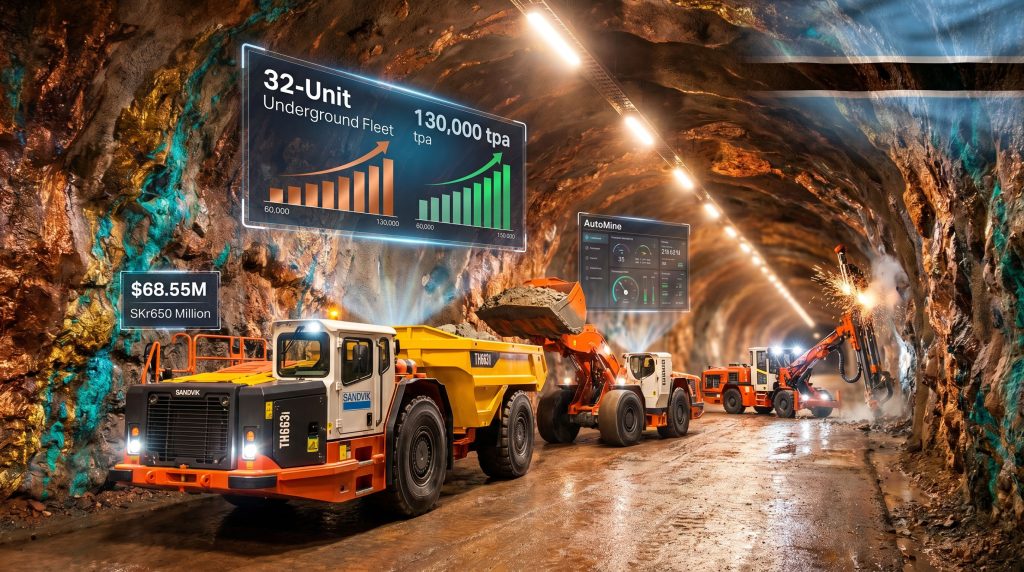
Booked by Sandvik during Q2 2026, the Sandvik Khoemacau Copper Mine equipment supply order is valued at approximately SKr650 million, equivalent to around USD $68.55 million. The contract was placed by JCHX Mining Management, a China-based mining contractor responsible for managing underground operations at the site. Equipment deliveries are scheduled to begin in Q3 2026, with the majority of the fleet to be delivered across a two-year window running through 2028.
The contract covers a 32-unit underground fleet, comprising a carefully matched combination of haulage, loading, drilling, and infrastructure development equipment:
| Equipment Type | Model | Quantity |
|---|---|---|
| Underground Haul Trucks | Toro TH663i | 12 units |
| Underground Loaders | Toro LH621i | 10 units |
| Development Drills | DD422i | 8 units |
| Longhole Drill | DL432i | 1 unit |
| Raise Borer | Rhino 100 | 1 unit |
Beyond the physical fleet, the contract integrates two critical digital and automation layers: AutoMine automation systems applied across the loaders and select drill units, and Sandvik's Remote Monitoring Service for real-time fleet data transmission and analytics.
Understanding the Equipment Roles in a High-Volume Underground Operation
Each equipment category within this fleet plays a distinct role in the underground production cycle:
-
Toro TH663i haul trucks are designed for high-payload underground haulage in large cross-section drives. At production scales targeting 130,000 tpa of copper in concentrate, high-efficiency truck fleets are critical bottleneck-management tools.
-
Toro LH621i loaders handle ore loading in stopes and drawpoints, moving blasted rock to truck loading positions. Their scale and automation compatibility make them suited to continuous-shift operations.
-
DD422i development drills advance the underground headings and horizontal infrastructure that physically extend the mine's accessible ore inventory. Development drilling pace directly governs how quickly the mine can ramp up production capacity.
-
DL432i longhole drills are purpose-built for production blasting within open stopes, enabling high-tonnage ore fragmentation in the underground production zones.
-
Rhino 100 raise borer is among the less publicly discussed but operationally critical pieces of equipment in this fleet. Raise borers are used to create vertical or inclined connections between underground levels, including ventilation raises, ore passes, and internal shaft development. As production volumes increase, underground air quality management becomes an engineering constraint in its own right. The Rhino 100's inclusion signals that Khoemacau's expansion involves deliberate ventilation network scaling.
AutoMine and Remote Monitoring: The Digital Infrastructure Layer
The integration of AutoMine automation across loaders and select drills is operationally significant. Autonomous underground equipment reduces the need for continuous operator presence in active stoping areas, directly lowering exposure risk in high-activity production zones. Beyond safety, automation enables continuous operational cycles that eliminate shift-change downtime, which in high-fixed-cost underground environments can meaningfully improve cost-per-tonne metrics.
Sandvik's Remote Monitoring Service functions as a real-time data aggregation and transmission layer. By continuously collecting machine health data, cycle times, fuel consumption, and component wear indicators, the service enables predictive maintenance interventions before failures occur. In a remote Botswana underground operation where equipment downtime carries significant opportunity costs, this digital layer is not an optional enhancement. It is a core element of total cost of ownership (TCO) management.
"The bundling of automation and digital monitoring with physical fleet supply marks a structural shift in how large OEM contracts are structured. Operators are no longer procuring equipment alone. They are procuring an integrated operational capability."
JCHX Mining Management and the Cross-Cultural Equipment Procurement Dynamic
The fact that JCHX Mining Management, a Chinese mining contractor with extensive African operational experience, selected Sandvik as the sole OEM supplier for this fleet is worth examining closely. Chinese contractors operating in Africa have historically demonstrated flexibility in equipment sourcing, drawing on both domestic Chinese OEMs and established Western manufacturers depending on project requirements.
JCHX's decision to standardise on Sandvik for this expansion reflects several practical realities of large underground projects:
- Parts and service standardisation across a single OEM supplier dramatically simplifies inventory management at remote sites.
- Integrated automation ecosystems from a single vendor reduce interoperability complexity compared to multi-vendor fleets.
- Digital monitoring continuity is more reliable when all fleet data flows through a unified platform.
- Warranty and support structures are simpler to manage under single-OEM contracts, especially in jurisdictions where OEM service networks require coordination.
MMG's 55% controlling stake in the Khoemacau joint venture adds another dimension to procurement decision-making. As an experienced major mining company with global operational reach, MMG's project management framework applies rigorous vendor assessment processes. The selection of Sandvik aligns with the kind of technically benchmarked, lifecycle-cost-oriented procurement logic that major mining company governance structures typically require.
The Production Doubling Ambition and What It Demands from the Fleet
Khoemacau completed a $936 million feasibility study in 2025, providing the financial and technical foundation for a production expansion from 60,000 tpa to 130,000 tpa of copper metal in concentrate. Achieving this doubling requires not just more equipment, but a specifically calibrated fleet that can sustain higher development rates, greater ore throughput, and expanded underground infrastructure simultaneously.
The production ramp-up logic is sequential:
- Development drills (DD422i) advance new underground headings, expanding the accessible ore footprint.
- Raise borers (Rhino 100) establish the ventilation and logistics infrastructure needed to support higher-intensity production zones.
- Longhole drills (DL432i) execute production blasting as new stopes are opened.
- Loaders (LH621i) and trucks (TH663i) handle the resulting ore flow from stope to surface.
Each category in the 32-unit fleet serves a discrete function in this ramp-up sequence. The fleet is not just sized for steady-state production at 130,000 tpa. It is dimensioned to actively build the underground mine infrastructure that makes that production level achievable.
Copper Market Fundamentals Underpinning the Capital Commitment
A capital commitment of this scale only makes economic sense against a backdrop of genuine long-term confidence in copper demand. Furthermore, the drivers are well understood in the mining sector but worth contextualising in terms of their magnitude. The copper supply crunch adds further urgency to expanding high-quality underground operations:
- Electric vehicles require roughly two to four times more copper per unit than internal combustion engine vehicles, depending on whether the comparison involves passenger cars or commercial EVs.
- Grid-scale renewable energy infrastructure, including wind turbines and solar farms, is highly copper-intensive relative to conventional power generation assets.
- Transmission network upgrades needed to accommodate distributed generation and EV charging loads represent a multi-decade copper demand driver independent of vehicle electrification itself.
"Projected copper supply deficits across multiple demand scenarios suggest that long-life, high-quality underground operations like Khoemacau, with mine lifespans exceeding two decades, are exactly the kind of assets the market needs. The $68.55 million equipment commitment is, in part, a bet on where copper demand sits in 2030 and beyond."
What makes the Khoemacau expansion particularly relevant from a supply perspective is that it is expanding an existing operating underground mine rather than progressing a greenfield development. Expansion projects of this type carry meaningfully lower execution risk than new mine construction. Existing shaft infrastructure, established underground access, proven ore characterisation data, and an operational workforce reduce the technical uncertainty that inflates capital costs and timelines on greenfield projects.
The next major ASX story will hit our subscribers first
Sandvik's Copper Sector Momentum: A Pattern Worth Noting
The Khoemacau contract follows Sandvik's receipt in Q1 2026 of an order from Glencore for three DR413i rotary blasthole drill rigs destined for the reopening of the Bajo de la Alumbrera copper mine in Argentina. Taken together, these two contract wins within a single quarter span two continents and two very different copper project types: an underground expansion and an open-pit reactivation.
| Project | Location | Contract Type | Order Period |
|---|---|---|---|
| Khoemacau Copper Mine | Botswana | 32-unit underground fleet, automation, digital monitoring | Q2 2026 |
| Bajo de la Alumbrera (Glencore) | Argentina | 3 x DR413i rotary blasthole drill rigs | Q1 2026 |
For mining equipment investors and sector analysts, consecutive contract wins across distinct copper project types and geographies within a single reporting period can function as a leading indicator of accelerating capital expenditure across the global copper sector. OEM order books often precede broader industry capital expenditure data by six to twelve months, making them a valuable forward-looking signal.
Why the Single-OEM Fleet Model Matters for Underground Project Economics
The decision to source an entire underground fleet from Sandvik, rather than distributing procurement across multiple OEMs, reflects a maturing understanding of total cost of ownership in large underground operations. The economics of multi-vendor fleets are often underestimated at the procurement stage. In addition, the future of copper mining increasingly favours integrated single-vendor solutions that reduce operational complexity:
- Parts inventory complexity multiplies with each additional OEM, increasing working capital requirements and the risk of critical spares shortages.
- Maintenance technician training requirements increase when operating mixed-brand fleets, particularly in remote locations with limited access to OEM service networks.
- Automation and digital monitoring integration becomes significantly more complex when equipment from different vendors operates within the same underground network.
For JCHX, operating in a remote Botswana location where logistical supply chains require careful management, the single-OEM approach simplifies an otherwise complex operational variable. For Sandvik, securing sole-supply status on a 32-unit fleet with an embedded digital monitoring and automation layer creates a multi-year service relationship that extends well beyond the initial hardware delivery period.
Frequently Asked Questions: Sandvik Khoemacau Copper Mine Equipment Supply
What equipment is Sandvik supplying to the Khoemacau Copper Mine?
Sandvik is delivering a 32-unit underground fleet made up of 12 Toro TH663i haul trucks, 10 Toro LH621i loaders, eight DD422i development drills, one DL432i longhole drill, and one Rhino 100 raise borer. The contract also encompasses AutoMine automation technology and Sandvik's Remote Monitoring Service for ongoing digital fleet management.
How much is the Sandvik Khoemacau equipment contract worth?
The order is valued at approximately SKr650 million, equivalent to roughly USD $68.55 million, and was recorded in Sandvik's Q2 2026 financial results.
Who placed the Sandvik equipment order for Khoemacau?
The order was placed by JCHX Mining Management, a China-based mining contractor responsible for managing underground operations at the site.
When will equipment deliveries to Khoemacau begin?
Deliveries are scheduled to commence in Q3 2026, with the majority of the fleet expected to be on site between 2026 and 2028.
What is Khoemacau's copper production expansion target?
Following the completion of a $936 million feasibility study in 2025, the mine is targeting a production increase from 60,000 tpa to 130,000 tpa of copper metal in concentrate.
Who owns the Khoemacau Copper Mine?
The mine operates under a joint venture structure in which MMG holds a 55% controlling ownership stake. The operation employs more than 2,200 workers and contractors, with approximately 90% sourced from Botswana.
Key Takeaways for Industry Observers and Investors
-
The Sandvik Khoemacau Copper Mine equipment supply contract, valued at approximately $68.55 million, represents one of the more substantive underground fleet orders placed in African copper mining in recent years.
-
The integration of AutoMine automation and Remote Monitoring Service within the physical fleet supply sets a new operational baseline for large underground expansions in emerging African mining jurisdictions.
-
JCHX's selection of Sandvik as the sole OEM supplier underscores the commercial logic of single-vendor fleet standardisation at scale, particularly in remote operational contexts.
-
Khoemacau's production doubling target, backed by a completed $936 million feasibility study, reflects genuine institutional confidence in long-cycle copper demand fundamentals tied to electrification and energy transition themes. Consequently, copper investment strategies focused on high-quality underground operations are gaining greater institutional traction.
-
The Kalahari Copper Belt is progressively establishing itself as one of sub-Saharan Africa's most consequential copper supply corridors, and Khoemacau is its most advanced producing operation.
-
Consecutive Sandvik contract wins across copper operations in Botswana and Argentina within a single quarter signal that the broader copper mining capital expenditure cycle is accelerating. Furthermore, efforts around mining decarbonisation are increasingly being embedded within these large-scale fleet procurement decisions, a trend that mining equipment investors and sector analysts should monitor closely.
Disclaimer: This article contains forward-looking statements and projections related to production targets, commodity demand outlooks, and capital expenditure trends. These involve inherent uncertainties and should not be interpreted as financial advice. Readers should conduct their own due diligence before making any investment decisions.
Want to Capitalise on the Next Major Copper Discovery Before the Market Moves?
As the global copper capital expenditure cycle accelerates and high-quality underground operations attract serious institutional attention, Discovery Alert's proprietary Discovery IQ model delivers real-time ASX mineral discovery alerts straight to subscribers — transforming complex data across 30-plus commodities into clear, actionable opportunities. Explore historic discovery returns on Discovery Alert's discoveries page and begin a 14-day free trial to position ahead of the market.