June 8, 2026
When the Geology Was Always There, But the Technology Wasn't Ready
For most of its known history, the Haib copper deposit in southern Namibia existed in a frustrating category familiar to resource geologists: too large to ignore, too low-grade to develop economically. Porphyry copper systems of this scale are rarely discovered twice. Yet successive owners, including some of the most technically sophisticated mining companies on the planet, walked away. The ore body was real. The tonnage was enormous. The economics simply didn't close.
What has changed at the Koryx Copper Haib project in Namibia is not the geology. It is the processing architecture applied to that geology, and the economic logic that flows from it.
When big ASX news breaks, our subscribers know first
What Makes the Haib Deposit Geologically Unusual
A Porphyry System With Uncommon Scale and Pedigree
Haib is a copper-molybdenum-gold porphyry deposit located in the //Karas Region of southern Namibia, near the country's border with South Africa. Porphyry deposits of this type are the dominant source of copper in global supply, accounting for the majority of the world's mined copper output. They are characterised by broad, bulk-tonnage mineralisation distributed across large intrusive complexes, making them well-suited to high-volume, mechanised open-pit extraction.
What distinguishes Haib within this deposit class is its combination of scale, exploration maturity, and infrastructure context. The project carries more than 70,000 metres of historical drilling accumulated across decades of work by some of the industry's most capable explorers, including Falconbridge, Rio Tinto, and Teck. This is not an early-stage exploration concept; it is one of the most thoroughly interrogated undeveloped copper systems in Africa.
A March 2026 mineral resource update reported 2.09 million tonnes of contained copper in the indicated resource category, alongside 380,200 ounces of gold in the inferred resource. The economic cut-off grade for the current mine plan sits at approximately 0.15% copper equivalent, reflecting a bulk-tonnage operational model rather than a high-grade selective mining approach.
Why Location and Infrastructure Genuinely Matter Here
The //Karas Region location provides access to several infrastructure enablers that meaningfully reduce development capital requirements relative to comparable greenfield projects in sub-Saharan Africa:
- Water supply is drawn from the Orange River, one of southern Africa's most significant river systems, eliminating the need for remote water sourcing or desalination infrastructure
- Grid power is accessible through NamPower, Namibia's national electricity utility, removing the cost and complexity of standalone power generation
- Road and border proximity to South Africa provides access to established cross-border logistics networks and regional industrial supply chains
This infrastructure context is not incidental. For a project requiring US$1.8 billion in development capital, the ability to connect to existing utilities rather than build them from scratch represents a material cost advantage.
The Global Copper Supply Picture That Makes Scale Assets Rare
Why 100,000+ tpa Projects Are Genuinely Scarce
The structural argument for large-scale copper development has strengthened considerably over the past decade, driven by the convergence of three demand vectors that collectively require enormous quantities of copper: electric vehicle manufacturing, utility-scale grid infrastructure expansion, and renewable energy deployment.
Electric vehicles require approximately three to four times more copper than equivalent internal combustion engine vehicles, according to figures published by the International Copper Association. Wind turbines require between 2.5 and 6 tonnes of copper per megawatt of installed capacity depending on the technology, while offshore wind installations require significantly more due to subsea cabling requirements. Grid infrastructure modernisation, driven by both electrification growth and the replacement of ageing transmission assets, represents an additional demand category that is often underweighted in market analysis.
Against this demand backdrop, existing producing mines face a well-documented structural challenge: average ore grades at operating copper mines have declined steadily over the past two decades. Industry analysis from CRU Group and S&P Global Market Intelligence has consistently documented this trend, with average feed grades at major copper operations falling from roughly 1.0% copper in the early 2000s to below 0.6% at many operations today. The consequence is that more material must be processed to produce the same quantity of copper, increasing unit costs and energy intensity across the industry. Furthermore, the copper supply crunch this creates is accelerating demand for large-scale development projects.
The development pipeline response to this dynamic has been inadequate. Projects capable of producing more than 100,000 tonnes per annum of copper from a single operation represent a genuinely rare subset of the global project inventory. Most development-stage assets target production profiles in the 30,000 to 70,000 tpa range, a scale that is insufficient to meaningfully address reserve replacement needs at major producers.
Projects producing over 100,000 tonnes of copper annually represent a small and increasingly scarce category in the global development pipeline. A 120,000 tpa operation running for 30+ years represents cumulative output of approximately 3.6 million tonnes of copper over its mine life, a volume that is material at the global market level.
This supply-demand dynamic directly elevates the strategic value of assets like Haib, which combines tier-one scale with a jurisdiction that, by African and global standards, ranks favourably on predictability and infrastructure access.
How Koryx Transformed the Haib Economics
The Technical Case for Coarse Particle Flotation
The most consequential development in Haib's recent history is a fundamental redesign of the ore processing flowsheet. The previous configuration incorporated heap leaching alongside conventional flotation, a hybrid approach that carried inherent limitations. Heap leaching operates most effectively on oxide ore and is mechanistically unable to recover molybdenum or gold from sulfide material. Since Haib is fundamentally a sulfide deposit, heap leaching was not the optimal processing route. Its inclusion in earlier study configurations added capital and operational complexity without unlocking the full mineralogical value of the ore body.
The revised flowsheet removes heap leaching entirely, replacing it with an all-flotation circuit anchored by coarse particle flotation (CPF) as a pre-processing step upstream of conventional milling and flotation.
CPF exploits a fundamental property of sulfide mineralisation: coarser fragments of crushed ore statistically carry lower concentrations of copper-bearing sulfide minerals than finer particles. By separating these coarser, lower-grade particles before they enter the energy-intensive milling circuit, CPF effectively pre-concentrates the feed to the main plant without requiring additional grinding.
The specific technology selected for Haib is the HydroFloat platform, supplied by Eriez, a commercially established system deployed at major copper operations globally. This is not experimental processing architecture; it is proven industrial practice with a documented operational track record.
At Haib, variability test work has demonstrated that approximately 25% of crushed material can be rejected prior to main processing, with copper losses of only 4 to 8%. The 75% of material that proceeds to the flotation plant does so at a materially higher effective grade. Combined with a lowered cutoff grade and the removal of heap leaching, this lifts the effective copper equivalent grade for the first decade of mining to approximately 0.5%, a threshold that removes Haib from the historical low-grade classification that had constrained institutional investor interest.
The Byproduct Dimension: Why Molybdenum and Gold Change the Numbers
The transition to an all-flotation flowsheet has an additional consequence that is easy to overlook but financially significant: it activates the molybdenum and gold byproduct streams that heap leaching was incapable of recovering.
Molybdenum is a high-value industrial metal used primarily in steel alloys and catalytic applications. Its recovery as a byproduct of copper flotation is well-established practice at operations like Freeport-McMoRan's Morenci mine in Arizona and Codelco's El Teniente complex in Chile. At Haib, the addition of molybdenum and gold to the revenue model is expected to contribute approximately 15% in incremental project value, a meaningful uplift that represents pure value creation from a metallurgical decision rather than any change to the underlying geology.
| Flowsheet Configuration | Previous Approach | Revised Approach |
|---|---|---|
| Processing Method | Flotation + Heap Leach/SX-EW | All-Flotation with CPF |
| Byproduct Recovery | Copper only | Copper + Molybdenum + Gold |
| Effective Grade (First Decade) | Below 0.5% CuEq | ~0.5% CuEq |
| Process Complexity | Higher | Simplified |
| Capital Risk Profile | Moderate-High | Reduced |
Production Targets, Cost Positioning, and Economic Outlook
What the Numbers Look Like Under the Revised Configuration
The combination of CPF pre-rejection, an optimised cutoff grade, and byproduct recovery produces a fundamentally different economic profile for Haib relative to prior study configurations.
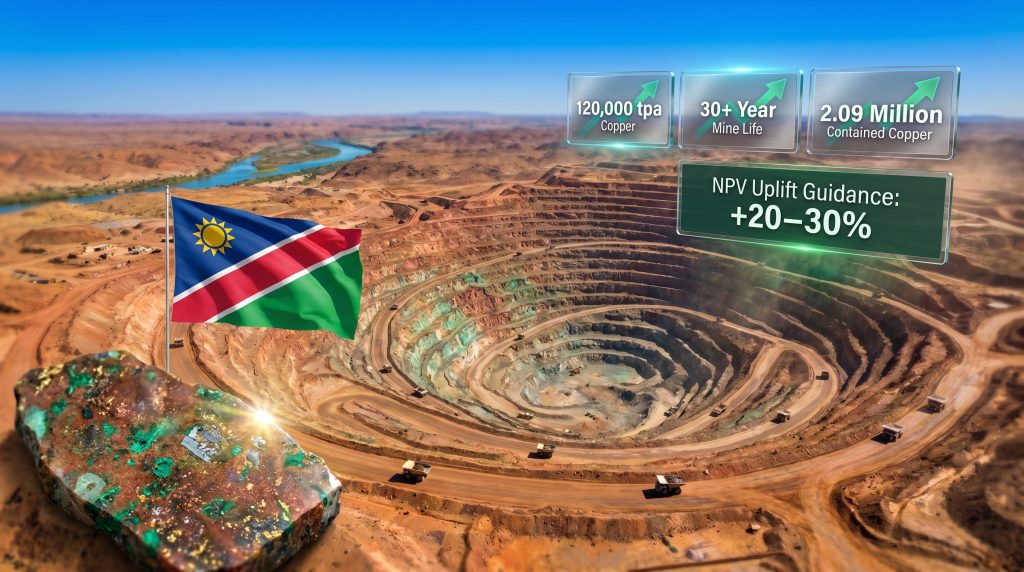
Annual copper production is now targeted at approximately 120,000 tonnes, a meaningful increase from the roughly 92,000 tpa outlined in the 2025 Preliminary Economic Assessment. The mine plan contemplates a large open-pit operation running at 80 to 100 million tonnes per annum of total material movement, utilising rope shovels and 500-tonne haul trucks, the largest equipment class available for open-pit mining. Multiple processing trains are incorporated to handle the throughput volumes required at this scale.
Mine life is projected to extend beyond 30 years at the economic cutoff grade of 0.15% copper equivalent, providing long-duration cash flow visibility that is particularly attractive to infrastructure-oriented capital and strategic acquirers focused on reserve replacement. Management has guided to a 20 to 30% improvement in NPV and core project metrics relative to the prior PFS, reflecting the combined impact of higher throughput, improved grade, byproduct monetisation, and simplified processing.
Cost curve positioning is equally important for strategic credibility. Haib is expected to sit in the second quartile of the global copper cost curve, a position that reflects both grade improvement and operational efficiency at scale.
| Metric | Prior PEA (2025) | Updated Targets (2026) |
|---|---|---|
| Annual Copper Production | ~92,000 tpa | ~120,000 tpa |
| Mine Life | 23-24 years | 30+ years |
| Effective First-Decade Grade | Below 0.5% CuEq | ~0.5% CuEq |
| Byproduct Value Contribution | Minimal | ~15% incremental |
| NPV Improvement Guidance | Baseline | +20-30% |
| Estimated Capital Expenditure | ~US$1.56 billion | ~US$1.8 billion |
| Cost Curve Position | Not disclosed | Second quartile (global) |
Namibia as a Mining Jurisdiction: What Investors Typically Underweight
A Regulatory and Infrastructure Context That Outperforms Regional Peers
Namibia occupies a distinct position within the African mining landscape that is frequently underestimated by international investors whose African exposure has been dominated by higher-risk jurisdictions. The country hosts large-scale uranium mining operations and has maintained a consistent legal and regulatory framework governing mineral extraction across multiple government administrations.
Environmental permitting follows a structured, predictable pathway. Koryx has completed baseline environmental assessments and is progressing through public participation processes, with an Environmental Clearance Certificate expected within approximately six to twelve months. A mining licence follows as a subsequent but similarly well-defined regulatory step.
The combination of available grid power through NamPower, Orange River water access, and proximity to South African logistics infrastructure means that Haib's infrastructure risk profile is materially lower than many comparable African development projects.
| Jurisdiction Factor | Namibia Assessment |
|---|---|
| Regulatory Framework | Established, well-understood |
| Social Licence | Broadly supportive |
| Infrastructure Access | Grid power (NamPower) + Orange River water |
| Permitting Predictability | High relative to regional peers |
| Political Stability | Investment-grade for mining |
The next major ASX story will hit our subscribers first
Development Pathway and the Path to Construction
Key Milestones From Here to Financing
The near-term development roadmap for Haib is structured around a series of technical derisking steps that sequentially compress the discount at which the asset currently trades relative to its in-situ value. The company currently operates 14 drill rigs on site, with ongoing programmes targeting higher-grade pods within the ore body that could further improve early-year mine economics.
- CPF variability test work – ongoing, underpins Pre-Feasibility Study inputs across the full range of ore types
- Updated resource estimate – March 2026 update completed; further refinement continuing
- Environmental Clearance Certificate – targeted within 6-12 months
- Pre-Feasibility Study completion – targeted for late 2026, incorporating updated test work and resource estimates
- Strategic partner and financing process – running concurrently with PFS development
- Definitive feasibility study – follows PFS completion
- Mining licence – follows environmental clearance through predictable regulatory pathway
- Construction decision – contingent on financing structure and DFS outcomes
The CPF variability testing programme deserves particular attention in this sequence. While HydroFloat is a commercially proven technology, confirming its performance consistency across the full range of ore types present in the Haib deposit is a critical risk mitigation step. Spatial variation in mineralogy, sulfide grain size distribution, and clay content can all affect CPF rejection rates, and the variability testing programme is specifically designed to characterise this range before it becomes a PFS assumption.
Financing a US$1.8 Billion Project: The Strategic Options
Why M&A Is the Most Rational Development Pathway
Development-stage companies with capital requirements at the scale of Haib face a structural challenge that is independent of project quality: the cost of capital available to a junior developer is materially higher than the cost of capital available to a major producer, and this differential can determine whether project economics are compelling or merely adequate.
Major mining companies seeking to replace depleting reserves at their existing operations can finance development projects at a substantially lower weighted average cost of capital than the equity-dependent structures available to junior developers. This creates a logical framework in which the most economically efficient path to development is through a strategic transaction rather than independent development.
The capital partner universe being targeted includes several distinct categories:
- Major mining companies seeking reserve replacement without the full discovery risk of greenfield exploration
- Commodity offtakers, including Japanese trading houses, global commodity merchants, and state-aligned procurement entities, who structure financing through long-term supply agreements
- Institutional investors with infrastructure or natural resources mandates seeking long-duration, cash-generative assets
- Streaming and royalty companies providing upfront capital in exchange for a percentage of future production revenue
CEO Heye Daun has been explicit that a strategic transaction is a likely development outcome, noting that development-stage companies of Koryx's size are heavily discounted precisely because financing uncertainty is the dominant valuation risk, and that larger companies with cheaper capital can finance projects of this type more efficiently. Furthermore, copper investment strategies at the major producer level increasingly prioritise assets with exactly these characteristics. Interest has been noted from a broad range of counterparties, including Japanese trading entities, global commodity merchants, and Chinese-affiliated entities, though no formal process has been announced.
The financing pathway for a US$1.8 billion project at the development stage is not simply a capital markets exercise. It is a strategic positioning process in which the quality, scale, and jurisdictional context of the asset determines which category of capital partner finds the opportunity compelling.
Risk Factors That Sophisticated Investors Should Evaluate
A Balanced Assessment Across Technical, Financial, and Market Dimensions
No investment analysis of a development-stage project is complete without a structured examination of the risks that could cause outcomes to diverge from management's guidance. For Haib, the key risk categories span technical execution, financial structure, regulatory timelines, and commodity price sensitivity. In addition, comparable projects such as the Reko Diq project in Pakistan illustrate how jurisdictional and financing complexities can materially affect development timelines even for world-class assets.
- Capital financing risk: The US$1.8 billion capital requirement is the single largest execution challenge. Without a strategic partner or major institutional commitment, the project cannot advance to construction on a standalone basis
- CPF variability risk: While HydroFloat is proven at other operations, its performance across Haib's full ore type distribution requires variability test confirmation. Deviations from average rejection rates could affect the effective grade assumption that underpins the revised economics
- Permitting timeline risk: Environmental clearance and mining licence processes, while characterised as predictable, remain subject to regulatory review timelines that can extend beyond initial projections
- Copper price sensitivity: Project economics are materially sensitive to long-term copper price assumptions. A sustained decline from current levels would compress NPV and reduce the urgency of strategic partner interest
- Grade variability risk: The 0.5% CuEq first-decade grade target depends on the spatial distribution of higher-grade pods identified through ongoing drilling. Variability in this distribution could affect early-year production economics
- M&A execution risk: While a strategic transaction is the most probable development pathway, the timing, structure, and terms of any such transaction are inherently uncertain and cannot be forecast with precision
This analysis reflects information available as of mid-2026 and should not be construed as financial advice. Development-stage mining projects carry material uncertainty. Readers should conduct independent due diligence and consult licensed financial advisers before making investment decisions.
The Broader Investor Case for Scale Copper in Africa
What Separates Tier-One Scale Assets From the Rest of the Development Pipeline
The copper market is moving into a phase where reserve replacement is becoming an existential strategic priority for major producers. Average mine life at existing large-scale copper operations has shortened as high-grade ore at accessible depths has been progressively depleted. New discoveries capable of sustaining 100,000+ tpa production profiles are becoming increasingly infrequent, a trend that industry analysts have consistently highlighted in copper market outlooks from firms including Wood Mackenzie and S&P Global Market Intelligence.
Within this context, the attributes that distinguish Haib from the broad universe of development-stage copper projects are not marginal. According to a recent analysis, the project's combination of scale, jurisdictional stability, and revised processing economics places it among the most credible large-scale copper development opportunities currently available to strategic acquirers:
- A 30+ year mine life provides the duration that major producers require for meaningful reserve replacement impact
- Second-quartile cost positioning ensures the project remains viable across a range of long-term copper price scenarios
- Byproduct revenue from molybdenum and gold adds resilience to the cash flow profile without requiring separate infrastructure investment
- Namibia's jurisdictional characteristics reduce the political and regulatory risk premium that investors typically apply to African assets
- The combination of scale and infrastructure access means Haib's development capital is deployed against a project that can genuinely move the production needle for a major acquirer
The structural copper supply deficit expected to persist through the 2030s, driven by electrification demand growth against a backdrop of constrained new supply, creates a macro environment in which assets of Haib's quality and scale command a significant scarcity premium. Projects with this combination of characteristics rarely come to market, and when they do, they attract capital from a global universe of strategic and financial buyers.
For investors evaluating exposure to the copper development cycle, the central question is not whether large-scale copper projects will attract capital in this environment. It is which specific projects will prove capable of delivering the technical, jurisdictional, and economic characteristics required to close a transaction at terms that reflect the asset's strategic value. Consequently, as detailed in Mining Review Africa, the Koryx Copper Haib project in Namibia presents a case that the most discerning capital allocators in the copper space are increasingly equipped to evaluate.
Ready to Uncover the Next Major Copper Discovery Before the Market Does?
Discovery Alert's proprietary Discovery IQ model scans ASX announcements in real time, delivering instant alerts on significant mineral discoveries — including the kind of large-scale copper opportunities that can generate substantial long-term returns — so subscribers can act decisively before the broader market catches on. Explore how historic discoveries have rewarded early investors on Discovery Alert's dedicated discoveries page, and begin your 14-day free trial today to secure a genuine market-leading edge.