June 8, 2026
When the Ore Gets Harder to Reach, the Industry Gets Smarter
The history of copper mining is, in many ways, a story of perpetual adaptation. Ancient miners followed visible surface deposits. Later generations developed underground techniques. The twentieth century brought flotation chemistry, heap leaching, and solvent extraction electrowinning. Each era of declining ore quality demanded a corresponding leap in processing intelligence.
Today, that leap is taking shape not in a metallurgical laboratory but inside cloud computing infrastructure, where artificial intelligence is being applied to one of the industry's oldest unsolved problems: how to recover more copper from ore that keeps getting harder to process.
This is not a peripheral innovation. The conditions driving investment in AI-assisted extraction are structural, persistent, and accelerating. Understanding why the BHP and Microsoft copper extraction AI partnership was forged requires first understanding the mineralogical and market forces that made such a collaboration practically inevitable.
When big ASX news breaks, our subscribers know first
The Declining Grade Problem and Why It Changes Everything
Copper ore grades at operating mines around the world have been falling for decades. This is not a temporary cyclical phenomenon but a long-term geological reality reflecting the progressive exhaustion of high-grade, easily accessible deposits. What was once considered low-grade ore is now the industry standard at many major operations, meaning vastly more material must be mined, crushed, and processed to yield each tonne of finished copper.
This grade decline has compounding consequences across the entire value chain:
- Higher energy consumption per unit of copper produced
- Greater water usage in processing circuits
- Elevated waste volumes and tailings management requirements
- Increased capital intensity for equivalent production levels
- Tightening margins that make incremental recovery improvements economically significant
Furthermore, the copper demand drivers have shifted dramatically upward. Electric vehicles require substantially more copper than their internal combustion counterparts, with estimates placing the copper content of an EV at roughly two and a half to four times that of a conventional vehicle, depending on drivetrain configuration and battery chemistry.
Utility-scale renewable energy infrastructure, including wind turbines, solar installations, and long-distance transmission upgrades, ranks among the most copper-intensive categories of industrial investment. Grid storage systems compound this demand further.
The convergence of falling grades and rising demand has created what analysts increasingly describe as a structural supply deficit expected to deepen through the late 2020s and into the 2030s. The copper supply crunch means the near-term supply response must come predominantly from improving recovery at existing operations rather than from new greenfield projects.
This is the context in which AI-assisted extraction must be understood: not as a technological novelty, but as a supply chain imperative operating against a tight timeline.
The Two-Phase Architecture of the BHP-Microsoft Approach
The BHP and Microsoft copper extraction AI partnership operates across two functionally distinct but strategically connected phases. The first addresses real-time operational efficiency at an existing major asset. The second targets a longer-horizon breakthrough in the underlying chemistry of copper recovery. Together, they represent a comprehensive approach to the extraction challenge spanning both incremental improvement and potentially transformative innovation.
Phase One: Live Process Optimisation at the World's Largest Copper Mine
Escondida, located in the Atacama Desert of northern Chile, is the single largest copper-producing mine on the planet by annual output. Its concentrator circuits process enormous volumes of ore daily, and even marginal improvements in copper recovery translate to significant absolute tonnage gains at that scale.
BHP deployed an integrated Azure cloud infrastructure at Escondida specifically designed to ingest, process, and interpret the continuous data streams generated by the concentrator circuit. The system architecture draws on three core components:
| Azure Component | Role in the Optimisation System |
|---|---|
| Azure Machine Learning | Builds and runs predictive models for recovery optimisation |
| Azure Synapse Analytics | Handles large-scale integration and processing of plant data |
| Azure Data Lake Storage | Provides centralised storage for continuous real-time inputs |
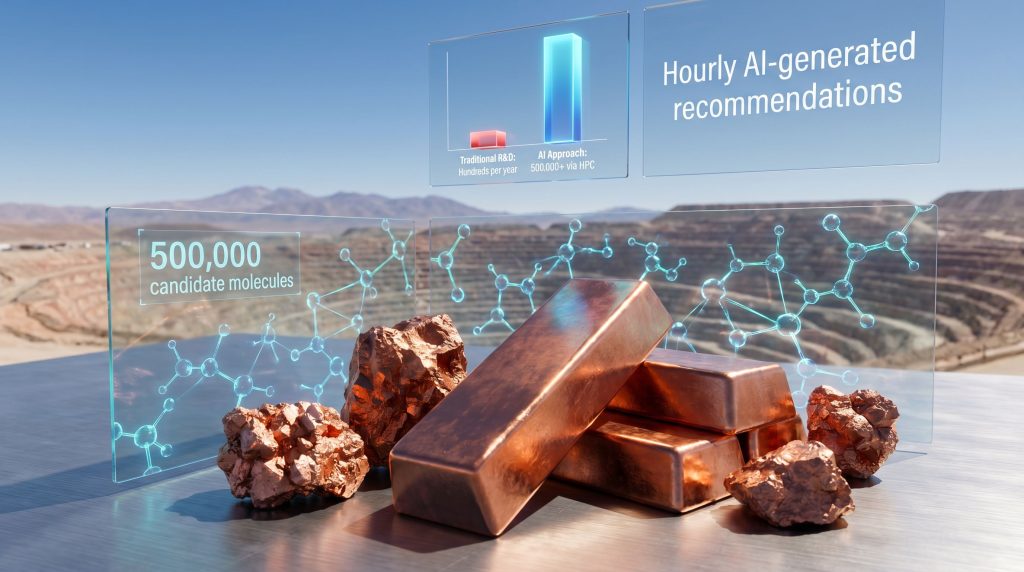
Rather than operating as a fully autonomous control system, the platform generates hourly operational recommendations delivered to on-site engineers and operators. This design choice reflects an important philosophy: the AI functions as an analytical layer that augments human expertise rather than displacing it.
Operators retain decision-making authority, informed by recommendations that account for ore variability, circuit conditions, and recovery efficiency in ways that periodic manual review cannot match.
The practical significance of this approach lies in what ore variability actually means at operating scale. Even within a single deposit, copper mineralogy changes as mining progresses through different zones. Traditional operating procedures tend toward fixed parameters representing average conditions, systematically underperforming at the extremes of variability. AI-driven dynamic adjustment closes this gap by continuously recalibrating recommendations in real time.
Phase Two: Molecular Discovery for Next-Generation Leaching Chemistry
The second phase moves into territory with no direct precedent in mining industry R&D: the application of high-performance computing and AI agents to screen candidate molecules for their potential as superior copper-leaching reagents. Understanding the copper leaching process reveals why this represents such a significant step forward.
Conventional copper leaching relies on acid-based hydrometallurgical processes. Sulfuric acid heap leaching, followed by solvent extraction and electrowinning, is the dominant approach for oxide copper ores. These methods are well understood and economically established, but they carry fundamental limitations in recovery efficiency, particularly as ore grades decline and mineralogy becomes more complex.
BHP, Microsoft, and specialist firm Prescience Insilico collaborated to address this limitation using the Microsoft Discovery platform, an AI-powered research acceleration system that combines autonomous AI agents with high-performance computing to evaluate scientific hypotheses at a scale impossible through conventional laboratory methods. BHP became the first mining company to operate on the Microsoft Discovery platform, a sector milestone carrying both symbolic and competitive significance.
The scale of the molecular screening undertaken in the 2025–2026 research phase is difficult to overstate in the context of traditional mining chemistry R&D:
- More than 500,000 candidate molecules were evaluated as potential copper-leaching reagents
- Assessment criteria included molecular binding behaviour, extraction efficiency, stability, and compatibility with downstream processing
- High-performance computing enabled simultaneous parallel evaluation that no laboratory could replicate through physical synthesis and testing
- The objective was to compress the viable candidate pool from hundreds of thousands of compounds to a targeted shortlist for focused laboratory validation
The significance here is not that AI replaces laboratory chemistry. It is that AI eliminates the decades of random exploration that precede meaningful laboratory chemistry, directing experimental resources toward the highest-probability candidates from the outset.
Why Reagent Chemistry Is the Hidden Frontier in Copper Processing
For investors and industry observers focused on visible capital investments like new mine construction or equipment upgrades, reagent chemistry can seem like a peripheral concern. However, this perception underestimates its strategic importance considerably.
The reagent used in a leaching operation determines, at a fundamental chemical level, which copper minerals can be dissolved, at what rate, under what conditions, and with what degree of selectivity relative to gangue minerals. A superior reagent does not merely improve recovery percentages at existing operations. It can reclassify previously uneconomic ore as viable, effectively expanding the copper resource base without additional drilling or development.
Current acid-based leaching systems have several well-documented limitations:
- Selectivity constraints that recover only copper accessible through acid dissolution, bypassing certain mineral forms
- Grade thresholds below which acid consumption costs make leaching uneconomic
- Environmental considerations around acid management, neutralisation, and tailings chemistry
- Water consumption in water-scarce operating environments like the Atacama Desert
- Processing time requirements that limit throughput at fixed-capacity facilities
A breakthrough reagent capable of addressing one or more of these constraints simultaneously would represent not just an incremental operational improvement but a genuine structural shift in the economics of copper recovery. The molecular screening programme is precisely aimed at identifying whether such compounds exist among the vast chemical space that traditional laboratory research has never systematically explored.
Consequently, if reagent candidates progress successfully through laboratory validation and pilot-scale testing, they could potentially be applied at operating mines within a timeframe that actually addresses the projected supply deficit, rather than arriving after the critical window has passed.
The Three-Party Structure and What It Signals About Mining R&D
The structural arrangement of the BHP-Microsoft partnership deserves attention beyond the specific technologies involved. The collaboration brings together a major diversified miner with deep operational expertise, a global cloud computing and AI platform provider, and a specialist computational chemistry firm bridging molecular science and high-performance computing applications.
This three-party model represents a meaningful departure from how large mining companies have traditionally approached research and development. The future of copper mining increasingly depends on exactly this kind of cross-industry collaboration. Historically, mining R&D has been conducted either entirely in-house through corporate technical centres, or through relationships with established equipment and reagent suppliers.
| R&D Model | Core Strength | Limitation |
|---|---|---|
| In-house corporate R&D | Domain expertise, operational integration | Limited computational scale, slow discovery cycles |
| Equipment supplier partnerships | Proven technology, commercial readiness | Innovation constrained by supplier product roadmaps |
| Academic collaboration | Scientific depth, access to frontier research | Long timelines, publication rather than application focus |
| Cross-industry AI partnership | Computational scale, speed of discovery | Requires domain expertise translation layer |
The addition of Prescience Insilico into the partnership addresses the critical translation challenge in the fourth model. Without domain-specific chemistry expertise, an AI platform screening millions of molecules risks optimising for theoretical molecular properties that do not correspond to real-world extraction outcomes. Prescience Insilico functions as the scientific quality filter ensuring that the AI's computational power is directed by metallurgically meaningful evaluation criteria.
This structural pattern may prove replicable across other critical minerals challenges. Lithium recovery from lower-grade brines, cobalt extraction from complex polymetallic ores, and rare earth element separation from mixed deposits all share the characteristic of facing chemistry-level constraints that computational molecular screening could potentially address.
Interpreting the Supply Implications for Copper Markets
Quantifying the potential supply impact of AI-assisted extraction improvements requires careful distinction between near-term operational gains and longer-term breakthrough scenarios.
In the near term, the Escondida process optimisation system represents compounding incremental gains. A one to two percentage point improvement in copper recovery at a mine producing over one million tonnes annually translates to tens of thousands of additional tonnes per year without new capital investment in mining equipment, additional workforce, or expanded tailings capacity.
The longer-term scenario, contingent on reagent discovery success, is harder to quantify but potentially more significant. Some analysts have suggested that the economically recoverable copper resource base could expand materially if processing constraints at the reagent chemistry level are addressed, though such projections carry significant uncertainty pending laboratory and pilot-scale validation.
It is important to note that these scenarios remain speculative at this stage. Molecular candidates identified through computational screening must proceed through extensive validation before commercial application, and the timeline from promising compound to operational deployment typically spans years even under accelerated research conditions.
In addition, copper investment strategies must increasingly account for this third pathway: improving recovery from existing ore bodies through processing innovation, enabled by computational tools that simply did not exist at the required scale until recently.
The next major ASX story will hit our subscribers first
What This Means for the Mining Technology Landscape
The BHP and Microsoft copper extraction AI partnership marks a qualitative shift in how computational technology intersects with the mining industry. Previous technology applications in mining, including autonomous haulage systems, remote monitoring platforms, and predictive maintenance tools, have primarily addressed operational efficiency within established process frameworks. The molecular discovery programme operates at a more fundamental level, using computation to challenge the chemical assumptions underpinning those frameworks.
Microsoft's digital transformation at Escondida illustrates how key observations worth tracking include:
- The information advantage of first-mover positioning on research platforms like Microsoft Discovery may be temporary but could be decisive in establishing proprietary processing methodologies that persist as competitive advantages for years
- Cloud-native R&D infrastructure is becoming a strategic asset class for major miners, comparable in importance to analytical laboratory capacity in an earlier era
- The convergence of materials science and mining through computational chemistry is creating new professional disciplines at the intersection of metallurgy, data science, and molecular engineering
- Operational AI at major assets is transitioning from pilot-stage experimentation to embedded process infrastructure at leading operations
For investors monitoring the copper sector, the emergence of AI-assisted extraction as a genuine near-term supply lever carries both reassuring and cautionary implications. Reassuring, because it suggests the supply deficit may be less severe than projections based purely on greenfield development pipelines imply. Cautionary, because the companies investing most heavily in processing innovation may develop structural cost and recovery advantages that affect competitive positioning across the industry over time.
Disclaimer: This article contains forward-looking statements and speculative assessments regarding copper supply dynamics, AI-assisted extraction outcomes, and reagent discovery timelines. These represent analytical perspectives based on publicly available information and should not be construed as investment advice. Actual outcomes may differ materially from projections discussed herein. Readers should conduct independent research before making any investment decisions.
Frequently Asked Questions: BHP and Microsoft Copper Extraction AI Partnership
What is the BHP and Microsoft copper extraction AI partnership?
BHP and Microsoft have formed a multi-phase technology collaboration applying artificial intelligence and high-performance computing to improve copper recovery at scale. The partnership encompasses real-time process optimisation at BHP's Escondida mine in northern Chile using Azure cloud infrastructure, as well as a molecular discovery programme that evaluated more than 500,000 chemical compounds to identify superior copper-leaching reagents through the Microsoft Discovery platform.
What is Microsoft Discovery and how does it apply to mining?
Microsoft Discovery is a scientific research acceleration platform that deploys AI agents alongside high-performance computing to evaluate large volumes of data, molecules, or variables simultaneously. BHP became the first mining company to operate on the platform, applying it to identify next-generation reagent candidates that could improve copper extraction efficiency from ore types currently limited by conventional leaching chemistry.
What is copper leaching and why does its chemistry matter?
Copper leaching is a hydrometallurgical process using chemical solutions to dissolve and recover copper from ore, particularly oxide and mixed mineralogy deposits. Conventional acid-based leaching methods have well-documented recovery limitations, especially as ore grades decline. Superior reagent chemistry could increase recovery rates, reduce chemical and water inputs, and make previously uneconomic deposits commercially viable, effectively expanding the recoverable resource base without additional mine development.
How does the Escondida AI optimisation system function?
At Escondida, BHP integrated Azure Machine Learning, Azure Synapse Analytics, and Azure Data Lake Storage to process continuous real-time data from the concentrator circuit. The system generates hourly operational recommendations for engineers and operators, enabling dynamic adjustment of processing variables as ore characteristics change, improving copper recovery without requiring additional capital investment.
Why is copper processing innovation so urgent right now?
Declining ore grades at existing mines, combined with rapidly growing copper demand driven by electric vehicles, renewable energy infrastructure, and grid expansion, have created a projected structural supply deficit expected to deepen through the 2030s. Developing new mines requires ten to twenty years from discovery to production, making improvement at existing operations the most practical near-term supply lever available to the industry.
Want to Capitalise on the Next Major Copper Discovery Before the Market Reacts?
Discovery Alert's proprietary Discovery IQ model delivers real-time alerts the moment significant ASX mineral discoveries — including copper — are announced, translating complex geological data into actionable insights for both short-term traders and long-term investors. With structural copper supply deficits deepening through the 2030s, understanding how historic discoveries have generated substantial returns has never been more relevant — start your 14-day free trial today and position yourself ahead of the broader market.