June 7, 2026
The Structural Crossroads Facing Australia's Copper Processing Heartland
Few industrial corridors in Australia carry the accumulated weight of history, geography, and economic consequence that the North West Minerals Province of Queensland does. Stretching across one of the continent's most remote and resource-rich landscapes, this region has functioned as a backbone of domestic copper production and processing for generations. Yet the convergence of global electrification demand, ageing processing infrastructure, and expiring government support frameworks is forcing a fundamental question to the surface: can Queensland's copper sector evolve to meet the demands of a decarbonising world, or does it face structural obsolescence without deliberate intervention?
The Queensland copper industry study, jointly commissioned by the Australian Federal Government and the Queensland State Government, represents the most systematic attempt to answer that question in recent memory. Its findings, expected before the end of 2026, will carry consequences not just for policymakers, but for investors, regional communities, and the broader trajectory of Australia's critical minerals strategy.
When big ASX news breaks, our subscribers know first
Understanding the Scale of What Is Actually at Stake
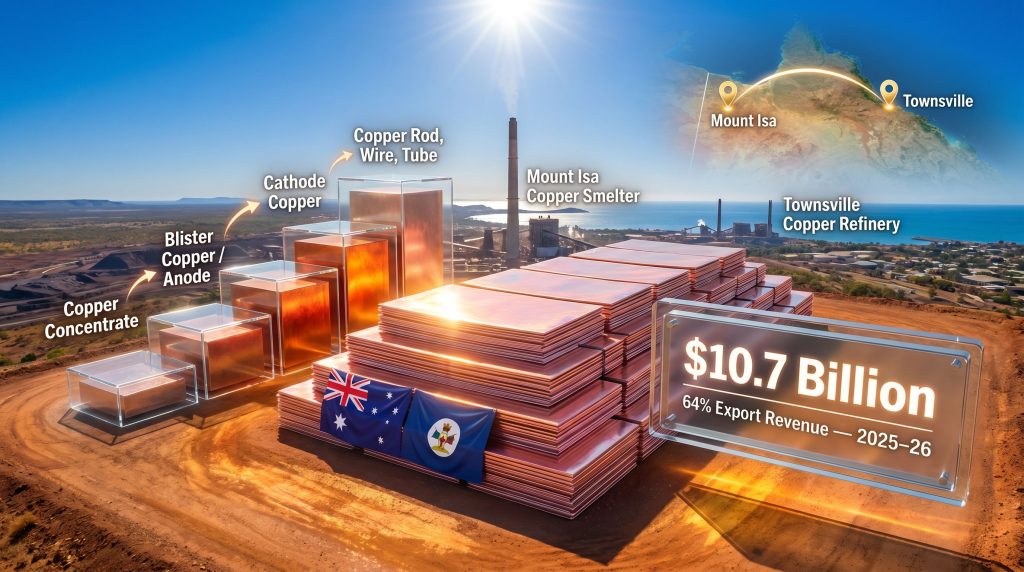
Before examining the study's methodology, it is worth anchoring the discussion in the sector's economic weight. Australia's copper ore mining industry generated an estimated $10.7 billion in revenue in 2025-26, according to IBISWorld estimates, with approximately 64% of that figure derived from export activity. That export dependency is both a measure of the sector's global integration and a signal of its vulnerability to commodity price volatility and shifting trade dynamics.
The sector recorded a five-year annualised revenue growth rate of 2.2% between 2020-21 and 2025-26, reflecting steady rather than spectacular expansion. That trajectory, however, masks the structural pressures accumulating beneath the surface. Understanding the copper price drivers is therefore essential context for any serious assessment of the sector's long-term prospects.
The North West Minerals Province: More Than a Mining Address
The Mount Isa-Cloncurry belt is not simply a collection of mines. It represents one of Australia's most complex polymetallic production systems, where copper is frequently extracted alongside zinc, lead, and silver within integrated operations. This co-product structure means the economic calculus of any individual operation is rarely determined by copper pricing alone.
Key characteristics that distinguish the province:
- One of the most concentrated polymetallic corridors on the continent, with decades of accumulated geological knowledge and extraction infrastructure
- Townsville's copper refinery represents a rare downstream processing asset, capable of producing cathode copper at 99.99% purity for industrial markets
- The Mount Isa Copper Smelter occupies a critical intermediate role between raw concentrate and refined product
- Regional communities along the corridor have limited economic diversification, meaning the copper sector's health is directly tied to local livelihoods
- Active exploration north of Mount Isa has identified more than 40 copper targets across tenure areas currently under assessment, pointing to meaningful discovery potential beyond existing operations
Who Is Leading the Queensland Copper Industry Study and Why It Matters
The appointment of CRU, a UK-headquartered commodities intelligence and consulting firm with deep expertise across metals, mining, and fertilizers markets, signals a deliberate choice to anchor the assessment in rigorous international benchmarking rather than domestically produced advocacy.
CRU operates across more than 40 commodity markets globally and is considered one of the most credible independent sources of cost and market analysis in the mining sector. Their methodology typically involves facility-level cost modelling, global supply curve analysis, and demand scenario construction — tools that will be directly relevant to evaluating Queensland's competitive position.
The study has been jointly announced by Federal Industry and Innovation Minister Senator Tim Ayres and Queensland Natural Resources and Mines Minister Dale Last, establishing a bipartisan political mandate that reduces the risk of findings being distorted by single-jurisdiction interests. Further detail on the Mount Isa transformation study is available through the Minister's official media release.
What the Assessment Will Examine Across the Full Value Chain
| Value Chain Stage | Key Infrastructure | Current Status |
|---|---|---|
| Mining and extraction | Mount Isa underground and open-cut operations | Active, with feasibility studies for new developments |
| Smelting | Mount Isa Copper Smelter | Operational, capital reinvestment needs under review |
| Refining | Townsville Copper Refinery | Produces 99.99% pure cathode copper |
| Export logistics | Port of Townsville corridor | Active supply chain integration |
The study's analytical pillars include:
- Global market intelligence examining copper supply and demand dynamics and Queensland's competitive positioning relative to major producing nations
- Facility-level cost benchmarking covering each production stage against international peers in Chile, Peru, China, and the Democratic Republic of Congo
- Structural opportunity mapping to identify viable industrial pathways once current government financial support arrangements conclude
- Workforce and community impact modelling assessing long-term employment and regional economic implications
Stakeholder engagement will run throughout 2026, with the final report scheduled for submission to both levels of government before year's end.
The Cost Competitiveness Challenge Queensland Cannot Ignore
One of the study's most consequential tasks will be quantifying the cost gap between Queensland's processing infrastructure and its global competitors. This is not a theoretical exercise. Copper smelting and refining are among the most energy-intensive industrial processes in the mining value chain, and Queensland's industrial energy pricing sits in a structurally challenging position relative to jurisdictions where state-subsidised power or cheaper energy inputs reduce operating costs dramatically.
Several interlinked cost pressures require honest assessment:
- Ore grade decline: As the most accessible high-grade mineralisation in mature deposits is exhausted, processing more tonnes to recover equivalent copper volumes increases both energy and reagent costs per unit of output
- Infrastructure age: Both the Mount Isa Smelter and Townsville Refinery carry the capital reinvestment burden of ageing assets. Sustaining global competitiveness typically demands ongoing modernisation investment that private operators may be reluctant to commit without policy certainty
- Treatment and refining charges: Global copper smelters earn income through treatment charges paid by miners to process their concentrate. These charges have been under pressure as global smelting capacity, particularly in China, has expanded faster than mine supply, compressing the economics of independent smelter operations
- Transition metal competition: As battery chemistry evolves, the specific copper alloys and product forms required by electric vehicle and grid storage manufacturers are becoming more technically demanding, raising quality benchmarks that older processing lines may struggle to meet without investment
Furthermore, the question of Mount Isa smelter support has already attracted significant policy attention, underscoring just how pressing these cost competitiveness concerns have become for government decision-makers.
A less commonly understood dynamic in copper processing is that smelter profitability is structurally distinct from mine profitability. A smelter can be operating at full capacity while generating thin margins if treatment charges are depressed, meaning facility-level viability and headline copper prices are only loosely correlated.
Copper's Role in the Energy Transition: Demand Signals That Reshape the Investment Case
The global copper demand outlook is one of the most extensively modelled commodity forecasting exercises in the resources sector, and the consensus direction is unambiguous. Copper is physically irreplaceable across the core technologies of the energy transition:
- A single onshore wind turbine requires between 2.5 and 6 tonnes of copper depending on capacity rating, with offshore installations requiring significantly more due to cabling requirements
- Electric vehicles contain two to four times more copper than internal combustion engine vehicles, with the figure rising further in commercial and heavy transport applications
- Grid-scale electricity transmission upgrades, required in virtually every major economy to accommodate variable renewable generation, are fundamentally copper-intensive infrastructure investments
- Industrial electrification across manufacturing, heating, and process industries represents a structural demand layer that exists independently of transport electrification
The cumulative effect of these demand vectors is projected to produce a sustained period of copper market tightness through the late 2020s and into the 2030s. This is particularly relevant given that the lead times required to bring new mining capacity online typically span 10 to 15 years from discovery to production. The broader critical minerals transition dynamic reinforces precisely why Queensland's copper infrastructure occupies such a strategically sensitive position.
The Downstream Processing Value Argument
A persistent theme in Australian resources policy is the question of whether the country captures sufficient economic value from its mineral endowment, or whether it exports raw materials and forfeits the manufacturing premium to processing nations.
The value differential across the copper chain is substantial:
| Processing Stage | Product Form | Relative Value |
|---|---|---|
| Mining only | Copper concentrate (typically 25-35% Cu content) | Base commodity pricing |
| Smelting | Blister copper or anode (98-99% Cu) | Moderate processing premium |
| Refining | Cathode copper (99.99% Cu) | Premium product for industrial buyers |
| Fabrication | Rod, wire, tube, sheet | Manufactured goods margin |
Queensland currently operates across the first three stages of this chain. However, the study's findings may clarify whether investment in fabrication-stage capacity represents a realistic industrial development opportunity or whether the cost and market access barriers make it unviable without significant structural support.
The Post-Support Mechanism Question: What Happens When the Safety Net Expires?
The most politically sensitive dimension of the Queensland copper industry study is its explicit mandate to examine the sector's future beyond existing government financial support arrangements. This framing represents a rare piece of policy transparency, acknowledging that current mechanisms sustaining the viability of certain processing operations cannot be assumed permanent.
The study is structured to answer a forward-looking question that policymakers have previously avoided asking explicitly: what does the industrial future of north-west Queensland look like once existing support frameworks are no longer in place? The Queensland government's support initiatives provide useful context for understanding the existing policy architecture surrounding these operations.
The scenarios the study may illuminate span a wide range of outcomes:
| Scenario | Core Assumption | Policy Implication |
|---|---|---|
| Modernisation pathway | Capital investment upgrades existing facilities to global cost competitiveness | Evidence base for co-investment frameworks |
| Consolidation model | Rationalisation improves per-unit economics at reduced scale | Managed transition support for affected workers and communities |
| Expansion opportunity | New capacity developed to capture transition metal demand growth | Streamlined approvals and infrastructure investment decisions |
| Export concentration persistence | Concentrate exports remain dominant; downstream processing declines | Policy focus shifts to mine-life extension and exploration facilitation |
The implications extend beyond industrial policy into regional development, workforce planning, and the fiscal calculations of both levels of government.
The next major ASX story will hit our subscribers first
Queensland's Legislative Environment: A Parallel Policy Track
The copper industry study does not exist in isolation. Queensland has recently introduced legislation specifically designed to accelerate approvals for critical minerals projects, creating a regulatory environment intended to reduce development timelines and attract investment across the state's resource sector.
This legislative initiative represents a complementary policy track to the strategic assessment, signalling that Queensland is simultaneously attempting to both understand its existing copper infrastructure's future and create conditions to attract new critical minerals investment. The two tracks are not inherently contradictory, but their interaction will shape whether Queensland emerges as a net beneficiary or a structural laggard in the global critical minerals competition.
It is important to note that legislative frameworks creating faster approval pathways represent a general regulatory environment, not project-specific endorsements or guarantees of support for individual operations.
What the Study Means for Investors and Capital Allocators
For those tracking Queensland's resource sector from an investment perspective, the Queensland copper industry study represents a material policy signal with several practical implications:
- Timeline clarity: Results anticipated in late 2026 provide a defined horizon for when the evidence base informing policy decisions will be publicly available
- Scope breadth: Full value chain analysis means the study's findings will be relevant across the investment universe from exploration companies through to logistics operators and downstream manufacturers
- Bipartisan mandate: Joint Commonwealth-Queensland commissioning reduces the risk of politically motivated framing and increases the probability of findings being acted upon across electoral cycles
- Exploration optionality: The identification of more than 40 copper targets north of Mount Isa within tenure areas currently under assessment suggests the province's resource inventory is not exhausted, maintaining discovery optionality for investors in the exploration space
In addition, those weighing copper investment strategies should monitor study developments closely, as the findings are likely to influence capital allocation decisions across the full value chain. The emerging copper supply crunch adds further urgency to this analysis, particularly for investors assessing exposure to Australian processing infrastructure.
This article contains forward-looking analysis based on publicly available information and does not constitute financial advice. Readers should conduct their own due diligence and seek professional guidance before making investment decisions.
Frequently Asked Questions: Queensland Copper Industry Study
What is the Queensland copper industry study examining?
The assessment covers the full copper value chain across the North West Minerals Province, from mining operations through smelting at Mount Isa to refining at Townsville, with a focus on long-term viability and structural opportunities beyond current support arrangements.
Who commissioned and who is leading the study?
The initiative was jointly announced by Australian Federal Industry and Innovation Minister Senator Tim Ayres and Queensland Natural Resources and Mines Minister Dale Last. UK-based commodities consultancy CRU is leading the work alongside consortium partners.
When will results be available?
Stakeholder engagement is active throughout 2026, with the final report scheduled for submission to both governments before the end of 2026.
Why does copper qualify as a critical mineral?
Copper is physically essential to electric vehicles, renewable energy generation, and electricity transmission infrastructure. Its demand trajectory is expected to rise sharply as global decarbonisation commitments accelerate, and there are no commercially viable substitutes for its core electrical applications at scale.
What is cathode copper and why does it matter?
Cathode copper is the refined output of the electrolytic refining process, typically achieving 99.99% purity. It is the standard feedstock for industrial copper fabrication into wire, rod, tube, and sheet products, commanding a price premium over lower-purity intermediate forms such as blister copper or anode.
What are treatment and refining charges in copper processing?
Treatment charges (TC) and refining charges (RC) are fees paid by copper miners to smelters and refiners to process copper concentrate into marketable metal. These charges fluctuate based on the balance of global smelting capacity versus mine supply and are a critical determinant of whether standalone processing operations remain economically viable independent of copper spot prices.
Want to Stay Ahead of the Next Major Copper Discovery on the ASX?
Discovery Alert's proprietary Discovery IQ model delivers real-time alerts the moment significant mineral discoveries are announced on the ASX, cutting through complex data to surface actionable opportunities in copper and beyond — ideal for investors tracking the structural shifts reshaping Queensland's processing corridor. Explore how historic mineral discoveries have generated substantial returns and begin your 14-day free trial today to position yourself ahead of the broader market.