June 5, 2026
When the Drill Bit Stops Exploring and Starts Engineering
Most investors think about drilling programmes explained in binary terms: either a company is finding new mineralisation or it is not. This framing misses one of the most important transitions in mine development, which is the shift from data collected to characterise a deposit to data collected to build and cost one. These two objectives look similar from the outside but serve entirely different masters. The first answers geological questions. The second generates the quantified inputs that engineers, metallurgists, and economists need to model a mine that can actually be financed and built.
Understanding this distinction is the key to reading the Selkirk Copper Minto Phase 2 drill program correctly. The programme launched in May 2026 is not a continuation of Phase 1 in any meaningful operational sense. It represents a deliberate pivot in programme architecture, one that adds geotechnical drilling and geometallurgical data collection to the scope for the first time and explicitly targets the information required for a definitive feasibility study rather than advancing geological knowledge alone.
When big ASX news breaks, our subscribers know first
Phase 1 vs. Phase 2: What the Numbers Do Not Tell You
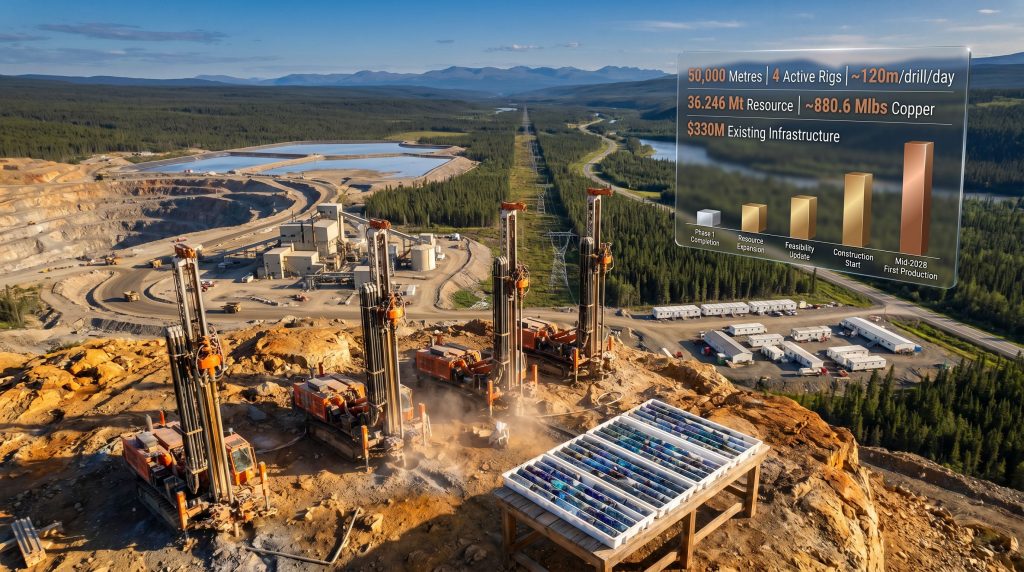
On a surface reading, Phase 1 and Phase 2 look broadly comparable. Phase 1 completed 52,288 metres across 175 diamond drill holes between August 2025 and April 2026. Phase 2 targets 50,000 metres with four active rigs already achieving approximately 120 metres per drill per day, compared with 94 metres per drill per day during Phase 1. By the end of the programme's first month, 14,000 metres had been completed across 59 holes, representing 28% of the planned total.
However, the metres are not the point. The distinction is in what those metres are designed to measure.
| Parameter | Phase 1 | Phase 2 |
|---|---|---|
| Duration | August 2025 to April 2026 | May 2026 onwards |
| Total Metres | 52,288m completed | 50,000m planned |
| Total Holes | 175 holes | 59 holes in first month alone |
| Primary Objective | Discovery and resource expansion | Engineering inputs for Feasibility Study |
| Geotechnical Drilling | Not included | Explicitly included |
| Geometallurgical Collection | Not included | Explicitly included |
| Drill Productivity | ~94m per drill per day | ~120m per drill per day |
| Active Rigs | Multiple | 4 active rigs |
| First Month Output | Not applicable | 14,000m (28% of programme total) |
| Study Output | Feeds Trade-Off Study and PEA | Feeds Feasibility Study |
Phase 1 delivered exactly what it was designed to deliver. The Minto North West zone expanded by approximately 90% during the programme, and two new mineralised lenses were confirmed at depth: the 117 Lens beneath the Area 2 Pit and the 301 Lens beneath Area 118. The programme was geological in character, focused on expanding known zones, identifying higher-grade intervals, discovering new lenses, and upgrading Inferred and Indicated Resource classifications.
Phase 2 begins where Phase 1 left off, but it asks fundamentally different questions. The geological foundation is established. What Phase 2 needs to build is the engineering layer on top of it.
What Geotechnical Drilling Actually Does in a Restart Context
Geotechnical drilling is often described in passing without being properly explained. At its core, it involves collecting oriented core samples to build structural models of the rock mass that allow engineers to quantify mechanical properties such as rock strength, fracture orientation, and discontinuity frequency. These parameters feed directly into pit slope design, underground support requirements, blast pattern optimisation, and waste rock characterisation.
For a restart project like Minto, geotechnical data carries specific importance. The site has existing open pit workings and underground development, both of which require engineering validation before production assumptions can be embedded in a Feasibility Study. The question is not simply whether the ore is there but whether the rock mass around it will behave the way the economic model assumes it will.
SRK Consulting (Canada) Inc. has been appointed to handle rock mechanics evaluation, geotechnical design, and water and waste management across the Trade-Off study and PEA. SRK's analytical framework draws directly on the structural models built from Phase 2 drilling and oriented core measurements. The quality of that data determines the confidence level of the mine design assumptions that flow through to the Feasibility Study.
How Does Geological Logging Feed Into Geotechnical Work?
When geological logging codes are applied consistently throughout a drill programme, they provide the standardised structural and lithological classifications that underpin geotechnical interpretation. In practice, this means the same core that informs resource modelling also generates the rock quality designation data that engineers rely on for slope stability and underground support design.
Geometallurgy: The Discipline That Connects Ore to Cash Flow
Geometallurgy sits at the intersection of geology and metallurgical engineering. Where traditional resource estimation focuses on grade and tonnage, geometallurgical characterisation maps the spatial variability of ore physical properties across the deposit to predict how different ore types will behave inside a processing plant.
This matters because ore is not uniform. A deposit may contain zones where the copper mineralogy, hardness, clay content, or liberation characteristics differ significantly from zone to zone. If a Feasibility Study assumes uniform processing performance across the whole resource, and the ore turns out to be geometallurgically variable, the mill throughput, reagent consumption, and recovery rate assumptions will all be wrong. That is how mines get built to a budget and then underperform it.
At Minto, the mineralisation is hosted in chalcopyrite-bornite-magnetite-bearing schist. One metallurgically significant characteristic that is not widely discussed in investor-facing material is the deposit's near-complete absence of pyrite. This is operationally important for two reasons:
- Pyrite is the primary driver of acid rock drainage (ARD), the process by which sulphide minerals oxidise on exposure to water and air to generate acidic leachate. Low pyrite content significantly reduces ARD risk and the associated long-term environmental liability for tailings management.
- Pyrite is also associated with reagent overconsumption in flotation circuits. Its absence simplifies the metallurgical process and tends to support cleaner copper concentrates with higher payable metal content.
Hatch Ltd. has been appointed to cover mineral processing, infrastructure, and mining engineering work packages. Geometallurgical data collected during Phase 2 will feed directly into Hatch's processing design assumptions, creating a real-time feedback loop between field geology and engineering modelling.
The integration of geotechnical and geometallurgical workstreams into a single drilling campaign is operationally significant. Conventional mine development sequences these activities after resource definition is complete, meaning a separate engineering drill programme is typically required. Running both concurrently with infill drilling compresses the timeline between resource confidence and Feasibility Study readiness.
The Resource Foundation: What Phase 2 Is Being Built On
The Selkirk Copper Minto Phase 2 drill program is operating on a classified resource base, not an exploration-stage assumption set. As of 7 April 2025, the resource position stands as follows:
| Resource Category | Tonnes | Cu Grade | Au Grade | Ag Grade | Contained Cu |
|---|---|---|---|---|---|
| Indicated | 12.588 Mt | 1.20% Cu | 0.46 g/t Au | 4.27 g/t Ag | 333.8 Mlbs |
| Inferred | 23.658 Mt | 1.05% Cu | 0.387 g/t Au | 3.90 g/t Ag | 546.8 Mlbs |
| Combined | 36.246 Mt | — | — | — | ~880.6 Mlbs |
The deposit sits in the Minto-Carmacks copper belt in central Yukon, approximately 250 kilometres north of Whitehorse on the Klondike Highway. It comprises more than 85 structurally disrupted lenses of copper-gold-silver-bearing schist across a 26,850-hectare property. Geologically, the deposit has been characterised as resembling either a strongly metamorphosed calc-alkaline porphyry or an iron-oxide-copper-gold style system, reflecting the structural complexity of the mineralised package.
One detail that carries strategic weight for the programme's long-term optionality: only 3 kilometres of a 7-kilometre mineralised trend within the licensed mine area has been explored to date. The Feasibility Study is being built on the 3 kilometres of known and classified mineralisation, while the remaining 4 kilometres represents discovery optionality that sits entirely outside the current study scope. Furthermore, Phase 2 is also testing new geophysical targets identified through historical magnetic and IP surveys, with focus areas including Minto North, Area 118, Ridgetop, and the 117 Lens.
The Inferred resource of 23.658 million tonnes provides a substantial conversion target through Phase 2 infill drilling. Converting a meaningful portion of that to Indicated classification through tighter drill spacing would directly improve resource confidence and reduce the technical risk embedded in the Feasibility Study's economic model.
Why Does Interpreting Drill Results Matter at This Stage?
Consequently, interpreting drill results accurately becomes especially important during Phase 2, because the same intercepts that define resource classification also feed geotechnical and geometallurgical models. Investors reviewing assay releases later in summer 2026 should consider not only grade and width but also how individual intercepts contribute to engineering data density across the deposit footprint.
$330 Million in Sunk Capital: Understanding the Restart Advantage
One of the structural characteristics that separates Minto from the broader universe of copper development projects is the scale of infrastructure already in place on site. The existing asset base includes:
- A 4,100-tonne-per-day processing mill, fully constructed and previously operational
- Existing open pit and underground mine workings
- A constructed and previously permitted tailings management facility
- A 400-person accommodation camp
- An operational water treatment plant
- Road access via the Klondike Highway
- Grid power connection
The replacement value of this infrastructure base exceeds $330 million. For a Feasibility Study, this means the capital cost estimate is not starting from zero on the most capital-intensive line items in mine construction. Power transmission, access roads, and above-ground processing facilities typically represent a substantial portion of upfront capital in greenfield mine development. At Minto, these categories are already built.
The financial profile of the asset was further restructured by the May 2023 bankruptcy of the previous operator, Minto Metals. The bankruptcy process extinguished two material financial obligations that had been attached to the site under prior ownership: a precious metals stream and a concentrate offtake agreement. These instruments, which in their prior form would have claimed a share of future production revenue or locked in sales terms, were cleared through the restructuring process. Future production from the site is not subject to those obligations.
The combined effect of existing infrastructure and cleared encumbrances creates a capital cost and revenue retention profile that is structurally different from both greenfield developments and from the asset's own prior operating history. Selkirk Copper's Phase 1 results demonstrated the operational readiness and geological quality that underpin this restart thesis.
Historical production benchmarks from prior operators provide a further data point on site capacity: the Minto operation previously produced up to 30,000 tonnes of copper per year, alongside up to 35,000 ounces of gold and 350,000 ounces of silver annually. These figures confirm that the processing infrastructure has operated at production scale under real operating conditions, which reduces the "unproven infrastructure" risk category that applies to greenfield projects.
The next major ASX story will hit our subscribers first
The Study Sequence and What Each Phase Delivers
The pathway from current drilling to potential production follows a clearly sequenced series of study deliverables, each of which depends on the outputs of the previous one.
| Milestone | Target Timing | Key Inputs |
|---|---|---|
| Phase 2 Drill Programme Commenced | May 2026 | 4 active rigs, 50,000m programme |
| First Month Output Achieved | June 2026 | 14,000m, 59 holes completed |
| Trade-Off Study and PEA | Mid-2026 | Phase 1 data, SRK and Hatch preliminary work |
| Feasibility Study | Mid-2027 | Phase 2 engineering data, updated resource model |
| Final Investment Decision | Mid-2027 | FS outputs, capital and operating cost estimates |
| Potential First Production | Mid-2028 | Post-FID restart execution |
The sequential logic is straightforward in principle but demanding in practice. The Trade-Off study and PEA, due in mid-2026, will establish the scope parameters and methodological assumptions that define the Feasibility Study work programme. The FS, targeted for mid-2027, will rely on Phase 2's geotechnical and geometallurgical data as its primary engineering data source for mine design and processing inputs.
The Final Investment Decision, also targeted for mid-2027, will then determine whether the data collected across both drill programmes and the two study phases is sufficient to support a restart commitment. The management team's stated philosophy toward this sequence reflects a deliberate preference for completeness over speed, positioning thorough data collection and disciplined study sequencing as a risk management approach rather than a pace constraint.
Assay results from Phase 2 drilling are expected later in the summer of 2026, which will provide the first external read on the programme's geological performance alongside its engineering data collection objectives.
What Phase 2 Completion Means for the Restart Risk Profile
Restart projects occupy a specific risk category that is distinct from both greenfield development and operating mine expansion. The core risk is that existing infrastructure, geological models, and prior production records may not accurately reflect current conditions, particularly in the geotechnical domain where rock mass behaviour in abandoned workings can change over time.
Phase 2 directly addresses the Selkirk Copper Minto Phase 2 drill program's central challenge of translating a well-defined resource into a bankable technical case. The three risk reduction factors that converge at Minto are:
- Over $330 million in sunk infrastructure eliminates the largest capital expenditure categories typically associated with new mine development, reducing both the absolute capital requirement and the execution risk associated with major construction programmes.
- Cleared precious metals stream and concentrate offtake obligations remove legacy financial encumbrances from the production economics, meaning future revenue is not subject to the claims that applied under prior ownership.
- Phase 2 engineering data provides the geotechnical and geometallurgical inputs that validate mine design assumptions and processing models before capital is committed at the FID stage.
In addition, understanding true vs apparent widths when reviewing Phase 2 intercepts will be particularly relevant given the structurally complex, multi-lens nature of Minto's mineralised package. The convergence of these three factors defines a restart risk profile that is structurally different from either a greenfield copper development or from the Minto asset under its prior owners.
Furthermore, the new mineralised zone discovered during Phase 1 adds additional geological optionality that sits beyond the current study scope, reinforcing the long-term resource potential of the property. What Phase 2 is engineering, in the most literal sense, is the data confidence required to make a Final Investment Decision with a defensible technical foundation.
This article is intended for informational purposes only and does not constitute financial advice. Forecasts, timelines, and production estimates are based on company-disclosed targets and are subject to material change. Readers should conduct their own due diligence before making investment decisions. Mineral resource estimates are not mineral reserves and do not have demonstrated economic viability.
Ready to Identify the Next Major Copper Discovery Before the Market Does?
Discovery Alert's proprietary Discovery IQ model scans ASX announcements in real time, instantly alerting subscribers to significant mineral discoveries — from early-stage exploration through to major resource expansions like those reshaping the copper sector today. Explore how historic discoveries have generated substantial returns on Discovery Alert's dedicated discoveries page, and begin your 14-day free trial to position yourself ahead of the broader market.