June 5, 2026
The Metallurgical Bottleneck Sitting Inside Mountains of Already-Mined Ore
Somewhere between the blast and the refinery, a significant portion of the world's copper quietly disappears. Not through theft or processing failure in the conventional sense, but through a more fundamental problem: the chemistry deployed to extract copper from complex ore bodies was never optimised for the specific mineralogical fingerprint of those rocks. BHP and Microsoft copper leaching AI is now addressing this challenge with the kind of computational firepower that once seemed reserved for pharmaceutical drug discovery.
The convergence of electrification, renewable energy deployment, digital infrastructure expansion, and artificial intelligence hardware buildout has created a copper demand outlook that existing supply pipelines are genuinely struggling to meet. Global copper consumption is projected to grow by approximately 50% between 2023 and 2035 under various energy transition scenarios, with annual demand potentially reaching 35 to 38 million metric tons by the mid-2030s against current production of roughly 24 million metric tons annually.
Furthermore, new greenfield deposits are not emerging fast enough, and the ones being developed are deeper, lower-grade, and more capital-intensive than the generation before them. Average copper ore grades have declined by approximately 30% since the 1950s, dropping from around 1.0% to current averages near 0.6%, while the capital cost of developing a new copper mine has risen from roughly US$1.5 billion in the early 2000s to over US$3.5 billion for projects initiated after 2015.
The growing copper supply crunch makes the decision by BHP and Microsoft to apply advanced AI to copper leaching reagent discovery less a story about technology novelty and more a story about strategic necessity.
When big ASX news breaks, our subscribers know first
Why Heap Leaching Has Always Had a Recovery Ceiling
Heap leaching is not new. The process of percolating dilute acid solutions through stacked ore to dissolve copper, then recovering the metal from the resulting solution through solvent extraction and electrowinning, has been a cornerstone of copper production for decades. It currently accounts for approximately 20% of global copper output and is particularly important for processing oxide and transitional ores that are unsuitable for conventional concentration and smelting.
The problem is that heap leach recovery rates vary enormously depending on ore mineralogy. Oxide ores typically achieve recoveries of 60 to 85%, transitional ores yield 40 to 70%, and sulfide ores often fall below 30% using conventional leaching methods. These figures represent a persistent gap between the copper that exists in the ore body and the copper that actually reaches the market.
Copper exists across a spectrum of mineral forms, each with different surface chemistry characteristics:
- Oxide minerals such as cuprite and tenorite dissolve relatively readily in acidic conditions
- Secondary sulfides like chalcocite are partially amenable to leaching but present complications at scale
- Primary sulfides such as chalcopyrite are notoriously resistant to standard acid leaching due to the formation of passivation layers on mineral surfaces that physically block reagent contact
The challenge at the mineral-reagent interface involves multiple competing reactions occurring simultaneously: passivation layer formation, side reactions with non-copper gangue minerals, and chemical degradation of the reagent itself under operational temperature and pH conditions. Each interaction affects recovery efficiency in ways that are difficult to predict without testing specific reagents against specific ores.
Historically, identifying which chemical reagents work best for a given ore body has required years of iterative laboratory experimentation. The chemical search space is essentially boundless, with the copper leaching process encompassing millions of known molecular compounds with potential application, plus a theoretically unlimited number of novel molecules that could be synthesised specifically for this purpose. Testing even a few hundred candidates manually could consume years of dedicated research effort.
The BHP and Microsoft Copper Leaching AI Collaboration: Architecture and Intent
The collaboration between BHP and Microsoft, conducted in partnership with computational chemistry specialists Prescience Insilico, began in early 2025 and represents an attempt to fundamentally restructure how metallurgical reagent discovery works. The platform at the centre of the initiative is Microsoft Discovery, an agentic AI research and development environment that reached general availability on June 2, 2026.
BHP is identified as the first mining industry partner of the Microsoft Discovery platform, a positioning that reflects both the novelty of the approach and the strategic importance BHP places on finding solutions to copper recovery limitations at its existing operations. BHP's partnership with Microsoft represents a landmark moment for the mining sector's embrace of advanced AI-driven research.
How the Microsoft Discovery Platform Functions
Microsoft Discovery is not a conventional AI tool in the sense of a model that answers queries or generates predictions from historical data. It is an integrated R&D acceleration environment that connects three distinct capabilities into a single workflow:
- Agentic AI systems that autonomously navigate complex chemical datasets, execute multi-step simulation tasks, and prioritise candidates based on predefined performance criteria without requiring continuous human intervention
- Quantum chemistry simulation that models molecular behaviour at the atomic level, calculating binding energies, electronic structure properties, and reaction pathways under conditions specific to real-world processing environments
- Laboratory workflow integration that bridges computational screening with physical experimental validation, ensuring the most promising computational candidates are efficiently routed to bench-scale testing
The "agentic" nature of the platform is particularly significant. Rather than functioning as a tool that researchers query, the AI agents autonomously execute research workflows, make intermediate decisions about which computational paths to pursue, and generate ranked hypothesis sets that direct laboratory resources toward the highest-probability candidates. This represents a qualitative shift from AI-as-tool to AI-as-research-collaborator, with implications for research throughput that extend well beyond incremental efficiency gains.
Breaking Down the 500,000-Molecule Screening Campaign
The scale of computational analysis conducted through this collaboration is worth examining in concrete terms, because the numbers fundamentally reframe what is possible in metallurgical research.
| Metric | Detail |
|---|---|
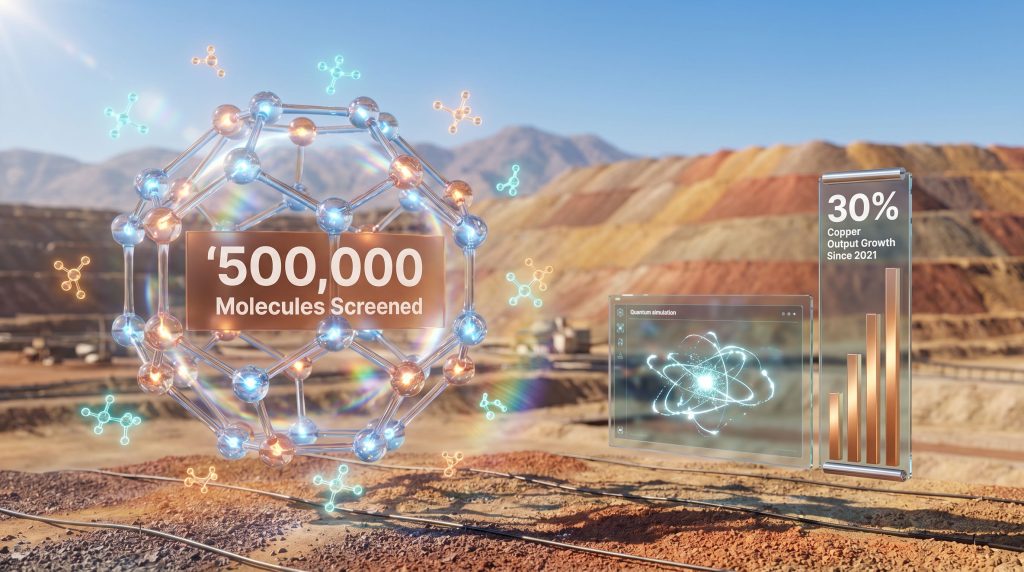
| Molecules evaluated | More than 500,000 potential leaching reagents |
| Simulation methodology | Quantum chemistry calculations |
| Simulation volume | Tens of thousands of individual runs |
| Screening criteria | Geochemical specificity, toxicity, environmental compliance, cost |
| Outcome | Shortlisted candidates for physical laboratory testing |
| Testing location | Scientific laboratories in Australia |
| Collaboration commencement | Early 2025 |
| Platform general availability | June 2, 2026 |
What makes this campaign distinct from generic computational chemistry work is the specificity of the conditions modelled. The quantum chemistry simulations were calibrated against the actual geochemical characteristics of BHP's copper ore bodies rather than idealised laboratory conditions. This means the computational screening was identifying reagents likely to perform well under the temperatures, pH levels, ionic compositions, and mineralogical complexities that exist in BHP's real operations in Chile and South Australia.
Operational screening criteria were also embedded into the process from the outset:
- Toxicity thresholds compatible with existing environmental management frameworks
- Environmental persistence and biodegradability assessments
- Cost parameters consistent with commercial deployment at scale
- Compatibility with existing water management and processing infrastructure
This multi-criteria approach means the shortlisted candidates are not purely optimised for copper recovery in isolation. They are candidates that have already been filtered for practical deployability, which consequently compresses the gap between computational discovery and operational implementation.
Conventional laboratory screening of individual reagents is so resource-intensive that testing even several hundred compounds manually could consume years of dedicated research effort. Computational pre-screening at the scale of half a million molecules compresses what would otherwise be a multi-decade discovery process into a manageable shortlist of high-probability candidates.
From Empirical Testing to Hypothesis-Driven Metallurgy
The traditional metallurgical research model is fundamentally empirical. Researchers identify candidate reagents based on chemical intuition and prior literature, synthesise or procure samples, prepare ore specimens, and run sequential leaching tests to measure performance. Each test cycle generates data that informs the next round of candidate selection. This process is constrained by the physical limits of laboratory throughput, the cost of materials, and the bandwidth of research personnel.
The AI-assisted model inverts this logic entirely. Computational screening generates a ranked hypothesis set based on simulated performance, and physical laboratory resources are deployed only against candidates that have already demonstrated promise in silico. This is the same methodological revolution that has transformed pharmaceutical drug discovery over the past two decades, compressing timelines in certain therapeutic areas from 10 to 15 years down to 2 to 3 years.
What Quantum Chemistry Simulation Actually Measures
Quantum chemistry modelling simulates the electronic structure of molecules and their interactions with mineral surfaces at the atomic level. In the context of copper leaching, this capability allows researchers to computationally assess:
- How strongly a candidate reagent molecule binds to copper-bearing mineral surfaces versus gangue minerals
- Whether a molecule can penetrate or disrupt passivation layers that prevent acid contact with chalcopyrite
- How the reagent behaves across the range of pH and temperature conditions encountered in heap leach operations
- Whether the molecule degrades, remains stable, or transforms into different compounds during the leaching process
- The ion exchange dynamics that govern how copper moves from mineral surface into solution
This level of mechanistic detail was simply not accessible at scale before the integration of high-performance computing with agentic AI workflows. Researchers could run individual quantum chemistry calculations, but the human bandwidth required to design, execute, and interpret tens of thousands of simulations made large-scale screening impractical.
BHP's Strategic Rationale: The Economics of Sweating Existing Assets
The business logic underpinning this initiative becomes clearer when viewed through the lens of capital efficiency. BHP has grown its copper output by approximately 30% since 2021, a significant achievement driven primarily by operational improvements at existing assets rather than new mine development alone. Sustaining and extending this trajectory requires either developing new mines or extracting more copper from resources already being processed.
Given that the capital cost of a new major copper mine now exceeds US$3.5 billion and development timelines routinely span a decade or more, improving recovery rates from existing operations represents a substantially more capital-efficient pathway. The copper demand drivers underpinning this initiative are rooted in the energy transition's insatiable appetite for the metal.
Jessica Farrell, BHP's Vice President of Innovation, has articulated the strategic imperative clearly: as copper demand grows and new deposits become progressively more difficult and expensive to develop, improving recovery from mineralisation already being mined functions as a critical lever for meeting future supply commitments. Even marginal recovery improvements carry material economic significance at the scale of BHP's copper operations:
- A 1 to 2 percentage point improvement in heap leach recovery across major operations translates to tens of thousands of additional tonnes of copper annually
- More effective reagents used at lower concentrations reduce reagent costs per tonne of ore processed
- Reagents with lower toxicity profiles can reduce environmental compliance costs and simplify handling and storage requirements
- Reduced reliance on new mine development extends the productive life of existing capital investments
The next major ASX story will hit our subscribers first
Environmental Performance as a Co-Equal Screening Criterion
One of the less discussed but strategically important dimensions of this collaboration is the deliberate integration of environmental performance criteria into the molecular screening process alongside metallurgical efficiency metrics.
The screening framework assesses candidate reagents across multiple environmental dimensions:
- Toxicity profile: compatibility with environmental management standards across BHP's operating jurisdictions
- Environmental persistence: how long the reagent remains chemically active in the environment after use
- Biodegradability: the capacity for natural biological processes to break down the compound
- Water system compatibility: behaviour within existing water management and treatment infrastructure
This dual-objective approach, optimising simultaneously for copper recovery and environmental footprint, represents an evolution beyond purely efficiency-driven reagent development. Historically, the most effective leaching reagents have not always been the most environmentally benign, creating operational trade-offs between metallurgical performance and regulatory compliance.
There is also a regulatory dimension worth noting. Leaching reagents deployed in heap operations are subject to environmental approvals in each jurisdiction where BHP operates. Reagents with lower toxicity and better biodegradability profiles may consequently face fewer regulatory barriers to deployment, reducing the time and cost of moving from laboratory validation to operational implementation.
How This Fits Within the Broader AI Adoption Landscape in Mining
The BHP and Microsoft copper leaching AI initiative occupies a distinct position within the wider pattern of AI adoption across the mining sector. Most existing applications of AI in mining target operational optimisation of processes that are already established:
| Application Area | AI Capability | Industry Adoption Stage |
|---|---|---|
| Copper leaching reagent discovery | Quantum chemistry simulation + agentic AI | Early-stage pilot (BHP-Microsoft) |
| Ore grade prediction | Machine learning on drill core datasets | Commercially deployed |
| Autonomous haulage systems | Computer vision and path planning AI | Commercially deployed across multiple majors |
| Predictive maintenance | Sensor data and anomaly detection models | Widely deployed |
| Geometallurgical modelling | AI-enhanced geological interpretation | Growing adoption |
| Materials discovery (general) | Foundation models and simulation platforms | Emerging, pharmaceutical sector leading |
The critical distinction is that most AI applications in mining work within existing operational frameworks, optimising parameters of processes that are already understood. The BHP-Microsoft collaboration, however, targets the upstream discovery phase of metallurgical science itself, seeking to identify solutions that do not yet exist in commercial form. This positions the initiative much closer to fundamental research than operational improvement.
Aseem Datar, Corporate Vice President of Product Innovation at Microsoft Discovery, has noted that BHP's role as the first mining partner of the platform positions the company at the leading edge of exploring how advanced computing and scientific simulation capabilities can address the industry's most complex technical challenges. Microsoft's AI-driven approach to materials discovery represents a meaningful shift in how the resources sector can tackle fundamental scientific problems.
The Validation Pipeline: What Comes After Computational Screening
Computational screening is the beginning of the discovery process, not the end. The shortlisted molecular candidates are currently undergoing physical testing in Australian laboratories, and the path from promising shortlist to commercially deployed reagent involves multiple additional validation stages:
- Bench-scale leaching tests: small-scale laboratory experiments confirming that computational predictions hold under physical conditions
- Column leach trials: larger-scale tests that simulate heap geometry and flow dynamics more realistically
- Pilot-scale heap trials: field-scale validation under operational conditions using representative quantities of ore
- Regulatory review and approval: environmental and safety assessments required before deployment in each operating jurisdiction
- Supply chain development: establishing reliable commercial supply of any novel reagent at the volumes required for industrial-scale operations
- Operational integration: modifications to processing infrastructure and procedures to accommodate new reagents
Success at any individual stage does not guarantee progression to the next. BHP's copper leaching operations span geographically and geochemically diverse ore bodies across Chile and South Australia, meaning a reagent optimised for one deposit may require reformulation for another. The Microsoft Discovery platform's ability to incorporate site-specific geochemical parameters into the screening criteria is designed to address this variability.
Implications Beyond Copper: A Replicable Framework for Hydrometallurgy
If validated at scale, the methodology established through the BHP-Microsoft collaboration could become a standard tool in the metallurgical R&D toolkit across the resources sector. The same computational approach applicable to copper leaching reagent discovery could be extended to other hydrometallurgical challenges that share similar characteristics: a vast chemical search space, complex mineral surface interactions, and significant economic consequences for even marginal improvements in recovery efficiency.
The future of copper mining may well hinge on precisely these kinds of innovations as the industry confronts increasingly difficult ore bodies. Candidate application areas include:
- Nickel laterite processing: a growing challenge as the nickel industry shifts toward lower-grade laterite deposits to meet battery material demand
- Lithium extraction from brines: where reagent selectivity and environmental performance are critical operational and regulatory concerns
- Cobalt recovery from polymetallic ores: particularly relevant for complex African ore bodies where cobalt is a valuable by-product of copper processing
- Refractory gold ores: where conventional cyanide leaching faces both metallurgical limitations and increasing regulatory scrutiny
Furthermore, smaller mining companies without in-house R&D capacity may eventually access similar capabilities through commercial reagent suppliers who adopt the methodology, or through platform licensing arrangements as the technology matures. The potential democratisation of AI-driven metallurgical discovery could narrow the innovation gap between major producers and mid-tier operators over time. This shift also connects directly to broader critical minerals demand pressures shaping the global resources sector.
Frequently Asked Questions: BHP and Microsoft Copper Leaching AI
What is the BHP and Microsoft copper leaching AI project?
BHP and Microsoft, working alongside Prescience Insilico, are using the Microsoft Discovery platform to accelerate the discovery of chemical reagents capable of improving copper recovery from ore bodies. The project deploys AI agents and quantum chemistry simulations to screen large numbers of molecular candidates before physical laboratory testing in Australia.
How many molecules did the collaboration screen?
The initiative evaluated more than 500,000 potential molecular compounds as candidate leaching reagents, executing tens of thousands of quantum chemistry simulations to narrow the field to the most promising candidates for laboratory validation.
What is Microsoft Discovery?
Microsoft Discovery is an agentic AI platform designed to accelerate scientific research and development by integrating AI agents, high-performance computing, and simulation capabilities into a single workflow. It became generally available on June 2, 2026, with BHP identified as its first mining industry partner.
Why is copper leaching important for the energy transition?
Copper is foundational to electric vehicles, renewable energy infrastructure, power transmission networks, and digital systems. Improving leaching recovery from existing ore deposits produces more copper from resources already being mined, reducing the need to develop new deposits that are typically more expensive and environmentally complex.
Is BHP the first mining company to use Microsoft Discovery?
Yes. BHP is confirmed as the first mining industry partner of the Microsoft Discovery platform, with the collaboration having commenced in early 2025.
What environmental benefits could AI-designed leaching reagents deliver?
The screening process incorporates environmental criteria including toxicity levels, environmental persistence, and biodegradability alongside metallurgical performance metrics. Reagents that perform well across both dimensions could reduce the ecological footprint of copper processing operations and simplify regulatory compliance in BHP's operating jurisdictions.
Key Takeaways
- The BHP and Microsoft copper leaching AI initiative is the first application of agentic AI and quantum chemistry simulation to copper leaching reagent discovery in the mining industry
- Screening more than 500,000 molecules computationally compresses a potential multi-decade research timeline into an actionable shortlist for physical validation
- The project is motivated by BHP's need to increase copper output from existing assets, given the capital intensity and development timelines associated with new mine construction
- Environmental performance functions as a co-equal screening criterion alongside metallurgical efficiency, addressing the historical trade-off between recovery performance and ecological impact
- The validation pipeline from computational shortlist to commercial deployment involves multiple stages including bench-scale tests, column trials, pilot heap trials, and regulatory approvals
- If validated, this methodology could establish a replicable discovery framework applicable to nickel laterite processing, lithium extraction, cobalt recovery, and other hydrometallurgical challenges
- BHP's 30% copper production growth since 2021 establishes the operational baseline against which this technology must demonstrate further incremental gains
This article is intended for informational purposes only and does not constitute financial or investment advice. Statements regarding projected outcomes, timelines, and commercial deployment of technologies discussed herein involve inherent uncertainty and should not be relied upon as guarantees of future performance. Readers are encouraged to conduct independent research before making any investment decisions related to companies or technologies mentioned.
Want to Know Which ASX Copper Discoveries Could Benefit From the Coming Supply Surge?
Discovery Alert's proprietary Discovery IQ model instantly identifies significant mineral discoveries on the ASX — turning complex geological data into actionable investment insights the moment announcements hit the market. Explore how historic copper and critical mineral discoveries have delivered extraordinary returns, then begin your 14-day free trial at Discovery Alert to position yourself ahead of the market.