June 5, 2026
The Hidden Structural Fault Line Running Through Australia's Copper Processing Sector
Every commodity boom eventually forces a reckoning with the infrastructure built to support it. Copper is no exception. Across the global mining industry, the gap between where copper is extracted and where it is meaningfully processed has widened steadily over the past two decades. Nations that once prided themselves on integrated, mine-to-market value chains are now confronting ageing smelters, shifting trade economics, and the uncomfortable question of whether legacy processing infrastructure can remain competitive in a world being reshaped by the energy transition.
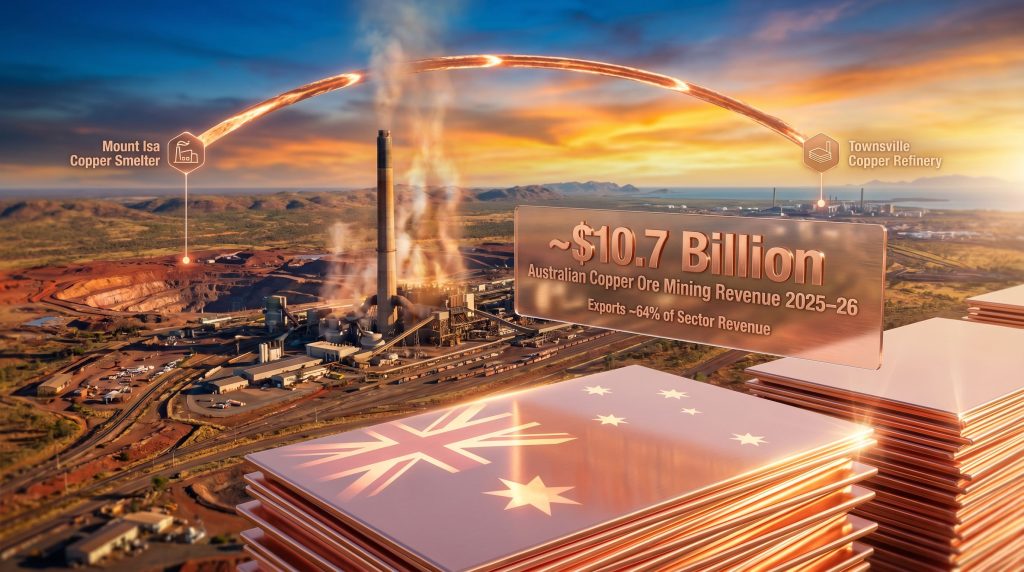
Australia sits at the centre of this tension in ways that are rarely discussed with the depth they deserve. The country's copper processing corridor, anchored by Mount Isa in Queensland's remote north-west and terminating at the Townsville refinery on the coast, represents one of the last fully integrated copper value chains in the southern hemisphere. Its future is now the subject of one of the most consequential industrial reviews in recent Australian mining history: the Queensland copper industry study.
When big ASX news breaks, our subscribers know first
Understanding the North West Minerals Province and Its Copper Legacy
To understand why this study matters, it helps to appreciate just how geologically and economically significant North West Queensland actually is. The North West Minerals Province is not a single deposit or a cluster of adjacent mines. It is a sprawling mineral corridor that has underpinned Queensland's export economy for generations, producing copper, lead, zinc, and silver at scale since the late nineteenth century.
Mount Isa itself is one of the most geologically unusual mining districts in the world. The ore bodies hosted within the Proterozoic metasedimentary sequences of the Mount Isa Inlier are notable for their exceptional vertical continuity and polymetallic character. Unlike many copper-dominant systems globally, the Mount Isa ore bodies yield both copper and lead-zinc mineralisation from separate but spatially associated deposits within the same geological package.
This dual-commodity architecture has historically provided processing infrastructure with a degree of revenue diversification that purely copper-focused operations lack. Furthermore, it positions the region as a uniquely resilient contributor to Australia's broader resource export base, even as global market conditions continue to evolve.
The smelting operations at Mount Isa convert copper concentrates through a pyrometallurgical process, producing blister copper with a purity typically in the range of 98 to 99 percent. That intermediate product then travels approximately 900 kilometres east to the Townsville copper refinery, where electrorefining processes upgrade it to London Metal Exchange-grade copper cathode, achieving purity levels of 99.99 percent or higher. This LME-grade standard is the benchmark for copper traded on global commodity markets and required by most industrial consumers, particularly those in electronics, electrical wiring, and motor manufacturing.
The two-node architecture of Mount Isa smelting and Townsville refining represents an integrated processing corridor of national significance, one where operational continuity at either node has cascading consequences for the entire value chain.
Why the Queensland Copper Industry Study Was Commissioned Now
The timing of the Queensland copper industry study is not incidental. It reflects a convergence of structural pressures that have been building for several years across the region's copper processing sector.
Legacy smelting infrastructure globally is under financial strain. The economics of copper smelting have deteriorated significantly as treatment charges and refining charges — the fees smelters earn for processing concentrate — have compressed amid a structural surplus of smelting capacity in Asia. Chinese copper smelting capacity has expanded aggressively over the past decade, creating intense competition for concentrate supply and squeezing the margins of older, less efficient facilities elsewhere in the world.
Australian copper ore mining industry revenue is estimated at approximately $10.7 billion in 2025-26, according to IBISWorld, with exports accounting for around 64 percent of total sector revenue. That export dependence means any deterioration in the global pricing environment for copper concentrates or refined cathode flows directly into the economics of Queensland's processing operations.
Beyond market dynamics, there is the question of infrastructure age. The Mount Isa copper smelter has operated for decades, and the capital investment required to maintain, upgrade, or decarbonise a facility of that scale is substantial. Consequently, questions around the Mount Isa smelter bailout have become central to industry debate. For private operators weighing future investment decisions, the uncertainty surrounding long-term viability creates a structural disincentive that only an authoritative, independent assessment can help resolve.
The study was jointly commissioned by the Australian Commonwealth Government and the Queensland State Government, with ministerial oversight sitting across the Federal Industry and Innovation portfolio and Queensland's Natural Resources and Mines portfolio. This dual-government commissioning structure reflects recognition that the policy levers required to address the region's challenges are distributed across both levels of government, and that a coordinated analytical foundation is a prerequisite for coherent policy action.
The Mount Isa transformation study forms part of a broader support package for Mount Isa's copper processing assets announced in October 2025, though the study itself is focused on analysis and long-term pathway identification rather than direct financial intervention. In addition, broader discussions around government support for copper operations have underscored just how critical this review is to the region's industrial future.
CRU's Appointment and What It Signals About the Study's Ambition
The selection of CRU Group as lead consultant is significant beyond the administrative detail. CRU is a UK-headquartered commodities research and consulting firm with decades of specialist expertise across metals, mining, and fertilizers. Its work spans cost curve modelling, market forecasting, and facility-level operational benchmarking — the precise analytical toolkit required to assess whether a regional processing corridor can compete globally.
CRU's role in the study has been described by the firm's global head of consulting as identifying practical pathways to strengthen the region's industrial capability, resilience, and competitiveness over the long term. The firm will work alongside consortium partners throughout 2026, conducting stakeholder engagement across mining operators, processing facility managers, workforce representatives, and community groups before delivering a final report to both governments by the end of the year.
What makes the CRU mandate particularly rigorous is its scope. The study is not a narrow operational review of a single facility. It covers:
- The full copper value chain from mining operations in the North West Minerals Province through smelting at Mount Isa to cathode production at Townsville
- Cost competitiveness benchmarking against global copper smelting and refining peers
- Integration of global copper demand trends, including energy transition-driven demand growth projections
- Workforce and community impact modelling across industrial employment scenarios
- Long-term facility viability and industrial transformation pathway assessment
This breadth positions the study as a genuine policy instrument rather than a commercially motivated feasibility exercise.
The Global Copper Demand Backdrop: Why Timing Matters
Any serious analysis of Queensland's copper processing future must be contextualised against one of the most consequential structural shifts in commodities markets in living memory: the energy transition's demand for copper. The relationship between critical minerals and energy transition objectives has never been more strategically significant for resource-rich nations like Australia.
Copper is uniquely irreplaceable in the infrastructure of decarbonisation. Electric vehicles require approximately two to four times more copper per unit than their internal combustion counterparts. Offshore wind turbines can contain up to 10 tonnes of copper each. Grid infrastructure upgrades required to accommodate renewable energy generation and electric vehicle charging networks represent what many analysts describe as a multi-decade demand wave with no historical precedent.
The International Energy Agency has projected that clean energy technologies could account for nearly half of global copper demand growth by 2040. For context, global copper consumption currently runs at approximately 26 to 28 million tonnes per year, and meeting net-zero pathway targets could require cumulative copper supply of more than 700 million tonnes between now and 2050, according to various industry estimates.
This demand environment creates a paradox for the Queensland copper industry study. On one hand, the long-run demand outlook for copper has rarely been more constructive. However, the competitive dynamics of copper processing — where Asian smelting overcapacity has structurally compressed margins for independent smelters — create a challenging near-term commercial environment for legacy facilities in higher-cost jurisdictions. Furthermore, the emerging copper supply crunch adds another layer of urgency to the study's findings.
| Processing Model | Characteristics | Margin Profile |
|---|---|---|
| Fully integrated mine-to-cathode | Controls full value chain; higher capital intensity | Margin captured at each stage |
| Concentrate export model | Lower domestic processing; higher export exposure | Dependent on treatment charge environment |
| Toll smelting arrangements | Third-party processing; flexible | Margin dilution through fees |
| Recycled copper processing | Lower energy intensity; growing circular economy role | Emerging margin opportunity |
Three Scenarios for North West Queensland's Copper Future
The Queensland copper industry study will ultimately produce findings that inform policy decisions across a range of plausible futures. Understanding the scenario space helps contextualise what the review is actually trying to resolve.
Scenario One: Modernisation and Competitive Continuation
In this pathway, targeted investment in smelting and refining technology upgrades allows the Mount Isa to Townsville corridor to remain cost-competitive through the 2030s. This could involve flash smelting technology upgrades, energy efficiency improvements, or integration of lower-carbon power sources to reduce operating costs and improve the corridor's environmental credentials for buyers increasingly subject to scope three emissions scrutiny.
For this scenario to be commercially viable, the economics of treatment charges would need to stabilise or improve, and capital partners would need sufficient confidence in long-term copper demand to justify the investment horizon.
Scenario Two: Partial Transformation and Value Chain Repositioning
Here, some existing infrastructure transitions toward new industrial roles. Possibilities could include processing battery-grade copper products for the electric vehicle supply chain, supporting copper recycling and circular economy activities, or leveraging existing pyrometallurgical expertise to process other base or critical metals present in the North West Minerals Province, including cobalt and nickel, which occur as byproducts in some regional ore systems.
Workforce redeployment programmes would be activated in parallel, potentially leveraging skills transfer pathways into adjacent sectors including battery metals processing and hydrogen infrastructure. In addition, exploring copper investment strategies aligned with these emerging opportunities could attract the private capital needed to underpin this transition.
Scenario Three: Managed Transition with Industrial Diversification
In this scenario, legacy copper processing operations gradually sunset as their economic case weakens, replaced by deliberate industrial diversification across critical minerals processing, clean energy infrastructure, or other advanced manufacturing activities. These would leverage the region's existing industrial skills base, logistics infrastructure, and energy connectivity.
The value of the Queensland copper industry study lies precisely in its capacity to equip decision-makers with the analytical evidence needed to navigate all three scenarios, rather than defaulting to any single predetermined outcome.
The next major ASX story will hit our subscribers first
Workforce and Community Dimensions: The Human Side of Industrial Transition
No serious industrial policy review can treat workforce implications as secondary considerations. Mount Isa's population and economic activity are deeply intertwined with copper processing employment. The closure or significant scaling back of smelting operations at any point in the past has historically produced sharp contractions in regional economic activity, with multiplier effects flowing through retail, services, housing, and local government revenue.
The study's explicit inclusion of workforce and community impact modelling is therefore one of its most practically important analytical dimensions. Understanding the employment intensity of different transition scenarios, the transferability of pyrometallurgical skills to emerging industries, and the timing mismatches between legacy employment contraction and new industry job creation is essential for designing effective policy responses.
Lessons from analogous transitions in the United Kingdom's steel belt, Germany's Ruhr industrial corridor, and parts of Canada's resource sector suggest that the quality of advance planning and the alignment between economic development strategy and workforce transition support are the primary determinants of regional outcome quality.
What the Study Means for Australia's Critical Minerals Positioning
The Queensland copper industry study connects to a larger strategic question about where Australia positions itself in global critical minerals supply chains. Copper is now classified as a critical mineral in several major economies, including the United States and across the European Union, reflecting its indispensability to energy transition technologies and the geographic concentration of its processing in a small number of jurisdictions.
Australia's ability to offer not just copper concentrate but refined, LME-grade copper cathode adds meaningful strategic value to its position in global supply chains. The question the study must ultimately help answer is whether that refining capability can be preserved, modernised, or transformed in ways that capture long-term value from the structural demand growth already underway.
With the final report due by the end of 2026, the findings will likely shape Queensland's copper and broader critical minerals industrial policy for the decade that follows. For investors, analysts, and communities across North West Queensland, the stakes could hardly be higher.
Frequently Asked Questions: Queensland Copper Industry Study
What is the Queensland copper industry study?
The Queensland copper industry study, also referred to as the Mount Isa Transformation Study, is a joint Commonwealth and Queensland Government initiative examining the long-term future of the copper value chain across North West Queensland, including the Mount Isa Copper Smelter and the Townsville Copper Refinery.
Who is leading the Queensland copper industry study?
CRU Group, a UK-headquartered commodities research and consulting firm, has been appointed to lead the study alongside a consortium of specialist partners.
When will the study be completed?
CRU will conduct stakeholder engagement throughout 2026 and is expected to deliver the final report to both the Commonwealth and Queensland governments by the end of the year.
How large is Australia's copper mining sector?
IBISWorld estimates Australian copper ore mining industry revenue at approximately $10.7 billion in 2025-26, with exports accounting for around 64 percent of total sector revenue.
Why does copper processing in Queensland matter strategically?
The Mount Isa to Townsville corridor is one of the only fully integrated copper value chains in the southern hemisphere capable of producing LME-grade copper cathode at scale, making it a strategically significant asset in the context of growing global demand for refined copper driven by the energy transition.
Want To Capitalise on the Next Major Copper Discovery Before the Broader Market Catches On?
Discovery Alert's proprietary Discovery IQ model scans ASX announcements in real time, instantly identifying significant copper and critical mineral discoveries and turning complex data into actionable investment insights — explore historic discoveries and their returns to understand the scale of opportunity, then begin a 14-day free trial at Discovery Alert to position yourself ahead of the market as Australia's copper sector enters a pivotal strategic phase.