
June 5, 2026
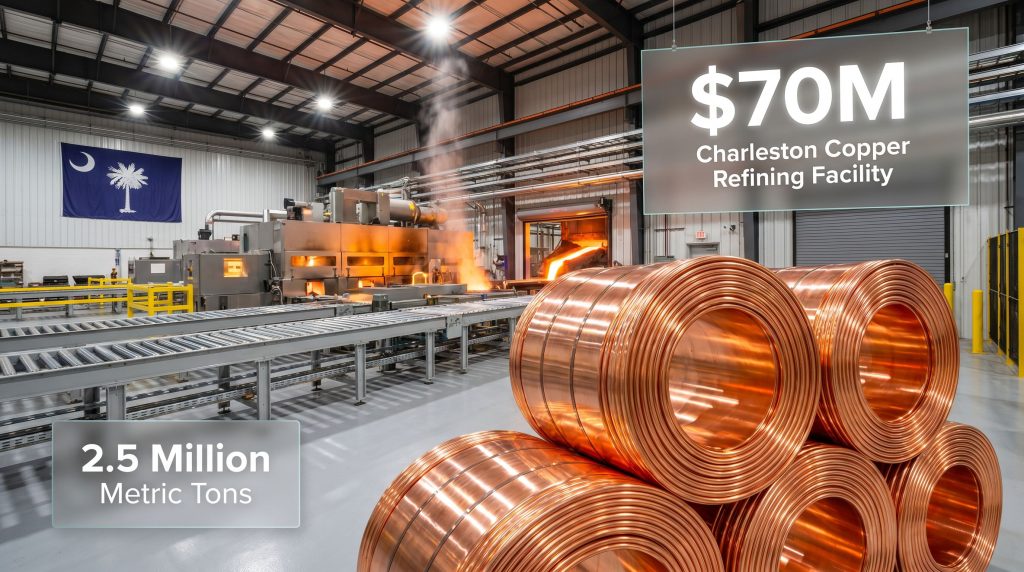
America's Copper Refining Deficit: Why the Problem Was Never About Mining
For decades, the United States has operated under a fundamental misconception about its copper vulnerability. The national conversation has focused almost exclusively on mining output, drilling deeper, opening new deposits, and accelerating permitting timelines. Yet the actual constraint has never sat underground. It sits in the space between raw material and finished product — in the refining, processing, and manufacturing infrastructure that transforms copper-bearing feedstocks into the high-conductivity materials that modern industrial economies cannot function without.
This distinction matters enormously as the energy transition accelerates. Electric vehicles require roughly four times the copper content of their internal combustion counterparts. Grid-scale storage systems, solar installations, wind turbines, and the data centre infrastructure powering artificial intelligence workloads all demand copper in volumes that dwarf historical consumption patterns. The US is heading into this demand supercycle with a processing base that bears little resemblance to the scale of the challenge ahead.
It is against this backdrop that the Red Metals US copper refining plant in Charleston, South Carolina, represents something more significant than a single industrial facility. It represents a direct attempt to rebuild the refining infrastructure that America systematically dismantled over several decades of offshoring.
When big ASX news breaks, our subscribers know first
The Scale of What the US Is Actually Missing
The numbers defining America's copper refining gap are striking in their specificity. US copper demand is projected to grow by more than one million metric tons per year by 2035, with the domestic market value tied to that expansion forecast to exceed $45 billion, according to Mining Weekly. The copper demand growth drivers include the electrification of transportation, the buildout of transmission grid infrastructure, EV manufacturing investment, and data centre construction.
What makes the situation structurally problematic is that mining expansion alone cannot resolve it. Even if every major announced copper mining project in the United States reaches its projected full production capacity, the country is still forecast to face a refined copper supply shortfall exceeding 2.5 million metric tons by 2035. The operative word is refined. Digging more ore out of the ground does not produce copper rod for electrical applications. It produces concentrate that still needs to travel through a complex international processing chain before it becomes industrially useful.
The US currently operates only two to three active copper smelters, depending on classification methodology, for the world's largest economy. This is a critically thin processing base. Meanwhile, the country generates an estimated 1.5 million metric tons of recoverable copper scrap annually, much of which flows offshore for refining before returning to the US market as finished products. This export-then-reimport cycle adds cost at every stage, creates unnecessary emissions, extends lead times, and introduces geopolitical concentration risk into supply chains that underpin national infrastructure.
Furthermore, the copper supply crunch has long been mischaracterised as a mining challenge rather than a processing one, which has delayed meaningful investment in the refining infrastructure that would actually resolve the bottleneck.
The US copper problem is not a mining problem. It is a refining and manufacturing infrastructure problem. Domestic feedstocks exist in volume. The bottleneck is at the processing and finishing stage.
What Red Metals Is Building in Charleston
Red Metals is a Canada-listed copper manufacturer whose strategic thesis centres on a deceptively simple proposition: convert domestically sourced copper feedstocks directly into finished industrial copper products within a single integrated operation, located close to where those products are actually consumed.
The company's first commercial facility is planned for Charleston, South Carolina, with Red Metals having secured economic development incentives from both the State of South Carolina and Charleston County to support the project. These are location-based incentives standard in industrial development, distinct from operational subsidies.
The project parameters are outlined in the table below:
| Parameter | Detail |
|---|---|
| Total planned facility investment | $70 million |
| Seed funding secured | $10 million |
| Location | Charleston, South Carolina |
| Initial product | High-conductivity copper rod |
| Feedstock source | Domestic copper scrap (feedstock-flexible design) |
| Projected job creation | At least 45 jobs (initial phase) |
| Operational model | Single continuous integrated process |
The facility's first commercial product, high-conductivity copper rod, is the foundational industrial input sitting at the entry point of most electrical manufacturing supply chains. It feeds wire drawing operations, magnet wire production, and a broad spectrum of electrical applications. Producing this intermediate domestically eliminates the dependency on importing it from overseas refiners — a dependency that has quietly accumulated over decades of infrastructure neglect.
Understanding High-Conductivity Copper Rod: The Industry's Critical Intermediate
To understand why copper rod matters so much, it helps to trace where it sits in the manufacturing chain. Copper rod, typically produced at around 8mm diameter, is the standardised form of refined copper that downstream wire and cable manufacturers draw down into finer gauges for specific applications. Without a domestic supply of rod at commercial scale, every electrical wire manufacturer, motor producer, and transformer builder in the US is dependent on international supply chains for their primary input material.
This dependency was largely invisible during periods of stable global trade. However, it has become increasingly visible as geopolitical disruption, tariff volatility, and supply chain concentration risks have fundamentally altered the calculus of industrial procurement.
How Red Metals' Process Differs From Conventional Copper Refining
The conventional copper refining pathway was engineered for a world where ore grades were the primary feedstock and geographic concentration of smelting capacity made economic sense. That world has changed substantially, but the infrastructure built for it persists by default rather than design.
The legacy process follows a sequential, multi-stage pathway:
- Ore extraction at grades typically below 1% copper content
- Concentration into copper concentrate through froth flotation
- Smelting to produce copper matte at approximately 65–70% copper
- Converting and fire refining to produce blister copper and then anode copper at 99%+ purity
- Electrorefining to produce cathode copper at 99.99% purity
- Rod rolling to produce finished copper rod for industrial use
Each stage typically occurs at a different facility, often in a different country, with significant working capital tied up in material moving across operators and international borders. As Red Metals notes in its public communications, this legacy process requires substantial energy, time, and working capital before feedstock reaches a finished product pure enough for industrial use. The system was designed for low-grade ore, not for the high-grade copper scrap the US generates in volume.
The Integrated Single-Operation Model
Red Metals integrates physical processing, advanced sorting technology, and metallurgical refining into a single continuous operation. The process converts copper feedstocks directly into finished copper rod while bypassing the intermediate product stages that accumulate cost, emissions, and time in the conventional model. In addition, these copper processing innovations represent a meaningful departure from the incumbent refining paradigm.
Red Metals founder and CEO Jackson Switzer has stated that America has the feedstocks, the demand, and the workforce to produce copper domestically at scale, and that what it has lacked is an economically viable refining process. Mining Weekly, June 5, 2026.
The key differentiators of the Red Metals approach include:
- Feedstock flexibility: Engineered to accept a range of copper-bearing inputs, with initial focus on domestic copper scrap
- Elimination of intermediate products: No concentrate, matte, or anode copper stages are required
- Proximity to demand centres: The integrated model enables facilities to be positioned near finished product consumers
- Subsidy-independent economics: Designed for commercial viability through operational efficiency rather than policy support
- Reduced emissions profile: Eliminating intermediate processing steps reduces the carbon footprint relative to the conventional multi-facility refining chain
The comparative differences between these two models are substantial:
| Dimension | Conventional Copper Refining | Red Metals Integrated Process |
|---|---|---|
| Number of processing stages | 5 to 6 stages | Single continuous operation |
| Facility requirements | Multiple facilities, often multi-country | Single integrated facility |
| Feedstock design | Low-grade ore below 1% copper | Domestic scrap (high-grade feedstock) |
| Working capital intensity | High (material tied up across stages) | Reduced (faster throughput cycle) |
| Geographic flexibility | Limited (smelter-dependent) | Proximity to demand centres |
| Subsidy dependency | Often requires policy support | Designed for subsidy-free viability |
| Carbon emissions profile | Higher (energy-intensive multi-step chain) | Lower (fewer processing steps) |
The Metallurgical Advantage of Scrap as Feedstock
One aspect of the Red Metals model that receives insufficient attention in mainstream coverage is the metallurgical logic of building a process around scrap rather than ore. Conventional smelters are optimised for homogeneous ore concentrate feeds with predictable chemical compositions. Scrap, by contrast, is compositionally variable, containing contaminants and alloying elements that conventional processes struggle to handle efficiently without additional preprocessing.
The advanced sorting technology component of Red Metals' integrated process is therefore not incidental. It is central to making scrap-based feedstock commercially viable at scale, enabling the system to handle variable input quality while maintaining finished product specifications. This represents genuine process innovation rather than incremental improvement on existing technology.
The Investors Behind the $10 Million Seed Round
The seed funding round that will contribute toward the $70 million Charleston facility was led by Gigascale Capital, with co-investment from Future Ventures and MCJ (My Climate Journey), alongside individual participation from JB Straubel, co-founder of Tesla and founder and CEO of Redwood Materials.
Straubel's involvement carries particular weight. Redwood Materials has already demonstrated at commercial scale that domestic critical materials processing — specifically battery materials recycling — can be rebuilt from effectively zero into a significant industrial operation with genuine supply chain impact. His participation in the Red Metals seed round signals alignment between the copper reshoring thesis and the broader effort to rebuild domestic clean energy supply chain infrastructure.
His perspective, as reported by Yahoo Finance, reflects a systemic view of the problem: the US has spent decades offshoring the refining and manufacturing capacity needed to produce copper, and rebuilding that capability requires companies combining technical depth with operational execution capability. Mining Weekly, June 5, 2026.
Gigascale Capital partner Victoria Beasley articulated the investment rationale clearly: the demand signal for domestically refined copper is undeniable, but the domestic infrastructure needed to support it barely exists today, and Red Metals represents the first company combining genuine process innovation with the execution capability to rebuild it. Mining Weekly, June 5, 2026.
This framing is significant from an investor psychology perspective. The conventional approach to backing industrial reshoring has waited for policy certainty before committing capital. The Gigascale Capital thesis appears to be that the commercial fundamentals — specifically the structural gap between scrap availability and refining capacity — are sufficient to drive returns independently of the policy environment.
The Scrap Feedstock Opportunity: A Resource the US Already Possesses
The 1.5 million metric tons of recoverable copper scrap that the US generates annually represents a feedstock base of extraordinary value that is currently being underutilised through a structural market failure. The absence of sufficient domestic refining capacity means this scrap flows to overseas processors, primarily in Asia, where it is refined and converted into rod or cathode before being shipped back to US manufacturers.
The economic inefficiency of this arrangement is evident. The US is effectively paying a refining margin to foreign processors on material it already owns, then paying again to reimport the finished product. The carbon emissions associated with transoceanic shipping in both directions add environmental cost on top of the financial inefficiency. Consequently, the case for US copper recycling expansion has never been more compelling from both an economic and environmental standpoint.
A domestic processing pathway for this scrap would simultaneously:
- Reduce import dependency for finished copper products
- Shorten supply chains and reduce lead times for US manufacturers
- Capture value-added manufacturing employment within the domestic economy
- Reduce the carbon footprint associated with international material flows
- Strengthen supply chain resilience against geopolitical disruption and tariff volatility
The next major ASX story will hit our subscribers first
Commercial Viability Without Subsidies: The Critical Claim
Red Metals has explicitly positioned its process as commercially viable without ongoing subsidy support. This is a significant claim in an industry where large-scale metals processing has historically been reliant on policy incentives, energy subsidies, or captive mine ownership to achieve acceptable economics.
The commercial viability argument rests on several interconnected efficiency gains:
- Eliminating five or six intermediate processing stages reduces energy consumption and processing costs
- Processing high-grade scrap rather than low-grade ore reduces the volume of material that must be handled per unit of finished product
- A single integrated facility reduces working capital requirements by accelerating throughput cycle time
- Proximity to demand centres reduces outbound logistics costs for finished copper rod
The economic development incentives secured from South Carolina and Charleston County are standard location-based incentives of the kind routinely offered to attract industrial investment and job creation. They are not operational subsidies, and their receipt is consistent with the subsidy-independence claim.
Risk Factors That Investors and Industry Observers Should Monitor
Balanced analysis requires acknowledging the execution challenges that remain:
- Scaling a novel metallurgical process from development to full commercial production carries inherent technical risk that has not yet been proven at the scale the facility targets
- The $70 million total facility investment requires substantial additional capital beyond the $10 million seed round secured to date, making future funding rounds a critical milestone
- Feedstock availability and pricing dynamics in the domestic copper scrap market will materially influence operating economics, particularly if scrap premiums tighten as domestic processing demand increases
- Regulatory permitting timelines for industrial facilities in the US introduce schedule uncertainty that can affect capital deployment timing
- Competition from established international refiners with lower labour cost structures remains a structural headwind for any domestic processing operation
Disclaimer: This article contains forward-looking projections and analysis based on publicly available information. It does not constitute financial advice. Investors should conduct independent due diligence before making investment decisions related to any companies or sectors mentioned.
Copper's Strategic Position in the Broader Industrial Landscape
Copper occupies a unique position among industrial metals because its demand growth is structurally linked to the energy transition across multiple vectors simultaneously. Electric vehicles, grid-scale storage, solar generation, offshore wind, transmission infrastructure, and advanced data centre power systems all exhibit increasing copper intensity relative to the technologies they replace.
This multi-vector demand dynamic creates a fundamentally different demand profile from historically cyclical base metals consumption, which tracked construction and manufacturing activity. Copper demand is now driven by long-duration structural investment programmes with decade-scale timelines, providing a more predictable demand backdrop for investment in processing infrastructure. Furthermore, copper investment strategies that account for this structural shift are increasingly attracting institutional capital.
Beyond energy transition applications, defence manufacturing and advanced electronics require reliable access to high-purity copper products. These applications add a supply chain security dimension to the reshoring argument that extends beyond commercial economics into national capability considerations.
The Red Metals US copper refining plant sits within a broader emerging ecosystem of domestic critical materials processing companies attempting to rebuild US manufacturing depth. The seed-stage positioning of the Charleston facility in 2026 mirrors the early profiles of other domestic materials processing ventures that have subsequently scaled into significant commercial operations — including Straubel's own Redwood Materials, which began with a similar thesis about domestic battery materials recovery before becoming a major participant in the US electric vehicle supply chain.
Whether the Red Metals US copper refining plant follows a similar trajectory will depend on technical execution, capital availability, and the company's ability to demonstrate consistent product quality at commercial scale. What is not in question is the structural gap it is attempting to fill — or the scale of the opportunity that gap represents for a country that has every feedstock it needs and has simply lacked the processing infrastructure to use it.
Frequently Asked Questions About the Red Metals US Copper Refining Plant
What is Red Metals building in Charleston, South Carolina?
Red Metals is developing a $70 million integrated copper refining and manufacturing facility in Charleston designed to convert domestic copper scrap directly into high-conductivity copper rod using a single continuous process that bypasses the intermediate stages of conventional copper refining.
How much funding has Red Metals raised so far?
Red Metals has secured $10 million in seed funding, led by Gigascale Capital with participation from Future Ventures, MCJ, and JB Straubel, co-founder of Tesla and founder of Redwood Materials.
Why does the US face a copper refining deficit?
The US faces a projected refined copper supply gap exceeding 2.5 million metric tons by 2035, despite generating 1.5 million metric tons of recoverable scrap annually. The absence of domestic refining capacity means scrap is exported for overseas processing and reimported as finished products, adding cost, emissions, and supply chain risk.
How does Red Metals' process differ from traditional copper refining?
Conventional refining moves material through five to six sequential stages across multiple facilities and often multiple countries. Red Metals integrates physical processing, advanced sorting, and metallurgical refining into a single continuous operation, eliminating intermediate products and enabling production closer to demand centres.
What will the Charleston facility produce?
The facility's first commercial product will be high-conductivity copper rod, the standard industrial input used in wire drawing, magnet wire, and electrical applications. You can find further detail on the facility and its projected local economic impact via the initial announcement.
How many jobs will the Charleston plant create?
The initial phase of the Charleston facility is projected to create at least 45 direct jobs.
Is the Red Metals process commercially viable without government subsidies?
Red Metals has stated that its integrated process is designed to be commercially viable without ongoing subsidy support. The company has received standard economic development incentives from South Carolina and Charleston County, which are location-based incentives distinct from operational subsidies.
Want to Stay Ahead of the Next Major Copper Discovery on the ASX?
Discovery Alert's proprietary Discovery IQ model scans ASX announcements in real time, instantly identifying significant mineral discoveries across copper and more than 30 other commodities — turning complex data into actionable investment insights before the broader market reacts. Explore historic examples of major mineral discoveries and their returns, then start your 14-day free trial to position yourself at the forefront of the next significant find.