
June 5, 2026
Water Scarcity and the Future of Copper: How Climate Pressure Is Reshaping Mining Infrastructure
Across Chile's semi-arid interior, the tension between industrial water demand and ecological limits has been building for decades. For copper producers operating in regions where river systems are already under stress from prolonged droughts and competing agricultural use, the question is no longer whether freshwater dependency must end, but how quickly the transition to alternative sources can be engineered at industrial scale. The Los Pelambres Proyecto Adaptación Operacional sits at the centre of this challenge, representing one of the most significant and technically ambitious responses to water scarcity in Latin American mining history.
When big ASX news breaks, our subscribers know first
What the Los Pelambres Proyecto Adaptación Operacional Actually Does
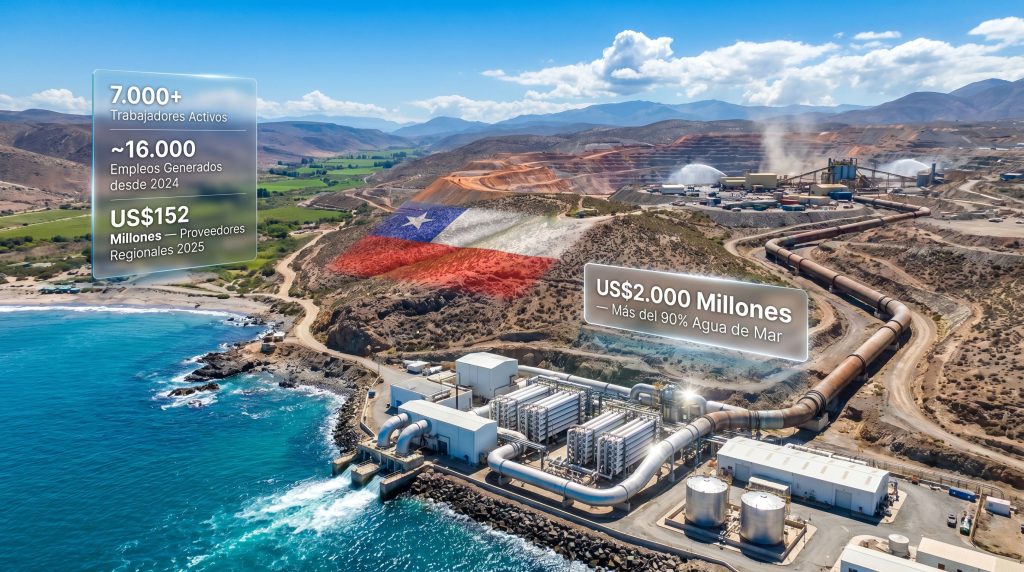
A common misconception about large mining capital programmes is that they are inherently tied to production growth. The Los Pelambres Proyecto Adaptación Operacional breaks this assumption entirely. With a total investment envelope of approximately US$2 billion, the project is not designed to increase copper output or extend the mine's reserve life. Its sole mandate is to fundamentally restructure the mine's water supply architecture, replacing freshwater sourced from the Choapa River system with seawater processed through expanded desalination capacity and internal recirculation.
This distinction matters enormously from both an environmental and strategic perspective. The PAO received environmental approval in October 2023, and construction commenced in 2024. The operational commissioning target is set for 2027, at which point more than 90% of all water used in copper production at Los Pelambres will derive from seawater and recirculated process water, rather than freshwater drawn from a river basin already under significant hydrological stress. The Chile copper market outlook reinforces just how critical operational resilience has become for producers in the region.
The PAO represents a rare case in large-scale mining where capital intensity is directed entirely at operational resilience rather than volume growth, establishing a new design standard for climate-adaptive copper production.
The project sits within Antofagasta Minerals' broader strategic framework known as Los Pelambres Futuro, a long-term operational roadmap oriented toward building a water matrix that is structurally independent of freshwater availability, regardless of how drought conditions evolve across the Choapa Valley in coming decades.
The Infrastructure Behind the Transition
Doubling Desalination Capacity at Los Vilos
The centrepiece of the PAO is the expansion of the desalination facility at Los Vilos, a coastal location that serves as the primary intake point for seawater feeding the mine's processing operations. Upon completion, the plant's capacity will be doubled relative to its current configuration, providing sufficient throughput to supply the overwhelming majority of the mine's industrial water needs from the ocean rather than inland river systems.
The engineering logic is straightforward but the execution is not. Scaling desalination infrastructure in a coastal industrial environment involves complex permitting, marine intake engineering, high-pressure membrane systems, and energy integration challenges. The operational energy intensity of reverse osmosis desalination at mining scale is non-trivial, and projects of this type typically require dedicated power supply agreements to manage operating costs effectively.
A New Concentrate Pipeline Routed Away from Communities
The second major infrastructure component of the PAO involves constructing a new concentrate transport pipeline connecting Chacay to the port facility. The routing of this pipeline has been deliberately designed to increase separation distance from densely populated localities, addressing one of the longstanding community concerns associated with concentrate transport infrastructure in the region.
The table below summarises the key infrastructure differences between current operations and the PAO's post-commissioning configuration:
| Component | Current Configuration | PAO Target (2027) |
|---|---|---|
| Primary Water Source | Freshwater (Choapa River system) | Seawater + recirculation (>90%) |
| Desalination Capacity | Single-train existing plant | Doubled capacity |
| Concentrate Pipeline | Existing route, closer to populated areas | New route with increased community separation |
| Industrial Water Redundancy | Limited drought buffering | Engineered redundancy systems included |
The inclusion of supplementary industrial water supply systems as a third infrastructure layer reflects a deliberate engineering redundancy philosophy baked into the PAO design. Even with a doubled desalination plant, the project architects have built in buffer capacity to maintain production continuity during periods of extreme operational variability, including equipment maintenance cycles or temporary coastal conditions affecting seawater intake.
Employment at Peak Construction: The Scale of the Workforce
As of mid-2026, the Los Pelambres Proyecto Adaptación Operacional has reached its peak construction workforce, with more than 7,000 workers currently active across the various project sites. Since construction launched in 2024, the cumulative number of jobs generated by the PAO has reached nearly 16,000, a figure that reflects the labour intensity of large-scale mining infrastructure development.
Of particular significance is the regional composition of this workforce. More than 5,000 workers participating in the PAO construction have been sourced directly from the Coquimbo Region, reflecting a deliberate hiring strategy that prioritises local and provincial employment over fly-in labour from other parts of Chile.
| Employment Metric | Figure |
|---|---|
| Peak active workforce (mid-2026) | 7,000+ workers |
| Cumulative jobs since 2024 launch | ~16,000 |
| Workers sourced from Coquimbo Region | 5,000+ |
| Local supplier investment during construction | US$74 million+ |
Patricio Chacana, General Manager of Minera Los Pelambres, has publicly reinforced the company's commitment to ensuring that a significant proportion of the construction workforce is drawn from the surrounding province and region, framing local hiring not as a concession but as a core operational principle.
Iván Arriagada, Executive President of Antofagasta Minerals, has stated that the PAO enables the company to contribute to the Coquimbo regional economy through employment, investment, and supplier development, while simultaneously being essential to projecting Los Pelambres' long-term development on a sustainable basis, using seawater as the primary input for copper production.
The Regional Economic Footprint of Los Pelambres
The broader economic significance of Los Pelambres within the Coquimbo Region is difficult to overstate. The mine accounts for approximately 25% of the region's gross domestic product and roughly 73% of its total exports, making it one of the most economically dominant single operations relative to a regional economy anywhere in Chile's mining landscape.
The PAO amplifies this footprint during the construction phase through supplier procurement and contract spending. The economic indicators below illustrate the scale of this contribution:
| Economic Indicator | Value |
|---|---|
| PAO local supplier investment (construction phase) | US$74 million+ |
| Regional supplier payments (2025) | US$152 million |
| Active regional supplier relationships | 200+ |
| Los Pelambres share of Coquimbo regional GDP | ~25% |
| Los Pelambres share of Coquimbo regional exports | ~73% |
The company's network of more than 200 regional suppliers receiving US$152 million in payments during 2025 alone points to an economic multiplier effect that extends well beyond direct employment. Regional businesses providing logistics, engineering services, consumables, catering, and maintenance support all benefit from the sustained procurement activity that a mine of Los Pelambres' scale generates annually.
Workforce Development: A Decade of Skills Investment
Beyond the headline employment figures associated with PAO construction, Minera Los Pelambres has maintained a sustained workforce development investment across the Choapa Valley over the past decade. More than 5,000 residents from the local community have been certified through structured training programmes during this period, with the curriculum designed to build transferable skills applicable beyond the mining sector.
The programme portfolio includes:
- Aprendices — entry-level skills certification for workers entering industrial employment for the first time
- Relevos Mina — mine operations succession training designed to build pipeline capacity for operational roles
- Programas de Prácticas — structured internship pathways connecting training graduates with employer placements
- Cursos de Formación Laboral — cross-sector vocational training expanding employability into agriculture, logistics, and other regional industries
This design philosophy — building competencies that function across multiple productive sectors rather than exclusively within mining — reflects a sophisticated understanding of the risks associated with mono-industrial regional economies. When a single mine accounts for a quarter of regional GDP, ensuring that the workforce development model creates broad-based human capital rather than mining-specific dependency becomes a material issue for long-term regional resilience.
The next major ASX story will hit our subscribers first
Why the PAO Model Matters Beyond Los Pelambres
Water Stress as a Systemic Mining Challenge
The Choapa Valley's situation is not unique. Freshwater scarcity is a structural constraint across multiple Chilean copper-producing regions, from the Atacama in the north to the semi-arid valleys of Coquimbo and parts of the Maule. The International Copper Study Group and various Chilean regulatory bodies have documented the long-term trend of declining precipitation and glacial retreat affecting Andean river systems that mining operations have historically relied upon. Furthermore, the looming copper supply crunch makes it even more urgent that producers secure operationally resilient water solutions.
What makes the PAO structurally significant for the broader industry is the scale at which seawater substitution is being implemented. Achieving more than 90% seawater dependency at a producing mine of Los Pelambres' size, processing millions of tonnes of ore annually, is a proof-of-concept demonstration for the entire sector. If the 2027 commissioning target is met on schedule and within budget, it will provide a credible operational template that other producers facing comparable water constraints can adapt.
The Energy-Water-Production Triangle
One dimension of large-scale desalination that receives insufficient attention in mainstream mining coverage is the energy intensity of the process. Reverse osmosis systems at industrial scale consume substantial electricity, meaning that the long-term operating economics of a seawater-dependent mine are closely tied to energy costs and the availability of renewable power. The role of renewable energy in mining is consequently becoming central to how producers structure their long-term water and power strategies together.
Chile's expanding renewable energy capacity, particularly solar in the north and wind in coastal regions, creates a structural opportunity for mining operations to pair desalination expansion with low-cost clean energy procurement, reducing both the carbon footprint and the operating expense of the water substitution model. The mining decarbonisation benefits of such integrated approaches extend well beyond regulatory compliance, offering genuine long-term cost advantages.
For mining investors and analysts assessing long-term operating cost trajectories, the relationship between desalination capacity and energy supply contracts is a critical variable that sits beneath the headline capital expenditure figures.
Execution Risk and the 2027 Timeline
Large-scale construction programmes of this complexity carry inherent execution risk. Key variables to monitor include:
- Coastal construction timelines for the desalination expansion, where weather windows and marine permitting can introduce delays
- Community consultation processes associated with the new concentrate pipeline routing
- Supply chain availability for specialised desalination membranes and high-pressure pump systems, which have experienced global capacity constraints
- Labour productivity at peak workforce density, given the logistical complexity of managing 7,000+ concurrent workers across multiple project sites
Investors and stakeholders should note that the 2027 commissioning target, while currently on track based on available information, remains subject to the inherent uncertainties of large-scale infrastructure construction in a complex operating environment.
Frequently Asked Questions About the Los Pelambres Proyecto Adaptación Operacional
Does the PAO increase copper production at Los Pelambres?
No. The project is specifically engineered to adapt existing operations to water scarcity conditions. It does not increase production volumes or independently extend the mine's operational life.
When is the PAO expected to become operational?
The project targets commissioning in 2027, following construction commencement in 2024.
How many jobs has the PAO generated?
Since launching, the project has created nearly 16,000 jobs cumulatively, with more than 7,000 workers currently active at peak construction. More than 5,000 of these workers come from the Coquimbo Region.
What percentage of water will come from the sea after the PAO?
More than 90% of water used in copper production will be sourced from seawater and internal recirculation systems upon project completion.
What is the total investment for the PAO?
Approximately US$2 billion, making it one of the largest active private investments in Chile's Coquimbo Region.
What is Los Pelambres Futuro?
It is Antofagasta Minerals' long-term strategic framework for the operation, with the PAO serving as a central component, oriented toward building a water supply model predominantly based on seawater and recirculated process water.
A New Benchmark for Climate-Adaptive Mining
The Los Pelambres Proyecto Adaptación Operacional presents the mining sector with a detailed case study in how to restructure an existing large-scale operation around a fundamentally different resource input. With US$2 billion committed, nearly 16,000 jobs generated, more than US$74 million invested in local suppliers during construction, and a target of exceeding 90% seawater dependency by 2027, the project demonstrates that operational adaptation at meaningful scale is achievable, even for some of the world's largest copper producers.
The broader implications extend across Chile's copper industry and into the global conversation about how mining can maintain production continuity as climate change progressively degrades access to the freshwater resources on which the sector has historically depended. In addition, the critical minerals demand accelerating through the energy transition — with copper central to electric vehicle manufacturing, grid infrastructure, and renewable energy systems — means the ability to produce it sustainably in water-stressed environments becomes not just an environmental obligation, but a competitive and strategic imperative.
For further detail on the PAO's construction progress and workforce milestones, Reporte Minero provides regularly updated reporting on the project's development across its various sites.
Want to Track the Next Major Copper Discovery Before the Market Does?
Discovery Alert's proprietary Discovery IQ model delivers real-time alerts on significant ASX mineral discoveries — instantly translating complex mineral data into actionable insights for investors across all experience levels. Explore historic discoveries that have generated substantial returns and begin your 14-day free trial today to position yourself ahead of the market.