August 24, 2026
The Copper Tipping Point: Understanding the Structural Forces Behind BHP's Record-Breaking Rally
There are moments in commodity markets when a price chart stops being a reflection of short-term trading sentiment and starts telling a deeper structural story. The BHP shares record high rally of 2026 is one of those moments. To understand why Australia's largest miner reached an all-time share price peak, and whether the momentum can persist, you need to look past the headlines and examine the architecture of what has fundamentally changed inside this business over the past several years.
When big ASX news breaks, our subscribers know first
BHP's Record High in Numbers: Putting the Rally in Context
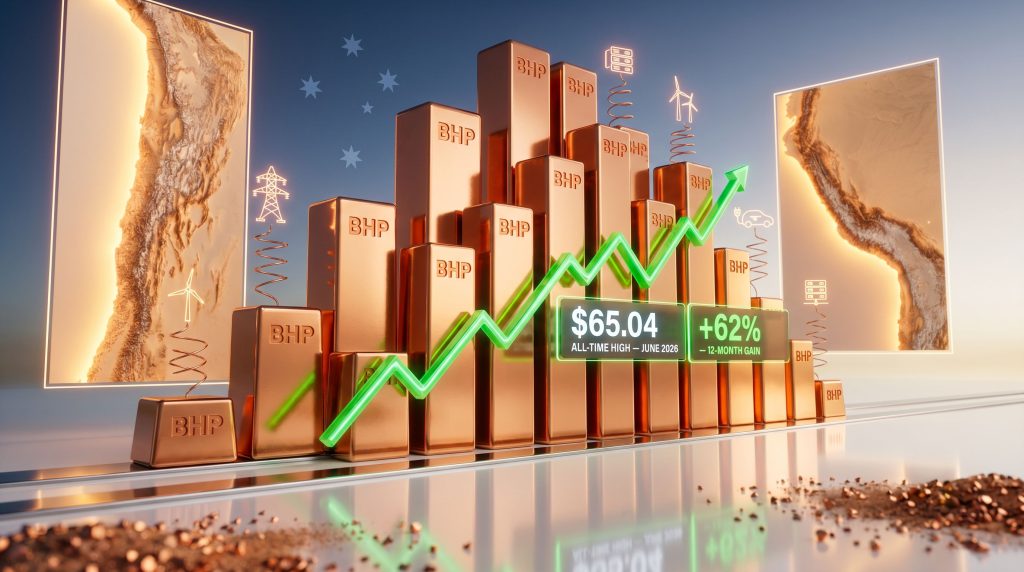
The BHP shares record high rally reached its peak on Wednesday, June 4, 2026, when the stock touched $65.04 on the ASX, before pulling back to $61.45 in subsequent trading. Even after that cooling-off period, the scale of the move remains extraordinary by any measure.
| Metric | Value |
|---|---|
| All-Time High (June 2026) | $65.04 |
| Share Price at Pullback | $61.45 |
| Year-to-Date Gain (2026) | ~35% |
| 12-Month Gain | ~62% |
| Market Capitalisation | ~A$312 billion |
| P/E Ratio | ~21.8x |
| Dividend Yield | ~3.2% |
| DZ Bank Price Target | $65.00 |
| FY26 Copper Production Guidance | 1.9 to 2.0 million tonnes |
A 62% gain over 12 months is not typical behaviour for a mega-cap miner. Resources companies of BHP's scale tend to deliver returns that track commodity cycles rather than compound like growth stocks. The magnitude of this re-rating signals that something more fundamental is being priced in by the market than simply a temporary commodity price uplift.
At its peak, BHP's A$312 billion market capitalisation briefly eclipsed Commonwealth Bank of Australia, making it the largest listed entity on the ASX. That is a threshold that carries significant institutional weight, as passive funds tracking ASX indices by weighting were forced to absorb BHP's expanding footprint automatically. Furthermore, BHP shares hitting a fresh all-time high has prompted analysts to question whether this is merely the beginning of a longer re-rating cycle.
Copper's Historic Ascent to the Top of BHP's Earnings Ledger
Perhaps the single most significant structural development embedded in this rally is the shift in BHP's earnings composition. For the first time in the company's corporate history, copper contributed more than half of group earnings during the most recent half-year reporting period, surpassing iron ore's share of profit for the first time ever.
This is not a cyclical fluctuation. It represents a permanent reorganisation of where BHP generates its economic value, and the market has begun to price the company accordingly.
The demand drivers behind copper's rise are well understood in aggregate but worth unpacking individually, because each operates on a different timeline and magnitude. Understanding the copper price growth drivers helps contextualise why BHP's strategic pivot has proven so timely:
- Electricity grid expansion: Aging grid infrastructure across Europe, North America, and parts of Asia requires substantial copper-intensive rebuilding and capacity additions.
- Data centre proliferation: AI-driven computing demands are triggering a wave of data centre construction globally. A single hyperscale data centre can require thousands of tonnes of copper for cabling, busbars, and cooling systems.
- Renewable energy infrastructure: Wind turbines, solar panels, and battery storage systems are substantially more copper-intensive per megawatt of capacity than fossil fuel equivalents. An offshore wind turbine requires roughly 4 to 8 tonnes of copper per megawatt of generating capacity.
- Electric vehicle adoption: A battery electric vehicle uses approximately 2.5 to 4 times the copper content of an internal combustion engine vehicle, across motors, wiring, and charging systems.
BHP's internal demand modelling projects global copper consumption rising from approximately 34 million tonnes per year today to more than 50 million tonnes by 2050, representing a structural uplift of nearly 50% in required annual supply. That gap between where demand is heading and where supply capacity currently sits forms the core of the long-term copper bull thesis.
Why Supply Cannot Simply Respond to Higher Prices
A critical but underappreciated feature of the copper market is the extreme difficulty of bringing new supply online quickly, regardless of how attractive prices become. Several structural constraints reinforce this dynamic, and the copper supply crunch is likely to intensify before it eases:
- Declining ore grades: Average copper ore grades have been falling globally for decades. Many currently operating mines are processing ore that contains less than 0.5% copper by weight, compared to grades of 1.5% to 2.0% that were common a generation ago. Lower grades mean more rock must be mined and processed per tonne of metal produced, driving up both energy intensity and unit operating costs.
- Development timeline length: From initial discovery to first commercial production, new copper mines typically require 10 to 20 years of exploration, permitting, feasibility, and construction work. Even with elevated copper prices providing strong investment incentives today, new supply from greenfield projects cannot materially address a near-term demand surge.
- Capital intensity escalation: The cost of building new copper capacity has increased substantially due to deeper ore bodies, water scarcity in key copper-producing regions such as the Atacama Desert in Chile, and tightening environmental and social approvals processes across Latin America, Africa, and Southeast Asia.
- Geopolitical concentration risk: Over 40% of global copper mine production is concentrated in Chile and Peru, both of which have experienced periods of regulatory uncertainty, community opposition, and political risk that can delay or curtail mine expansions.
These constraints create a market structure where price signals take far longer to generate supply responses than in most other industrial commodities, which structurally supports elevated copper prices over the medium term. In addition, major new copper projects such as Reko Diq demonstrate just how geopolitically complex and capital-intensive new supply development has become.
Iron Ore: A Shifted Role, Not an Exit
While copper now commands the spotlight in BHP's earnings narrative, iron ore remains a substantial revenue and cash flow contributor. The iron ore price trends show the spot price recently softening to approximately US$101.96 per tonne, retreating from earlier highs but remaining elevated by longer-term historical averages.
The more significant concern for BHP's iron ore earnings comes from the supply side rather than current pricing. Guinea's Simandou iron ore project, long regarded as one of the most consequential undeveloped iron ore deposits on the planet, is advancing toward production ramp-up. Simandou is estimated to hold reserves capable of producing over 100 million tonnes per annum at scale, representing a material structural addition to seaborne iron ore supply.
The key question for investors is not whether Simandou will eventually impact the iron ore price curve, but rather when and by how much. Infrastructure development for the project, including a lengthy railway corridor through Guinea's interior, has historically been the binding constraint on the project's timeline. Progress on that infrastructure is now moving more concretely than in previous years.
BHP's strategic pivot toward copper provides a natural earnings hedge against the possibility of sustained iron ore price softness. The diversification is no longer accidental. It is a deliberate architectural decision that the market is beginning to reward.
Valuation at the Record: Has the Easy Money Already Been Made?
After a 62% share price gain, the valuation conversation around BHP has shifted considerably. At a P/E ratio of approximately 21.8x, BHP is trading at a meaningful premium to the long-run average for major ASX resources companies, which have historically traded in a range of 12x to 16x earnings across a full commodity cycle. Consequently, understanding how commodity prices and miners interact at elevated multiples becomes increasingly important for investors.
Valuation Framework Comparison:
| Valuation Lens | Assessment |
|---|---|
| P/E Ratio (21.8x) | Above historical mining sector average; reflects a structural growth premium |
| Dividend Yield (3.2%) | Below typical resource sector yield; market pricing capital growth over income |
| DZ Bank Price Target ($65.00) | Marginally above post-pullback price; implies limited near-term upside |
| Market Cap (A$312B) | Rivals CBA; reflects a blue-chip re-rating beyond typical mining multiples |
| Copper Earnings Mix | First-time majority contributor; a structural re-rating catalyst |
Germany's DZ Bank recently upgraded BHP to a hold rating with a price target of $65.00. The nuance worth noting is that this target sits only modestly above the post-record pullback price of $61.45, suggesting the broker views the business favourably but sees the valuation as largely reflecting the known positives at current levels. However, BHP shares hit record high territory on the back of a first-half profit surge, reinforcing that earnings momentum has genuine fundamental support.
A dividend yield of 3.2% sits below the historical norms associated with large ASX resource companies, where yields of 4% to 6% have been more typical across previous cycles. This compression signals that the market has shifted its framing of BHP from a cyclical income play toward a growth and quality re-rating story, at least at current price levels.
Scenarios That Could Extend the Rally
- Copper prices sustaining above US$10,000 per tonne, which would meaningfully lift BHP's copper division earnings
- Iron ore stabilisation or a recovery toward US$110 per tonne driven by Chinese infrastructure stimulus
- Additional production upgrades at Escondida or Antamina pushing FY26 copper output toward or above the top of guidance
- Stronger-than-expected progress on BHP's potash ambitions through the Jansen project in Canada, which adds a third long-term growth pillar
- Capital return announcements, including special dividends or buybacks, leveraging strong free cash flow generation
Scenarios That Could Crack the Rally
- A sharper-than-expected Simandou ramp-up accelerating iron ore price declines
- A speculative unwind in copper futures markets, where positioning has at times run ahead of physical demand fundamentals
- Broader ASX or global equity market risk-off rotations, particularly given BHP's elevated weighting in passive fund portfolios
- Chinese property sector weakness persisting longer than consensus expectations, dampening both iron ore and copper demand simultaneously
- Labour disruptions or operational challenges at Escondida, which has historically been vulnerable to union-related stoppages
BHP's Strategic Architecture: Beyond the Two-Commodity Narrative
The most sophisticated way to understand BHP's current position is not simply as a copper-and-iron ore company, but as a business that has deliberately engineered a portfolio aligned with the three most structurally significant commodity demand themes of the next three decades: green electrification metals, food security, and industrial infrastructure.
The Jansen potash project in Saskatchewan, Canada, adds exposure to global agricultural demand growth and long-term food security themes that operate entirely independently of industrial commodity cycles. This third leg of BHP's portfolio is still early in its development but represents a meaningful source of future earnings diversification.
BHP vs. ASX Peers: Strategic Positioning Compared
| Company | Primary Commodity | Key Differentiator | Strategic Transition Status |
|---|---|---|---|
| BHP (ASX: BHP) | Copper + Iron Ore | Copper now majority earner | Advanced copper pivot underway |
| Rio Tinto (ASX: RIO) | Iron Ore + Aluminium | Lithium (Rincon) + copper pipeline | Early-stage diversification |
| South32 (ASX: S32) | Base metals | Manganese and aluminium focus | Ongoing portfolio restructuring |
| Mineral Resources (ASX: MIN) | Lithium + Iron Ore | Cost-reduction focus | Active restructuring phase |
BHP's Escondida mine in Chile remains the single most important asset in the copper portfolio. As the world's largest copper mine by annual production volume, Escondida provides BHP with substantial operating leverage to copper price movements. Importantly, it also provides a cost base that most greenfield copper developers cannot match, even at lower ore grades than operated historically.
Antamina in Peru adds geographic diversification and polymetallic production complexity, as the mine also produces significant zinc and molybdenum alongside copper, providing partial natural hedging across the base metals complex.
The next major ASX story will hit our subscribers first
Key Considerations for ASX Investors Assessing BHP Now
The BHP shares record high rally raises a genuinely complex question for investors approaching the stock today versus those who participated in the rally from its earlier stages. Several frameworks are worth holding in mind simultaneously:
- The structural re-rating thesis remains intact. Copper as majority earnings contributor is not a temporary condition. It reflects capital allocation decisions made years ago beginning to deliver financial results, and those results are likely to compound further as demand grows.
- The entry price matters more now than it did 12 months ago. At 21.8x earnings with a 3.2% yield, BHP is priced for continued delivery. Any operational disappointment, commodity price reversal, or macro deterioration carries more downside risk than it did when the stock was trading at deeply discounted multiples.
- Iron ore remains a swing factor. Investors should not underestimate the earnings sensitivity to iron ore price movements, even as copper's relative contribution has grown. A sustained move below US$90 per tonne in iron ore would materially affect near-term free cash flow generation.
- For income-focused investors, the current yield profile makes BHP less compelling than it has been in previous cycles. Those constructing high-yield dividend portfolios may find better risk-adjusted income elsewhere in the ASX resources sector at current prices.
- The long-term copper demand runway stretching toward 2050 provides a credible multi-year earnings growth thesis that is difficult to replicate across most other large-cap ASX equities.
This article is intended for general informational purposes only and does not constitute personal financial advice. Past share price performance is not indicative of future returns. Investors should consider their own financial circumstances and, where appropriate, seek independent professional advice before making investment decisions.
Want to Identify the Next Major Copper or Mineral Discovery Before the Market Does?
Discovery Alert's proprietary Discovery IQ model scans ASX announcements in real time, instantly converting complex mineral data across more than 30 commodities into clear, actionable insights — the same kind of structural opportunity that has historically driven extraordinary returns, as showcased on Discovery Alert's dedicated discoveries page. Begin your 14-day free trial at Discovery Alert today and position yourself ahead of the market before the next significant mineral discovery is announced.