
July 13, 2026
Africa's Rail Deficit and the Race to Rewire the Copperbelt
For decades, the fundamental bottleneck limiting the economic potential of Central Africa's mineral wealth has not been geology. The ore is there, in extraordinary abundance. The constraint has been steel and sleepers: the chronic absence of reliable, high-capacity rail infrastructure connecting landlocked mining districts to ocean ports. Across the Copperbelt, where some of the world's richest copper and cobalt deposits sit beneath the red laterite soils of the Democratic Republic of Congo and Zambia, producers have long operated at a structural disadvantage that no amount of geological fortune could fully overcome.
That disadvantage is now being addressed at a scale that would have seemed improbable a decade ago. The Congo Mota-Engil Lobito Corridor rail link represents the most ambitious logistics intervention in the African mining sector in a generation, and its implications extend well beyond transport economics into the contested terrain of great-power competition over the raw materials underpinning the global energy transition.
When big ASX news breaks, our subscribers know first
The Logistics Penalty: What Inadequate Rail Has Cost Copperbelt Producers
Mining economics are ruthlessly sensitive to transport costs. Unlike precious metals, where high value-to-weight ratios make air freight plausible, bulk copper and cobalt concentrates require high-volume, low-cost movement to remain competitive. The DRC's existing road-heavy export model has imposed a sustained penalty on producers, with trucking routes through Zambia to South African ports adding thousands of kilometres and significant cost compared to a direct Atlantic corridor.
The consequences of this infrastructure gap have been layered:
- Ore grade thresholds are set artificially high, as lower-grade deposits that would be economically viable with efficient rail access cannot be profitably processed given elevated freight costs
- Working capital cycles lengthen, as slower transport increases the time between production and receipt of payment
- Carbon intensity rises, as diesel trucking across poorly maintained road networks carries a significantly higher emissions profile than electrified rail
- Supply chain reliability suffers, as road transport is more vulnerable to seasonal disruptions, border delays, and security incidents
The DRC's paradox is stark: it holds approximately 70% of the world's cobalt reserves and ranks as the globe's second-largest copper producer, yet its export infrastructure has historically resembled that of a nation with a fraction of its mineral endowment. Furthermore, global cobalt production patterns continue to be shaped heavily by how efficiently these resources can reach international markets.
What the Lobito Corridor Actually Is: A Technical Breakdown
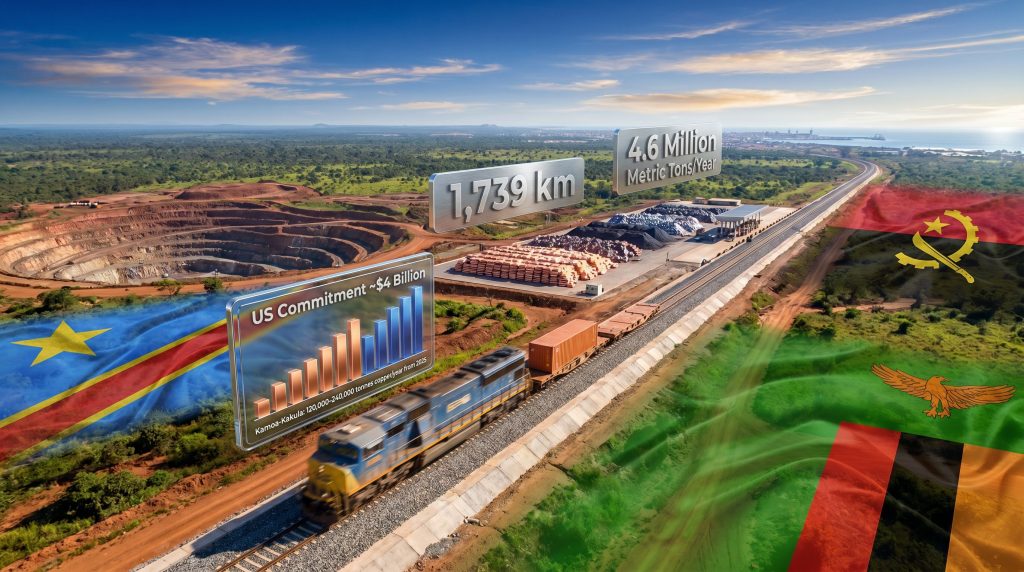
The Lobito Corridor is a transcontinental rail system anchored at the Port of Lobito on Angola's Atlantic coast and designed to penetrate deep into the copper-producing heartland of Central Africa. Its operational and planned components span three countries and represent both rehabilitation of existing colonial-era infrastructure and construction of entirely new greenfield rail.
| Parameter | Detail |
|---|---|
| Total Corridor Length | Up to 1,739 km (Lobito to Kolwezi, DRC) |
| Angola Section (Operational) | ~1,300 km, Lobito to Luau border crossing |
| Phase 2 Greenfield Extension | ~800 km, Luacano (Angola) to Chingola (Zambia) |
| DRC Rehabilitation Scope | Kolwezi, Tenke, and Lubumbashi mining hub network |
| Concession Term | 30-year operating agreement (under negotiation) |
| Phase 2 Construction Start | February 2026 |
| Target Operational Window | First sections: 2028 to 2029 |
The Angolan section, operated by the Lobito Atlantic Railway consortium, is already functional. That consortium is led by Mota-Engil, the Portuguese engineering and construction firm, alongside commodity trading house Trafigura Group and rail operations specialist Vecturis. The critical extension into the DRC, covering the rehabilitation of deteriorated track connecting Kolwezi, Tenke, and Lubumbashi, is what the July 2026 DRC cabinet decision has now formally set in motion.
Open Access Architecture: Why the Corridor's Commercial Model Matters
A frequently overlooked feature of the Lobito Corridor's design is its open-access framework. Rather than being reserved exclusively for a single operator or offtake partner, the corridor is structured to allow multiple mining companies to purchase haulage capacity. This design principle has significant implications: it reduces the risk of corridor economics being captured by one dominant producer and creates incentives for broader investment in the surrounding mineral districts.
Open access also means that the infrastructure investment can aggregate volume from numerous smaller operations that could not individually justify a private rail solution, effectively lowering the viability threshold for a wider range of projects across the Copperbelt.
The DRC Cabinet Decision: What July 2026 Actually Authorised
On July 10, 2026, the DRC government endorsed a public-private partnership framework with Mota-Engil for the complete rehabilitation and operation of the Congolese rail network connecting the country's primary copper and cobalt mining districts to the Angolan border crossing at Luau. The announcement was read from cabinet meeting minutes on state television, confirming governmental endorsement of the arrangement.
The contract itself remains under finalisation. Negotiations are focused on a 30-year operating concession that would give Mota-Engil long-duration responsibility for maintaining and running infrastructure that passes through the three central mining hubs. The firm's existing consortium on the Angolan side already holds a track access agreement with Congo's state rail company, which provides a degree of cross-border operational continuity that competitors would struggle to replicate quickly.
The US International Development Finance Corporation (DFC) had already signalled its financial intent in December 2025, issuing a letter of interest for up to $1 billion to support Mota-Engil's rehabilitation and management role in the DRC. This financial positioning reflects Washington's broader strategic calculus around securing Western-aligned supply chains in Central Africa, and it directly connects to the broader surge in critical minerals demand driven by the global energy transition.
The Full Capital Stack: Breaking Down a $6 Billion Infrastructure Commitment
The Lobito Corridor's financing architecture is one of the most complex in contemporary African infrastructure development, drawing on multilateral institutions, bilateral government commitments, and private capital.
| Funding Source | Commitment |
|---|---|
| Total Corridor Investment (All Phases) | ~$6 billion |
| US Government Commitment (Total) | ~$4 billion |
| Biden Administration Initial Pledge (Dec 2023) | $600 million |
| Mota-Engil Angola Commitment | $455 million |
| Mota-Engil DRC Commitment | Up to $100 million |
| DFC Letter of Interest (DRC rail) | Up to $1 billion |
| China's Competing Zambia–Tanzania Rail Upgrade | $1.4 billion |
The G7's Partnership for Global Infrastructure and Investment (PGII) framework provides the multilateral scaffolding through which US commitments have been coordinated. The African Development Bank and Africa Finance Corporation have also been identified as regional co-investors, providing institutional legitimacy and local financial architecture that strengthens the project's long-term governance foundations. In addition, trends in African mining finance suggest increasing appetite from multilateral institutions for large-scale corridor investments of precisely this type.
Transport Economics: How Lower Freight Costs Reshape Mine Feasibility
The most immediate commercial consequence of an operational Lobito Corridor is a material reduction in per-tonne freight costs for Copperbelt producers. Analysts tracking the corridor have pointed to potential reductions in the range of 30% compared to existing road-based routes, driven by the inherent efficiency advantages of rail over trucking for bulk mineral movement at scale.
Significant reductions in per-tonne transport costs do not merely improve margins on existing production. They expand the economically viable ore grade envelope, effectively enlarging the investable resource base across the broader Copperbelt region.
This point deserves emphasis for investors and analysts evaluating the corridor's second-order effects. When freight costs fall substantially, deposits that were previously sub-economic at prevailing cut-off grades become viable. This dynamic can meaningfully expand reserve estimates across the region without a single new exploration discovery, simply by changing the economics of extraction and export for existing resource inventories.
Capacity targets reflect the ambition of the project:
| Milestone | Target |
|---|---|
| Near-Term Capacity Goal | 1 million tonnes per year before 2030 |
| Long-Term Capacity Goal | 4.6 million tonnes per year |
| Kamoa-Kakula Offtake Agreement | 120,000 to 240,000 tonnes copper per year from 2025 |
| KoBold Metals Commitment | ~300,000 tonnes |
The Kamoa-Kakula offtake commitment is particularly instructive. Africa's largest copper mine by resource size has already aligned its export strategy with the Lobito Corridor, providing an anchor volume that de-risks the infrastructure's early operational phase. KoBold Metals, the AI-driven exploration company backed by significant private capital, has also committed substantial volume, signalling that the corridor is already attracting forward-looking producers who see rail access as central to their development models.
The next major ASX story will hit our subscribers first
Geopolitical Architecture: The US-China Dimension
The Lobito Corridor cannot be understood purely as an infrastructure project. It is simultaneously a geopolitical instrument in the contest between Western powers and China for preferential positioning in Central Africa's critical mineral supply chains. The intensifying Congo cobalt rivalry between Washington and Beijing gives the corridor an outsized strategic significance beyond its freight economics alone.
China's commercial footprint in the DRC's mining sector is dominant. CMOC Group and Zijin Mining currently account for the majority of the DRC's copper and cobalt production, having secured those positions through years of direct investment and, in CMOC's case, the acquisition of assets from Western majors. This commercial dominance gives Beijing leverage over the upstream supply of materials that are essential to electric vehicle batteries, power infrastructure, and defence applications.
Washington's response has been to compete on infrastructure rather than directly on mine ownership. A US-DRC minerals agreement signed in December 2024 grants American investors preferential access to deposits of copper, cobalt, lithium, and tantalum, with the agreement explicitly recognising the strategic importance of the Congo Mota-Engil Lobito Corridor rail link to that framework.
Simultaneously, China is advancing a $1.4 billion upgrade of the TAZARA railway connecting Zambia to the Tanzanian port of Dar es Salaam on the Indian Ocean. This competing corridor would provide an alternative export route aligned with Chinese logistics infrastructure, giving Beijing the ability to influence the direction of mineral flows from Africa's second-largest copper producer.
The competitive dynamic is direct and consequential:
- Western-aligned Atlantic route via Lobito offers shorter ocean transit to European and North American markets
- Chinese-aligned Indian Ocean route via Dar es Salaam provides an alternative export pathway under Beijing-influenced logistics control
- Whichever corridor achieves scale first is likely to capture the structural loyalty of regional producers through long-term offtake and freight agreements
This execution speed variable explains why the Trump administration's active support for Mota-Engil's DRC bid carries strategic significance beyond any single infrastructure contract.
Mota-Engil's Unique Position: Why This Firm Won the Concession
Mota-Engil's competitive advantage in securing the DRC concession rests on a combination of factors that would be difficult for any rival to replicate quickly. Its existing operational role in the Lobito Atlantic Railway consortium on the Angolan side creates cross-border continuity that a new entrant would require years to establish. The firm's track access agreement with Congo's state rail company provides an existing legal and operational relationship with the DRC counterpart.
The company's broader African footprint spans engineering, industrial, and mining projects across 20 countries, providing both the operational experience and the institutional relationships that large-scale infrastructure concessions in complex frontier markets require. Consequently, Mota-Engil's portfolio on the Lobito Corridor underscores just how deeply embedded the firm already is within the corridor's operational framework.
One structural complexity deserves attention: China Communications Construction Co. holds a 31% stake in Mota-Engil. This means a Chinese state-linked entity is a significant shareholder in the primary vehicle through which Washington is attempting to build a Western-aligned supply chain corridor. The governance implications of this ownership structure for future decision-making, particularly if US-China tensions escalate, represent a genuine risk factor that has received insufficient analytical attention.
Mota-Engil's other recent DRC commitment reinforces its strategic depth in the country. The firm secured a €230 million contract from DP World to lead development of the DRC's first deep-water port, creating a complementary logistics footprint that extends from inland rail to coastal port infrastructure.
The Zambia Extension: From Bilateral to Transcontinental
Phase 2 of the Lobito Corridor involves constructing approximately 800 km of greenfield rail linking Luacano in Angola to Chingola in Zambia. This extension transforms the corridor from a DRC-specific export solution into a genuinely transcontinental network serving both of Africa's largest copper-producing nations. Moreover, shifts in global copper supply dynamics make this Zambian extension increasingly critical to Western procurement strategies.
Construction is scheduled to begin in February 2026, with initial sections targeting operational status between 2028 and 2029. Greenfield African rail construction carries inherent execution risk: terrain challenges, supply chain logistics for construction materials, community engagement requirements, and the complexity of managing cross-border regulatory frameworks across three sovereign nations all introduce timeline variability.
The strategic prize, however, is substantial. Zambia produced approximately 763,000 tonnes of copper in 2023 according to government data, and is actively pursuing expansion toward the 3 million tonne annual target that has long been a stated national ambition. Connecting Zambian production centres directly to the Lobito Atlantic port system would give Western buyers reliable, diversified access to Copperbelt copper from two sources through a single coordinated logistics network.
Three Scenarios for Corridor Impact Over the Next Decade
Scenario 1: Accelerated Build-Out (Base Case Optimistic)
Full corridor capacity approaches the 4.6 million tonne annual target by 2030. Western supply chains consolidate around the Atlantic route. Ore grade viability thresholds across the DRC and Zambia fall materially, unlocking previously marginal deposits. Cobalt supply security for Western battery manufacturers improves meaningfully.
Scenario 2: Moderate Progress (Base Case Realistic)
Partial DRC rehabilitation delivers the 1 million tonne near-term target before 2030, but the Zambia greenfield extension faces delays into the early 2030s. Incremental freight cost reductions benefit major producers but do not yet shift the economics for smaller operators. The corridor functions but operates below its transformational potential.
Scenario 3: Structural Disruption (Tail Risk)
Governance friction between the DRC state rail company and the private concession operator, security incidents in eastern DRC, financing shortfalls as multilateral institutions face competing priorities, or escalating US-China tensions that complicate Mota-Engil's mixed-ownership structure introduce significant delays. The corridor's timeline extends materially, ceding competitive ground to China's Indian Ocean alternative.
The Congo Mota-Engil Lobito Corridor rail link represents one of the most consequential pieces of mining-related infrastructure under active development globally. Its completion timeline, financing execution, and geopolitical durability will directly influence the cost structure and supply security of copper and cobalt markets well into the 2030s.
Frequently Asked Questions
What is the Lobito Corridor and why is it strategically important?
The Lobito Corridor is a transcontinental rail system connecting Angola's Port of Lobito to the copper and cobalt mining districts of the DRC and Zambia. Its strategic importance derives from its potential to reduce freight costs for critical minerals, diversify Western supply chains away from Chinese-dominated logistics networks, and unlock previously uneconomical mineral deposits across the Central African Copperbelt.
How much has the United States committed to the Lobito Corridor?
Total US government financial commitment to the corridor stands at approximately $4 billion across various instruments, including a $600 million initial pledge during the Biden administration and a DFC letter of interest for up to $1 billion specifically directed at Mota-Engil's DRC rehabilitation role.
What is the 30-year concession and what does it cover?
Mota-Engil and the DRC government are negotiating a three-decade operating agreement giving the Portuguese firm responsibility for renovating and running the rail network passing through Kolwezi, Tenke, and Lubumbashi. The concession covers both the rehabilitation of deteriorated infrastructure and its ongoing operation as a commercial freight corridor.
How does the Lobito Corridor compare to China's competing rail infrastructure?
The Lobito Corridor provides an Atlantic Ocean export route approximately suited to European and North American market access. China's $1.4 billion upgrade of the TAZARA railway offers an Indian Ocean alternative via Dar es Salaam. The two corridors compete for the long-term freight loyalty of Copperbelt producers, with execution speed a critical determinant of which network captures dominant market position.
Key Takeaways for Critical Mineral Market Participants
-
The DRC cabinet's July 2026 endorsement of the Mota-Engil public-private partnership marks the transition from planning to execution for the corridor's most strategically sensitive segment
-
A potential 30-year operating concession positions Mota-Engil as a long-duration infrastructure anchor across the Central African Copperbelt with compounding competitive advantages
-
Capacity targets of 4.6 million metric tonnes annually represent a structural uplift that could materially alter the landed cost of DRC copper and cobalt in Western markets
-
The open-access framework could expand the economically viable resource base across the region by lowering per-tonne freight costs below critical grade thresholds for previously marginal deposits
-
China Communications Construction Co.'s 31% stake in Mota-Engil introduces a governance complexity that warrants close monitoring as geopolitical tensions around critical mineral supply chains intensify
-
The parallel advancement of China's Indian Ocean rail corridor makes execution speed the decisive strategic variable for Western-aligned supply chain positioning in the African Copperbelt
Disclaimer: This article contains forward-looking statements, scenario projections, and analytical commentary regarding infrastructure timelines, capacity targets, and market impacts. These projections involve significant uncertainty and should not be construed as financial advice or investment recommendations. Actual outcomes will depend on financing execution, geopolitical developments, regulatory approvals, and construction timelines that remain subject to material change.
Want to Track the Next Major Mineral Discovery Before the Market Moves?
The Lobito Corridor's potential to unlock previously marginal copper and cobalt deposits across the Central African Copperbelt signals a significant shift in critical mineral supply chains — and Discovery Alert's proprietary Discovery IQ model ensures subscribers receive real-time alerts the moment significant ASX mineral discoveries are announced, turning complex commodity data into actionable investment insights. Explore historic discoveries and their remarkable returns to understand what early positioning can mean, then begin a 14-day free trial at Discovery Alert to secure your market-leading edge.