July 13, 2026
Why Domestic Copper Production Is Becoming America's Most Urgent Industrial Priority
The global copper supply chain has quietly become one of the most strategically exposed systems in the modern industrial economy. Unlike oil, which benefits from a deep network of domestic producers and strategic reserves, refined copper production in the United States represents only a fraction of national consumption. That structural gap has grown more visible as demand accelerates across data centre construction, defence manufacturing, electric grid modernisation, and clean energy deployment. Understanding how individual development-stage projects fit into this macro picture is essential for investors and industry observers trying to assess where domestic supply capacity will actually come from.
The Gunnison Copper project in Arizona sits at the intersection of all these forces. With a resource base exceeding 831 million tonnes, an adjacent operating mine already delivering copper cathode to one of the world's largest technology companies, and a capital structure undergoing rapid institutional maturation, Gunnison Copper Corp. represents one of the most substantive domestic copper development narratives currently in progress on the continent.
When big ASX news breaks, our subscribers know first
The U.S. Copper Supply Gap: Scale, Context, and Consequences
How Dependent Is America on Foreign Copper Processing?
The United States consumes significantly more refined copper than it produces domestically. The gap is filled primarily through imports, including refined metal sourced from processing facilities concentrated in Asia and South America. This arrangement creates a structural vulnerability that has drawn increasing attention from policymakers, defence procurement officials, and industrial planners.
Copper's role in the modern economy is not incidental. Furthermore, the copper supply crunch is intensifying across critical infrastructure categories. Consider its presence in:
- Data centres: server racks, cooling systems, power distribution, and networking hardware are copper-intensive at every layer
- Defence manufacturing: precision electronics, radar systems, munitions, and naval vessels all depend on high-purity refined copper
- Energy transition: electric vehicle motors, grid-scale battery systems, solar panel wiring, and wind turbine generators require substantially more copper per unit than the fossil-fuel systems they replace
- Telecommunications: fibre network infrastructure, 5G tower components, and satellite ground stations all rely on refined copper
Washington has responded to this reality by elevating copper to critical mineral status. However, it is important to note that policy classification alone does not translate directly into project-level support or funding. What the classification does create is a regulatory and political environment in which domestic copper projects receive heightened attention from multiple federal agencies simultaneously. The broader US critical minerals strategy reflects just how seriously policymakers are taking this structural exposure.
Arizona's Position in North American Copper Development
Arizona has been the backbone of American copper production for more than a century. The state's geology is defined by a Laramide-age porphyry copper belt that runs through southeastern and central Arizona, producing some of the largest and longest-lived copper deposits on the continent. Cochise County, in the state's southeastern corner, sits within this productive geological corridor.
Unlike copper projects located near major population centres, where community opposition and litigation risk can significantly extend permitting timelines, Cochise County offers a business-friendly regulatory environment with an established history of mining employment. The county's administration has maintained productive relationships with operating mining companies for decades, reducing the political friction that has derailed or delayed comparable projects elsewhere.
The Gunnison project's location, approximately 99 to 105 kilometres from Tucson and accessible via the Interstate 10 corridor, provides meaningful logistical advantages for bulk material transport. It also remains sufficiently remote to limit the community opposition dynamics that have complicated permitting for projects situated closer to urban centres.
Project Fundamentals: Resource Scale and Processing Architecture
Core Mineral Resource Statistics
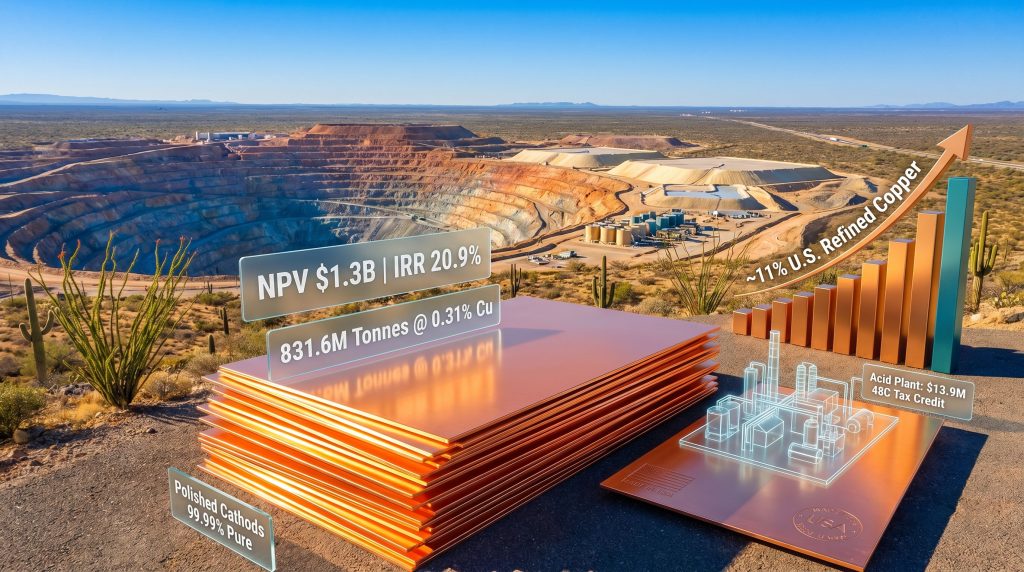
The scale of the Gunnison resource base is one of its most defining characteristics. The deposit's oxide-dominant composition is commercially significant because oxide copper responds directly to conventional heap-leach and solvent extraction/electrowinning (SX/EW) processing, producing finished copper cathode entirely within the United States without requiring offshore concentrate smelting.
| Metric | Detail |
|---|---|
| Total Mineral Resource | 831.6+ million tonnes |
| Average Copper Grade | 0.31% Cu |
| Higher-Grade Component | 191.3 million tonnes @ 0.37% Cu |
| Lower-Grade Component | 640.2 million tonnes @ 0.29% Cu |
| Primary Deposit Type | Copper oxide with molybdenum by-product |
| Location | Little Dragoon Mountains, Cochise County, Arizona |
| Distance from Tucson | ~99 to 105 km |
An 831-million-tonne oxide copper resource is a genuinely rare asset class in North American copper development. The higher-grade component, comprising roughly 191 million tonnes at 0.37% copper, provides a foundation for prioritising higher-return ore in the early years of production. Consequently, the broader lower-grade envelope supports long-duration mine life extension.
Molybdenum, present as a secondary by-product, adds a meaningful secondary revenue stream. It is used primarily in high-strength steel alloys and in catalysts for oil refining, meaning its demand profile is relatively independent of copper price cycles, providing some natural revenue diversification.
From In-Situ Recovery to Open-Pit Heap Leach: A Fundamental Pivot
The Gunnison project's development history includes an important inflection point that prospective investors need to understand clearly. The predecessor company, Excelsior Mining, originally developed the deposit using in-situ recovery (ISR) technology, which involves injecting a leaching solution directly into the ore body underground and recovering the copper-laden solution through extraction wells. The first copper cathode was produced using this method in December 2020.
However, ISR operations at Gunnison encountered persistent technical challenges related to carbon dioxide flow-rate constraints that limited solution circulation through the ore body. These constraints reduced throughput below commercially viable thresholds and could not be resolved within the original operational design. By 2022, the ISR operation had been suspended.
The 2024 decision to pivot toward conventional open-pit, heap-leach, and SX/EW processing was not simply a technical adjustment. It fundamentally redefined the project's economic footprint. In addition, the copper leaching process employed here is a mature, globally proven methodology. The pivot redefined the project in several important ways:
- Resource envelope expansion: open-pit mining can access the full three-dimensional ore body, not just zones accessible to ISR wellfields
- Production rate scalability: heap-leach systems can be sized to support production targets up to 100,000 metric tonnes of copper per year
- Processing certainty: heap-leach and SX/EW are mature, globally proven technologies with well-understood capital and operating cost profiles
- Permitting pathway: transitioning from ISR to open-pit requires permit amendments to existing operational permits, not entirely new permit applications, which is a materially different and faster regulatory process
"The distinction between a new permit application and a permit amendment to an existing operational permit is not merely procedural. It reflects a fundamentally different relationship between the project and the relevant regulatory agencies, one built on years of established engagement, compliance history, and operational data."
Preliminary Economic Assessment: What the November 2024 Numbers Reveal
PEA Headline Metrics
The November 2024 Preliminary Economic Assessment (PEA) established the economic framework for the open-pit development scenario. It is important to understand that a PEA represents a conceptual-level study with inherent uncertainties. The upcoming definitive feasibility study process — beginning with the Preliminary Feasibility Study (PFS) — is expected to refine and potentially expand these figures.
| PEA Metric | Value |
|---|---|
| Study Release | November 2024 |
| Mine Life | 18 years |
| NPV at 8% Discount Rate | USD $1.3 billion |
| Internal Rate of Return | 20.9% |
| Payback Period | 4.1 years |
| Total Capital Cost | ~USD $1.6 billion |
| Capital Intensity (with acid plant) | ~$17,000 per tonne of capacity |
| Capital Intensity (without acid plant) | ~$14,000 per tonne of capacity |
A capital intensity of approximately $14,000 to $17,000 per tonne of annual copper production capacity places Gunnison in approximately the second quartile globally among copper development projects. For institutional investors comparing development-stage copper assets, capital intensity per tonne of production capacity is a key screening metric because it speaks directly to the capital efficiency of converting ore in the ground into refined metal at the gate.
The target production rate of up to 100,000 metric tonnes per year over a 20-year mine life represents a scale that, if achieved, would account for approximately 10 to 11% of current U.S. refined copper production capacity. That is a structural contribution to domestic supply, not a marginal increment.
The Acid Plant: A Strategic Infrastructure Component Often Overlooked
Perhaps the least understood but most strategically significant component of the Gunnison capital plan is the integrated sulfuric acid production facility, which accounts for approximately $300 million of the $1.6 billion total capital estimate.
Sulfuric acid is the chemical workhorse of copper oxide heap-leach operations. Without a reliable, cost-competitive acid supply, heap-leach processing economics deteriorate rapidly. The United States currently faces a structural domestic acid supply deficit, and China's export restrictions on sulfuric acid have disrupted global markets, creating supply anxiety for projects that depend on third-party acid procurement.
Gunnison's approach addresses this vulnerability directly:
- Feedstock sourcing: the plant is designed to consume elemental sulfur, a by-product of U.S. oil and gas processing, available domestically from sources including West Texas production facilities
- Conversion efficiency: every tonne of sulfur purchased can be converted into approximately three tonnes of sulfuric acid, creating significant freight cost leverage
- Self-sufficiency: the plant eliminates dependence on foreign acid supply chains, a material operational risk reduction
- Third-party revenue: excess acid production capacity can be sold to neighbouring copper operations or other industrial users, creating a secondary revenue stream
- Broader market relevance: the defence sector, lithium processing industry, and agricultural fertiliser producers are all significant acid consumers, providing multiple potential offtake relationships
"The integrated acid plant transforms Gunnison from a copper producer that requires acid supply into a copper producer that generates acid supply. That inversion of the supply chain dependency is commercially and strategically significant in the current environment."
The Johnson Camp Mine: America's Newest Copper Producer
Production Milestone and Strategic Rationale
Located approximately one mile from the main Gunnison deposit, the Johnson Camp Mine (JCM) has operated intermittently since the 1970s. Its restart was not simply a cash-flow exercise; it serves as a proof-of-concept facility, a permitting precedent, and a commercial demonstration platform for novel processing technology.
JCM achieved its first copper cathode production milestone in late August 2025, built within 18 months from final investment decision to first production. At full capacity, the mine is designed to produce up to 25 million pounds of copper cathode annually.
The Nuton Sulfide Leach Technology: A Potential Game-Changer for U.S. Copper
Conventional copper sulfide ore processing follows a well-established but geopolitically exposed pathway: ore is crushed, ground, and processed through flotation to produce a copper concentrate, which is then shipped offshore — predominantly to Asian smelters — for conversion into refined metal. This process generates significant emissions, requires large tailings storage facilities, and concentrates control of U.S. mineral output in foreign processing infrastructure.
Nuton LLC, Rio Tinto's sulfide leach technology venture, is demonstrating an alternative at Johnson Camp. The Nuton approach applies heap-leach and SX/EW methodology to copper sulfide ores — materials previously considered unsuitable for leach processing. If the technology performs commercially at scale, the implications are substantial:
- Future U.S. sulfide copper projects could produce finished copper cathode domestically, bypassing offshore smelting entirely
- Tailings dam requirements are reduced compared to flotation-based processing
- Emissions associated with smelting are eliminated from the domestic processing footprint
- Supply chain control remains within the United States from mine to market
JCM is currently serving as the live commercial demonstration of this technology, with production data accumulating in real time since late 2025.
Amazon Web Services as Offtake Customer
The copper cathode produced at JCM is being sold to Amazon Web Services (AWS) for use in data centre construction. This relationship carries significance beyond the commercial terms of a single offtake agreement. Technology companies building AI infrastructure at scale are increasingly focused on supply chain traceability and domestic sourcing. An AWS offtake arrangement signals that technology-sector buyers are actively seeking partnerships with domestic copper producers, and that JCM's output meets the quality and provenance standards required for that relationship.
Tax Credits, Government Funding, and Capital Formation Strategy
Section 48C Advanced Energy Tax Credit
Under the U.S. Department of Energy's advanced energy tax credit framework, Gunnison Copper received an allocation of USD $13.9 million in Section 48C tax credits, with the company noted as the only copper project in 2025 to receive such an allocation. The application was supported by the project's status as a domestic critical mineral production facility demonstrating novel processing technology through the Nuton sulfide leach programme. Certification requirements have since been submitted to the Department of Energy.
Arizona State Incentives and Federal Agency Engagement
At the state level, the Arizona Commerce Authority's Qualified Facility Tax Credit (QFTC) programme represents an additional non-dilutive capital source currently pending audit confirmation. Approximately 80 new jobs have been created at JCM, a figure relevant to state-level employment incentive calculations.
At the federal level, discussions with multiple Washington agencies are ongoing regarding critical mineral project financing facilities. A notable characteristic of the current federal posture is that minimum deployment thresholds under discussion are in the range of $1 billion per qualifying project, suggesting that a project of Gunnison's scale is appropriately sized to participate in these programmes if and when they are formalised. It should be noted that no formal government funding commitment has been confirmed at this stage.
"Policy frameworks and federal agency interest do not constitute confirmed funding commitments. Investors should treat government financing discussions as potential catalysts rather than secured capital until formal agreements are announced."
The next major ASX story will hit our subscribers first
Capital Structure: A Balance Sheet Transformation Story
From Distressed Predecessor to Institutional-Grade Platform
The evolution of Gunnison Copper's balance sheet over the past two years is one of the more striking capital structure turnarounds in the junior mining sector. The company inherited a challenged financial position from its predecessor, including secured debt obligations and outstanding convertible debentures that created uncertainty for institutional investors.
| Balance Sheet Metric | 2024 Position | 2026 Position |
|---|---|---|
| Market Capitalisation | ~CAD $30 million | ~CAD $200 million+ |
| Average Daily Trading Volume | ~50,000 shares/day | ~3 million shares/day |
| Institutional Ownership | 0% | ~60% (40 to 50 institutions) |
| Secured Debt | USD $15 million (due 2026) | Fully retired January 2026 |
| Convertible Debentures | Outstanding | Settled at 54% discount to equity raise price |
| Net Value Created (debenture settlement) | n/a | ~USD $5 million in shareholder value |
The secured debt retirement in January 2026 removed a significant overhang that had made institutions cautious about entering the stock. Equally important was the settlement of convertible debentures, where equity raised at CAD $0.42 per share was used to retire debenture obligations at approximately CAD $0.20, creating approximately USD $5 million in net shareholder value through the discount captured.
The $200 million base shelf prospectus should be understood as a maturity signal rather than a dilution signal. Qualifying for a base shelf prospectus requires meeting specific financial reporting and market capitalisation thresholds that many junior companies cannot satisfy. Its existence confirms institutional-grade compliance infrastructure, not an imminent intention to issue equity.
The 2026 Bought Deal: Oversubscription as a Confidence Indicator
The 2026 bought deal financing provides a useful data point on institutional sentiment. The company sought CAD $30 million and received CAD $51 million in orders, ultimately accepting CAD $34.5 million to maintain valuation discipline. An oversubscribed bought deal managed through Canaccord Genuity, with approximately 40 to 50 institutions participating, represents a qualitatively different investor profile from the retail-dominated capital raises of 2025.
Proceeds of USD $15 to $20 million are being directed toward the current drilling and metallurgical testing programme, with specific objectives including:
- Resource expansion targeting a minimum of 1.2 billion additional pounds of copper
- Scaling metallurgical column leach tests from 25 (PEA-level) to 270 (more than ten times the data density)
- Supporting the PFS with substantially higher-confidence recovery and acid consumption data
For context, a USD $5 million drilling programme in 2025 added approximately 500 million pounds of copper to the resource, growing the contained metal estimate from 2.7 billion to 3.2 billion pounds. The current programme, budgeted at three to four times that scale, is targeting at least 1.2 billion additional pounds.
Permitting: A Structural Competitive Advantage
Gunnison vs. Peers on Permitting Risk
Permitting risk is frequently cited by institutional investors as the single largest binary risk factor in U.S. copper development. Projects that face litigation-driven permitting delays can find themselves locked in legal proceedings for years or even decades, regardless of the quality of their underlying ore body or the efficiency of their processing design.
Gunnison's permitting position differs from many peers across several dimensions:
| Factor | Gunnison Position | Typical Competitor Risk |
|---|---|---|
| Jurisdiction | Cochise County, business-friendly | Varies; urban-adjacent projects face higher opposition |
| Community Dynamics | Established operating area since 1970s | New mine proposals face higher opposition risk |
| Permit Type Required | Amendments to existing operational permits | New permit applications (longer, more contested) |
| JCM Amendment Timeline | Under 12 months, zero legal challenges | Industry average significantly longer |
| Agency Relationships | Long-established through continuous operations | New relationships required for greenfield projects |
| Water Modelling Data | Order-of-magnitude more data than open-pit requires | Limited historical data for new applications |
The Johnson Camp Mine permit amendment, completed in under 12 months with no legal challenges, established a benchmark that is genuinely unusual in the U.S. mining permitting context. For the main Gunnison deposit, the most immediately actionable permit amendment is the Mine Land Plan of Reclamation, which governs the transition from ISR to open-pit methodology. Management has indicated this amendment could potentially be secured within the current calendar year, which would represent a meaningful de-risking catalyst.
An often-overlooked technical advantage emerges from the ISR operational history: subsurface water modelling data generated during years of ISR operations is typically far more extensive than what is required to satisfy open-pit permit amendment water-related submissions. This pre-existing data asset reduces both the time and cost required to prepare regulatory submissions.
Strategic Partnership and Valuation Pathway
What Kind of Partner Is the Company Seeking?
The company has been explicit about its preferred strategic partnership structure. Rather than entertaining full acquisition approaches at current valuations, management is targeting a roughly 10% toehold investment from a recognised mid-tier mine-builder. A toehold investment from a company with established Arizona operational capability would function as a market validation signal, accelerating institutional re-rating without transferring ownership at a discount to intrinsic value.
Target partner profiles include mid-tier mining companies with existing Arizona platforms such as Hudbay Minerals, Capstone Copper, and South32, as well as Japanese and South Korean industrial conglomerates that have committed substantial capital to U.S. investment programmes. Japan's stated commitment of more than $500 billion in U.S. investments, combined with significant South Korean commitments, creates a pool of potential strategic capital that extends well beyond traditional mining company acquirers. For investors exploring copper investment strategies at this stage of the cycle, the strategic partnership angle represents a particularly compelling catalyst to monitor.
The Arizona Sonoran Copper precedent is instructive. That company executed a block distribution from a concentrated private equity holder, achieved wide institutional ownership, and was subsequently acquired by Hudbay Minerals at a valuation representing approximately 10 times the market capitalisation at which the stock traded when it began attracting institutional interest.
Current Valuation vs. Peer Group
| Valuation Metric | Gunnison Copper | Development-Stage Peer Average |
|---|---|---|
| Price-to-NAV (P/NAV) | ~0.2x | ~0.8 to 0.9x |
| Implied Re-rating to Peer Parity | ~4 to 4.5x | Baseline |
A P/NAV of approximately 0.2x against a peer group trading at 0.8 to 0.9x implies substantial re-rating potential if the company successfully executes on its identified catalysts. Management has identified two primary near-term re-rating events:
- A strategic toehold investment from a recognised mine-builder, providing market validation of the project's development thesis
- A federal government debt facility commitment of $1 billion or more, which would materially de-risk the capital formation pathway for the $1.6 billion capex requirement
Disclaimer: Valuation comparisons using P/NAV ratios involve inherent uncertainty. NAV estimates depend on assumptions about commodity prices, capital costs, operating costs, discount rates, and project execution timelines that may not be realised. This article does not constitute financial advice, and readers should conduct their own due diligence before making investment decisions.
Frequently Asked Questions: Gunnison Copper Project in Arizona
What commodity does the Gunnison Copper project in Arizona produce?
The primary output is copper cathode at 99.99% purity, produced through heap-leach and SX/EW processing. Molybdenum is recovered as a secondary by-product. The Johnson Camp Mine also produces copper cathode using Nuton sulfide leach technology.
Where exactly is the Gunnison Copper project located?
The project is situated in the Little Dragoon Mountains of Cochise County in southeastern Arizona, approximately 99 to 105 kilometres from Tucson, accessible via the Interstate 10 corridor connecting Tucson, Benson, and Willcox.
What is the current production status?
The main Gunnison deposit is advancing through feasibility study and permitting amendment phases. The adjacent Johnson Camp Mine achieved first copper cathode production in late August 2025 and is ramping toward its full-capacity target of up to 25 million pounds annually.
What royalty obligations exist on the project?
Altius Minerals holds a 1.625% gross sales royalty on the main Gunnison project. This royalty does not, however, apply to the Johnson Camp Mine.
What is the timeline to a construction decision?
Management is targeting a construction decision by mid-2028, contingent on PFS completion, permit amendment delivery, and capital commitment from government financing facilities and strategic partners.
How does Gunnison's processing method differ from conventional copper mining?
The open-pit heap-leach SX/EW process produces finished copper cathode on-site in the United States, eliminating the need for offshore concentrate smelting. This is a fundamental distinction from projects that produce concentrate requiring foreign processing, and it preserves domestic supply chain control from extraction through to refined metal delivery.
The 12 to 24 Month Catalyst Roadmap
For investors and industry observers tracking the development trajectory of the Gunnison Copper project in Arizona, the near-term milestones that matter most cluster around four sequential deliverables:
- Metallurgical testing data delivery (6 to 12 months): scaling from 25 to 270 column leach tests provides the statistical confidence that strategic investors and federal agencies require before committing capital
- Mine Land Plan of Reclamation amendment (potentially within the current calendar year): the first tangible permit amendment converting the main deposit from ISR to open-pit methodology
- Strategic toehold investment (12 to 24 months): a 10% investment from a recognised Arizona mine-builder or allied-nation industrial partner, functioning as a market validation catalyst
- PFS completion (targeting completion in advance of mid-2028 construction decision): refining and expanding on the PEA's $1.3 billion NPV and optimising the capital structure
Each of these milestones is independently significant. However, their sequential delivery creates a compounding de-risking narrative that progressively closes the gap between the current 0.2x P/NAV and the peer group's 0.8 to 0.9x trading range.
The convergence of resource scale, permitting maturity, processing self-sufficiency through the integrated acid plant, and a capital formation environment shaped by allied-nation investment commitments and federal critical mineral policy creates a genuinely unusual set of conditions for a project at this stage of development. Whether the execution matches the opportunity is a question that the next 12 to 24 months of operational and technical milestones will begin to answer concretely.
This article is intended for informational purposes only and does not constitute financial, investment, or legal advice. All forecasts, projections, and forward-looking statements involve material uncertainty and should not be relied upon as predictions of future outcomes. Readers should seek independent professional advice before making any investment decisions.
Want to Stay Ahead of the Next Major Copper Discovery on the ASX?
Discovery Alert's proprietary Discovery IQ model scans ASX announcements in real time, instantly identifying significant mineral discoveries — including copper — and delivering actionable alerts before the broader market reacts. Explore historic examples of major mineral discoveries and their returns on Discovery Alert's dedicated discoveries page, and begin your 14-day free trial today to position yourself at the forefront of the next significant find.