June 9, 2026
The Geology Is Compelling. The Economics Are Not.
Frontier oil and gas exploration has always operated at the intersection of geological promise and commercial pragmatism. History is littered with resource basins that looked transformative on paper but failed to attract sustained capital due to factors entirely unrelated to what lies beneath the surface. Litigation exposure, infrastructure deficits, political reversals, and ESG-driven capital constraints have collectively reshaped how integrated oil majors evaluate prospective acreage. Nowhere is this dynamic more visible right now than in Arctic Alaska, where the gap between estimated resource potential and investor appetite has never been wider.
The June 2026 ANWR lease sale oil majors opt out story is not simply a headline about a quiet auction. It is the third consecutive data point in a pattern that reveals something fundamental about how major energy companies are currently pricing non-geological risk in frontier environments. Furthermore, this pattern sits within a much broader geopolitical risk landscape that is reshaping capital allocation decisions across the entire resources sector.
When big ASX news breaks, our subscribers know first
Three Strikes: The ANWR Lease Sale Track Record
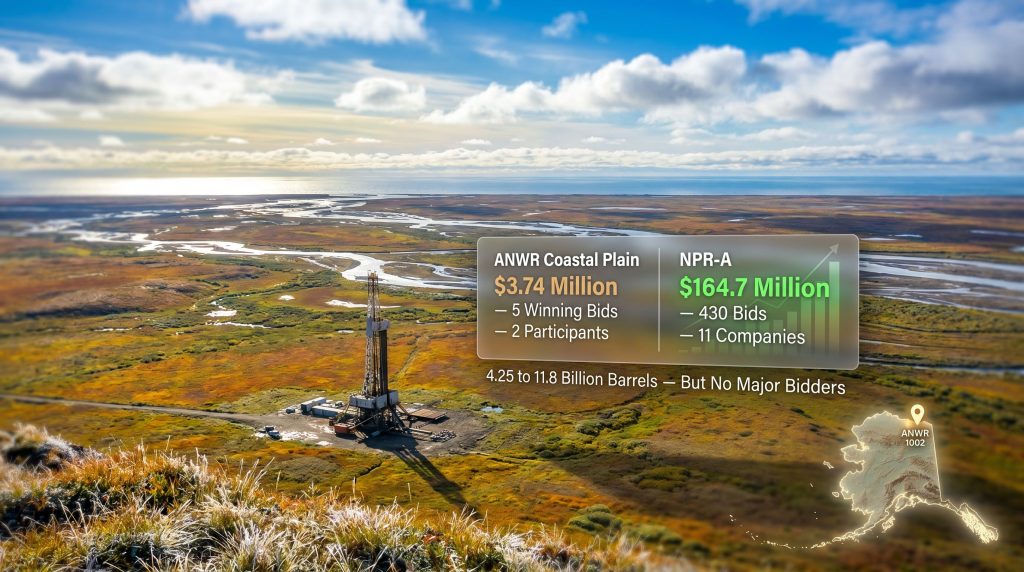
When the Bureau of Land Management held its June 5, 2026, lease sale for tracts across the Arctic National Wildlife Refuge coastal plain, the result was striking in its sparseness. Of 58 tracts covering approximately 690,000 acres made available, only five received winning bids. Those five tracts cover roughly 70,000 acres, representing about 10% of the offered area. Total winning bids reached $3,741,528, with half of that revenue flowing to the State of Alaska as required by federal statute.
Just two entities participated. The Alaska Industrial Development and Export Authority (AIDEA), a state-owned development corporation, secured three tracts. Hex Energy LLC, a Cook Inlet natural gas producer with no existing North Slope footprint, acquired two. Not a single privately held major integrated oil company submitted a bid.
This was not an isolated outcome. Examining the full ANWR auction history reveals a consistent and worsening trajectory:
| Sale Date | Revenue Generated | Major Participation | Notable Context |
|---|---|---|---|
| January 2021 | ~$14 million | None | Held in final days of Trump administration |
| January 2025 | $0 | None | Mandated by Congress; zero bids received |
| June 2026 | $3.74 million | None | Two non-major participants only |
As Bobby McEnaney, director of land conservation for the Natural Resources Defense Council, noted publicly, the absence of major companies at a federally organised energy auction communicates a clear message about the perceived economics of the play. The direction of travel across these three sales does not suggest building momentum. It suggests institutional capital has reached a firm conclusion.
Why the NPR-A Sale Tells a Different Story
The starkest way to understand what is happening in ANWR is to compare it directly with the National Petroleum Reserve-Alaska (NPR-A) lease sale held just weeks earlier on March 18, 2026. That auction produced results that stand in almost complete contrast:
| Metric | ANWR (June 2026) | NPR-A (March 2026) |
|---|---|---|
| Tracts offered | 58 | Not specified |
| Bids received | 5 winning bids | 430 bids |
| Companies participating | 2 | 11 |
| Revenue generated | $3.74 million | $164.7 million |
| Major participation | None | Yes, including ConocoPhillips and Repsol |
The NPR-A sale set financial and participation records simultaneously. The same companies that ignored ANWR were actively competing for NPR-A acreage just weeks earlier. This is not a story about Alaska being broadly unattractive to oil and gas investment. It is a story about which parts of Alaska are currently investable under prevailing risk frameworks.
The critical differentiator is infrastructure proximity. NPR-A acreage sits adjacent to established North Slope production operations, with existing pipeline connections, operational precedent, and a logistics network that materially reduces development capital requirements. In ANWR's 1.56-million-acre coastal plain, known as the 1002 area, virtually none of that infrastructure exists. Every development scenario requires building it from scratch at multi-billion-dollar cost before a single barrel reaches market.
The Four-Layer Risk Framework Deterring Major Capital
Understanding why the ANWR lease sale oil majors opt out pattern persists requires examining each layer of non-geological risk that major operators must price into their investment calculus. These risks interact with the broader US macro headwinds currently weighing on energy investment decisions across North America.
Litigation Risk: Title Uncertainty as a Financing Barrier
Active federal litigation over ANWR leasing is arguably the single most decisive deterrent to institutional participation. A broad coalition of conservation groups and Indigenous organisations filed a federal lawsuit against the government in 2020, updated in January 2026, alleging violations of environmental protection statutes, endangered species regulations, and other federal law.
For a major oil company, acquiring a lease under active title litigation creates a structural problem: project financing becomes extremely difficult to secure when the legal validity of the underlying asset remains unresolved. Banks and institutional lenders require clear title as a precondition for committing capital at the scale Arctic development demands. This is not an ideological objection to drilling; it is a fundamental underwriting reality. Indeed, environmental groups have warned that any development risks transforming the refuge into a fossil fuel industrial zone, further intensifying legal and reputational exposure.
Political Cycle Risk: The Administration Reversal Problem
ANWR's development history has functioned almost as a political pendulum. Congressional authorisation for leasing was secured under the Tax Cuts and Jobs Act of 2017, requiring at least two lease sales within a ten-year window. Leases awarded in the January 2021 sale were subsequently cancelled following the change in federal administration.
For a major integrated operator considering a decade-long capital commitment to develop Arctic infrastructure, this pattern creates an almost impossible planning environment. The risk is not just that permits might be delayed. The risk is that lease positions themselves may be legally extinguished before development can begin. The shifting Alaska drilling policy environment has consequently become one of the most closely watched variables in North American energy planning.
ESG Exposure and Cost of Capital
ANWR's coastal plain carries a level of reputational sensitivity that extends well beyond standard regulatory risk. As one of North America's most ecologically prominent wilderness areas, any company acquiring ANWR leases faces sustained scrutiny from conservation organisations, Indigenous communities, and institutional investors with environmental mandates.
For publicly traded majors, this translates directly into financial risk. Institutional shareholders with ESG-linked investment policies may reduce allocations to companies with ANWR exposure, effectively raising the cost of capital for those projects. This dynamic is increasingly embedded in capital allocation decisions at the board level across the major integrated operators.
The Infrastructure Gap: Arctic Development Economics
The US Geological Survey estimates ANWR's coastal plain may hold between 4.25 and 11.8 billion barrels of technically recoverable oil. That is a genuinely significant resource figure. However, industry analysts generally estimate that Arctic frontier development of this nature requires sustained oil prices above $80–$90 per barrel to generate acceptable internal rates of return, given the infrastructure build-out required.
Geological resource size is a necessary but insufficient condition for investment. The ANWR coastal plain illustrates this principle clearly: billions of barrels of estimated resource have failed to attract a single major oil company bid across three consecutive federal auctions.
Unlike the NPR-A, where pipeline access is already established and incremental development costs are relatively contained, ANWR would require the construction of access roads, processing facilities, and pipeline connections across some of the most environmentally sensitive and logistically challenging terrain in North America. In addition, the prevailing crude oil price trends make it even harder to justify committing capital to high-breakeven frontier plays.
Who Did Bid, and What Does That Actually Mean?
AIDEA's participation should not be interpreted as a market signal of commercial viability. The authority is a state-owned entity with a statutory mandate to advance Alaska's economic development. It already held existing ANWR leases from prior sales, and its acquisition of additional tracts aligns with its institutional mission rather than reflecting a private-sector risk-adjusted investment decision. AIDEA is functioning as a policy instrument, not a capital markets participant.
Hex Energy LLC's participation is similarly constrained in its signal value. As primarily a Cook Inlet natural gas producer, the company has no existing North Slope operations and a balance sheet that is modest relative to the capital requirements of large-scale Arctic development. Its two-tract acquisition is best understood as a speculative land position rather than a near-term development commitment.
What Would It Take to Change the Investment Calculus?
Several structural conditions would need to converge before major integrated operators seriously re-evaluate ANWR acreage:
- Legal resolution of active federal litigation, through either a definitive court ruling or legislative intervention that establishes clear and durable lease validity
- Sustained commodity prices above the $80–$90 per barrel threshold generally cited by analysts as necessary to justify Arctic frontier development economics
- Infrastructure development, whether through state-backed financing or federal investment, that reduces the standalone capital burden for initial operators
- Multi-administration policy consistency, meaning at least two consecutive administrations maintaining a pro-development posture to reduce the political reversal risk that has defined ANWR's history
- Financing market evolution, including ESG framework adjustments or carve-outs that allow institutional lenders to engage with Arctic projects without triggering divestment mandates
The current administration has indicated that additional leasing opportunities will be created under the One Big Beautiful Bill Act, and BLM Alaska State Director Kevin Pendergast characterised the June sale as consistent with a shared industry-government vision for coastal plain development. However, market participation data from three consecutive auctions suggests the private sector's assessment of ANWR's near-term commercial viability diverges substantially from that institutional optimism. Consequently, the broader oil price crash dynamics of 2025 have further reduced the commercial urgency that might otherwise motivate frontier exploration bids.
The next major ASX story will hit our subscribers first
Alaska's Broader Offshore Signal
ANWR is not the only Alaskan frontier arena experiencing capital withdrawal. The Bureau of Ocean Energy Management's March 2026 offshore lease sale in Cook Inlet, offering approximately one million acres, received zero bids. Cook Inlet has historically been an active producing basin, which makes the complete absence of interest particularly significant.
The parallel with ANWR is instructive: in both cases, ongoing legal and regulatory uncertainty appears to be functioning as an absolute deterrent rather than a manageable risk factor that can be priced into a bid. This dual failure — ANWR and Cook Inlet — suggests that Alaska's frontier energy investment environment faces structural headwinds that go beyond any single project's geological characteristics.
FAQ: ANWR Lease Sale and Major Oil Company Participation
Why did no major oil companies bid in the June 2026 ANWR lease sale?
Major operators assessed a combination of active federal litigation creating title uncertainty, documented political reversal risk across multiple administrations, reputational and ESG exposure, and an absence of existing infrastructure. Collectively, these factors placed ANWR below the investment threshold for companies that can deploy capital across more commercially certain global opportunities.
How much did the June 2026 ANWR lease sale generate?
Total winning bids reached $3,741,528 across five tracts covering approximately 70,000 acres. Federal law directs 50% of that revenue to the State of Alaska.
What is the ANWR 1002 area?
The 1002 area refers to the 1.56-million-acre coastal plain within the Arctic National Wildlife Refuge in northern Alaska. Designated as a potential petroleum resource zone under the Alaska National Interest Lands Conservation Act of 1980, the US Geological Survey estimates it may contain between 4.25 and 11.8 billion barrels of technically recoverable oil.
How does the ANWR result compare with the NPR-A sale?
The contrast is substantial. The NPR-A sale generated $164.7 million from 430 bids submitted by 11 companies, including major and independent operators. The ANWR sale produced $3.74 million from two participants. Infrastructure proximity, litigation status, and commercial track record account for the divergence.
What happened to leases from the 2021 ANWR sale?
Several leases issued in the January 2021 sale were subsequently cancelled following the change in federal administration, reinforcing the political cycle risk that discourages long-horizon capital commitments from major operators. The ANWR lease sale oil majors opt out pattern therefore reflects accumulated institutional memory of that reversal, not merely current market conditions.
Disclaimer: This article contains forward-looking assessments, analyst estimates, and geological projections. These represent informed analysis rather than guaranteed outcomes. Oil price thresholds, resource recovery estimates, and investment timeline projections are subject to significant uncertainty and should not be construed as financial advice. Readers should conduct independent due diligence before making investment decisions.
Want To Stay Ahead Of The Next Major Resource Discovery?
While frontier oil and gas faces mounting non-geological headwinds, significant mineral discoveries on the ASX continue to generate transformative returns — and Discovery Alert's proprietary Discovery IQ model ensures subscribers receive real-time alerts the moment those discoveries are announced. Explore historic examples of exceptional discovery-driven outcomes and begin a 14-day free trial today to position yourself ahead of the broader market.