June 8, 2026
The Geopolitics of Energy Disruption: When Conflict Becomes a Market Mechanism
Oil markets have a long history of treating geopolitical conflict as a temporary variable, one that spikes prices briefly before diplomacy intervenes and supply normalises. That assumption has underpinned energy investment models, central bank forecasts, and corporate hedging strategies for decades. However, the structural conditions underpinning the current U.S.-Iran stalemate suggest something fundamentally different may be unfolding. For investors, policymakers, and energy-intensive industries, this may be the opening chapter of a genuine Iran oil supercycle trigger, with consequences that extend well beyond any ceasefire timeline.
When big ASX news breaks, our subscribers know first
Why Neither Side Has a Genuine Incentive to Settle
Understanding the oil market implications of the current conflict requires first understanding the political architecture that sustains it. The Islamic Revolutionary Guards Corps functions not merely as a military institution within Iran, but as an embedded economic and ideological actor with deep roots across the country's financial, commercial, and political infrastructure. Any comprehensive peace framework that dismantles this structure would constitute an existential threat to the current regime, not simply a security concession.
Every iteration of a nuclear deal framework, from the original Joint Comprehensive Plan of Action through to its most recent form, has targeted the same institutional vulnerability: the IRGC's unique position within Iranian society. Washington's long-term objective has been to strip away the financial and political support structures that sustain the IRGC. Analysts of the region argue this transformation would, over time, prove fatal to the Islamic regime itself, creating a rational incentive for Tehran to treat any comprehensive settlement as a strategic trap rather than an opportunity.
Washington's calculus is equally deliberate. Pentagon wargaming around a ground invasion of Iran has consistently produced conclusions that make sustained economic pressure the only operationally viable instrument for achieving long-term strategic objectives. Furthermore, the conflict serves multiple U.S. interests simultaneously. The Strait of Hormuz, through which approximately one-fifth of all globally traded oil and gas flows, had previously become a zone of deep Chinese strategic influence through comprehensive cooperation agreements between Beijing and Tehran.
Sustained disruption of that transit corridor weakens China's energy supply chain dependencies at a critical moment in the broader Indo-Pacific strategic competition. The April 2025 U.S.-Indonesia Major Defense Cooperation Partnership, signed on 13 April, reflects the broader architecture of this strategy: reinforcing U.S. influence across critical maritime chokepoints while constraining Beijing's ability to project economic and military power through them.
The Donroe Doctrine and Its Energy Market Consequences
The Trump administration's 2025 National Security Strategy formalised what analysts have termed the Donroe Doctrine, a term derived from the doctrine's explicit invocation of the Monroe Doctrine as its conceptual ancestor. The NSS describes the Trump Corollary to the Monroe Doctrine as a reassertion of American pre-eminence across the Western Hemisphere and a commitment to denying non-hemispheric competitors the ability to own or control strategically vital assets within the Americas.
The geopolitical implication is a world carved into three distinct spheres of influence: Chinese primacy in Asia, Russian dominance or significant influence over Europe, and direct U.S. control across North and South America. For a comprehensive crude oil market overview, this represents a structural blueprint for redirecting global supply geography, with the U.S. seeking to accelerate production ramp-ups across Latin America to compensate for losses from the Middle East.
The Three Primary Substitution Targets
The three primary substitution targets each carry significant constraints:
- Venezuela: Sanctions relief functions as the primary production unlock mechanism, but infrastructure decay after years of underinvestment means any output recovery would be gradual rather than immediate.
- Brazil: Deepwater pre-salt reserves represent genuine long-term production potential, but near-term output ceilings are constrained by existing project timelines and capital deployment schedules.
- Argentina: The Vaca Muerta shale formation holds world-class resource potential, but infrastructure bottlenecks in pipeline capacity and export logistics limit how quickly production can scale to meaningful export volumes.
The Donroe Doctrine reframes the Middle East conflict not as a crisis requiring urgent resolution, but as a geopolitical opportunity being actively managed, with the consequence that a near-term supply gap remains structurally unaddressed while the longer-term Americas energy bloc takes shape over a multi-year horizon.
Quantifying the Hormuz Shock: A Supply Disruption Without Modern Precedent
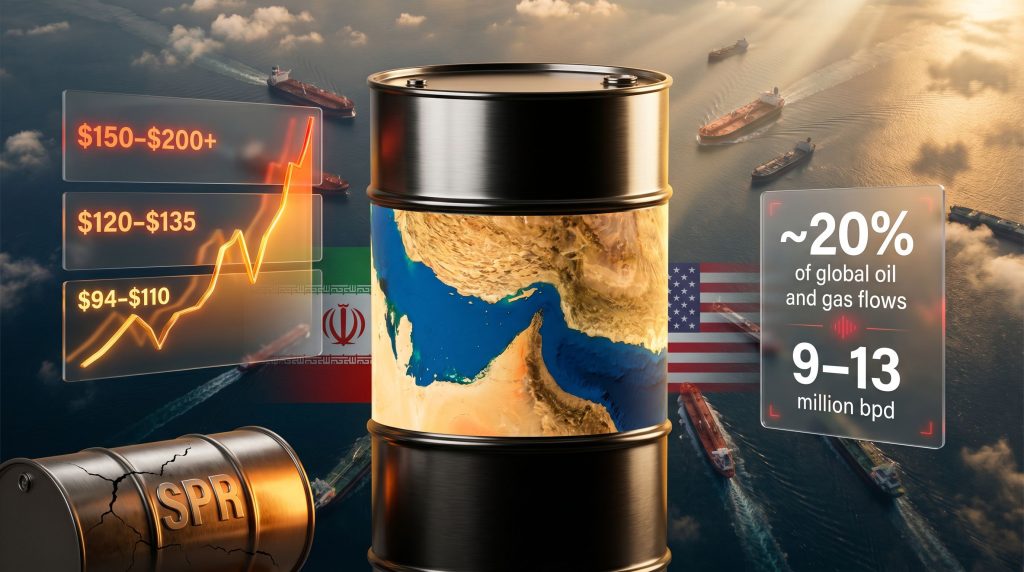
The scale of the current supply disruption is difficult to overstate. The combination of the Strait of Hormuz blockade and infrastructure damage across Gulf production and refining facilities has shut in an estimated 9 to 13 million barrels per day of combined production and refining capacity. Consequently, this represents approximately 16% of global oil supply, a disruption magnitude that has no equivalent in the modern era of energy markets.
| Metric | Figure |
|---|---|
| Share of global oil and gas flows through the Strait of Hormuz | ~20% |
| Estimated production and refining capacity shut in | 9 to 13 million bpd |
| IEA emergency reserve release (largest coordinated release in history) | 400 million barrels |
| Barrels drawn down in April and May alone | 250+ million barrels |
| U.S. baseline production at conflict onset | 13.6 million bpd |
| IMF-projected inventory trajectory | Five-year low by July 2026 |
| Estimated share of world oil supply disrupted | ~16% |
The response to this shock was itself historically unprecedented. In March 2026, the 32 member nations of the International Energy Agency executed the largest coordinated emergency stock release in the organisation's history, flooding markets with 400 million barrels of emergency oil. The effect was to create what analysts describe as a temporary wall of global emergency supply that suppressed front-month price volatility and provided a misleading sense of market stability.
The fundamental problem is that this instrument is a one-time deployment, not a repeatable lever. With over 250 million barrels consumed in drawdowns during April and May alone, the consumption rate is outpacing any realistic replenishment timeline. Furthermore, an oil price shock of this magnitude demonstrates that strategic petroleum reserve releases manage the timing of price discovery; they cannot replace physical supply.
The U.S. domestic production picture compounds the challenge. American producers were already operating at record highs of 13.6 million bpd at the onset of the conflict. Despite political calls for output expansion, major independent producers and integrated oil companies have confirmed they are maintaining pre-war capital expenditure plans and are running near capacity limits with no short-term pathway to meaningful expansion.
Phase-by-Phase: How the Price Escalation Could Unfold
The oil price trajectory from this point forward is best understood through a phased framework rather than a single price forecast.
Phase 1: Inventory Depletion (Present Through July 2026)
Brent crude has been trading in the $94 to $110 range, with emergency buffers absorbing the initial shock and masking the underlying severity of physical supply loss. Refiner behaviour has shifted toward substituting Middle Eastern heavy crude grades with alternative barrels at elevated premiums, widening crack spreads and applying downstream margin pressure. Eurozone fuel sales have already declined by 3.5% as price-driven demand destruction begins to register in consumption data.
Phase 2: The July Cliff
The IMF has formally warned that global oil inventories are on track to reach a critical five-year low by July 2026. The World Bank's Large Disruption Scenario projects Brent breaking above the $95 to $110 range and spiking toward $120 to $135 per barrel by late summer 2026, driven by refiner competition for scarce physical barrels and the emergence of localised product shortages as commercial inventories cross critical thresholds.
Phase 3: Secondary Demand Wave and Panic Buying
The most structurally dangerous phase arrives if the stalemate persists beyond mid-2026. Governments that emptied strategic reserves would re-enter the market as buyers at elevated prices, creating artificial demand layered on top of already constrained physical supply. This feedback dynamic, where institutional re-stocking behaviour amplifies an existing supply shortage, is the mechanism through which extreme price outcomes become self-reinforcing.
According to analysis from OilPrice.com, the Iran stalemate carries the structural hallmarks of a genuine supercycle trigger rather than a temporary price spike.
Important disclaimer: The $200 per barrel scenario represents a tail-risk outcome, not a base-case forecast. It becomes structurally plausible only under conditions where SPR depletion, prolonged Hormuz closure, and secondary government panic buying converge simultaneously. Investors and risk managers should treat this as a stress scenario for model testing purposes, not a central projection.
Structural Shifts in Refining, Trade Routes, and Supply Geography
One of the least-discussed consequences of the Hormuz disruption is the refinery configuration mismatch it has exposed. Complex refineries across Asia and Europe were built specifically to process the heavy sour crude grades that dominate Persian Gulf production. These facilities cannot simply pivot to lighter barrels from the Americas or the North Sea without significant throughput penalties and product yield distortions. China's decision to delay 500,000 bpd of refining capacity as Hormuz disruptions deepened is a concrete leading indicator of this downstream stress.
Major importers are responding through rapid supply diversification strategies:
- India has pivoted aggressively toward Russian, Brazilian, and Venezuelan crude as Middle Eastern volumes contract. Indian imports from Venezuela surged by 51% in a single month, a remarkable pace of trade reorientation. India has simultaneously launched an 85% ethanol fuel initiative as a structural long-term hedge against oil import dependence.
- South Korea has locked in Canadian crude and LNG contracts in what amounts to a wholesale overhaul of its supply portfolio, reducing its historical dependence on Middle Eastern barrels.
- China's LNG imports have reached their highest level since the Iran conflict began, a substitution signal with long-term infrastructure implications for global LNG market pricing.
Perhaps the most revealing data point regarding supply normalisation timelines comes from Kuwait, which has acknowledged that domestic oil output would require 10 to 12 weeks to recover after any Hormuz reopening. This quantifies the lag between conflict resolution and physical supply normalisation, a gap that markets consistently underestimate when pricing geopolitical resolution scenarios.
The next major ASX story will hit our subscribers first
Central Banks, the IMF, and the Macroeconomic Transmission Problem
Supply-side inflation originating from geopolitical disruption creates a fundamental policy problem for central banks. The Bank of England has acknowledged that the oil price shock is clouding the interest rate outlook, a signal that energy-driven inflation has become a primary monetary policy variable. In addition, ongoing trade war oil markets dynamics are further complicating the policy environment for central banks globally.
The challenge is structural: conventional demand-management tools like interest rate increases are poorly calibrated to address inflation whose origin is a physical supply shortage rather than excess demand. The stagflation risk matrix becomes particularly acute if Brent sustains above $120. At those price levels, the combined effect of elevated fuel costs, higher industrial input prices, and reduced consumer discretionary spending creates conditions consistent with slowing growth and persistent above-target inflation simultaneously.
The SPR arithmetic adds a further dimension of concern. SPR borrowers currently owe the U.S. government approximately 40 million additional barrels, an outstanding obligation that constrains future emergency release capacity precisely when market conditions may demand it most. Nations holding SPR replenishment obligations consequently face a dual pressure: diplomatic obligations to the U.S. and domestic energy security imperatives that pull in the opposite direction.
Scenario Framework: Three Pathways Through 2026 and Beyond
| Scenario | Conflict Resolution | Hormuz Status | Brent Price Range | Supercycle Risk |
|---|---|---|---|---|
| Rapid Diplomatic Settlement | Q3 2026 ceasefire | Partial reopening | $75 to $90 | Low |
| Prolonged Stalemate (Base Case) | No resolution through 2026 | Effectively closed | $120 to $135 | High |
| Escalation and Infrastructure Strikes | Conflict widens | Full closure and asset damage | $150 to $200+ | Extreme |
The rapid settlement scenario faces the highest structural obstacles. It requires IRGC institutional concessions that the regime has consistently treated as existential threats, alongside a U.S. sanctions rollback framework that would undermine Washington's broader strategic objectives in the region. The political prerequisites for this scenario are, on current evidence, absent.
The prolonged stalemate is the most structurally consistent outcome given the incentive analysis on both sides. Under this pathway, the July 2026 inventory threshold represents the critical inflection point, after which price formation reverts increasingly to physical supply-demand dynamics rather than emergency buffer management.
The escalation scenario is given additional credibility by the Oman terminal attack, which demonstrated that infrastructure previously considered outside the conflict's effective range was vulnerable to targeting. An expansion of Houthi operations in the Red Sea, additional Gulf export terminal strikes, or damage to Oman's oil infrastructure would compress the gap between the base case and the extreme price scenario.
Non-Oil Energy Markets: The Compounding Disruption Layer
The Iran conflict's energy market implications extend well beyond crude oil. LNG markets are experiencing China's import volumes at their highest level since the conflict began, driving spot price premiums and tightening a market that was already structurally constrained. Escalating industrial action at Australian LNG export facilities adds supply risk to an already stressed market, creating a compounding disruption layer that has implications for Asian energy security more broadly.
Asian coal prices have surged as Indonesia tightened export controls, removing a key supply buffer that importing nations had relied upon to partially offset elevated oil and gas costs. Japan, drawing lessons from its acute energy vulnerability during the conflict period, has accelerated plans to replace up to 14 nuclear reactors by 2050, treating energy security as a strategic national priority rather than a purely economic calculation.
These dynamics across LNG, coal, and nuclear markets collectively reinforce the case that the current disruption is reshaping energy market architecture at a structural level. Notably, geopolitical oil price analysis suggests this is far more than a temporary price shock that will self-correct once hostilities cease.
Key Investment and Risk Management Considerations
For investors and risk managers assessing their exposure to the Iran oil supercycle trigger thesis, several structural conclusions emerge from the analysis. Furthermore, the OPEC market influence across this period adds another layer of complexity to any long-term supply outlook.
- The absence of a near-term peace resolution is not a diplomatic failure but a reflection of rational strategic incentives on both sides that make prolonged conflict the most durable equilibrium.
- Emergency supply buffers have created a window of artificial price stability that delays but cannot prevent structural price repricing once the July 2026 inventory threshold is reached.
- The refinery configuration mismatch between available alternative crude grades and existing processing infrastructure is a structural constraint that cannot be resolved quickly, amplifying downstream price pressure independently of crude oil spot prices.
- The $120 to $135 base case and the $150 to $200+ tail-risk scenario should both be stress-tested across energy sector equity positions, inflation-linked asset allocations, and industrial cost models.
- Supply diversification strategies being executed by India, South Korea, and China are permanently reshaping long-term crude trade flows, pricing benchmark relationships, and supplier-buyer contracts in ways that will persist beyond any eventual conflict resolution.
As ABC News reports, Iran-related conflict has historically triggered severe oil supply shocks, and the current episode carries the structural hallmarks of the most consequential disruption in the modern era of energy markets.
This article contains forward-looking analysis, scenario projections, and price forecasts that involve assumptions and uncertainties. Nothing in this article constitutes financial or investment advice. Readers should conduct independent research and consult qualified advisors before making investment decisions.
Want to Stay Ahead of the Next Major Resource Discovery Triggered by Energy Market Shifts?
While geopolitical disruption reshapes global energy supply chains and commodity pricing, Discovery Alert's proprietary Discovery IQ model delivers real-time alerts on significant ASX mineral discoveries — instantly translating complex market signals into actionable investment opportunities for subscribers at every experience level. Explore how historic discoveries have generated substantial returns by visiting Discovery Alert's dedicated discoveries page, and begin your 14-day free trial today to position yourself ahead of the market.