

May 11, 2026
The Infrastructure Bet That Changed Everything: How Pipeline Engineering Became Saudi Arabia's Greatest Geopolitical Asset
Long before the first tanker rerouted through the Red Sea in 2026, energy strategists had argued for decades that the world's oil supply chain contained a fatal architectural flaw: an overwhelming dependence on a small number of maritime chokepoints that could be severed by a single geopolitical event. That theoretical vulnerability became a lived reality when the Strait of Hormuz effectively closed in late February 2026, triggering one of the most consequential energy supply disruptions in modern history. What followed revealed something equally significant: the producers who had invested in overland bypass infrastructure decades earlier were not just better positioned financially. They had quietly engineered a form of geopolitical immunity that no short-term policy response could replicate.
Aramco pipeline exports offset Hormuz disruption — this became the defining energy story of Q1 2026, but understanding why requires looking at the infrastructure decisions made long before the crisis, the financial outcomes they enabled, and the structural gaps that still remain.
When big ASX news breaks, our subscribers know first
The Chokepoint That Was Always a Risk, Not a Surprise
The Strait of Hormuz has never been a secret vulnerability. At its narrowest point, the waterway measures approximately 33 kilometres across, with navigable shipping lanes occupying an even more compressed corridor within those boundaries. Before the 2026 disruption, the strait facilitated the transit of roughly 20% of all globally traded oil on a daily basis, alongside significant volumes of liquefied natural gas, refined petroleum products, and petrochemical feedstocks.
What made the strait uniquely dangerous as a single point of failure was its geography. The waterway sits between the Omani coast to the south and Iranian territorial waters to the north, meaning any actor with Iranian territorial influence holds effective veto power over one-fifth of the world's seaborne oil supply. This was not a new insight in 2026. It was a structural reality that energy security planners had documented for decades and that market participants had consistently underpriced.
The closure was formalised on March 2, 2026, following Iranian navigation restrictions that took effect in the immediate aftermath of coordinated military operations involving the United States and Israel. A compounding U.S. naval presence in the region further suppressed tanker movements. By mid-May 2026, the disruption had extended to approximately 2.5 months with no confirmed pathway to near-term de-escalation, elevating the crisis from a temporary oil price shock to a structural logistics crisis with cascading consequences.
The Hormuz closure did not create a vulnerability. It exposed one that had existed for decades while global energy markets priced risk as though the strait would remain open indefinitely.
The East-West Pipeline: Engineering Built for Exactly This Moment
Saudi Aramco's East-West Pipeline was not conceived as a commercial optimisation project. It was designed with a single strategic objective: to ensure that Saudi crude exports could reach international markets even if the Persian Gulf became completely inaccessible. That design principle, built into the pipeline's original engineering rationale, proved its value in Q1 2026 in ways that no financial model could fully anticipate.
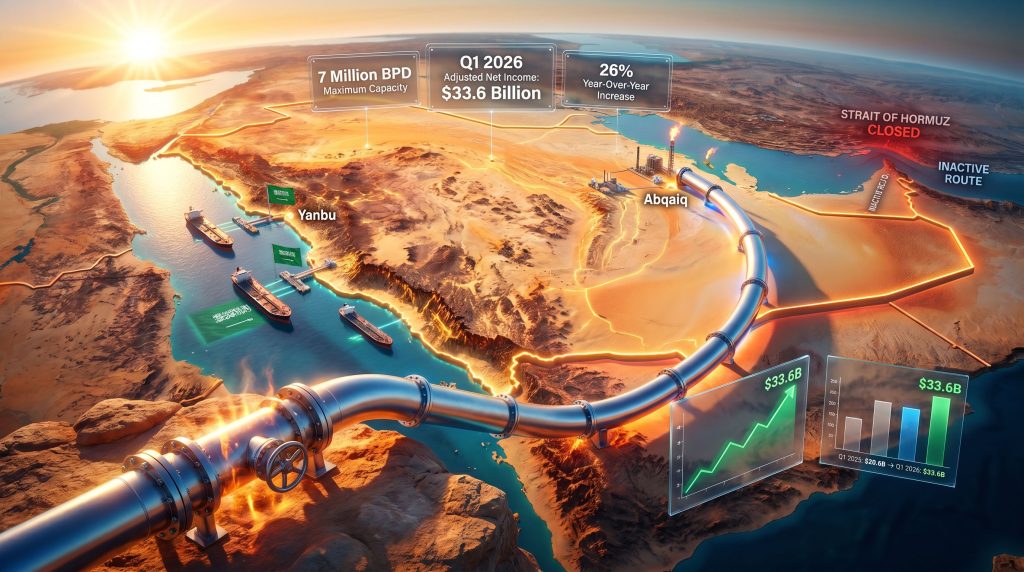
The pipeline runs from Saudi Arabia's eastern production heartland, anchored by the Abqaiq processing complex, westward across the kingdom to the Red Sea port of Yanbu. Depending on the segment measured, the route spans between 745 and 1,200 kilometres of overland infrastructure, passing through terrain that bypasses the Persian Gulf entirely. The pipeline's rated maximum throughput is 7 million barrels per day (bpd), a figure that places it among the highest-capacity crude transport systems in the world.
Under ordinary market conditions, the pipeline operated well below its rated capacity. The economics of Gulf export logistics historically favoured maritime routes through Hormuz, which offered lower per-barrel transport costs and direct access to Asian import markets. Furthermore, the East-West Pipeline was maintained as a contingency asset, valued for its optionality rather than its routine utilisation.
The Hormuz closure fundamentally inverted that calculus. Aramco immediately ramped pipeline throughput to its full 7 million bpd ceiling, redirecting production from eastern fields to Yanbu for Red Sea loading and onward export. The operational pivot was rapid precisely because the infrastructure already existed and had been maintained in operational readiness.
| Metric | Detail |
|---|---|
| Pipeline Route | Abqaiq (Eastern Fields) to Yanbu (Red Sea) |
| Maximum Rated Capacity | 7 million bpd |
| Q1 2026 Operating Rate | 100% of maximum capacity |
| Domestic Refinery Allocation | ~2 million bpd |
| Primary Export Terminal | Yanbu, Red Sea coast |
| Pipeline Length | 745 to 1,200 km (route dependent) |
An important constraint is embedded in this table. Approximately 2 million bpd of the pipeline's total throughput is allocated to domestic west coast refineries, meaning the net export capacity available for international markets sits meaningfully below the headline 7 million bpd figure. This distinction matters significantly when assessing whether the pipeline can fully replace Hormuz export volumes — a question explored further below.
Aramco's Q1 2026 Financials: What Infrastructure Resilience Looks Like in Practice
The financial outcomes of Aramco's infrastructure positioning were reported on May 9, 2026, and the headline figure was striking. Aramco posted adjusted net income of $33.6 billion for the first quarter of 2026, representing a 26% year-over-year increase from $26.6 billion in Q1 2025. According to World Oil's reporting, the result directly reflected the pipeline's strategic role during the crisis.
The profit surge was driven by two converging forces: elevated crude prices created by the Hormuz supply shock, and the preservation of export volumes through the East-West Pipeline that would otherwise have been entirely stranded. The combination produced a financial result that demonstrated the direct translation of pre-crisis infrastructure investment into earnings resilience.
Several additional financial metrics from the quarter deserve examination:
- Quarterly dividend: Maintained at $21.9 billion, a 3.5% year-over-year increase, signalling confidence in cash flow sustainability despite geopolitical uncertainty
- Operating cash flow: $30.7 billion generated during the quarter, reflecting strong revenue conversion
- Free cash flow: $18.6 billion, partially constrained by a substantial working capital build
- Working capital build: $15.8 billion, the single largest drag on free cash flow during the quarter
- Capital expenditure: $12.1 billion deployed, reflecting continued investment in long-term growth infrastructure
- Gearing ratio: Rose to 4.8% at end of March 2026, up from 3.8% at year-end 2025
The $15.8 billion working capital build is the most analytically interesting figure in this set. A working capital build of this magnitude during a supply chain crisis signals deliberate inventory accumulation and logistics pre-positioning, not passive balance sheet movement. Aramco was effectively warehousing crude and pre-purchasing logistical capacity to buffer against the uncertainty of how long the Hormuz closure would persist.
This is strategic balance sheet deployment in response to an operational crisis, and it explains why free cash flow came in below what operating cash flow alone might suggest.
The gearing ratio increase from 3.8% to 4.8% in a single quarter, combined with a $15.8 billion working capital build, reflects deliberate financial flexibility being deployed during a crisis, not deteriorating balance sheet health.
Aramco's chief executive Amin H. Nasser described the pipeline as a critical supply artery that helped mitigate the impact of a global energy shock, providing material relief to customers facing shipping constraints in the strait. He also emphasised that recent events had demonstrated the vital contribution of reliable oil and gas supply to energy security and the global economy. As Bloomberg reported, the war-driven oil price rise played a significant role alongside the pipeline's contribution in shaping Aramco's earnings performance.
The Structural Gap: Why Maximum Pipeline Capacity Is a Ceiling, Not a Solution
The East-West Pipeline's performance during Q1 2026 is a genuine infrastructure success story. It is also, however, an incomplete one. Operating at maximum throughput prevents the pipeline from absorbing any additional volume, and the constraints that define its ceiling reveal a structural supply gap that will persist until Hormuz reopens.
Several dynamics compound this limitation:
- Storage saturation progression: With the pipeline running at its hard ceiling of 7 million bpd, onshore storage capacity along the Red Sea export chain accumulates crude at the rate of any production that cannot be immediately loaded onto tankers. As storage tanks approach capacity limits, the system faces a physical bottleneck that pipeline throughput alone cannot resolve.
- Field-level production curtailments: As storage approaches saturation, field operators including Aramco must reduce upstream production rates to maintain system integrity. This creates a feedback loop where infrastructure constraints suppress production output.
- Domestic consumption as a throughput offset: The ~2 million bpd allocation to domestic refineries means international export capacity via the pipeline is effectively capped at approximately 5 million bpd, well below the volumes previously routed through Hormuz.
- No equivalent bypass for regional peers: The structural gap extends beyond Saudi Arabia's borders. Kuwait, Iraq, and Qatar lack comparable overland pipeline infrastructure capable of bypassing the strait at any meaningful scale, meaning the aggregate regional export shortfall is vastly larger than Aramco's own logistics constraints.
| Producer | Hormuz Dependency | Existing Bypass Capacity | Infrastructure Status |
|---|---|---|---|
| Saudi Arabia | High (pre-crisis) | East-West Pipeline (7M bpd) | Operational at full capacity |
| UAE | Very High | ADCOP (~1.5M bpd) | Partially operational |
| Kuwait | Extremely High | None at scale | No viable bypass exists |
| Iraq | Extremely High | None at scale | No viable bypass exists |
| Qatar (LNG) | Very High | None (LNG-specific) | No viable bypass exists |
The UAE's Abu Dhabi Crude Oil Pipeline (ADCOP) provides a partial analogue to the East-West Pipeline, with capacity of approximately 1.5 million bpd running to the port of Fujairah on the Gulf of Oman. However, its capacity is a fraction of the volumes previously transiting Hormuz from UAE fields, meaning it provides relief rather than a solution. For Kuwait, Iraq, and Qatar, no bypass infrastructure exists at meaningful scale, making their export revenues and production rates almost entirely hostage to the strait's reopening. Furthermore, the constraints on global LNG supply from the region amplify the economic consequences well beyond crude oil markets alone.
Scenario Modelling: Three Pathways From Here
The trajectory of this crisis is shaped by geopolitical variables entirely outside any energy company's operational control. Nevertheless, the scenarios carry meaningfully different economic and infrastructure implications worth mapping.
Scenario A: Rapid De-escalation (0 to 3 months)
- Diplomatic or military resolution reopens Hormuz to commercial navigation
- Aramco resumes full eastern export operations; storage overhang within the pipeline system clears progressively over weeks
- The crude price premium attributable to the Hormuz closure retreats sharply as supply returns to market
- Working capital built during Q1 2026 converts to cash flow as inventory is liquidated
Scenario B: Prolonged Stalemate (3 to 12 months)
- The East-West Pipeline continues at maximum throughput; domestic storage progresses toward critical saturation thresholds
- Aramco implements structured upstream production cuts to maintain system integrity
- Global oil markets experience persistent structural undersupply and elevated price volatility
- Gulf nations accelerate feasibility work on additional bypass pipeline projects previously considered uneconomic
- Demand destruction begins to emerge in price-sensitive Asian import markets
Scenario C: Extended Closure With Infrastructure Escalation (12+ months)
- New pipeline corridors and Red Sea terminal capacity projects are fast-tracked across the Arabian Peninsula
- Yanbu terminal infrastructure is expanded significantly to accommodate higher throughput
- Global shipping route realignment becomes permanent rather than temporary, reshaping tanker trade economics
- Importing nations, particularly across Asia, accelerate strategic petroleum reserve expansion and supply diversification strategies
- Long-term demand trajectories are affected as energy transition investment accelerates in response to sustained high prices
The Hormuz disruption is not merely testing existing infrastructure. It is rewriting the economic feasibility calculations for bypass projects that were previously marginalised as too expensive to justify.
The next major ASX story will hit our subscribers first
What This Crisis Reveals About Underpriced Infrastructure Risk
One of the less discussed dimensions of the Hormuz crisis is the extent to which bypass infrastructure investment had been systematically undervalued by global energy markets before February 2026. The East-West Pipeline had existed for decades, but its strategic value was largely invisible in normal market conditions. Aramco's pipeline capacity was an asset that markets essentially priced as if the strait would never close.
This represents a broader pattern in energy infrastructure valuation. Redundancy and resilience are difficult to price when the risks they hedge against appear remote. The result is a chronic underinvestment in bypass capacity that only becomes apparent when a chokepoint failure occurs. In addition, OPEC's market influence over production decisions means that individual member states face structural disincentives to invest in infrastructure that effectively routes around shared chokepoints.
The Hormuz closure has now fundamentally altered the cost-benefit calculus for pipeline investment across the Arabian Peninsula. Projects that were shelved in prior decades due to marginal economics are being re-evaluated with a different lens — one that prices in the possibility of extended maritime disruption as a scenario worth insuring against. Aramco's East-West Pipeline, which operated at full capacity during the quarter, has been cited regionally as validation of the investment thesis for similar projects.
Aramco's capital expenditure of $12.1 billion in a single quarter, sustained through a period of acute geopolitical uncertainty, signals that the company's investment thesis continues to prioritise physical infrastructure expansion as a strategic priority rather than a financial concession. Moreover, the crude oil price analysis for this period reveals just how dramatically benchmark pricing shifted as a direct consequence of the strait's closure.
The Price Dynamics: Who Benefits and at What Cost
The Hormuz closure has created a bifurcated market structure with asymmetric outcomes across the global energy landscape.
Producers with functional bypass capacity — primarily Saudi Arabia — benefit from the combination of elevated prices driven by the supply shock and continued export volume through alternative routes. This is a rare combination: supply disruptions typically force producers to choose between price gains and volume losses. Infrastructure redundancy, however, allows Aramco to capture both effects simultaneously.
Producers without bypass alternatives face the inverse outcome: high prices that cannot be converted to revenues because export volumes are physically constrained or stranded. This divergence will progressively widen the financial gap between infrastructure-capable producers and those dependent on strait access.
For importing nations, particularly across South and Southeast Asia where energy cost sensitivity is acute, prolonged high prices create compounding economic stress. The longer the closure persists, the more credible demand destruction becomes as an economic outcome. These geopolitical trade tensions are increasingly reshaping supply relationships in ways that extend well beyond the immediate energy market disruption.
This dynamic introduces an ironic longer-term consequence: extended elevated prices may accelerate energy transition investment in importing nations, creating a structural shift in long-term demand trajectories that outlasts the immediate crisis.
Frequently Asked Questions
What is the maximum capacity of Aramco's East-West Pipeline?
The East-West Pipeline has a rated maximum throughput of 7 million barrels per day. During Q1 2026, Aramco operated the pipeline at this full capacity ceiling, redirecting crude from eastern production fields to the Red Sea port of Yanbu for international export. Approximately 2 million bpd of this throughput is allocated to domestic west coast refineries, leaving roughly 5 million bpd available for international export terminals.
How much did Aramco's profits increase in Q1 2026?
Aramco reported adjusted net income of $33.6 billion in Q1 2026, a 26% increase compared to $26.6 billion in Q1 2025. The growth reflected both elevated crude prices resulting from the Hormuz supply shock and the preservation of export volumes through the East-West Pipeline, confirming that Aramco pipeline exports offset Hormuz disruption effects on the company's bottom line.
Can the East-West Pipeline fully replace Strait of Hormuz export capacity?
No. The pipeline provides critical relief but cannot serve as a complete substitute. Storage saturation limits, domestic refinery allocations consuming approximately 2 million bpd of throughput, and the absence of equivalent bypass infrastructure for other Gulf producers mean a structural supply gap persists until the strait reopens.
When did the Strait of Hormuz effectively close?
The strait was effectively closed on February 28, 2026, following military operations involving the United States, Israel, and Iran. Iranian navigation restrictions were formalised from March 2, 2026, triggering immediate disruptions to tanker movements, insurance premiums, and crude benchmarks globally.
What is Aramco's gearing ratio after Q1 2026?
Aramco's gearing ratio rose to 4.8% at the end of March 2026, up from 3.8% at year-end 2025. The increase reflects a $15.8 billion working capital build during the quarter, associated with strategic inventory accumulation and logistics repositioning during the crisis period.
How does the Hormuz closure affect other Gulf producers?
Unlike Saudi Arabia, most other major Gulf producers — including Kuwait, Iraq, and Qatar — lack equivalent pipeline infrastructure capable of bypassing the strait at scale. Their export revenues and production volumes remain far more directly exposed to the closure, creating a regional economic impact significantly larger than Aramco's own financial metrics indicate.
Key Takeaways
- Aramco pipeline exports offset Hormuz disruption at scale because the East-West Pipeline, operating at its 7 million bpd maximum capacity, was designed decades earlier for precisely this contingency
- The 26% year-over-year profit increase to $33.6 billion in Q1 2026 demonstrates that pre-crisis infrastructure investment translates directly into financial resilience when geopolitical events materialise
- A structural supply gap persists because pipeline throughput, though maximised, cannot fully absorb volumes previously routed through Hormuz, particularly for regional peers with no bypass alternatives
- The $15.8 billion working capital build signals deliberate strategic inventory positioning rather than passive balance sheet deterioration
- Full market normalisation requires Hormuz to reopen — a variable entirely outside any energy company's control and contingent on a geopolitical resolution that remains unconfirmed as of mid-May 2026
- The crisis is accelerating a structural reassessment of pipeline and terminal investment across the Arabian Peninsula, with previously marginal projects now being reconsidered as essential strategic assets
- Physical infrastructure redundancy has been reaffirmed as the most durable form of energy security, a principle that extends well beyond Saudi Arabia and carries lasting implications for how major producers, importing nations, and infrastructure investors evaluate bypass capacity going forward
This article contains forward-looking scenario analysis and financial commentary for informational purposes only. It does not constitute investment advice. Geopolitical forecasts involve inherent uncertainty, and actual outcomes may differ materially from scenarios described. Readers should consult qualified financial and energy market advisors before making investment decisions.
Want to Capitalise on the Next Major Resource Discovery Before the Market Does?
Discovery Alert's proprietary Discovery IQ model delivers real-time alerts on significant ASX mineral discoveries — transforming complex data across 30+ commodities into clear, actionable investment insights for both short-term traders and long-term investors. Explore historic discoveries and their exceptional market returns, then start your 14-day free trial at Discovery Alert to position yourself ahead of the broader market.

