
August 14, 2026
When Land Rights Meet Megawatts: The New Economics of Indigenous Energy Ownership
The energy transition unfolding across Australia's Pilbara region is not simply a story about decarbonising iron ore production. It is a story about who owns the infrastructure that powers it. For decades, the dominant model of engagement between major mining companies and Traditional Owner groups centred on consultation requirements, heritage agreements, and royalty distributions. The Yindjibarndi Rio solar deal represents a structural departure from that model, embedding Indigenous equity ownership directly into the commercial architecture of large-scale renewable energy generation.
Understanding why this shift is happening now, and what it means for the future of resource sector partnerships across Western Australia, requires looking at three converging forces simultaneously: the industrial decarbonisation imperative facing Rio Tinto, the maturing legal landscape around native title compensation, and the emergence of purpose-built Indigenous energy corporations capable of acting as genuine commercial counterparties. Furthermore, Australia's green metals leadership is increasingly dependent on how well these forces align at the project level.
When big ASX news breaks, our subscribers know first
The Jinbi Solar Farm: What the Deal Actually Involves
At its core, the Yindjibarndi Rio solar deal is structured around a 30-year power purchase agreement between Yindjibarndi Energy Corporation (YEC) and Rio Tinto for energy generated at the Jinbi solar project, located on Yindjibarndi Country in the Pilbara. The foundation of the commercial relationship was a Memorandum of Understanding signed in October 2023, which established the collaborative framework for renewable energy development across the region.
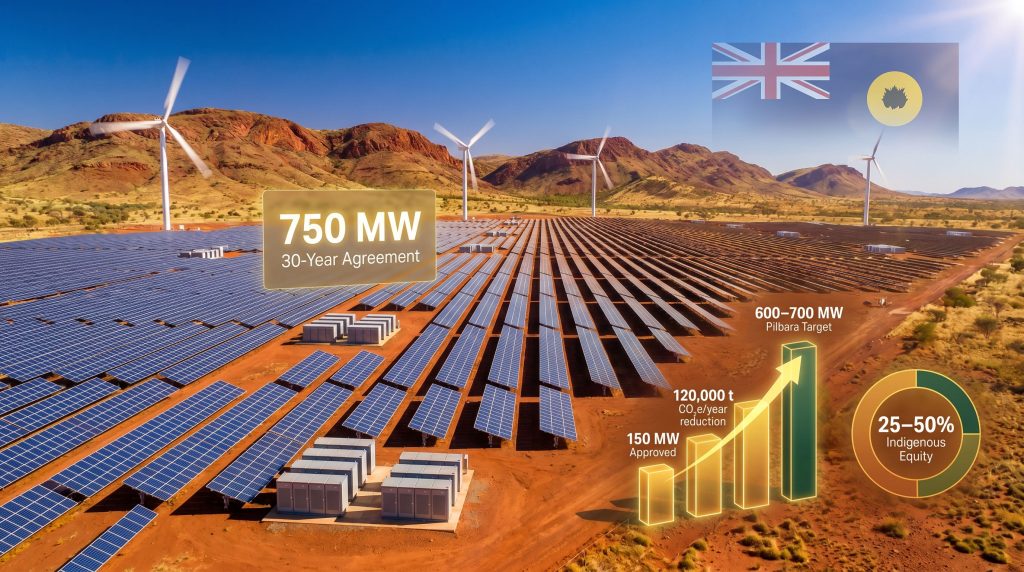
The project's ambition extends well beyond a single solar installation. Stage 1 of the development targets 750 MW of combined wind, solar, and battery storage capacity, with an approved solar farm capacity of 150 MW forming a central pillar of the early build programme. Initial array targets for the first construction phase sit in the range of 75 to 100 MW.
The emissions implications are material. Once operational, the project is expected to:
- Displace up to 11% of natural gas currently used for electricity generation across Rio Tinto's integrated Pilbara mining operations
- Reduce Rio Tinto's annual emissions by up to 120,000 tonnes of CO₂ equivalent per year
- Feed into Rio Tinto's stated commitment to reach net-zero Scope 1 and 2 emissions by 2050
The following table summarises the key project parameters drawn from available disclosures:
| Project Parameter | Detail |
|---|---|
| Initial Array Target | 75–100 MW |
| Approved Solar Farm Capacity | 150 MW |
| Stage 1 Total Target | 750 MW (wind, solar, battery storage) |
| Rio Tinto Pilbara Renewables Requirement | 600–700 MW total |
| Annual CO₂e Reduction Potential | Up to 120,000 tonnes |
| Pilbara Gas Displacement Potential | Up to 11% |
| Power Agreement Duration | 30 years |
Understanding the YEC Structure: Indigenous Equity as Commercial Architecture
Yindjibarndi Energy Corporation is not a passive beneficiary of this arrangement. It is the product of a joint venture between Yindjibarndi Aboriginal Corporation (YAC) and ACEN, the renewable energy arm of the Philippine-based Ayala Group, which operates one of Southeast Asia's largest independent power generation portfolios.
This partnership structure is significant for several reasons. YAC brings native title rights over approximately 13,000 square kilometres of Yindjibarndi Country, giving the joint venture a land access position that no external developer could replicate. ACEN brings capital, technical capability, and project development experience across large-scale renewable energy infrastructure in multiple markets.
Across projects developed on its native title land, YAC holds equity stakes ranging from 25% to 50%, depending on the specific project structure. Critically, cultural site protections, waterway buffers, and local procurement requirements are built into the partnership as foundational conditions rather than optional addenda. This is a meaningful distinction from earlier generations of mining agreements, where cultural heritage protections were often treated as compliance obligations rather than structural features of the commercial deal.
"The integration of cultural site protections as non-negotiable commercial terms rather than regulatory afterthoughts marks a fundamental shift in how Indigenous land rights translate into project governance."
The Native Title Compensation Backdrop Reshaping Pilbara Negotiations
The timing of the Yindjibarndi Rio solar deal cannot be understood in isolation from the broader legal landscape facing Pilbara mining operations. A landmark compensation ruling related to Fortescue's Solomon Hub operations has been proceeding through Australian courts, and its outcome carries significant implications for how mining companies calculate the cost of not reaching negotiated commercial agreements with Traditional Owners.
The Solomon Hub case is testing the quantum of compensation available to Traditional Owners for the impact of large-scale mining operations on native title rights. The significance extends far beyond any single company or community. If courts establish a higher compensation baseline for native title impacts, the commercial calculus for mining companies weighs heavily toward proactive partnership arrangements rather than contested legal processes.
This creates a dynamic that legal and commercial observers have begun to describe as the shift from consultation to co-ownership. The distinction is precise:
- Consultation models require miners to engage with Traditional Owners before projects proceed, but do not transfer economic rights or ongoing commercial participation
- Co-ownership models establish Traditional Owners as equity holders in the economic activity occurring on their country, creating ongoing revenue streams that compound over the project's life
A 30-year power agreement is qualitatively different from a royalty arrangement in this respect. Royalties are typically calculated as a percentage of revenue or production from the mining activity itself. An equity stake in an energy company generating power under a long-term offtake agreement creates a recurring revenue stream tied to energy pricing dynamics and the operational life of the renewable asset, independent of fluctuations in iron ore prices or mine production rates.
Rio Tinto's Pilbara Decarbonisation Pipeline: Where the Yindjibarndi Deal Fits
Rio Tinto has publicly committed to reaching net-zero Scope 1 and 2 emissions by 2050, with its Pilbara iron ore operations representing one of the most significant emissions sources within its global portfolio. The company has assessed approximately 300 MW of solar projects across the Pilbara as part of a broader renewables strategy requiring between 600 MW and 700 MW of new renewable generation capacity to meet its operational energy transition targets. In addition, the renewable energy solutions being pursued across the mining sector more broadly reflect how widespread this decarbonisation pressure has become.
The Jinbi solar farm connects directly to the Yurralyi Maya power station, which currently operates as a gas-fired facility supplying Rio Tinto's Pilbara mining network. The transition pathway envisions a solar-gas hybrid configuration in which renewable generation progressively displaces gas-fired output, preserving grid reliability while reducing the carbon intensity of power supply across the integrated mining operation.
The Yindjibarndi deal sits alongside the separately announced partnership with Ngarluma Aboriginal Corporation for an 80 MW solar farm near Karratha, also connected to the Yurralyi Maya infrastructure. This dual-track Indigenous partnership approach suggests Rio Tinto is pursuing a deliberate strategy of securing renewable energy supply through Traditional Owner partnerships rather than developer-led procurement alone. Furthermore, Rio Tinto's broader zero-carbon steel ambitions demonstrate how deeply decarbonisation objectives now run through its global operations strategy.
| Project | Indigenous Partner | Capacity | Connection Point |
|---|---|---|---|
| Jinbi Solar Farm | Yindjibarndi Energy Corp (YAC/ACEN) | 750 MW Stage 1 target | Pilbara operations network |
| Karratha Solar Farm | Ngarluma Aboriginal Corp | 80 MW | Yurralyi Maya power station |
| Pilbara Renewables Total Target | Multiple Traditional Owner groups | 600–700 MW | Integrated Pilbara grid |
The Mechanics of Just Transition: Beyond Royalties and Revenue Sharing
The phrase "just transition" has become common currency in energy policy discussions, but its practical meaning varies substantially depending on how it is implemented at the project level. In the context of the Yindjibarndi Rio solar deal, several features distinguish this arrangement from traditional benefit-sharing frameworks:
- Equity ownership rather than passive royalty entitlements gives YAC ongoing decision-making rights within the project governance structure
- Local employment obligations embedded in the partnership create pathways for Yindjibarndi community members to participate directly in construction and operational roles
- Procurement requirements favour local and Indigenous-owned suppliers, directing economic activity back into the community rather than extracting it
- Cultural heritage protections with specific waterway buffers and site exclusion zones ensure that renewable energy development does not replicate the cultural impact patterns of earlier extractive industries
This model reflects a growing recognition in both corporate and policy circles that economic sovereignty for Indigenous communities requires active participation in asset ownership, not simply improved benefit-sharing from assets others control. Consequently, the natural capital embedded in mining operations is increasingly being recognised as something Traditional Owner groups should have a direct stake in preserving and profiting from.
The next major ASX story will hit our subscribers first
Key Risks and Execution Challenges
Despite the strategic logic underpinning the Yindjibarndi Rio solar deal, material execution risks remain. Investment decisions for the initial 75 to 100 MW array were originally targeted for completion by end-2024, followed by a 12 to 18 month construction timeline. Given the current date of May 2026, the status of that investment decision milestone warrants close monitoring by stakeholders.
The primary risk categories include:
- Grid integration constraints: The Pilbara operates as an isolated, off-grid power system. Integrating several hundred megawatts of variable renewable generation requires careful management of frequency stability and backup capacity, with battery storage playing a critical balancing role
- Native title process timelines: Even with co-ownership structures in place, certain project components may require formal native title process clearances that operate on their own regulatory timelines
- Capital commitment sequencing: The joint venture's ability to progress from MoU to final investment decision depends on alignment between ACEN's capital allocation priorities and Rio Tinto's procurement scheduling
- Construction cost escalation: The Pilbara's remote location creates logistics premiums for equipment, labour, and materials that can materially affect project economics relative to urban solar developments
"Investors and industry observers should note that all project timelines discussed in this article are subject to change based on regulatory approvals, investment decisions, and joint venture governance outcomes. This article does not constitute financial advice."
Frequently Asked Questions: The Yindjibarndi Rio Solar Deal
What is Yindjibarndi Energy Corporation?
Yindjibarndi Energy Corporation (YEC) is a joint venture between Yindjibarndi Aboriginal Corporation (YAC) and ACEN, the renewable energy subsidiary of the Ayala Group. It was established to develop renewable energy projects on Yindjibarndi Country in Western Australia's Pilbara region.
What is the Jinbi Solar Farm?
The Jinbi Solar Farm is a large-scale solar, wind, and battery storage project proposed for development on Yindjibarndi Country in the Pilbara. Construction has begun on the initial 75 MW phase, with Stage 1 targeting 750 MW of combined renewable generation and storage capacity.
How long is the Rio Tinto power agreement?
The power purchase agreement between YEC and Rio Tinto for energy generated at the Jinbi solar farm has a duration of 30 years.
How much renewable energy does Rio Tinto need for Pilbara operations?
Rio Tinto has estimated a requirement of between 600 MW and 700 MW of renewable energy capacity to meet its Pilbara energy transition objectives.
What emissions reductions will the project deliver?
Once operational, the project is projected to reduce Rio Tinto's annual emissions by up to 120,000 tonnes of CO₂ equivalent and displace up to 11% of the natural gas currently used in Pilbara power generation.
What is the connection to the Solomon Hub native title case?
A compensation ruling related to Fortescue's Solomon Hub operations is proceeding through Australian courts. Its outcome is expected to influence the broader industry approach to native title engagement, with higher compensation risk accelerating commercial negotiation between miners and Traditional Owner groups.
What This Deal Signals for the Industry
The Yindjibarndi Rio solar deal is best understood not as an isolated commercial arrangement but as an indicator of where the relationship between Australia's mining industry and Traditional Owner communities is heading. Several structural signals emerge from examining the deal in detail:
- Indigenous co-ownership is transitioning from a desirable outcome to a baseline expectation in major renewable energy developments on native title land
- The 30-year agreement duration fundamentally changes the economic relationship between Yindjibarndi communities and the infrastructure operating on their country, creating intergenerational asset value
- Rio Tinto's dual-track strategy of partnering with both Yindjibarndi and Ngarluma communities suggests that reaching the 600 to 700 MW Pilbara renewables target requires multiple Traditional Owner partnerships rather than a single consolidated procurement approach
- The YAC-ACEN joint venture model offers a replicable template, combining Indigenous land rights with an experienced international renewable energy developer, that other communities and developers may seek to replicate across the Pilbara and beyond
- Pending native title compensation rulings are reshaping the negotiating environment in ways that make early, substantive partnership arrangements commercially rational for mining companies regardless of regulatory requirements
The Pilbara's transformation from a purely extractive landscape to one in which Traditional Owners hold equity stakes in the energy infrastructure powering that extraction is underway. The WA resources sector's economic impact will increasingly be shaped by how equitably that transformation is structured. Whether the pace of that transformation accelerates will depend in part on how quickly the broader industry draws the same commercial conclusions that the Yindjibarndi Rio solar deal appears to reflect.
Want to Capitalise on the Resource Sector's Next Major Transformation?
Discovery Alert's proprietary Discovery IQ model delivers real-time alerts on significant ASX mineral discoveries, instantly converting complex data across 30-plus commodities into clear, actionable insights — explore historic discovery returns to understand just how transformative early positioning can be, then begin your 14-day free trial at Discovery Alert to secure your market-leading advantage.