May 20, 2026
Why the Mining Sector's Information Problem Is Finally Getting a Technical Solution
The history of industrial resource extraction is, in large part, a history of working blind. Ore bodies are inherently heterogeneous, geological variability is the rule rather than the exception, and the distance between what a resource model predicts and what a processing plant actually receives has long been one of mining's most persistent and expensive inefficiencies. For decades, the industry has tolerated this disconnect because the tools to close it simply did not exist at scale. That is now beginning to change.
A new generation of ARC data-driven mining tools is emerging from university research environments and moving toward commercial deployment, bringing with it the potential to fundamentally restructure how data-driven mining operations collect, interpret, and act on geological and process data. The Australian Research Council's Training Centre for Integrated Operations for Complex Resources, known as the IOCR and based at Adelaide University, has developed four research-validated technologies that are now being positioned for industry pilot partnerships.
Understanding what these tools do, how they differ from existing approaches, and why their timing matters requires a look at both the technical mechanisms involved and the broader operational pressures that have made this kind of innovation urgent.
When big ASX news breaks, our subscribers know first
The Structural Inefficiency Driving Demand for Smarter Mining Technology
Why Traditional Resource Modelling Falls Short
Static resource models have been the backbone of mining planning for generations. Geologists collect core samples, analyse grade distributions, and build three-dimensional models that inform drilling, blasting, and processing decisions. The problem is that these models are snapshots. By the time ore reaches a crushing circuit or a processing plant, the geological reality it represents may differ significantly from what the model predicted.
This gap between modelled and actual ore characteristics creates cascading inefficiencies. Crushers operating on incorrect feed assumptions consume more energy than necessary. Processing plants calibrated for one grade profile receive material with a different profile entirely. Grade control decisions made upstream propagate errors downstream. In operations handling millions of tonnes annually, even small discrepancies in feed characterisation translate into measurable financial losses.
The core issue is not a lack of data. Modern mining operations generate enormous volumes of sensor data, drill logs, and assay results. The problem is the latency between data collection and operational response. When geological information takes days or weeks to influence processing decisions, the value of that information degrades in proportion to the time elapsed. Furthermore, 3D geological modelling techniques have advanced considerably, yet the integration between static models and live operational systems remains a persistent challenge.
The Sensing Gap That Smart Technology Is Designed to Close
One of the less-discussed dynamics in contemporary mining is the underutilisation of real-time sensing infrastructure that already exists on many sites. Sensors capturing vibration, density, particle characteristics, and chemical signals are increasingly common in modern operations, yet the data they produce often feeds into systems that cannot update resource models at the same speed the data is generated.
This creates what could be described as a false sense of operational intelligence: the appearance of technological sophistication without the decision-support capability that should accompany it. Real-time data capture without real-time model updating leaves operators in much the same position as their predecessors, making decisions based on information that no longer accurately reflects conditions underground or in the processing circuit.
Inside the IOCR Training Centre: Four Technologies Ready for Deployment
Professor Peter Dowd, Director of the ARC IOCR Training Centre and Professor of Mining Engineering at Adelaide University, has been explicit that the technologies developed through the centre are not conceptual prototypes. They have been engineered to address specific operational problems and have undergone research validation. The next step is commercial pilot deployment in partnership with mining industry operators.
The four technologies represent distinct but increasingly interconnected responses to the information challenges outlined above.
Technology One: Sensor-Driven Orebody Knowledge Updating
The first technology addresses the static model problem directly. By fusing data from multiple sensor sources, this system continuously refreshes orebody models in near real-time, replacing the traditional cycle of periodic sampling and batch analysis with a dynamic, self-updating resource knowledge framework.
The operational implications are significant. Drill-and-blast engineers working with current orebody information can optimise fragmentation targets more precisely. Grade control teams gain the ability to make sorting decisions based on actual rather than predicted ore characteristics. Processing plants receive feed profiles that reflect the material that is actually arriving, not what a model built weeks earlier suggested it might be.
Technology Two: AI-Powered Mine-to-Mill Optimisation
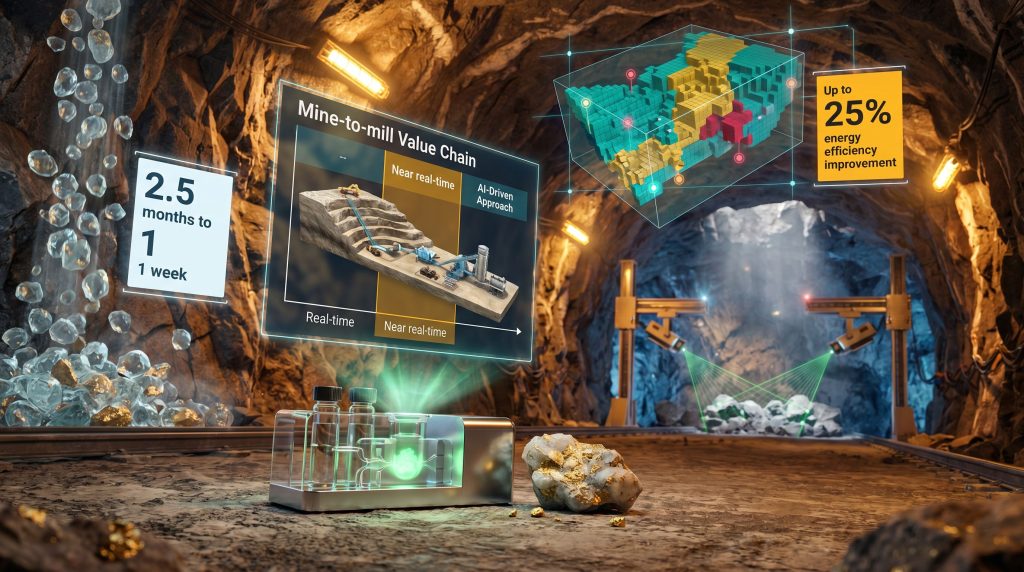
The concept of mine-to-mill integration has existed in the mining industry for some time, but its practical implementation has been limited by the difficulty of maintaining a live data connection between resource characterisation and processing performance. The IOCR centre's AI-driven optimisation tool is designed to bridge this gap by linking upstream resource data directly to downstream processing and financial outcomes. In addition, advances in AI in drilling and blasting have demonstrated that intelligent automation can deliver measurable improvements across the extraction value chain.
The distinction between traditional and AI-driven approaches across this value chain is substantial:
| Optimisation Lever | Traditional Approach | AI-Driven Approach |
|---|---|---|
| Resource-to-process linkage | Manual sampling and batch analysis | Real-time sensor fusion with AI modelling |
| Crusher energy efficiency | Fixed operational parameters | Dynamic particle size optimisation |
| Financial performance visibility | Lagged reporting cycles | Continuous performance-linked modelling |
| Decision latency | Days to weeks | Near real-time |
Rather than treating mining and processing as separate operational silos managed by different teams with different data systems, this technology treats the entire chain from orebody to final product as a single integrated value stream. The financial performance implications of this integration are potentially material, particularly for operations processing large volumes of heterogeneous ore.
Technology Three: Cave Draw-Point Fragmentation Sensing
Underground caving methods, including block caving and sublevel caving, present unique operational challenges that surface mining does not encounter. Fragmentation within cave columns is inherently unpredictable. Draw-point hang-ups, uneven material flow, and dilution from waste material mixing with ore create conditions where real-time monitoring has historically been difficult to achieve with precision.
Automated fragmentation sensing technology developed through the IOCR centre is designed to improve draw-point management by providing operators with accurate, current information about material characteristics at extraction points. Reduced dilution, more informed draw sequencing, and better integration with existing underground monitoring infrastructure are the primary operational benefits this system targets.
Technology Four: Protein-Based Real-Time Gold Biosensor
The most technically distinctive of the four technologies is a protein-based gold biosensor developed by Dr. Akhil Kumar. This system uses a biologically derived detection mechanism to identify gold presence and concentration in ore samples, producing results in real time and on-site rather than requiring material to be sent to an external laboratory for analysis.
The comparison between this technology and conventional gold detection methods illustrates the magnitude of the potential improvement:
| Detection Method | Speed | Cost Profile | Environmental Impact | On-Site Capability |
|---|---|---|---|---|
| Off-site laboratory assay | Days to weeks | High | Moderate | No |
| X-ray fluorescence (XRF) | Hours | Moderate to High | Low | Partial |
| Protein-based gold biosensor | Real-time | Lower operational cost | Environmentally friendly | Yes |
The financial case for this technology rests on a straightforward logic: ore that does not contain economic gold concentrations should not enter the processing circuit. Every tonne of barren material that passes through a processing plant consumes energy, reagents, water, and equipment capacity without contributing to revenue. Real-time sorting decisions at the mine gate, informed by biosensor readings, have the potential to substantially reduce this form of processing cost. Furthermore, X-ray ore sorting technologies offer complementary pre-concentration capabilities that can work alongside biosensor detection systems.
Dr. Kumar has characterised the biosensor as offering a faster and more cost-efficient alternative to X-ray and off-site laboratory methods, with the additional advantage of being biologically based and therefore more environmentally compatible than chemical-intensive detection approaches. Its core value proposition is enabling mining operations to avoid the cost of processing material that will not yield payable gold.
The protein-based biosensor represents a meaningful departure from conventional detection paradigms. Rather than inferring gold content through spectroscopic or chemical analysis conducted away from the mining environment, it uses a biological interaction mechanism that can generate usable data at the point of extraction. The environmental compatibility of this approach may also carry increasing relevance as regulatory pressure on mining reagent use intensifies across multiple jurisdictions.
How Physics Engine Simulation Changes the Economics of Process Modelling
Compressing the Simulation Cycle from Months to Days
One of the less prominent but potentially transformative contributions from the IOCR research program is the application of physics engine simulation to particle size distribution and material flow modelling. Conventional simulation of the relationship between particle size characteristics and downstream material flow behaviour has historically been a time-intensive process, often requiring months of computational work to generate reliable outputs for a single operational scenario.
Dr. Akhil Kumar's work has demonstrated that physics engine methodologies can reduce this simulation timeline from approximately two and a half months to approximately one week. The significance of this compression extends beyond simple time savings.
When simulation cycles are measured in months, iterative process design becomes practically difficult. Engineers cannot rapidly test multiple feed scenarios, crusher configurations, or ore blending strategies because each iteration requires an extended computation period before results are available. Compressing the cycle to one week changes the economics of iterative design fundamentally, enabling significantly more sophisticated optimisation before operational parameters are committed.
The Energy Efficiency Case for Particle Size Optimisation
The connection between particle size targeting and crusher energy consumption is a well-established principle in mineral processing engineering. What the IOCR physics engine work adds is the ability to model this relationship with sufficient speed and precision to make it operationally actionable rather than theoretically interesting.
Optimising particle size inputs to crushing circuits based on physics engine modelling is expected to improve crusher energy efficiency by up to 25 per cent. The step-by-step mechanism connecting simulation outputs to energy cost reduction follows a clear logic:
- The physics engine generates particle size distribution models at accelerated speed, completing in days what previously required months.
- Optimal feed size parameters are identified for specific crusher types, ore characteristics, and throughput targets.
- Operational settings upstream, including blast design and primary crushing parameters, are adjusted to deliver feed material matching the modelled targets.
- Energy draw across the crushing circuit is monitored and benchmarked against pre-optimisation baselines.
- Financial savings are quantified and reintroduced into continuous improvement planning cycles.
At scale, across large mining operations processing tens of millions of tonnes annually, a 25 per cent improvement in crusher energy efficiency represents a financially material outcome. Crushing and grinding circuits are typically among the highest energy-consuming processes in mining operations, often accounting for a significant proportion of total site energy expenditure.
Cross-Technology Integration: Building an Interconnected Decision Architecture
From Independent Research Streams to a Unified System
An important dimension of the IOCR program's approach is the trajectory from independent research projects toward integrated system design. Each of the four technologies was initially developed as a standalone PhD research stream, addressing a specific operational challenge in isolation. As the research has matured, however, the team has identified substantial crossover potential between projects.
Sensor-driven orebody updating provides the geological intelligence that feeds AI mine-to-mill optimisation. AI mill optimisation informs the feed characterisation parameters that make crusher energy modelling meaningful. Fragmentation sensing in underground operations contributes material flow data that feeds back into orebody knowledge systems. Gold biosensor readings at the mine gate provide real-time grade information that can trigger sorting decisions before material enters the processing circuit.
When these systems operate in isolation, each delivers incremental operational improvement. When integrated into a unified decision-support architecture, they create compounding benefits across the full information lifecycle from geological characterisation to final product identification.
The research team's current focus on integrating projects with crossover capability reflects a deliberate strategic evolution, moving from point solutions toward what Professor Dowd's centre has described as a system capable of maximum operational impact.
What This Means for the Smart Sensing Gap
The broader industry problem that this integrated architecture addresses is the disconnect between data abundance and decision quality. Mining operations in 2026 are not suffering from a shortage of sensor data. They are suffering from an inability to convert that data into updated operational understanding at the speed that modern extraction environments demand.
Integrated platforms that connect sensing, modelling, and decision-support functions are the mechanism through which raw sensor outputs become actionable geological and process intelligence. This is the gap the IOCR program's integrated approach is designed to close.
How ARC Data-Driven Mining Tools Compare to Broader Industry Platforms
Understanding where IOCR technologies sit within the wider landscape of ARC data-driven mining tools requires some context about what other platforms offer and where they are positioned in the operational value chain.
Esri's ArcGIS platform, for example, provides geospatial data management and analytics capabilities across the mining lifecycle, from exploration data mapping and field mobility tools through to lifecycle data integration and real-time spatial decision support. Its Space Time Pattern Mining toolbox enables analysts to aggregate timestamped operational data into structured models, applying exponential smoothing, forest-based predictive methods, and spatial cluster analysis to identify anomalies, trends, and operational hotspots across both two-dimensional and three-dimensional datasets.
These capabilities address a different but related challenge: making sense of large-scale geospatial and temporal datasets at the exploration and monitoring stages of a project's lifecycle. The IOCR technologies, by contrast, operate at the process interface, where operational decisions are made in real time against moving targets.
| Tool Category | Primary Function | Data Input Type | Output Type | Operational Stage |
|---|---|---|---|---|
| ARC IOCR Biosensor | Real-time gold detection | Biological/chemical signal | Presence and concentration reading | Ore sorting, grade control |
| ARC IOCR AI Mill Optimiser | Mine-to-mill value chain linkage | Resource and process data | Financial performance model | Processing optimisation |
| ArcGIS Space Time Mining | Spatiotemporal pattern analysis | Timestamped geospatial data | Cluster, trend, and forecast layers | Exploration and monitoring |
| ArcGIS for Mining Platform | Lifecycle geospatial management | Multi-dataset integration | Maps, dashboards, and field tools | Exploration to rehabilitation |
| Industrial IoT and AI Platforms | Predictive maintenance and sensor fusion | Equipment sensor streams | Maintenance alerts and anomaly flags | Asset management |
The distinctions in this comparison matter for mining companies evaluating technology investment priorities. No single platform addresses all stages of the information lifecycle simultaneously. The strategic opportunity lies in identifying which gaps are causing the greatest operational and financial drag and selecting tools that close those gaps most directly.
The next major ASX story will hit our subscribers first
The Strategic Case for Early Technology Adoption in Resources
First-Mover Dynamics in Mining Technology Deployment
Mining is historically a sector that approaches technology adoption with considerable caution. Capital costs are high, operational disruption during technology integration carries real financial risk, and the consequences of system failures in underground or processing environments can be severe. This risk aversion is not irrational. However, it creates first-mover opportunities for operators willing to engage with research-validated technologies before they reach mass market adoption.
Companies that establish pilot partnerships with institutions like the IOCR centre gain more than access to the technology itself. They gain the ability to shape how these tools are configured, calibrated, and integrated for their specific ore types, mining methods, and operational environments. This proprietary configuration knowledge becomes a competitive asset that later adopters cannot easily replicate by simply purchasing a commercialised product.
Professor Dowd has stated directly that companies engaging with the IOCR program at the pilot stage will not only strengthen their own operations but will contribute to shaping the competitive trajectory of the broader industry. For context on interpreting drill results within this evolving technological landscape, the ability to integrate near real-time geological data with investment decision-making represents a significant advancement.
Risk Reduction Across the Mining Value Chain
The risk management case for these technologies is as compelling as the efficiency case. Real-time orebody knowledge updating reduces the probability of drilling, blasting, and processing decisions made on the basis of outdated geological information. This is not merely an efficiency issue; it is a capital allocation issue. Mischaracterised ore drives misallocated investment in processing capacity, reagent procurement, and energy infrastructure.
Biosensor-based sorting at the mine gate reduces the risk of committing processing resources to material that will not return a payable concentrate. Fragmentation sensing in underground caving operations reduces the risk of draw-point hang-ups and associated production disruptions. Consequently, each technology addresses a specific category of operational risk that currently exists as an accepted cost of doing business.
For operations processing high volumes of low-grade or geologically complex ore, the financial case for real-time sensing and AI-driven optimisation extends beyond operational efficiency metrics. It reaches into reserve economics, processing throughput modelling, and the accuracy of capital allocation decisions over the life of a project. These are not marginal improvements; they are structural changes to how operational value is created and protected.
Frequently Asked Questions: ARC Data-Driven Mining Tools
What does data-driven mean in the context of modern mining operations?
Data-driven mining refers to the systematic use of real-time sensor data, AI-assisted modelling, and geospatial analytics to inform operational decision-making continuously, as opposed to periodic sampling and manual analysis workflows that introduce latency between data collection and operational response.
How does a protein-based gold biosensor work?
The protein-based biosensor developed at the IOCR centre uses a biologically derived detection mechanism in which proteins interact with gold ions present in ore samples. These interactions generate measurable signals that can be quantified to indicate gold presence and concentration. The biological basis of the system means it does not rely on the chemical reagents or radioactive sources associated with some conventional detection methods, making it more environmentally compatible and suitable for on-site deployment without specialised laboratory infrastructure.
What is mine-to-mill optimisation and why does it matter?
Mine-to-mill optimisation describes the integration of resource characterisation data with processing plant performance metrics to maximise value recovery across the full extraction and processing chain. When mining and processing are managed as separate operational functions with separate data systems and reporting cycles, information that could improve processing outcomes often does not reach plant operators in time to be useful. AI-driven integration of these functions allows feed characteristics identified upstream to immediately inform processing parameters downstream, reducing the financial losses that result from the mismatch between modelled and actual ore behaviour.
What types of mining operations benefit most from these technologies?
The technologies developed by the IOCR centre are particularly relevant for:
- Operations extracting ore from complex, geologically variable deposits where static resource models consistently diverge from actual conditions
- Underground caving operations managing fragmentation variability and draw-point dilution challenges
- Gold operations seeking to improve sorting efficiency and avoid processing costs associated with barren material
- Operations with high energy consumption in crushing and grinding circuits where particle size optimisation can deliver meaningful efficiency gains
- Processing plants experiencing financial performance variability that cannot be adequately explained by conventional operational analysis
How long does deployment of a data-driven mining tool typically take?
Deployment timelines depend on the readiness of existing data infrastructure, the complexity of sensor integration requirements, workforce capability in operating and interpreting new systems, and any site-specific regulatory considerations. The pilot partnership model being used by the IOCR centre is specifically designed to compress these timelines by enabling researchers and industry operators to work through integration challenges collaboratively rather than transferring a finished product to an operator unfamiliar with its technical foundations.
What Comes Next for the IOCR Research Pipeline
Additional Technologies Approaching Commercialisation
The four technologies currently seeking pilot partners represent the leading edge of the IOCR centre's commercialisation pipeline, not its complete output. The training centre model, structured around multi-disciplinary cohorts of researchers working toward shared operational outcomes, generates successive waves of innovation rather than a single endpoint.
The research team, which includes Dr. Sultan Abulkhair, Pouya Nobahar, and Ahmadreza Khodayari alongside Dr. Kumar, is actively engaging with industry to advance the current solutions while additional innovations from the centre's broader research program continue to mature toward operational readiness. Furthermore, the Canadian Mining Journal has highlighted the significance of these breakthrough technologies as they approach industry deployment, underscoring the international interest in the IOCR program's outputs.
The Trajectory Towards Autonomous Resource Management
Looking further ahead, the convergence of biosensing, AI modelling, physics simulation, and real-time geospatial analytics points toward a future state where resource management systems can operate with significantly greater autonomy than is currently feasible. The integration of continuous orebody updating with AI-driven processing optimisation and real-time grade detection at the mine gate creates the technical foundation for adaptive mining systems that can respond to geological variability faster than human decision cycles currently allow.
The workforce capability, infrastructure investment, and regulatory frameworks required to support this level of operational integration are not yet uniformly in place across the industry. However, the technologies being piloted through the IOCR program represent a meaningful step toward that future state, and the data infrastructure established through early pilot deployments will position forward-looking operators advantageously as the broader transition accelerates.
Key Takeaways: ARC Data-Driven Mining Tools at a Glance
| Technology | Core Function | Key Metric | Stage |
|---|---|---|---|
| Integrated Sensor Orebody Updating | Real-time resource model refresh | Eliminates static model latency | Pilot-ready |
| AI Mine-to-Mill Optimiser | Links resource characteristics to processing and financial outcomes | Dynamic value chain integration | Pilot-ready |
| Cave Draw-Point Fragmentation Sensor | Underground draw management and fragmentation monitoring | Reduces dilution and operational risk | Pilot-ready |
| Protein-Based Gold Biosensor | Real-time on-site gold detection | Avoids processing of non-gold-bearing ore | Pilot-ready |
| Physics Engine Process Simulation | Accelerated particle size and material flow modelling | Simulation time reduced from 2.5 months to one week | Research-validated |
| Crusher Energy Optimisation | Particle size targeting for energy efficiency | Up to 25% energy efficiency improvement | Research-validated |
This article is intended for informational purposes only and does not constitute financial or investment advice. Performance metrics and efficiency projections cited reflect research-stage findings and laboratory-validated results. Actual outcomes in commercial mining environments may vary based on site-specific conditions, ore characteristics, and operational factors. Readers should conduct independent due diligence before making operational or investment decisions.
Readers seeking further context on emerging technologies across mining, geotechnical, and drilling operations can explore ongoing industry coverage through GeoDrilling International at geodrillinginternational.com.
Want to Know Which ASX Mining Companies Are Deploying Tomorrow's Technology Today?
As data-driven mining technologies move from research validation toward commercial deployment, the companies securing early pilot partnerships in these innovations may represent some of the most compelling discovery opportunities on the ASX. Discovery Alert's proprietary Discovery IQ model scans ASX announcements in real time, instantly identifying significant mineral discoveries and translating complex geological data into actionable insights — explore historic discoveries and the returns they generated, then begin your 14-day free trial to position yourself ahead of the broader market.