
August 9, 2026
When the Earth's Most Remote Mines Face an Unforgiving Market
The economics of natural diamond mining have never been straightforward, but the past several years have exposed a structural vulnerability that no amount of operational efficiency can fully offset. Remote, high-cost operations in Arctic and sub-Arctic regions sit at the most precarious end of the commodity cost curve. When rough diamond prices fall, demand evaporates, and external cost pressures compound simultaneously, even historically significant assets can find themselves in financial distress. This is the environment in which Arctic Canadian Diamond Company insolvency protection became not just a consideration, but the most defensible course of action available.
Understanding what this filing means, why it happened, and what it signals for the broader natural diamond sector requires moving beyond the headline and into the mechanics of Canadian insolvency law, the geology and operational realities of Arctic mining, and the structural forces reshaping global diamond demand.
When big ASX news breaks, our subscribers know first
Understanding CCAA Creditor Protection and Why It Matters for Mining
When a Canadian company files under the CCAA, it is not declaring defeat. The Companies' Creditors Arrangement Act (CCAA) is a federal restructuring statute that enables companies with liabilities exceeding $5 million CAD to seek court-supervised protection while negotiating with creditors, lenders, and other stakeholders. The critical distinction is operational continuity. Unlike receivership or a formal bankruptcy proceeding where assets are wound down and sold, CCAA allows management to retain control of the business, operations to continue, and workforce employment to be maintained while a restructuring plan is developed.
For mining companies in particular, this distinction carries enormous practical significance. Mining assets are not easily restarted once shut down. Decommissioning, environmental compliance, workforce dispersal, and equipment degradation can make resumption prohibitively expensive. A functioning mine that files under CCAA retains its operational value. One that goes into receivership-led liquidation may not.
The CCAA's design reflects a deliberate policy preference for restructuring over destruction of value. For remote resource operations where hundreds of direct and indirect jobs depend on continuity, this preference has real-world consequences for communities and regional economies.
The resource sector has increasingly turned to CCAA during commodity downturns precisely because it preserves optionality. It creates a structured environment in which lenders can negotiate covenant modifications, new financing can be arranged, and strategic alternatives — including asset sales, joint ventures, or new equity investment — can be explored without the clock running down under liquidation pressure.
The Ekati Diamond Mine: Canada's First and Most Storied Diamond Operation
The Ekati diamond mine holds a place in Canadian mining history that few operations can match. Located in the Northwest Territories, well above the 64th parallel, Ekati was Canada's first diamond mine and remains one of the highest-latitude commercial diamond operations in the world. Its discovery in the early 1990s opened a new chapter for the Canadian minerals sector and established Northwest Territories mining as a legitimate competitor to the dominant African and Russian diamond-producing regions.
Ekati's kimberlite pipes yield gem-quality rough diamonds with characteristics that have historically commanded premium positioning in international markets. The mine operates in one of the world's most logistically challenging environments, where permafrost geology, extreme temperature ranges, and the absence of road access for most of the year create a cost structure fundamentally different from mines in more accessible geographies.
| Metric | Detail |
|---|---|
| Mine Location | Northwest Territories, Canada |
| Ownership (Current) | Arctic Canadian Diamond Company (subsidiary of Burgundy Diamond Mines) |
| Previous Owner | Dominion Diamond Mines ULC |
| Acquisition Year | 2020 |
| Current Legal Status | Operating under CCAA creditor protection (filed May 1, 2026) |
| Court Jurisdiction | Supreme Court of British Columbia |
| Mine Significance | Canada's first commercial diamond mine |
Despite filing for CCAA protection on 1 May 2026, Ekati continues to operate. This is not incidental. Management's ability to maintain operations during proceedings is central to the restructuring thesis. An operating mine generates cash flow, retains its workforce and institutional knowledge, and presents a more attractive proposition for potential investors or strategic partners than a care-and-maintenance asset.
Three Converging Pressures That Forced the CCAA Application
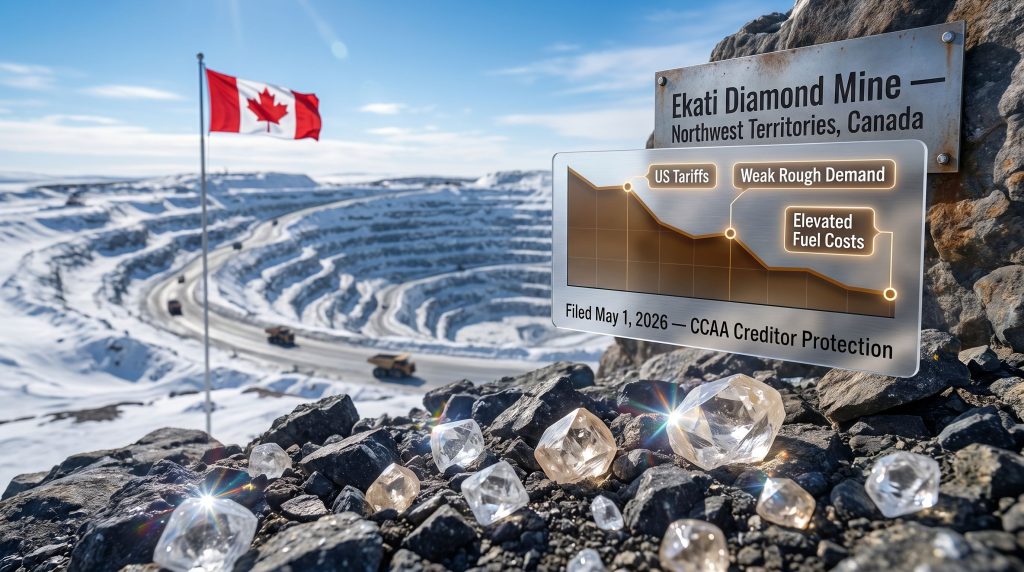
Arctic Canadian Diamond Company insolvency protection filing was not the product of a single shock. Three distinct but reinforcing pressures converged to make the filing unavoidable. Each is worth examining in depth because together they illustrate the structural fragility of high-cost natural diamond production in the current macroeconomic environment.
US Tariff Headwinds and the Diamond Import Chain
The United States remains the world's largest consumer market for diamond jewellery. Canadian rough diamonds have historically flowed through a value chain that includes cutting and polishing facilities, many of which are accessed via US-based trading relationships. Furthermore, the broader tariffs and commodity markets relationship has created additional friction throughout the pipeline, meaning the economics of Canadian rough diamond production shift materially.
The impact is not uniform across the diamond sector. Lab-grown diamond producers, whose manufacturing costs have declined sharply over the past decade, carry fundamentally different tariff exposure profiles to natural rough diamond miners. For Arctic producers relying on premium positioning of natural gems, tariff-induced margin compression arrives at precisely the moment when the price premium of natural over synthetic diamonds is already under pressure.
Prolonged Structural Weakness in Rough Diamond Demand
The rough diamond market has experienced a multi-year demand contraction that goes beyond cyclical weakness. The proliferation of laboratory-grown diamonds has introduced a substitution dynamic that did not exist a decade ago. Today, lab-grown diamonds are chemically and physically identical to natural diamonds and retail at a fraction of the price. In key consumer markets including the United States, China, and India, younger buyers in particular have demonstrated willingness to choose lab-grown alternatives.
This shift creates a structural pricing problem for natural rough diamond producers. When the end-consumer market commoditises a product through synthetic substitution, the upstream producer of the natural commodity faces a permanent, not cyclical, demand destruction. High-cost producers at the margin of the cost curve feel this dynamic most acutely.
The natural diamond industry's challenge is not a temporary demand dip. The lab-grown diamond market has grown from a niche curiosity to a structurally significant alternative, and the trajectory of that substitution does not reverse simply because commodity cycles turn.
Fuel Cost Escalation in an Energy-Intensive Arctic Environment
Remote open-pit mines of this nature carry a fuel cost burden that has no equivalent in more accessible mining jurisdictions. Ekati's location requires diesel to be transported via ice roads during the narrow winter window when surface transport is viable, with additional supply flown in during other periods. This logistics profile means that rising fuel costs, amplified by the regional cost of delivery to the Northwest Territories, land directly on the operational cost line.
Ongoing geopolitical instability has sustained elevated energy prices, and for an operation where fuel underpins not only equipment operation but also camp heating, power generation, and water treatment systems, the cumulative impact is substantial. When this cost escalation is layered on top of falling revenue from weak rough diamond prices and tariff disruption, the financial model becomes extremely difficult to sustain without restructuring intervention.
| Trigger Factor | Mechanism | Impact Type |
|---|---|---|
| US Tariffs on Natural Diamonds | Disrupts cutting/polishing pipeline economics | Revenue compression |
| Weak Rough Diamond Demand | Lab-grown substitution suppresses pricing | Structural revenue reduction |
| Elevated Fuel Costs | Energy price movements from geopolitical instability | Cost escalation |
Burgundy Diamond Mines: Parent Company Status and the Non-Applicant Stay Party Order
ASX-listed Burgundy Diamond Mines is the parent company of Arctic Canadian Diamond Company, and its position in these proceedings deserves careful analysis. Burgundy did not file for CCAA protection directly. Instead, the Supreme Court of British Columbia granted a non-applicant stay party order extending the protective stay to Burgundy as the parent entity.
In practical terms, this mechanism shields Burgundy from creditor action and legal proceedings during the restructuring period without requiring the parent company itself to become a direct applicant in the CCAA case. This is a meaningful legal tool that preserves Burgundy's operational and corporate capacity while Arctic works through its restructuring process.
Burgundy has publicly affirmed its commitment to Ekati's workforce and to the Indigenous and northern communities that depend on the mine's operation. The parent company has also acknowledged that consistent efforts to reduce costs and refocus business plans toward high-quality diamond production were insufficient to overcome the combined weight of the three macro pressures driving the filing. This candid acknowledgment is significant; it signals that the restructuring is responsive to external forces, not a symptom of operational mismanagement.
Investors monitoring Burgundy's ASX position should note that the non-applicant stay provides a degree of insulation for the parent during proceedings, but the outcome of Arctic's restructuring will have material consequences for Burgundy's consolidated financial position and strategic direction regardless.
Disclaimer: Nothing in this article constitutes financial or investment advice. Investors should conduct independent due diligence and consult qualified financial advisers before making investment decisions.
FTI Consulting as Court-Appointed Monitor: Oversight Mechanics
Under CCAA proceedings, the court appoints an independent monitor to oversee the debtor company's activities, report to the court on the progress of restructuring negotiations, and provide transparency to creditors and other stakeholders. For the Arctic Canadian CCAA filing, this role has been assigned to FTI Consulting.
FTI's mandate encompasses several distinct functions:
- Monitoring Arctic's business operations and financial activities during the stay period
- Preparing and filing reports to the Supreme Court of British Columbia on a scheduled basis
- Facilitating communication between Arctic, its lenders, and creditors
- Maintaining a publicly accessible case website at cfcanada.fticonsulting.com/ACDC/ where court documents, monitor reports, and procedural updates are published
- Ensuring that any strategic transactions or operational decisions during the restructuring comply with court orders
The monitor's role is deliberately structured to be independent of management, lenders, and creditors. This independence is the mechanism through which the court maintains oversight of a proceeding that is otherwise conducted by the debtor company rather than a trustee. For stakeholders including community groups, unsecured creditors, and employees, the monitor's public reporting obligations are a primary source of verified information about the proceeding's progress.
The next major ASX story will hit our subscribers first
A Mine That Has Been Here Before: The 2020 Dominion Precedent
What makes the Arctic Canadian Diamond Company insolvency protection filing particularly notable from an industry perspective is that Ekati has navigated CCAA proceedings before. In 2020, the mine's then-owner Dominion Diamond Mines ULC filed for creditor protection, and that proceeding ultimately resulted in Arctic Canadian Diamond Company acquiring Ekati out of the restructuring process, backed by an investor consortium that included DDJ Capital Management, Brigade Capital, and Western Asset.
The 2020 restructuring was itself shaped by a convergence of challenging conditions, including the operational disruptions of that period and pre-existing market weakness. The fact that Ekati now finds itself in a second CCAA proceeding within six years raises a question that the industry cannot easily dismiss.
Is Ekati's cost structure fundamentally viable under current market conditions, or does each restructuring cycle defer rather than resolve the underlying economic challenge of operating a high-cost Arctic diamond mine in a market being structurally reshaped by synthetic alternatives?
This is not a rhetorical question. The answer has implications not only for Ekati's future but for how investors, lenders, and strategic partners assess the risk profile of remote natural diamond assets more broadly. The recurrence of insolvency proceedings at the same asset, under different ownership, suggests that the challenge may be more structural than operational.
Strategic Alternatives Under Consideration
CCAA protection creates the space for Arctic to pursue a range of restructuring pathways. The company has stated its intention to engage lenders, creditors, and stakeholders on strategic alternatives. In the context of a CCAA mining proceeding, these alternatives typically fall into several categories:
- Financial restructuring including debt renegotiation, covenant modifications, interest deferrals, and new credit facilities that reflect the current operational and market reality
- Operational restructuring including production optimisation, selective prioritisation of higher-grade ore bodies, cost rationalisation across the mine's operational footprint, and workforce right-sizing if necessary
- Strategic transactions including a partial or full asset sale, the introduction of a new strategic investor, a joint venture arrangement, or a recapitalisation involving new equity
- Comprehensive plan of arrangement under which a restructured balance sheet and business plan are presented to creditors for approval under court supervision
The hierarchy of stakeholders in CCAA proceedings shapes which outcomes are most likely. Secured creditors hold the strongest negotiating position and their terms largely determine the available solution space. Unsecured creditors and equity holders occupy progressively weaker positions, with equity the most residually exposed to dilution or elimination in a restructuring outcome.
Implications for the Broader Natural Diamond Industry
Supply Concentration and the Canadian Premium
Global rough diamond supply is heavily concentrated across three principal sources: Russia, Botswana, and Canada. Canadian diamonds have historically commanded a reputational premium tied to their traceable, conflict-free provenance and consistent gem quality. Any prolonged disruption to Canadian supply, whether from Ekati or other operations, tightens the supply side of a market that is already grappling with demand headwinds.
For rough diamond traders and polished diamond manufacturers seeking Canadian-origin material, the CCAA filing introduces procurement uncertainty even while Ekati continues to operate. The outcome of restructuring will determine whether that supply continues, is curtailed, or changes hands.
The Lab-Grown Pressure Is Not Temporary
The demand-side context for this filing cannot be separated from the broader structural shift underway in the diamond market. Laboratory-grown diamonds have moved from approximately 1% of the global diamond jewellery market in 2015 to a meaningfully larger share by the mid-2020s, with the trajectory still pointed upward. The cost of producing lab-grown diamonds has fallen dramatically as technology has scaled, and there is no fundamental production constraint that will arrest that trend.
For natural diamond miners, particularly those at the high end of the cost curve, this dynamic translates directly into margin compression. The premium that natural diamonds commanded historically was partly based on scarcity and partly on cultural positioning. Both of those pillars are under sustained pressure.
A Pattern Emerging Across High-Cost Producers
Arctic Canadian Diamond Company is not an isolated case. The combination of weak rough pricing, synthetic substitution, global trade tariff impact, and rising operating costs in remote jurisdictions is creating stress across the high-cost tier of natural diamond production globally. Industry observers tracking this pattern will note that the competitive pressure on Arctic mirrors challenges facing other producers operating outside the most cost-advantaged tier of African and Botswana-based production.
Frequently Asked Questions: Arctic Canadian Diamond Company Insolvency Protection
Will Ekati continue operating during the CCAA proceedings?
Yes. The CCAA structure is explicitly designed to enable operational continuity. Arctic retains management control of Ekati during proceedings, and the mine remains active while restructuring negotiations proceed.
What happens to employees?
Management continuity under CCAA means existing employment is maintained during the restructuring period. Burgundy Diamond Mines has publicly committed to its workforce. The final restructuring outcome will determine longer-term employment implications.
What is the role of creditors in this process?
Creditors are subject to the court-supervised stay of proceedings, which prevents individual creditor enforcement action during the restructuring. FTI Consulting, as court-appointed monitor, manages creditor engagement and provides reporting to the Supreme Court of British Columbia.
How long do CCAA proceedings typically last?
Duration varies considerably depending on the complexity of the capital structure, the number of creditor classes involved, and whether a strategic transaction is required. Mining sector CCAA proceedings have ranged from several months to over a year. The FTI Consulting case details at cfcanada.fticonsulting.com/ACDC/ provide ongoing updates.
What does the non-applicant stay party order mean for Burgundy Diamond Mines?
It means Burgundy receives the protective benefit of the CCAA stay without being a direct applicant in the proceedings. This insulates the parent company from creditor enforcement during the restructuring period while Arctic pursues its restructuring plan.
Key Takeaways
| Factor | Detail |
|---|---|
| Filing Date | 1 May 2026 |
| Legal Mechanism | CCAA creditor protection, Supreme Court of British Columbia |
| Primary Triggers | US tariffs on natural diamonds, weak rough diamond demand, elevated fuel costs |
| Operational Impact | Ekati mine continues operating under management control |
| Court-Appointed Monitor | FTI Consulting (case website: cfcanada.fticonsulting.com/ACDC/) |
| Parent Company Status | Burgundy Diamond Mines (ASX-listed), protected via non-applicant stay party order |
| Prior Restructuring Precedent | Ekati previously restructured in 2020 under Dominion Diamond Mines ULC |
| Strategic Goal | Financial and operational restructuring through stakeholder engagement |
| Industry Context | Reflects broader structural pressures on high-cost natural diamond production |
The Arctic Canadian Diamond Company insolvency protection filing is simultaneously a company-specific event and an industry-wide signal. For stakeholders across the natural diamond value chain — from rough traders to polished manufacturers to retail jewellers — it is a reminder that the economics of natural diamond mining are being tested in ways that have no recent historical parallel. How Ekati and its parent navigate this restructuring will be closely watched by anyone with exposure to the natural diamond sector.
This article is intended for informational purposes only and does not constitute financial, legal, or investment advice. Readers should conduct independent research and seek professional advice tailored to their specific circumstances before making any financial or investment decisions.
Want to Stay Ahead of Significant ASX Mineral Discoveries Before the Broader Market?
Discovery Alert's proprietary Discovery IQ model delivers real-time alerts on high-potential ASX mineral discoveries — instantly translating complex data into actionable opportunities for traders and investors at every level. Explore historic examples of major discovery returns and start your 14-day free trial today to secure a market-leading edge.