July 29, 2026
The Geological Lottery That Argentina Is Only Beginning to Cash In
Most mining booms are discovered gradually, through decades of drilling, failed projects, and incremental capital deployment. Argentina's current transformation follows a different pattern entirely. The country is not simply expanding existing production capacity. It is activating a geological endowment that has sat largely untouched while neighbouring Chile and Peru built world-class copper and lithium industries around it.
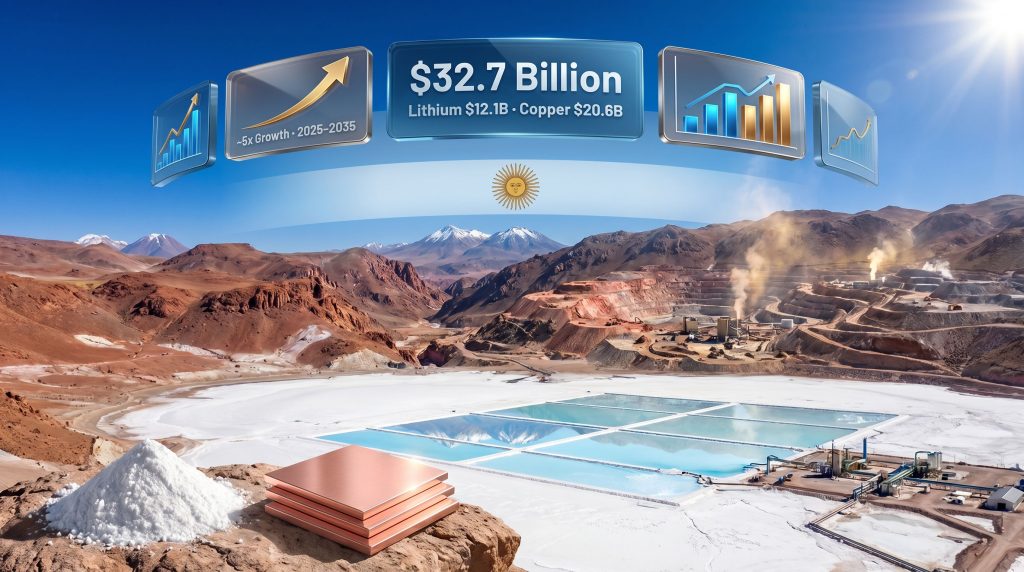
That distinction matters enormously for understanding what the Argentina lithium and copper exports forecast of $32.7 billion actually represents. It is not merely a production ramp. It is the monetisation of territory that has never been systematically explored at scale, by a country that is simultaneously rebuilding its investment architecture from the ground up.
When big ASX news breaks, our subscribers know first
What the $32.7 Billion Target Actually Means in Context
Argentina's mining minister Luis Lucero outlined the projection during a May 2026 industry event in San Juan province, describing combined lithium and copper export targets of $12.1 billion and $20.6 billion respectively over the next decade, reported by Reuters. Starting from a total mining export base of approximately $6 billion in 2025, achieving these figures would represent a greater than five-fold expansion of the country's mineral export revenues within ten years.
The sheer scale of the projected jump is easier to appreciate when broken down across both commodities.
| Mineral | 2025 Exports | 2035 Target | Production Target | Growth Multiple |
|---|---|---|---|---|
| Lithium | ~$911 million | $12.1 billion | 580,000 t LCE/year | ~13x |
| Copper | ~$13 million | $20.6 billion | 1.2–1.6 million t/year | ~1,500x |
| Combined | ~$924 million | $32.7 billion | Multiple projects | ~35x |
| Total Mining | ~$6.1 billion | ~$36+ billion | All minerals | ~6x |
The copper figures in particular underline a critical point: Argentina is not incrementally expanding a functioning copper industry. It is building one from near zero. The $13 million in copper exports recorded in 2025 represents a figure so marginal it barely registers as a line item in national trade statistics. The projection to $20.6 billion by 2035 assumes a complete industrial transformation within a single decade, contingent on approximately nine major copper projects reaching full operational capacity.
All export value projections are inherently price-sensitive. A sustained 20 to 30 percent decline in either lithium carbonate or copper prices could materially reduce the dollar value of exports even if physical production volumes are fully achieved. Volume and price scenarios should be evaluated independently when assessing these forecasts.
Understanding Argentina's Lithium Position and the Brine Extraction Advantage
Argentina's place within the global lithium supply chain is already well-established. The country ranks as the world's fourth-largest lithium producer, holds approximately 20% of global lithium reserves, and sits at the northern apex of the so-called Lithium Triangle, the geographic zone spanning Argentina, Chile, and Bolivia that contains the highest concentration of economically extractable lithium on the planet. Furthermore, the scale of Argentina lithium brines across the country's Andean provinces positions it as a uniquely strategic supplier for the coming decade.
What is less commonly understood is why Argentina's lithium is particularly well-suited to scaled production, and why the production economics differ fundamentally from lithium extracted elsewhere.
The Science Behind Salar Brine Extraction
Argentina's lithium is predominantly hosted in salt flat systems known as salars, high-altitude Andean basins where lithium-rich brines accumulate beneath the surface crust. Unlike hard rock spodumene deposits mined in Australia and other regions, lithium brine extraction involves pumping lithium-laden water to the surface and concentrating it through solar evaporation over large evaporation pond systems, before further processing into lithium carbonate or lithium chloride.
This approach carries distinct advantages:
- Lower per-tonne extraction costs compared to hard rock crushing and processing
- Simpler mechanical infrastructure requirements in early production stages
- Solar evaporation reduces energy input needs significantly
- Argentina's high-altitude Andean salars receive intense solar radiation, accelerating evaporation cycles
However, brine operations also carry constraints that affect project timelines. Evaporation pond construction at altitude is capital-intensive and slow. Water rights in arid Andean regions are subject to environmental and community scrutiny. And brine chemistry varies significantly between salars, meaning lithium grade and impurity profiles differ across projects and require customised processing solutions.
To reach the 580,000 tonne LCE annual production target, Argentina requires approximately 12 lithium projects to achieve full operational capacity simultaneously. Lithium export growth in early 2026 was reported at approximately 74.5% year-on-year, one of the fastest such growth trajectories observed globally, reflecting new project capacity coming online rather than simply price movement. If sustained at scale, this production ramp positions Argentina to supply approximately 16% of global lithium demand by 2030.
How RIGI Is Restructuring Argentina's Investment Landscape
The policy architecture enabling this minerals expansion centres on the Régimen de Incentivos para Grandes Inversiones, known by its acronym RIGI. Launched in 2024 under President Javier Milei's administration, the framework is specifically designed to attract large-scale capital into mining, energy, and agriculture by providing long-term investment certainty and fiscal stability.
By May 2026, the total value of projects approved and submitted under RIGI had reached $50.6 billion. Milei's stated ambition at the time of launch was to attract approximately $70 billion in interested projects within the first year of implementation, a target that the $50.6 billion figure indicates was substantially progressed though not yet confirmed as fully achieved.
Who Has Committed Capital Under RIGI
| Company | Country of Origin | Project | Sector |
|---|---|---|---|
| BHP | Australia | Vicuña (copper) | Copper |
| Rio Tinto | UK/Australia | Rincón (lithium) | Lithium |
| Lundin Mining | Canada | Vicuña (copper, joint) | Copper |
| McEwen Copper | Canada | Los Azules | Copper |
The presence of BHP and Rio Tinto among RIGI participants is significant beyond the capital figures involved. These are among the most risk-averse allocators of long-duration capital in global mining. Their commitments signal that RIGI's stability provisions are being taken seriously at the highest levels of institutional mining finance, and that Argentina's jurisdiction risk profile has shifted materially in the eyes of major international operators.
Rio Tinto's Rincón lithium project and BHP's participation in the Vicuña copper development alongside Lundin Mining represent the kind of Tier 1 operator validation that emerging mining jurisdictions typically spend decades trying to attract.
What RIGI Offers That Competing Frameworks Do Not
Argentina's RIGI framework represents one of the most aggressive mineral investment liberalisation initiatives undertaken in South America in recent decades. While the precise tax and depreciation terms vary by project category, the framework's core appeal lies in multi-decade stability guarantees that insulate major projects from the policy volatility that has historically deterred long-horizon mining capital in Argentina. This places it structurally alongside frameworks in Chile and Peru as a competitive destination for global mining capital, though the details of each country's arrangements differ and direct comparison requires project-specific analysis.
Argentina's Copper Opportunity: Building an Industry From the Ground Up
Copper's role in Argentina's forecast is the more remarkable of the two stories. While lithium development involves scaling an existing, proven industry, copper represents a genuine greenfield industrial creation. Indeed, the scale of the Argentina copper system now being delineated across Andean provinces suggests the country's copper endowment has been significantly underestimated.
Argentina's copper production effectively collapsed after 2018 and has remained negligible since. The $13 million in copper exports recorded in 2025 reflects this near-zero base. The path to $20.6 billion in annual copper exports by 2035 requires not just project development, but the simultaneous construction of processing facilities, roads and transport corridors, water and power infrastructure in remote high-altitude terrain, and the training of a workforce that largely does not yet exist in the required specialisations.
Key Copper Projects Driving the Forecast
| Project | Operator(s) | Province | Annual Output Target | Expected Operations |
|---|---|---|---|---|
| Vicuña | BHP + Lundin Mining | San Juan | ~395,000 t/year | ~2030 |
| Los Azules | McEwen Copper | San Juan | ~150,000 t/year | ~2030 |
| Additional pipeline | Various | Multiple | Remainder of target | 2030–2035 |
The total copper project capital pipeline stands at approximately $41 to $42 billion, with the six most advanced projects alone representing roughly $20 billion in capital investment and the potential to generate approximately $9 billion in annual export revenue at full capacity. San Juan province has emerged as the focal point of Argentina's copper development corridor, hosting both the Vicuña and Los Azules projects. In addition, ongoing Argentina copper exploration activity continues to expand the known resource base across adjacent provinces.
The critical timing constraint is that most new copper operations are not expected to begin production until around 2030. Copper projects of this scale typically carry 6 to 10 year development timelines from approval to first commercial production, meaning that decisions being made now under RIGI will determine whether the 2035 target is achievable or whether it slides toward 2037 or 2038.
The Emerging Copper Triangle Concept
Mining minister Lucero introduced the concept of a Copper Triangle spanning Argentina, Chile, and Peru during his May 2026 San Juan remarks, as reported by Reuters. The parallel to the Lithium Triangle is deliberate. Just as the Lithium Triangle defined the geography of battery metal supply throughout the 2020s, the recognition that Argentina, Chile, and Peru together contain one of the world's most significant concentrations of undeveloped copper resources has implications for how global supply chains for this critical metal could be reorganised through the 2030s and beyond.
Copper's role in global electrification makes this framing strategically relevant. Every electric vehicle requires roughly three to four times more copper than a conventional internal combustion vehicle. Grid infrastructure expansion requires copper wiring at scale. Data centres and renewable energy installations are significant copper consumers. Understanding global copper supply trends is therefore essential context for appreciating why the structural demand tailwind for copper through 2035 creates such a favourable macro backdrop for projects with the scale and quality of Vicuña and Los Azules.
The $57 to $62 Billion Capital Requirement and What It Demands
The aggregate capital expenditure required to build out Argentina's lithium and copper sectors to the targets outlined by Lucero is estimated at $57 to $62 billion. This encompasses:
- Approximately 9 copper projects requiring sustained capital deployment
- Approximately 12 lithium projects reaching full operational capacity
- Supporting infrastructure including roads, water systems, and power connections in remote Andean provinces
- Processing facilities capable of handling output at the projected production volumes
To put this number in context, $57 to $62 billion represents roughly ten times Argentina's total mining export revenues in 2025. It is a capital mobilisation task of genuinely transformational scale for a country historically constrained by foreign exchange shortages and sovereign risk perceptions that deterred long-duration capital.
The RIGI framework's $50.6 billion in approved and submitted projects represents meaningful progress toward this total, but the gap between committed project proposals and actual deployed construction capital is a critical distinction that warrants ongoing monitoring.
The next major ASX story will hit our subscribers first
Argentina's Geological Advantage: The Importance of Being Late
Perhaps the most counterintuitive element of Argentina's mining thesis is that its underdevelopment is itself a competitive advantage. Lucero described this directly when addressing the San Juan mining event, characterising the country's vast stretches of geologically prospective but minimally surveyed territory as a structural differentiator that neither Chile nor Peru can replicate at this stage of their development cycles.
In Chile, the most accessible copper porphyry deposits are already under production or in advanced development. In Peru, decades of exploration have mapped the most obvious target geology. Argentina, by contrast, retains large areas of Andean and sub-Andean geology that have received only preliminary prospecting. The implication is a multi-decade exploration upside that does not exist to the same degree in more mature regional mining jurisdictions.
This argument has geological credibility. The Andes mountain belt hosts one of the world's great copper metallogenic provinces, stretching from southern Peru through Chile and into northwestern Argentina. The section of this belt that crosses Argentine territory is among the least explored, suggesting that currently known resources represent only a fraction of total endowment. Argentina's mining revival has consequently attracted a wave of global capital seeking exposure to this underexplored geological frontier.
Risk Factors That Could Derail the Forecast
Three Core Execution Risks
-
Infrastructure deficit in remote terrain. Mining at altitude in Argentina's Andean provinces requires road, rail, water, and power access that is either absent or severely limited. The cost of providing this enabling infrastructure adds to project capital requirements and extends timelines.
-
Political continuity risk. RIGI's attractiveness depends on its durability across future administrations. Argentina has a well-documented history of policy reversal on investment frameworks. The degree to which RIGI terms are embedded in contract law versus administrative policy will determine their resilience.
-
Development timeline compression. Achieving the 2035 export targets requires that construction commenced now reaches full production within the decade. Any systematic slippage of two to three years across the copper project portfolio would materially reduce the 2035 figures without necessarily invalidating the longer-term thesis.
Commodity Price Sensitivity
The export values in the forecast are a product of both volume and price. A 20 to 30 percent sustained decline in lithium carbonate prices or copper prices would reduce the dollar value of exports even if every tonne of production target is met. The lithium market in particular has demonstrated extreme price volatility across the 2020s, with lithium carbonate prices rising more than tenfold between 2020 and 2022 before correcting sharply in 2023 and 2024. The recovery trajectory matters for the ultimate revenue realisation of Argentina's lithium investment pipeline.
Environmental and Water Rights Considerations
Brine extraction in Andean salt flats raises genuine environmental questions around water consumption and ecosystem impact in high-altitude wetland systems. Argentina's northern provinces, including Jujuy, Salta, and Catamarca, contain internationally recognised biodiversity in their salar systems. Navigating community and regulatory consent for water access across 12 simultaneously developing lithium projects represents a material social licence challenge that is often underweighted in production forecasts.
What $32.7 Billion in Exports Does to Argentina's Economy
The macroeconomic consequences of achieving even a significant portion of the Argentina lithium and copper exports forecast are profound for a country whose structural economic vulnerabilities have historically centred on foreign exchange scarcity and over-reliance on agricultural commodity cycles.
- Mining revenues at this scale could generate a $7 billion annual trade surplus from the mining sector alone
- Approximately 40,000 direct and indirect jobs could be created across the lithium and copper project pipeline
- Foreign exchange earnings of this magnitude would materially reduce Argentina's structural dependency on soybean and corn export cycles for dollar revenues
- Sovereign debt servicing capacity would improve substantially if export projections are realised
The transition from a foreign-exchange constrained agricultural exporter to a diversified critical minerals powerhouse represents one of the most significant potential economic repositionings of any emerging market economy in the current decade. Whether the timeline holds, and whether the capital continues to flow, will define whether that repositioning remains aspirational or becomes structural. Analysts tracking Argentina's mining export outlook note that a sixfold rise in total mining exports by 2035 remains achievable, provided project timelines and policy settings hold firm.
Frequently Asked Questions: Argentina Lithium and Copper Exports Forecast
What is Argentina's combined lithium and copper export forecast?
Argentina's mining minister Luis Lucero has projected combined lithium and copper exports of $32.7 billion within ten years, comprising $12.1 billion from lithium and $20.6 billion from copper, up from a combined base of under $1 billion in 2025.
When will Argentina's major copper projects begin production?
The most advanced copper projects, including Vicuña (BHP and Lundin Mining) and Los Azules (McEwen Copper), are both anticipated to begin operations around 2030, consistent with typical 6 to 10 year development timelines from project approval to first commercial production.
What is RIGI and what role does it play?
RIGI is Argentina's Large Investment Incentive Regime, launched in 2024 under President Javier Milei, designed to attract large-scale capital into mining, energy, and agriculture through long-term fiscal and regulatory stability provisions. As of May 2026, the value of projects approved and submitted under RIGI had reached approximately $50.6 billion.
What is the Copper Triangle concept?
The Copper Triangle refers to the emerging recognition that Argentina, Chile, and Peru collectively represent one of the world's most significant undeveloped copper resource corridors. Argentina's entry into large-scale copper production through the 2030s has the potential to reshape global copper supply chains in a manner structurally analogous to how the Lithium Triangle defined battery metal supply through the 2020s.
What are the main risks to Argentina's mining forecasts?
Key risks include infrastructure gaps in remote Andean provinces, the durability of RIGI-aligned policy across future administrations, the length of copper project development timelines, environmental and water access considerations in brine lithium operations, and sensitivity to global commodity price movements for both copper and lithium.
Key Metrics at a Glance
| Metric | Figure |
|---|---|
| Combined lithium and copper export target (10 years) | $32.7 billion |
| Lithium export target | $12.1 billion |
| Copper export target | $20.6 billion |
| Total mining exports 2025 | ~$6.1 billion |
| Implied growth multiple | ~5x |
| Total RIGI-approved project value | $50.6 billion |
| Total capex requirement | $57–62 billion |
| Lithium production target | 580,000 t LCE/year |
| Copper production target | 1.2–1.6 million t/year |
| Projected job creation | ~40,000 |
| Major copper projects operational | ~2030 |
| Lithium export growth (early 2026, YoY) | ~74.5% |
This article is based on statements made by Argentina's mining minister Luis Lucero as reported by Reuters via Mining Weekly on 7 May 2026, supplemented by publicly available data on Argentina's mining sector, project pipeline, and the RIGI investment framework. Forecast figures represent government projections and are subject to commodity price movements, project development timelines, and policy continuity. Nothing in this article constitutes investment advice.
Want to Track the Next Major Mineral Discovery Before the Broader Market Does?
Argentina's lithium and copper transformation signals the kind of structural shift that historically produces significant discovery moments on the ASX and beyond — and Discovery Alert's proprietary Discovery IQ model ensures subscribers receive real-time alerts the moment significant mineral discoveries are announced, turning complex geological and commodity data into actionable insights. Explore historic examples of major discovery returns and begin a 14-day free trial to position ahead of the market.