July 20, 2026
The Battery Economy's Raw Material Fault Line Runs Through the Andes
Every electric vehicle sold today, every grid-scale battery storage installation commissioned, and every consumer electronics device shipped depends on a supply chain that ultimately traces back to a handful of geological formations scattered across one of the world's most remote and inhospitable landscapes. The high-altitude salt flats of South America's Lithium Triangle hold a disproportionate share of the world's known lithium brine reserves, and the decisions being made right now about how to extract and process those resources will shape the battery economy for decades.
Argentina's Catamarca province sits at the heart of this unfolding story. A cluster of capital commitments now totalling billions of dollars is transforming what was once considered a frontier mining jurisdiction into one of the most consequential lithium production hubs on the planet. The approval of a US$709 million Phase 2 expansion at the Tres Quebradas lithium project is the latest and largest signal that this Argentina lithium expansion project in Catamarca is accelerating.
When big ASX news breaks, our subscribers know first
What Makes Catamarca's Lithium Geology So Distinctive
Understanding why capital is flowing into Catamarca at this scale requires appreciating a fundamental distinction that is frequently overlooked in mainstream coverage of the lithium sector: the difference between hard-rock spodumene mining and brine-based lithium extraction.
Australia dominates global lithium production through hard-rock spodumene deposits, which require conventional open-pit or underground mining, crushing, and flotation processing before lithium can be isolated. The capital and energy intensity of this pathway is considerable. Brine operations, by contrast, pump lithium-rich subsurface water to the surface and concentrate it through solar evaporation in large engineered ponds before further chemical processing into lithium carbonate or lithium hydroxide.
The lithium brine extraction model carries several structural advantages worth understanding:
- Lower energy intensity during the extraction phase, as solar evaporation does much of the concentration work
- Lower capital cost per tonne at comparable production scales compared to hard-rock operations
- Scalability, since increasing output often involves expanding evaporation pond capacity and adding processing throughput rather than sinking new mine development capital
- Long resource life, with Tres Quebradas' subsurface brine resource estimated to support more than 19 years of sustained production
The trade-off is time. Brine operations require lengthy evaporation cycles, typically many months, before concentrated brine is ready for processing. This creates production lag between investment and revenue that hard-rock operations can sometimes avoid.
Catamarca's salars, including the Salar Tres Quebradas and Salar del Hombre Muerto, are notable not only for their lithium concentration but for the relative simplicity of their brine chemistry compared to some competing deposits in Chile and Bolivia. Lower concentrations of magnesium, which competes with lithium in processing and significantly increases purification costs, make certain Catamarca brines more economically attractive than raw lithium grade comparisons alone would suggest. Furthermore, the Argentina lithium brine market continues to attract increasingly sophisticated investor interest as a result of these geological advantages.
Tres Quebradas Phase 2: Scale, Infrastructure, and the Production Roadmap
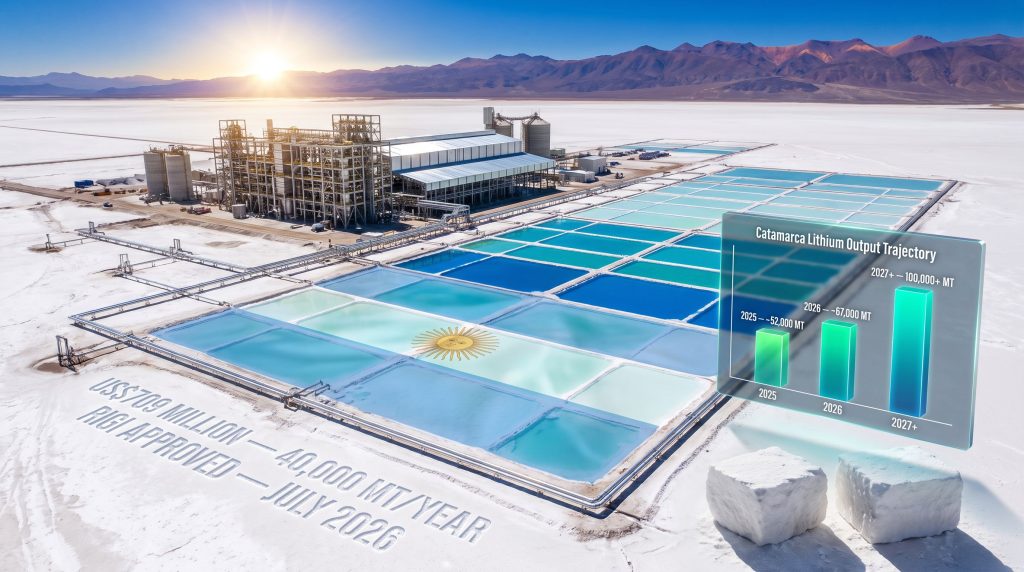
The Tres Quebradas project, operated by Liex, the Argentine subsidiary of China's Zijin Mining, reached a critical milestone in July 2026 when Argentina's Large Investment Committee approved the Phase 2 expansion under the country's RIGI framework. The approval covers a US$709 million capital program targeting an additional 40,000 metric tonnes of lithium carbonate equivalent (LCE) annual production capacity.
The scale of what Phase 2 involves physically is substantial. Infrastructure components include:
- A new lithium carbonate processing plant engineered for 40,000 MT annual throughput
- An expanded network of brine extraction wells to increase subsurface draw rates
- Pipeline systems connecting extraction fields to processing infrastructure
- Advanced purification systems designed to achieve battery-grade lithium carbonate specifications
- Flood control and civil infrastructure suited to the challenging high-altitude Puna terrain
- Road networks and auxiliary industrial facilities for long-term operational logistics
Phase 1 of the project commenced production in September 2025 at 20,000 MT per year. Zijin has indicated plans to lift that baseline output to approximately 30,000 MT through engineering optimisations before Phase 2 comes online, creating a stepped capacity expansion rather than a single large-scale ramp.
| Development Phase | Capacity Addition | Cumulative Capacity |
|---|---|---|
| Phase 1 (September 2025) | 20,000 MT/year | 20,000 MT/year |
| Technical Upgrade (planned) | +10,000 MT/year | 30,000 MT/year |
| Phase 2 (RIGI approved July 2026) | +40,000 MT/year | 60,000–70,000 MT/year |
| Potential Phase 3 | +20,000–30,000 MT/year | Up to 80,000–100,000 MT/year |
Note: Capacity figures are based on announced project plans. Actual ramp-up timelines may vary depending on construction progress, regulatory processes, and operational conditions.
How RIGI Works and Why It Matters for the Argentina Lithium Expansion Project in Catamarca
Argentina's Régimen de Incentivo para Grandes Inversiones, universally referred to as RIGI, is a structured concession framework designed to attract large-scale foreign and domestic investment by offering a defined package of fiscal and regulatory protections.
The key incentive categories RIGI provides to qualifying projects include:
- Long-term tax stability guarantees that protect operators against legislative changes affecting their fiscal position across multi-decade project lifecycles
- Customs duty exemptions on imported capital equipment, directly reducing the cost of constructing processing plants and extraction infrastructure
- Foreign exchange flexibility, allowing operators to repatriate a negotiated portion of export revenues under defined terms
- Regulatory certainty extending across the operational life of qualifying projects
The formal pathway to RIGI inclusion follows a defined sequence:
- Application submission covering resource estimates, environmental assessments, and economic modelling
- Committee review against RIGI eligibility thresholds and investment criteria
- Committee approval representing the final pre-admission stage reached by Tres Quebradas Phase 2 in July 2026
- Formal registration into the RIGI program, triggering access to the full incentive package
- Construction commencement under the protection of the regulatory framework
Once formally registered, Tres Quebradas Phase 2 will become the 21st project admitted under RIGI, bringing the total committed investment portfolio across all approved projects to approximately US$46.7 billion.
This figure is significant. It illustrates that RIGI has succeeded in attracting capital at scale from both Chinese state-linked mining companies and major Western miners, suggesting the framework has achieved credibility across otherwise competing investor categories. For a broader perspective on Argentina's investment opportunity in the Lithium Triangle, Argentina's own trade promotion resources offer additional context on the framework's design intent.
Catamarca's Broader Project Pipeline: Tres Quebradas in Context
Tres Quebradas is the largest single capital commitment in Catamarca's current lithium expansion wave, but it is far from the only project reshaping the province's production profile.
| Project | Operator | Investment | Planned Capacity | Status |
|---|---|---|---|---|
| Tres Quebradas Phase 2 | Zijin Mining / Liex | US$709 million | +40,000 MT/year | RIGI approved July 2026 |
| Fénix Expansion | Rio Tinto | US$530 million | +9,500 MT/year (to 41,500 MT total) | RIGI approved March 2026 |
| Sal de Vida | Rio Tinto | US$700 million | 15,000 MT/year | Production expected H2 2026 |
| Hombre Muerto West | Galan Lithium | US$217 million | 20,850 MT LCE/year | RIGI approved July 2025 |
| Archibarca | Lithiumcycle / LTA | Undisclosed | Up to 20,000 MT (3 stages) | Development stage |
The diversity of capital sources in this table deserves attention. Rio Tinto represents one of the world's largest mining companies pursuing a Western-aligned supply chain strategy. Zijin Mining represents Chinese state-linked capital securing upstream battery material assets. Galan Lithium represents a smaller-capitalisation developer. The coexistence of these different investor types suggests the investment case for Catamarca lithium is broadly compelling across commercial frameworks, not confined to any single strategic logic.
The Zijin Ownership Factor: Supply Chain Geopolitics in the Puna
The Tres Quebradas ownership history is instructive for understanding the broader dynamics of the global battery supply chain. Canadian developer Neo Lithium conducted the original resource delineation work and advanced the project through early feasibility stages. The Zijin Mining expansion strategy through the acquisition of Neo Lithium transferred full ownership to one of China's most acquisitive mining groups, with Liex established as the Argentine operating entity.
This ownership structure creates a set of strategic scenarios that carry real consequences for battery supply chains outside China:
Scenario A: Integrated supply chain consolidation
At full development capacity of up to 80,000 MT annually, Tres Quebradas could supply a material share of mid-tier Chinese battery cell manufacturers' lithium carbonate requirements, further consolidating Chinese control over a critical battery input.
Scenario B: Reduced optionality for Western buyers
If Zijin's Catamarca output is preferentially directed toward Chinese customers, European and North American battery manufacturers seeking supply chain diversification face structurally fewer alternatives within Argentina's Lithium Triangle, potentially increasing the commercial premium on Rio Tinto's competing Catamarca assets.
Scenario C: Argentine regulatory risk
Argentina's policy environment has historically been subject to significant volatility across political cycles. The 19-plus year resource life at Tres Quebradas makes the long-term durability of RIGI's protections a material investment risk factor. Future administrations could revisit export tax structures or impose domestic processing requirements, and the RIGI framework's enforceability across government transitions remains an unresolved question for long-term project stakeholders.
The next major ASX story will hit our subscribers first
Environmental and Judicial Dimensions of Catamarca Lithium Development
How Does Water Use Affect Brine Operations?
The water dimension of brine extraction is the central environmental debate in Lithium Triangle operations globally, and Catamarca is not exempt. High-altitude Puna ecosystems are extremely sensitive hydrological environments where brine aquifers may be connected, at varying degrees, to freshwater systems that support indigenous communities and fragile wetland habitats.
A judicial injunction previously imposed restrictions on new mining permits at Salar del Hombre Muerto, the location of Rio Tinto's Fénix project, reflecting the intersection of indigenous water rights litigation and the province's expanding extraction footprint. The anticipated resolution of this restriction has been tied to the implementation of a formal provincial hydrological monitoring program.
This governance evolution matters for the entire Catamarca project pipeline. Operators are increasingly expected to demonstrate hydrological neutrality, meaning brine extraction and reinjection practices that preserve the volumetric and chemical integrity of subsurface water systems. Projects that fail to satisfy this standard face regulatory and reputational risks that could materially affect their operational licences regardless of RIGI status.
In addition, innovations in direct lithium extraction technology are increasingly being evaluated as a means of reducing the hydrological footprint of brine operations, potentially offering a pathway to greater water stewardship across the Puna's sensitive salar environments.
Projected Economic Impact and What It Means for Catamarca Province
The economic case for Tres Quebradas Phase 2 extends well beyond the capital investment figure itself.
| Economic Metric | Projected Figure | Timeframe |
|---|---|---|
| Total capital investment | US$709 million | Construction phase |
| Direct and indirect employment | ~4,400 jobs | Operational phase |
| Annual export revenue contribution | ~US$400 million | At full Phase 2 capacity |
| RIGI total committed portfolio | ~US$46.7 billion | All 21 approved projects |
Catamarca is one of Argentina's least-populated and least-industrialised provinces. The employment multiplier from large-scale formal industrial operations is disproportionately significant in this context. Combined with the employment projections from Rio Tinto's Sal de Vida and Fénix expansions, Galan Lithium's Hombre Muerto West project, and development-stage assets, the cumulative labour market impact across Catamarca's lithium sector could exceed 10,000 positions by 2027.
The approximately US$400 million in projected annual export revenues from Tres Quebradas Phase 2 alone is also significant for Argentina's national economic position. Argentina has faced chronic current account pressures over multiple economic cycles, making hard currency export earnings from a non-agricultural commodity sector genuinely valuable at the macroeconomic level.
Catamarca's Production Trajectory: Becoming a Benchmark Jurisdiction
Can Catamarca Compete With the World's Largest Lithium Reserves?
Taking the announced project timelines at face value, Catamarca's aggregate lithium carbonate production capacity is on a trajectory that would place the province among the most significant single-jurisdiction lithium production hubs globally within this decade. Indeed, when considered alongside countries with the largest lithium reserves, Argentina's growing output profile commands serious attention from battery supply chain strategists.
| Year | Estimated Catamarca Capacity (LCE/year) | Key Drivers |
|---|---|---|
| 2025 | ~52,000 MT | Fénix Phase 1 (~32,000 MT) + Tres Quebradas Phase 1 (20,000 MT) |
| 2026 | ~67,000 MT | Sal de Vida online (15,000 MT), Fénix expansion (+9,500 MT) |
| 2027+ | 100,000+ MT | Tres Quebradas Phase 2 (+40,000 MT), HMW (+20,850 MT) |
Note: Estimates are indicative based on publicly announced project timelines. Actual production ramp-up rates are subject to construction schedules, commissioning outcomes, and market conditions. This does not constitute investment advice.
Three outcomes will ultimately determine whether Catamarca achieves this trajectory:
- Construction and commissioning velocity for Phase 2 specifically, given the complexity of building large-scale processing infrastructure at high altitude in a remote environment
- Transparency around off-take destination for Tres Quebradas output, which will signal whether Catamarca's expanded production reaches global battery supply chains equitably or concentrates within Chinese-aligned downstream channels
- The long-term durability of RIGI protections across Argentina's inevitably shifting political landscape, which is now a systemic question for a programme with nearly US$47 billion in committed capital across 21 projects
However, the broader question of environmental accountability and community consent will prove equally decisive. The environmental challenges facing lithium operations in Argentina, particularly around water resources, represent a governance dimension that no capital framework alone can resolve. This Argentina lithium expansion project in Catamarca is, in the end, more than a single project milestone. It is a data point in the ongoing and accelerating contest over who controls the upstream inputs to the global battery economy, and which jurisdictions prove capable of converting geological endowment into lasting industrial value. Catamarca is making its bid.
Disclaimer: This article contains forward-looking projections and scenario analyses based on publicly available information. Production capacity estimates, employment projections, and revenue forecasts are subject to material uncertainty. Nothing in this article constitutes financial or investment advice. Readers should conduct independent due diligence before making any investment decisions.
Want to Stay Ahead of the Next Major Resource Discovery?
Discovery Alert's proprietary Discovery IQ model delivers real-time alerts on significant ASX mineral discoveries — instantly turning complex resource data into actionable investment insights for both short-term traders and long-term investors. Explore historic examples of exceptional discovery returns or visit the Discovery Alert home page to begin your 14-day free trial and secure a market-leading edge.