July 17, 2026
The Battery Mineral Race Nobody Saw Coming From Central Africa
For decades, the conventional wisdom around lithium supply held that the world's decisive reserves sat beneath the salt flats of Chile, Argentina, and Bolivia, with hard-rock spodumene operations in Western Australia filling the gaps. The Democratic Republic of Congo barely featured in that conversation, despite sitting atop what geologists had long recognised as one of the most mineralogically significant lithium deposits on the planet. That calculus has now changed. The commencement of Congo lithium exports to China in June 2026 marks not just a new chapter for the DRC but a structural reconfiguration of how the global battery supply chain sources its most critical input material.
Understanding why this moment matters requires looking beyond the shipment itself and examining the interlocking forces of Chinese capital strategy, African resource politics, and the unresolved tension between attracting foreign investment and capturing domestic economic value.
When big ASX news breaks, our subscribers know first
Why Manono Commands Attention Far Beyond Its Geography
The Geological Case for Significance
The Manono deposit in the DRC's Tanganyika province is consistently described by mining analysts as one of the largest lithium deposit resources on earth. To appreciate why that matters, it helps to understand the fundamental distinction between the two primary forms of lithium mineralisation.
Brine-based lithium, which dominates production in South America's Lithium Triangle, is extracted by pumping mineral-rich groundwater into evaporation ponds over extended periods. The process is relatively low-cost but water-intensive and geographically constrained. For a deeper understanding of how lithium brines explained compare to hard-rock sources, the distinction becomes particularly important when assessing supply chain resilience.
Hard-rock lithium, by contrast, occurs in pegmatite formations where the mineral spodumene crystallises directly into the rock matrix. Spodumene extraction allows material to be mined conventionally, processed into concentrate on-site, and then refined into battery-grade materials with a more predictable timeline and consistent grade profile.
Hard-rock sources have become increasingly strategically important for battery manufacturers that require supply chain predictability rather than exposure to the seasonal and hydrological variability that can affect brine operations. Manono's scale, combined with its hard-rock character, places it in a category of global strategic importance that few deposits anywhere can claim.
What makes the DRC's emergence as a lithium exporter particularly significant is that the country was already the world's dominant cobalt producer and a major copper source. Lithium's addition completes a near-comprehensive footprint across the three minerals most fundamental to lithium-ion battery chemistry.
How Chinese Capital Moved Faster Than the Competition
Zijin Mining's ability to move from project acquisition to first export within a compressed development timeline reflects both the quality of the deposit and the structural advantages that Chinese mining companies have developed through decades of African resource engagement.
The project's ownership architecture is itself revealing. Zijin holds 54.9% of the Manono joint venture, with state-owned Cominiere holding 35.1% and the Congolese government retaining a 10% stake. This structure is not coincidental. It follows a well-established Chinese investment model in African resource development that aligns majority foreign capital with meaningful sovereign participation, creating shared incentives between the investor and the host government.
A key policy lever that materially altered the commercial calculus was the DRC-China mining agreement that took effect on May 1, 2026, introducing duty-free access for Congolese mineral exports destined for China. This framework did not emerge in isolation. It represents the latest iteration of a long-running Chinese strategy of embedding preferential trade terms within resource-rich African economies, a model that has already proven its effectiveness across the DRC's cobalt and copper sectors through operators including CMOC and Huayou Cobalt.
The duty-free access arrangement functions as a structural cost advantage for Chinese buyers, effectively widening the price gap between China-bound exports and any competing destination market. For project economics, this is not a minor adjustment; it reshapes the entire export revenue model.
Decoding the Export Product: What Is Actually Being Shipped
Crude Lithium Sulfate and the Value Chain Problem
A technically important distinction sits at the centre of the DRC's current lithium export story. The material being shipped is not battery-grade lithium carbonate, the refined product that flows directly into cathode manufacturing for electric vehicle batteries. It is crude lithium sulfate, an intermediate-stage material that occupies a position roughly halfway between raw spodumene ore and the finished chemical inputs that battery manufacturers actually require.
The economic implication of this distinction is substantial. Consider the simplified processing journey:
| Processing Stage | Output Material | Relative Value Captured | Processing Location |
|---|---|---|---|
| Stage 1 | Raw spodumene ore | Very low | DRC (Manono mine) |
| Stage 2 | Spodumene concentrate | Moderate | DRC (Manono plant) |
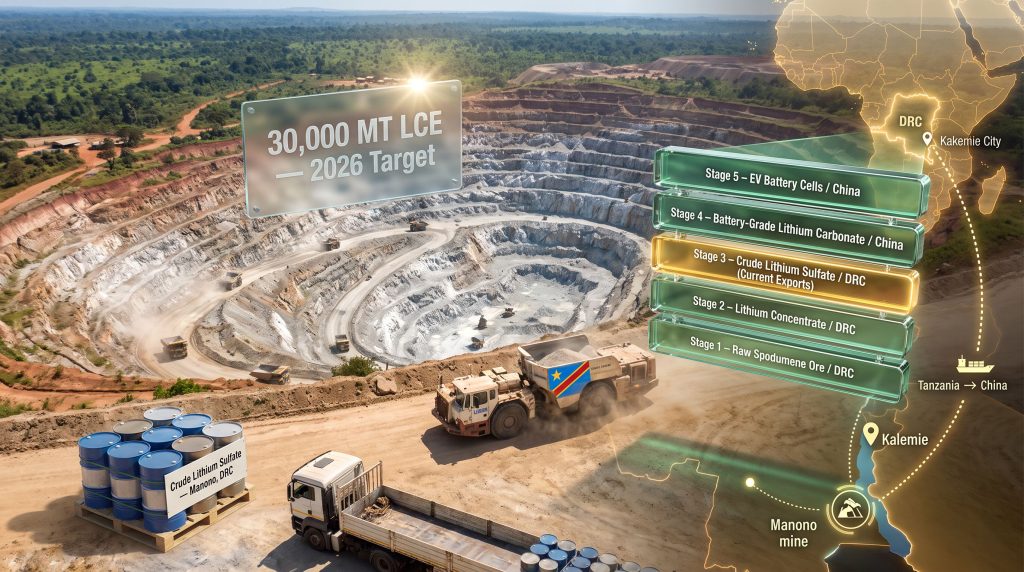
| Stage 3 | Crude lithium sulfate | Medium | DRC (current exports) |
| Stage 4 | Battery-grade lithium carbonate | High | China (refineries) |
| Stage 5 | EV battery cells | Highest | China / South Korea / Japan |
Exporting at Stage 3 rather than Stage 4 means the DRC is currently capturing only a fraction of the total economic value generated by its own lithium resource. The majority of the value-adding chemistry, and the revenue it generates, takes place in Chinese refining facilities after the material leaves African soil.
The 2026 Production and Logistics Framework
Zijin's processing plant entered production in May 2026, arriving one month ahead of its scheduled commissioning date. The first export shipments commenced in June 2026, with all material from the project currently destined for China. According to reporting on Congo lithium exports, sources with direct knowledge of operations confirmed both the June export commencement and the exclusive China destination of current shipments.
The logistics corridor presents its own set of complexities. Concentrate is transported overland by truck from Manono to Kalemie, a city situated on the western shore of Lake Tanganyika. From Kalemie, material moves onward via Tanzania before making its way to Chinese refineries. Transit time is substantial: material shipped from mid-2026 is expected to arrive at Chinese processing facilities by October 2026, indicating a roughly four-month journey from mine gate to refinery intake.
Zijin has set a 2026 production target of 30,000 metric tons of lithium carbonate equivalent (LCE) from the Manono operation, with initial shipment volumes consistent with a trial-phase ramp-up. Tens of thousands of tons of concentrate have been produced on-site ahead of and alongside the initial export phase.
December 2026: The Inflection Point for Higher-Value Exports
The most commercially significant near-term milestone for the project is Zijin's plan to commission downstream smelting and refining facilities by December 2026. Furthermore, the adoption of direct lithium extraction technologies in adjacent operations signals a broader shift toward more efficient processing methodologies across the continent. If executed on schedule, this would shift the DRC's lithium export profile from crude lithium sulfate toward battery-grade lithium carbonate, fundamentally altering the revenue equation.
This transition should be understood as a planned but not yet realised upgrade. December 2026 represents a critical checkpoint for investors and policymakers alike. Whether the commissioning proceeds on schedule, and whether the quality of the refinery output meets international battery-grade specifications, will determine how quickly the DRC begins capturing a meaningfully larger share of its own lithium value chain.
China's Critical Mineral Footprint in the DRC Is Now Complete
Cobalt, Copper, Lithium: The Three Pillars of Battery Chemistry
The strategic significance of Zijin's Manono exports extends well beyond the lithium market. Viewed alongside China's existing DRC operations, the development completes what is effectively a comprehensive Chinese footprint across the three minerals most critical to lithium-ion battery manufacturing:
- Cobalt: CMOC operates major cobalt and copper mines in the DRC, making it one of the world's largest cobalt producers. Huayou Cobalt has also built significant DRC cobalt processing and supply chain integration.
- Copper: Multiple Chinese-linked operations contribute to the DRC's position as Africa's largest copper producer.
- Lithium: Zijin's Manono operation now adds the third leg, creating a near-complete Chinese supply chain position in the DRC's critical mineral economy.
For battery manufacturers in China seeking to vertically integrate their raw material supply, this concentration of Chinese-controlled production within a single African country represents a remarkable strategic achievement, assembled over roughly two decades of incremental investment.
The Competitive Disadvantage Now Facing Western Buyers
The duty-free access agreement that took effect in May 2026 does not apply universally. It is specifically structured to benefit Chinese buyers of Congolese minerals, creating a preferential trade environment that non-Chinese buyers cannot access on equivalent terms.
This matters directly for KoBold Metals, the US-backed exploration company that holds rights on a block adjacent to the Zijin-operated Manono zone. KoBold has formally delayed construction on its adjacent Manono block until outstanding legal disputes over project ownership are fully resolved. That delay, whatever its legal origins, now compounds into a broader commercial disadvantage: by the time Western-backed operators resolve their legal position, Zijin will have established:
- Operational logistics corridors from Manono to Kalemie to Tanzania
- Established refinery integration relationships at Chinese processing facilities
- A commissioned downstream refinery (if the December 2026 target is met)
- A production track record that strengthens regulatory and community relationships in the DRC
Incumbency in resource development is not merely a legal concept. It is a relational, operational, and infrastructural reality that is extremely difficult for late-arriving competitors to displace.
The Resource Nationalism Paradox: Is Exporting Intermediate Lithium Good Enough?
Africa's Structural Export Trap
The DRC's lithium export story plays out against a backdrop that African economists have analysed with increasing urgency: the continent holds extraordinary concentrations of global critical mineral reserves, yet the nations producing those minerals consistently rank among the world's least economically developed. This is not a coincidence. It is a structural outcome of exporting raw or semi-processed materials while the value-adding stages of refining, manufacturing, and technology application remain located offshore.
The economics are stark. A tonne of raw spodumene concentrate trades at a fraction of the value of an equivalent tonne of battery-grade lithium carbonate. Every processing step that occurs in China rather than in the DRC represents economic value that leaves the African continent permanently.
Zimbabwe's Lithium Export Ban: Lessons and Limits
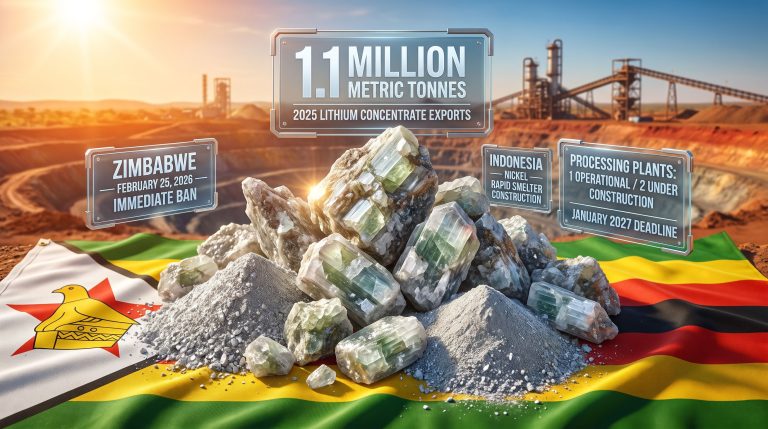
Zimbabwe took a deliberate policy stance on this issue by implementing a ban on the export of raw, unprocessed lithium, with the explicit objective of forcing the construction of domestic refining capacity rather than allowing economic value to flow offshore. Comparing Zimbabwe's approach against the DRC's current model highlights meaningfully different strategic choices:
| Policy Dimension | Zimbabwe | DRC (Current) |
|---|---|---|
| Export restriction on raw lithium | Yes, ban in place | No, exports permitted |
| Domestic refining mandate | Enforced | Planned (Dec 2026 target) |
| Value chain capture | Higher in theory | Lower currently |
| Foreign investment model | Selective | Chinese-dominated |
| Short-term revenue risk | Higher disruption | Lower disruption |
Zimbabwe's export ban has not been without implementation challenges. The assumption that restricting raw exports automatically catalyses domestic industrial development has not proven uniformly true. Capital, technical expertise, and infrastructure must accompany the policy intent for value addition to actually occur. This offers a cautionary note for those who view export restrictions as sufficient on their own.
The Cocoa Parallel and What It Signals for Lithium
In July 2026, leaders and representatives from major cocoa-producing African nations gathered in Abuja, Nigeria, to formalise the Cocoa Value Addition Alliance. The nations represented collectively account for approximately 70% of the world's cocoa bean supply. The alliance was explicitly designed to phase out raw bean exports in favour of domestic processing and manufacturing, with Nigeria immediately following the summit by announcing a strict ban on raw cocoa bean exports.
The cocoa movement carries a direct analytical implication for lithium: if agricultural commodity producers are willing to accept short-term trade disruption to capture processing margins, the argument becomes even more compelling for critical minerals where processing margins are substantially larger and strategic leverage over importers is considerably higher.
The question confronting the DRC is not whether to pursue greater value chain participation, but at what pace, under whose industrial terms, and at what cost to near-term export revenue. The December 2026 refining facility is the first test of whether the DRC can credibly advance from exporting intermediate chemicals to exporting finished battery-grade materials.
Competitive Landscape: The Contested History of Manono
The AVZ Minerals Dispute and Its Legacy
The Manono project's path to production has been anything but straightforward. The AVZ legal dispute over the DRC government's decision to revoke the exploration licence previously held by Australian miner AVZ Minerals remains contested, as reported by Reuters. This decision created a complex legal and reputational environment around the project's ownership structure that has not been fully resolved.
The AVZ dispute illustrates with unusual clarity the sovereign risk dimension of operating in the DRC. For Western institutional investors accustomed to stable regulatory frameworks, this history represents a meaningful consideration that geological quality alone cannot offset.
Scenario Analysis: Three Futures for Congo Lithium Exports
Looking forward, three distinct trajectories emerge for the DRC's role in global lithium supply:
Scenario 1: Chinese Consolidation (Base Case)
Zijin commissions its December 2026 refining facility on schedule, transitions to battery-grade lithium carbonate exports, and deepens integration with Chinese battery manufacturers. KoBold Metals delays persist. The DRC becomes structurally embedded in China's lithium supply chain, mirroring its existing cobalt role.
Scenario 2: Competitive Bifurcation (Moderate Probability)
KoBold Metals resolves its legal disputes by mid-2027 and advances construction, creating a dual-operator dynamic at Manono. The DRC leverages competing Chinese and Western interests to negotiate improved royalty terms and domestic processing mandates. Global lithium supply receives a material boost from parallel development tracks.
Scenario 3: Resource Nationalism Escalation (Lower Probability, High Impact)
Emboldened by the cocoa value-addition movement and Zimbabwe's precedent, the DRC implements restrictions on crude lithium sulfate exports, mandating further domestic refining before export. Chinese operators accelerate their December 2026 refining facility; Western operators face steeper entry barriers. The DRC captures a larger share of value chain economics but at the cost of near-term revenue and potential investor caution.
The next major ASX story will hit our subscribers first
FAQ: Congo Lithium Exports to China
When did Congo lithium exports to China begin?
The DRC's first-ever lithium exports commenced in June 2026, following the commissioning of Zijin Mining's processing plant at the Manono project in May 2026.
What product is the DRC currently exporting?
Current exports consist of crude lithium sulfate, an intermediate material between raw spodumene concentrate and battery-grade lithium carbonate. Higher-value battery-grade exports are planned following the commissioning of downstream refining facilities targeted for December 2026.
What is Zijin's 2026 production target at Manono?
Zijin has set a 2026 production target of 30,000 metric tons of lithium carbonate equivalent (LCE) from the Manono project.
How is the material transported from Manono to China?
Concentrate is trucked overland from Manono to Kalemie, then shipped onward via Tanzania to Chinese refineries. Material is expected to arrive at Chinese facilities by October 2026.
Who owns the Manono project?
The Manono joint venture is owned 54.9% by Zijin Mining, 35.1% by state-owned Cominiere, and 10% by the Congolese government.
Why has KoBold Metals not begun construction at its adjacent Manono block?
KoBold Metals has delayed construction pending full resolution of outstanding legal disputes over project ownership.
Does a preferential trade arrangement exist between the DRC and China for mineral exports?
A DRC-China mining agreement that took effect on May 1, 2026 introduced duty-free access for Congolese mineral exports destined for China, creating a structural cost advantage for Chinese buyers. Furthermore, energy industry analysts tracking the Zijin Congo operations have noted this arrangement as a defining feature of the project's commercial competitiveness.
What Manono's First Exports Mean for Africa's Critical Minerals Trajectory
The commencement of Congo lithium exports to China is simultaneously a genuine developmental milestone and a reminder of how far the DRC remains from capturing the full economic potential of its own resource wealth. Exporting crude lithium sulfate rather than battery-grade material means the majority of value-adding chemistry still takes place in Chinese facilities, not Congolese ones.
The December 2026 refining commissioning date is the next critical test. If Zijin delivers on schedule, the DRC's lithium export profile will shift materially. If delays occur, the gap between first-mover promise and industrial reality will widen again.
Africa's critical minerals endowment spans lithium, cobalt, copper, manganese, and rare earths, positioning the continent as structurally indispensable to the global energy transition. The policy choices made by the DRC, Zimbabwe, and other mineral-rich African nations over the next five years will ultimately determine whether that endowment translates into lasting industrial capacity or remains, as so many African resource booms have before, a mechanism for transferring continental wealth to offshore processing industries.
The Manono project's first exports are most accurately understood not as an endpoint but as an opening move in a longer strategic contest, one in which Chinese capital, Western challengers, African resource nationalism, and genuine developmental ambition are all active forces pulling in fundamentally different directions.
Disclaimer: This article is intended for informational purposes only and does not constitute financial or investment advice. Forecasts, scenario analyses, and production targets referenced herein are based on available reporting and are subject to material change. Investors should conduct independent due diligence before making any investment decisions related to the companies, projects, or sectors discussed.
Want to Know Which ASX Mineral Discoveries Could Reshape Battery Supply Chains?
Discovery Alert's proprietary Discovery IQ model delivers real-time alerts the moment significant ASX mineral discoveries are announced, transforming complex geological and commodity data into clear, actionable investment insights — explore historic discoveries and their exceptional market returns to understand the scale of opportunity, then start your 14-day free trial at Discovery Alert to position yourself ahead of the broader market.