July 17, 2026
When Growth Becomes the Problem: Understanding China's Industrial Policy Reversal
Few economic phenomena are as paradoxical as industries that grow themselves into crisis. The canonical example from classical economics involves markets where excess supply destroys the price signals needed to guide rational investment, creating a self-reinforcing cycle of expansion and margin destruction. China's clean energy manufacturing sector has lived this paradox in real time, and the China battery and solar consumption taxes announced for 2026 through 2028 represent Beijing's most direct fiscal intervention yet to break the cycle.
The scale of the problem defies easy summary. China's six largest polysilicon producers alone hold combined capacity approaching 2.5 million metric tons, with the remainder of the industry contributing a further 700,000 MT. Global demand, by comparison, cannot absorb this output at prices that cover production costs for the majority of participants. For more than two years, manufacturers across the solar and battery supply chains have operated at or below breakeven, with many sustaining negative margins only through subsidised financing and deferred capital write-downs.
Understanding why Beijing has turned to consumption taxes, rather than direct capacity mandates or state-orchestrated consolidation, requires examining what happened when those alternatives were attempted.
When big ASX news breaks, our subscribers know first
The Collapse of Market-Led Consolidation
In early 2026, China's six largest polysilicon producers, including Tongwei, GCL, Daqo, Xinte, East Hope, and Asia Silicon, put forward a plan to raise approximately CNY 50 billion (roughly $7 billion USD) to purchase and permanently idle around one-third of the country's polysilicon production capacity. The ambition was straightforward: shrink supply to a level consistent with sustainable pricing.
China's State Administration for Market Regulation (SAMR) blocked the proposal, determining that concentrating control over such a large share of polysilicon output among six entities would create monopolistic market conditions incompatible with China's evolving competition law framework. The decision revealed an important tension in Chinese industrial policy: the same regulatory architecture that Beijing has strengthened to reduce anticompetitive behaviour can, under certain conditions, obstruct the state-sanctioned restructuring it simultaneously seeks to encourage.
With direct consolidation off the table, fiscal instruments became the primary lever. Consumption taxes operate differently from capacity mandates. They do not force any producer to close. Instead, they recalibrate the economics of operating marginal capacity, making it progressively more expensive to sustain uncompetitive production while leaving the exit decision to individual market participants. For a government sensitive to employment and regional economic stability, this indirect approach carries significant political advantages over direct closure orders. The broader challenge here mirrors patterns seen across China industrial overcapacity in other sectors, where state-backed financing has historically delayed necessary market corrections.
Full Rate Schedule: China Battery and Solar Consumption Taxes
The structure of the new China battery and solar consumption taxes reflects a carefully sequenced implementation designed to give producers time to adapt while creating unmistakable incentives for capacity rationalisation.
| Product Category | Tax Start Date | Initial Rate | Escalation Date | Final Rate |
|---|---|---|---|---|
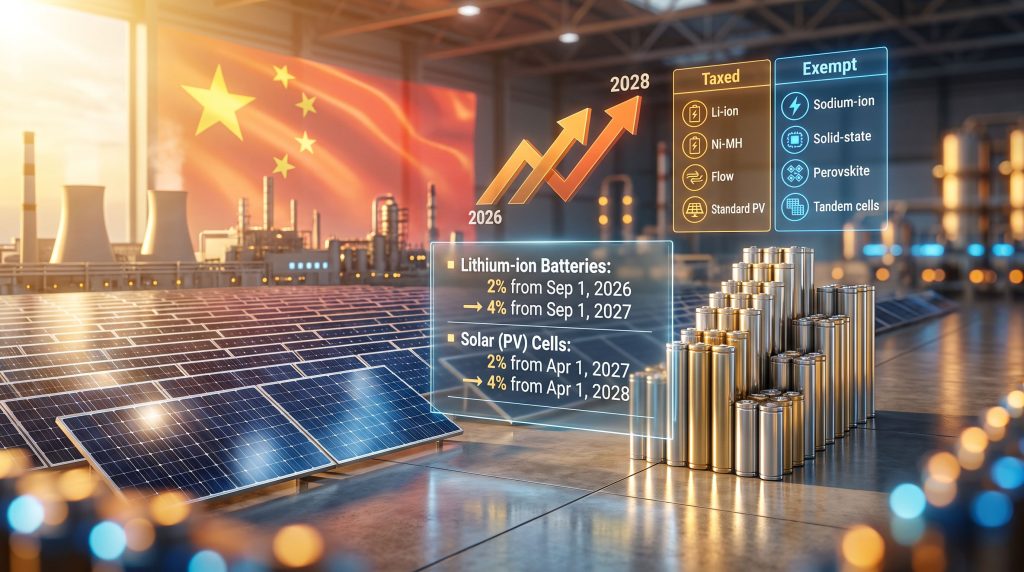
| Lithium-ion and lithium primary batteries | September 1, 2026 | 2% | September 1, 2027 | 4% |
| Nickel-metal hydride (Ni-MH) batteries | September 1, 2026 | 2% | September 1, 2027 | 4% |
| Vanadium flow batteries and other storage | September 1, 2026 | 2% | September 1, 2027 | 4% |
| Solar (PV) cells | April 1, 2027 | 2% | April 1, 2028 | 4% |
This framework ends an 11-year exemption that dated to 2015, when Beijing deliberately shielded lithium-ion batteries and solar cells from the existing 4% consumption tax applied to conventional battery technologies. The rationale at the time was growth acceleration: tax exemptions functioned as implicit subsidies that helped China build the world's dominant clean energy manufacturing base. The reversal now underway uses the same fiscal instrument in the opposite direction, applying pressure to discipline the very capacity that earlier policy incentivised. According to analysis from Pinsent Masons, this shift marks a fundamental change in China's approach to its clean energy export strategy.
Technologies Exempt From the New Framework
The Ministry of Finance has carved out explicit exemptions for technologies Beijing wants to prioritise commercially, covering the period from September 1, 2026 through December 31, 2028:
- Sodium-ion batteries (exempt through end of 2028)
- Solid-state batteries (exempt through end of 2028)
- Fuel cells (permanent exemption)
- Perovskite solar cells (exempt through end of 2028)
- Tandem solar cells (exempt through end of 2028)
- Gallium arsenide solar cells (exempt through end of 2028)
The exemption list functions as an embedded technology roadmap. By excluding next-generation chemistries and advanced cell architectures from taxation, Beijing is using the tax code to reshape investment flows toward the formats it intends to dominate in the next decade of global clean energy competition.
VAT Export Rebate Removal: The Second Policy Track
The consumption tax framework does not operate in isolation. It layers onto a parallel set of VAT export rebate changes that alter the economics of Chinese clean energy exports, creating what amounts to a dual-pressure system targeting both domestic margins and international pricing.
| Policy Lever | Affected Products | Effective Date | Direction |
|---|---|---|---|
| VAT export rebate elimination | Solar PV products | April 1, 2026 | Reduces export price subsidy |
| VAT export rebate reduction | Battery products | April–December 2026 | Rate reduced from 9% to 6% |
| VAT export rebate elimination | Battery products | January 1, 2027 | Fully removes export subsidy |
| Consumption tax introduction | Batteries | September 1, 2026 | Increases domestic cost base |
| Consumption tax introduction | Solar cells | April 1, 2027 | Increases solar production costs |
| Consumption tax escalation | All taxed categories | 2027–2028 | Further margin compression |
The sequencing here carries strategic logic. Export rebate removal preceded domestic consumption taxes in both the solar and battery segments. By reducing the artificial price advantage Chinese manufacturers held in international markets before tightening the domestic cost environment, Beijing signals an intent to address trade friction with the European Union and other major importing regions before squeezing its own producers further. The EU has pursued anti-dumping and countervailing duty investigations against Chinese solar manufacturers for years, with Chinese export pricing strategies at the core of those disputes. Furthermore, export tax rebate cuts are already reshaping how international buyers structure procurement contracts for 2027 and beyond.
Margin Arithmetic: Why Small Tax Rates Have Large Structural Effects
A common initial reaction to a 2% to 4% consumption tax is to dismiss it as immaterial. That intuition is incorrect when applied to industries operating at or below breakeven margins.
In sectors where typical net margins have compressed to low single digits or turned negative, an additional 2% cost layer does not represent a manageable headwind. It represents the difference between a producer that can theoretically survive and one that cannot. The tax is not designed to generate meaningful fiscal revenue for Beijing. Its purpose is to function as a threshold mechanism, pushing producers already at the margin of viability past the point where continued operation is economically rational.
This dynamic is particularly pronounced in solar manufacturing, where legacy PERC (Passivated Emitter and Rear Cell) technology platforms face a compounding challenge. Not only are they subject to the new consumption tax, but they must simultaneously meet mandatory national energy efficiency standards issued in early July 2026 and effective January 1, 2027. These standards impose minimum efficiency thresholds and energy intensity requirements across the photovoltaic value chain. Producers using older cell architectures that cannot economically be upgraded face two simultaneous compliance burdens with no viable path to meeting both.
Winners and Losers Under the New Regime
Positioned to benefit:
- Manufacturers with advanced cell platforms including TOPCon and heterojunction (HJT) technologies that already exceed new efficiency standards
- Vertically integrated producers with sufficient scale to absorb additional tax costs across multiple value chain stages
- Sodium-ion battery developers who carry no consumption tax liability and benefit from growing cost parity with lithium-ion chemistries
- Perovskite and tandem cell developers operating entirely outside the tax framework during the critical 2026 to 2028 commercialisation window
Facing accelerated pressure:
- Manufacturers dependent on PERC cell technology with limited capital for efficiency upgrades
- Sub-scale battery producers whose fixed-cost structures cannot absorb new tax layers without price increases they cannot pass through in a deflationary market
- Companies reliant on high domestic sales volumes to absorb overhead, given that the consumption tax applies to domestic transactions
Critical Minerals Demand: An Underappreciated Downstream Effect
The China battery and solar consumption taxes carry implications that extend well beyond China's borders into global critical minerals markets, and these connections receive less analytical attention than they warrant. Indeed, the role of the critical minerals energy transition thesis may need recalibrating as China's manufacturing consolidation alters near-term demand trajectories.
Consumption tax pressure on lithium-ion battery production in China could modestly reduce the near-term demand trajectory for battery-grade lithium, cobalt, and nickel from Chinese manufacturers. If marginal lithium-ion capacity is retired rather than maintained, the feedstock demand that capacity would have consumed disappears with it. For lithium producers globally, this is a nuanced consideration: reduced Chinese manufacturing volume at the margin could offset some of the demand growth that large-scale deployment projections assume.
The sodium-ion exemption introduces a structurally different dynamic. Sodium-ion batteries do not require lithium as a primary input. The more aggressively the Chinese tax framework accelerates sodium-ion adoption in stationary storage applications, the more the demand composition for battery materials shifts. Furthermore, the lithium market downturn already underway may deepen if Chinese lithium-ion manufacturing volumes contract more sharply than anticipated.
Vanadium flow batteries present a more ambiguous picture. Subject to the same consumption tax schedule as lithium-ion chemistries, vanadium redox flow systems serve a distinct long-duration storage niche where lithium-ion is less competitive. The tax adds cost pressure but does not directly alter the technical case for vanadium in applications requiring eight hours or more of discharge duration. Monitoring whether the consumption tax meaningfully affects vanadium flow battery deployment rates in China over the 2026 to 2028 period will be instructive for understanding how sensitive this niche technology segment is to fiscal cost signals.
The next major ASX story will hit our subscribers first
Three Scenarios for Market Outcomes
Whether the China battery and solar consumption taxes achieve their intended restructuring objectives is genuinely uncertain. Market analysts hold meaningfully divergent views on the likely effectiveness of this approach.
| Scenario | Key Conditions Required | Probable Market Outcome |
|---|---|---|
| Gradual rationalization over 18 to 24 months | Financing conditions tighten for sub-scale producers; enforcement of efficiency standards is consistent | Modest price stabilisation; overcapacity persists at reduced intensity |
| Accelerated consolidation with M&A wave among mid-tier producers | Tax burden combines with credit tightening and rigorous efficiency standard enforcement | Meaningful capacity reduction; improved pricing environment emerging by 2028 |
| Limited structural impact as state-backed producers absorb costs | Policy enforcement is uneven; state financing remains accessible to uncompetitive producers | Continued price depression; further trade friction with Western markets |
The core limitation of fiscal instruments in this context is that they increase the cost of maintaining uncompetitive capacity without mandating its exit. Producers with access to patient, state-supported financing can absorb years of sub-economic operation before the tax burden forces a genuine decision. The policy's ultimate effectiveness depends heavily on conditions outside the tax framework itself.
However, the outlook for the broader battery raw materials market will depend substantially on which of these scenarios plays out over the next 18 to 24 months. In addition, advances in the Chinese battery recycling breakthrough space may further complicate virgin material demand projections if secondary supply scales alongside manufacturing consolidation.
Key Dates for Market Participants to Track
The implementation timeline is spread across nearly two years, with each milestone carrying distinct market implications:
- April 1, 2026 – VAT export rebates on solar products fully abolished (already in effect)
- September 1, 2026 – 2% consumption tax on lithium-ion, Ni-MH, and other batteries commences
- January 1, 2027 – VAT export rebates on battery products fully eliminated; mandatory PV energy efficiency standards take effect
- April 1, 2027 – 2% consumption tax on solar cells commences
- September 1, 2027 – Battery consumption tax escalates to 4%
- April 1, 2028 – Solar cell consumption tax escalates to 4%
Frequently Asked Questions
What triggered China's decision to introduce consumption taxes on batteries and solar cells?
More than two years of structural overcapacity, sustained negative margins across the solar and battery supply chains, and the failure of a market-led consolidation attempt in polysilicon prompted Beijing to deploy fiscal instruments as an indirect capacity rationalisation mechanism.
How does China's 2026 battery consumption tax differ from the 2015 framework?
In 2015, China introduced a 4% consumption tax on conventional batteries but explicitly exempted lithium-ion batteries and solar cells to encourage adoption of these technologies. The 2026 framework reverses this exemption, applying new consumption taxes to the same technologies previously protected, while shifting the exemption to next-generation formats including sodium-ion, solid-state, perovskite, and tandem technologies.
Will the consumption tax affect Chinese battery export prices?
The consumption tax applies to domestic transactions. However, the parallel removal of VAT export rebates directly affects the pricing advantage Chinese manufacturers have held in international markets. Together, these measures narrow but do not eliminate China's cost leadership in global battery and solar supply chains.
Which battery chemistry benefits most from the new tax exemption structure?
Sodium-ion batteries carry no consumption tax liability under the current framework through December 2028 and do not require lithium as a primary feedstock. This combination of fiscal advantage and input cost differentiation positions sodium-ion technology as a meaningful commercial alternative to lithium-ion in stationary storage applications over the medium term.
Disclaimer: This article is provided for informational purposes only and does not constitute financial, investment, or legal advice. Forecasts, scenario analyses, and market projections discussed herein involve material uncertainty and should not be relied upon as the basis for investment decisions. Readers should conduct independent research and consult qualified advisers before making any investment decisions related to the topics covered.
Want to Track the ASX Mineral Discoveries Reshaping the Critical Minerals Landscape?
As China's industrial policy reshuffles global battery and solar supply chains, the real opportunity for investors lies in identifying the significant ASX mineral discoveries emerging in this evolving environment — and Discovery Alert's proprietary Discovery IQ model delivers real-time alerts the moment those discoveries are announced, turning complex market shifts into actionable insights. Explore historic examples of major mineral discoveries and their market returns to understand the scale of opportunity, then begin a 14-day free trial to position yourself ahead of the broader market.