July 20, 2026
The Infrastructure Trap at the Heart of Africa's Battery Metal Ambitions
Resource nationalism is rarely a clean policy instrument. When governments restrict raw mineral exports to force domestic value-addition, they are making a calculated bet: that industry will build processing capacity fast enough to absorb the output that can no longer leave the country in its raw form. Sometimes it works. Indonesia's nickel ore export ban, enforced from 2020, triggered a wave of smelter construction and drew significant foreign direct investment into downstream processing. However, the gap between policy intent and industrial readiness has derailed similar ambitions elsewhere, and the Zimbabwe lithium concentrate export ban is now testing that same fault line under considerable pressure.
What makes Zimbabwe's situation particularly instructive is not simply the policy itself, but the structural paradox embedded within it: a government mandating domestic processing of lithium while the only completed processing facility in the country operates at full capacity and cannot accept material from any other producer. This is the central tension that will define how Africa's largest lithium producer navigates the next six months.
When big ASX news breaks, our subscribers know first
From Export Commodity to Processed Product: Understanding the Value-Add Logic
To understand why Zimbabwe moved in this direction, it helps to understand what is actually being traded in the lithium supply chain and where the economic value accumulates.
Spodumene concentrate, the form in which Zimbabwe has historically exported lithium, is a hard rock mineral product typically grading between 5% and 6% lithium oxide (Li2O). It is a feedstock, not a finished battery material. Furthermore, understanding the journey from spodumene to lithium salts helps clarify why so much value is captured at the refining stage rather than at the point of extraction.
Before it can be used in cathode manufacturing or electrolyte production, it must be converted into a refined lithium compound, most commonly lithium hydroxide or lithium carbonate, or in Zimbabwe's specific context, lithium sulphate as an intermediate product.
The price differential between spodumene concentrate and refined lithium compounds can be substantial. Historically, lithium hydroxide battery-grade has commanded prices several multiples higher than raw spodumene, meaning that countries exporting unprocessed concentrate are effectively exporting the bulk of the product's value to wherever the refinery sits. For Zimbabwe, that refinery has overwhelmingly been in China.
The value-add imperative is straightforward in theory: retain the processing step domestically, and the economic benefit, the jobs, the tax revenue, and the industrial capability, stays within the country rather than being captured offshore.
A Policy Built in Stages: The Timeline of Zimbabwe's Export Restrictions
Zimbabwe's move against raw lithium exports did not begin in 2026. The policy foundation was laid in 2022 when the government first imposed restrictions on raw ore exports, signalling an intent to extract greater economic value from its mineral endowment. This was an early iteration of the broader resource nationalism framework that has since escalated significantly.
The more decisive announcement came in mid-2025, when the government formally established a January 2027 deadline for a full ban on lithium concentrate exports. This gave producers roughly 18 months to construct domestic processing facilities, a timeline that many in the industry immediately flagged as ambitious given the capital requirements and construction lead times involved.
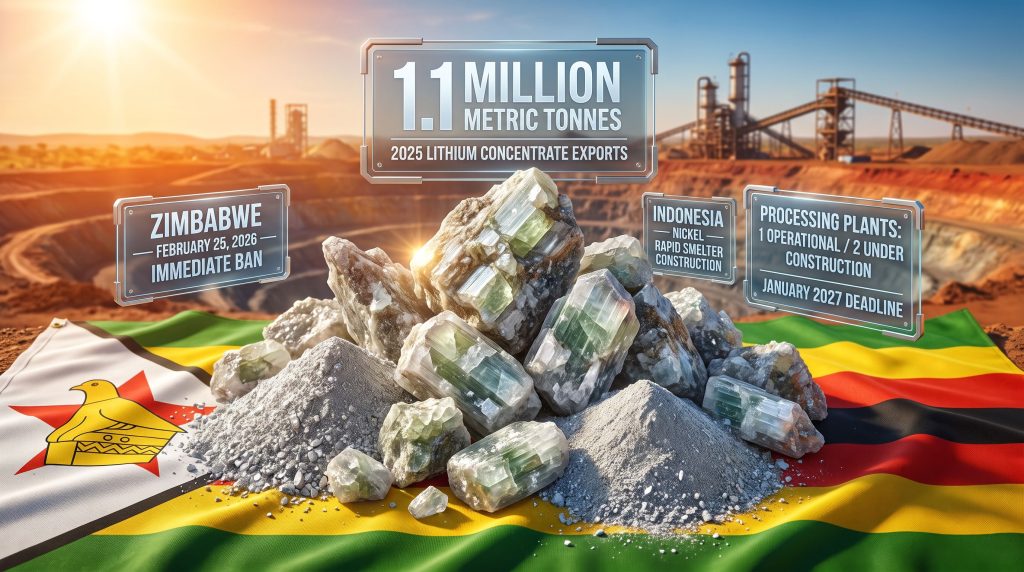
What accelerated the situation dramatically was the government's decision on February 25, 2026, to enact an immediate suspension of all raw mineral and lithium concentrate exports, more than ten months before the announced deadline. According to Al Jazeera, the official justification centred on documented evidence of mineral malpractice: systematic under-declaration of export volumes, illicit stockpiling of concentrate, and a coordinated rush by producers to maximise shipments ahead of the original cutoff.
The suspension was applied without a grace period. Shipments already in transit were intercepted, including trucks en route to ports and vessels in pre-departure stages. The scope extended beyond lithium to cover all categories of unprocessed raw minerals, making it one of the most comprehensive mineral export actions Zimbabwe has taken.
The Quota System: A Transitional Mechanism With Strict Conditions
Following the immediate shock of the February suspension, the government introduced a limited quota framework in April 2026, allowing a subset of producers to resume restricted concentrate exports while the industry works toward the January 2027 full enforcement deadline.
| Policy Element | Detail |
|---|---|
| Quota System Introduction | April 2026 |
| Eligible Producers | Six approved producers only |
| Export Tax Rate | 10% to 16% on lithium concentrates |
| Full Ban Enforcement Target | January 1, 2027 |
| Extension Request Filed By | Zimbabwe Lithium Producers' Association |
| Extension Requested Until | June 2027 |
| Government Response to Extension | No formal response issued as of July 2026 |
Access to the quota system is not unconditional. Producers seeking approval must satisfy several requirements:
- A formal, documented commitment to constructing lithium sulphate processing facilities before January 2027
- Mandatory publication of annual financial statements to establish transparency
- Demonstrated compliance with both labour regulations and environmental standards
Mines Minister Polite Kambamura has been unequivocal in public statements, making clear that the January 2027 deadline is not subject to negotiation and that requests for timeline extensions will not be entertained. As of July 2026, the Zimbabwe Lithium Producers' Association has formally requested an extension to June 2027, but the government had not issued any formal response to that petition.
The Processing Capacity Crisis: One Plant, Zero Spare Capacity
Here lies the most consequential challenge facing Zimbabwe's lithium policy. As of mid-2026, the country has a single operational lithium sulphate processing facility. It is located at the Arcadia mine, operated by Prospect Lithium Zimbabwe, a subsidiary of China's Zhejiang Huayou Cobalt. The plant produces approximately 400,000 tonnes per annum of output from its own concentrator, and its site management has confirmed that the facility holds no spare capacity to process material from third-party producers.
This is not a minor operational detail. It is a structural bottleneck that undermines the entire premise of the export ban as a domestic processing mandate. If producers cannot export their concentrate and cannot access an existing processing facility, their output is effectively stranded.
The two other processing plants under construction belong to Sinomine Resource Group's Bikita Minerals and Kamativi Mining Company, the latter a Zimbabwean subsidiary of China's Yahua Group. Both are progressing, but neither is expected to be operational before the January 2027 enforcement deadline.
| Producer | Parent Company | Plant Status | Readiness for January 2027 |
|---|---|---|---|
| Prospect Lithium Zimbabwe (Arcadia) | Zhejiang Huayou Cobalt | Operational | Capacity fully committed to own output |
| Bikita Minerals | Sinomine Resource Group | Under construction | Unlikely to meet January 2027 deadline |
| Kamativi Mining Company | Yahua Group | Under construction | Unlikely to meet January 2027 deadline |
The paradox is striking: a ban designed to force domestic processing is being enforced at a moment when the domestic processing infrastructure does not yet exist to receive the output it is supposed to refine. This is the defining operational risk for producers operating in Zimbabwe today.
China's USD $2 Billion Footprint and the Geopolitical Dimension
It would be difficult to analyse Zimbabwe's lithium sector without examining the depth of Chinese investment that underpins it. Since 2021, Chinese mining and processing companies have deployed approximately USD $2 billion into Zimbabwe's lithium assets, establishing operational control across the country's primary producing mines and the only completed refining facility.
This concentration of Chinese capital creates a layered dynamic. On one hand, it was Chinese investment that built the processing infrastructure that now exists, however limited. On the other hand, the fact that the sole operational processing plant is a captive facility serving its Chinese parent company means that competing producers, including those without Chinese backing, have no domestic processing pathway available to them.
Zimbabwe has also been exploring minerals-backed financing arrangements with Chinese counterparts to fund broader infrastructure development, a model with precedent across sub-Saharan Africa. This minerals-for-infrastructure framework positions lithium as a strategic bargaining chip in bilateral negotiations, adding a geopolitical layer to what might otherwise appear to be a straightforward industrial policy debate.
Chinese investment dominance in Zimbabwe's lithium sector creates both the solution to the processing capacity gap and a conflict of interest that complicates how that solution is deployed.
The next major ASX story will hit our subscribers first
Supply Chain Consequences: What Zimbabwe's Output Means at Scale
Zimbabwe's relevance to the global lithium supply chain is not marginal. The country exported over 1.1 million metric tonnes of lithium concentrate in 2025, making it Africa's largest lithium producer by volume. The overwhelming majority of that material flowed to Chinese processing facilities, which then supplied refined lithium compounds into the battery manufacturing ecosystem serving electric vehicle and energy storage markets.
The February 2026 suspension delivered an immediate shock to global spodumene spot markets. Understanding how lithium mining works helps contextualise why a disruption at the concentrate stage sends ripple effects so far downstream. Battery manufacturers operating downstream of the African feedstock supply chain, particularly those with exposure to cathode production reliant on lithium hydroxide converted from African spodumene, faced a period of acute supply uncertainty.
This dynamic mirrors what the global nickel market experienced after Indonesia's export restrictions tightened. In that case, the short-term supply shock ultimately resolved through accelerated smelter construction, but the transition period was marked by price volatility and supply chain restructuring. Zimbabwe's situation introduces similar stress but with a harder timeline constraint and a smaller pool of available processing infrastructure.
Scenario Analysis: Three Pathways to January 2027
Scenario 1: Full Enforcement With Incomplete Infrastructure
Zimbabwe holds the January 2027 deadline without extension. The Bikita and Kamativi plants remain incomplete at enforcement date. Significant volumes of spodumene concentrate are stranded domestically with no processing pathway. Global lithium supply tightens as African feedstock availability contracts, and spot market prices respond to the shortfall. This outcome carries the highest economic cost for Zimbabwe's mining sector in the short term but demonstrates policy credibility.
Scenario 2: Negotiated Extension to June 2027
The government accepts the Producers' Association extension request, granting an additional six months of transitional quota access. Producers gain runway to advance plant construction timelines. The export tax regime and quota system continue in modified form. The risk in this scenario is regulatory credibility erosion: a government that moved the deadline forward without warning and then retreats under industry pressure may find future policy enforcement more difficult.
Scenario 3: Tolling Arrangement or Capacity Sharing
The government brokers a formal arrangement enabling Prospect Lithium Zimbabwe's existing sulphate plant to process concentrate from third-party producers under a tolling model, where external miners pay a fee for processing services rather than operating their own facilities. Simultaneously, construction incentives or financing mechanisms accelerate the Bikita and Kamativi plant timelines. This scenario offers the most pragmatic resolution but requires the cooperation of Zhejiang Huayou Cobalt, which currently has no commercial incentive to process competitors' material.
How Zimbabwe's Approach Compares to Other Resource Nationalism Models
| Country | Mineral | Restriction Type | Year Enacted | Outcome |
|---|---|---|---|---|
| Indonesia | Nickel ore | Full raw ore export ban | 2020 (enforced) | Rapid smelter construction; significant FDI inflow |
| Democratic Republic of Congo | Cobalt/copper | Processing incentives and export levies | Ongoing | Mixed results; infrastructure gaps persist |
| Zimbabwe | Lithium concentrate | Immediate suspension and quota transition | February 2026 | Processing capacity shortfall; industry under pressure |
The Indonesian precedent is frequently cited as evidence that export bans can work. However, Indonesia's nickel ban was implemented against a backdrop of existing smelting infrastructure and an established industrial base capable of scaling. Zimbabwe is attempting a similar outcome from a much lower base of processing capability, which makes the transition harder and the timeline more precarious.
The DRC cobalt experience offers a cautionary parallel: policy ambition for domestic processing has not consistently translated into the infrastructure investment required, partly because global commodity buyers have found alternative supply sources rather than investing in constrained environments. In addition, innovations such as direct lithium extraction are reshaping how efficiently lithium can be processed, potentially influencing the economics of domestic refining ambitions in countries like Zimbabwe.
Frequently Asked Questions: Zimbabwe Lithium Concentrate Export Ban
When did Zimbabwe ban lithium concentrate exports?
Zimbabwe enacted an immediate suspension of lithium concentrate and raw mineral exports on February 25, 2026, accelerating a policy deadline that had originally been set for January 2027.
Why did Zimbabwe move the ban forward without warning?
The government cited documented evidence of mineral malpractice, including systematic under-declaration of export volumes, illicit stockpiling, and a coordinated rush by producers to maximise shipments ahead of the original deadline.
Can lithium producers still export concentrates from Zimbabwe?
As of April 2026, a limited quota system permits six approved producers to export concentrates subject to a 10% to 16% export tax, provided they commit formally to completing domestic processing infrastructure before January 1, 2027.
How much lithium concentrate does Zimbabwe produce?
Zimbabwe exported over 1.1 million metric tonnes of lithium concentrate in 2025, making it Africa's largest lithium producer by volume.
Is there enough processing capacity in Zimbabwe to absorb stranded concentrate?
No. As of July 2026, only one lithium sulphate processing plant is operational in Zimbabwe. It runs at full capacity processing its own mine's output and cannot accept third-party material. Two additional plants are under construction but are not expected to be ready before January 2027.
What happens if domestic plants are not ready by the enforcement deadline?
Full enforcement without adequate processing infrastructure would effectively strand significant volumes of concentrate within Zimbabwe, restricting global spodumene supply and creating downstream pressure on battery manufacturers dependent on African feedstock.
What the Zimbabwe Situation Signals for the Broader Battery Metals Landscape
The tension at the centre of Zimbabwe's lithium policy is not unique to Zimbabwe. It reflects a broader structural challenge facing every resource-rich nation attempting to shift from raw commodity exporter to processed-product supplier: the capital intensity and lead time required to build processing infrastructure routinely outpaces the political timelines governments impose.
For battery metal supply chain participants, from cathode material producers to cell manufacturers and EV assemblers, the Zimbabwe lithium concentrate export ban is a live case study in how quickly African supply can be interrupted by policy action. The lesson for procurement strategy is that single-source or single-region exposure to battery metal feedstock carries policy risk that traditional commodity hedging instruments do not fully address. Consequently, the battery raw materials market is being forced to reassess sourcing strategies and geographic diversification with renewed urgency.
The January 2027 deadline now functions as a countdown for the entire lithium market. Furthermore, this situation compounds an already challenging lithium market downturn that has weighed on producer margins across the sector. Whether Zimbabwe enforces the deadline cleanly, negotiates an extension, or finds a creative processing arrangement in the intervening months will have measurable consequences for global spodumene availability and, by extension, for the economics of battery manufacturing at scale. S&P Global analysis suggests the policy could meaningfully reshape African feedstock flows regardless of which scenario ultimately unfolds.
This article is informational in nature and does not constitute financial or investment advice. Forecasts and scenario projections reflect available information as of July 2026 and are subject to change as policy, market, and operational conditions evolve. Readers should conduct independent research before making investment decisions related to lithium markets or companies operating in Zimbabwe.
Want to Identify the Next Major Battery Metals Discovery Before the Market?
Discovery Alert's proprietary Discovery IQ model delivers real-time alerts on significant ASX mineral discoveries — instantly transforming complex commodity data across 30+ sectors into actionable investment insights, so subscribers can act ahead of the broader market. Explore historic discoveries and their returns to understand the opportunity, then begin your 14-day free trial at Discovery Alert to position yourself at the forefront of the next major find.