July 20, 2026
The Industrial Electrification Frontier: Why Off-Highway Battery Packs Are a Different Beast Entirely
The narrative around electrification has been dominated almost entirely by passenger vehicles for the better part of a decade. Range anxiety, charging infrastructure, and consumer adoption curves have consumed the conversation while a far more complex and commercially significant transformation has been quietly taking shape in the background. Industrial and off-highway equipment, from underground mining loaders to agricultural machinery operating across vast remote terrain, presents a fundamentally different engineering challenge. Battery packs for off-highway vehicles are more demanding, more specialised, and increasingly, more valuable than their consumer counterparts.
When big ASX news breaks, our subscribers know first
The Market in Numbers: From $4.5 Billion to $8 Billion
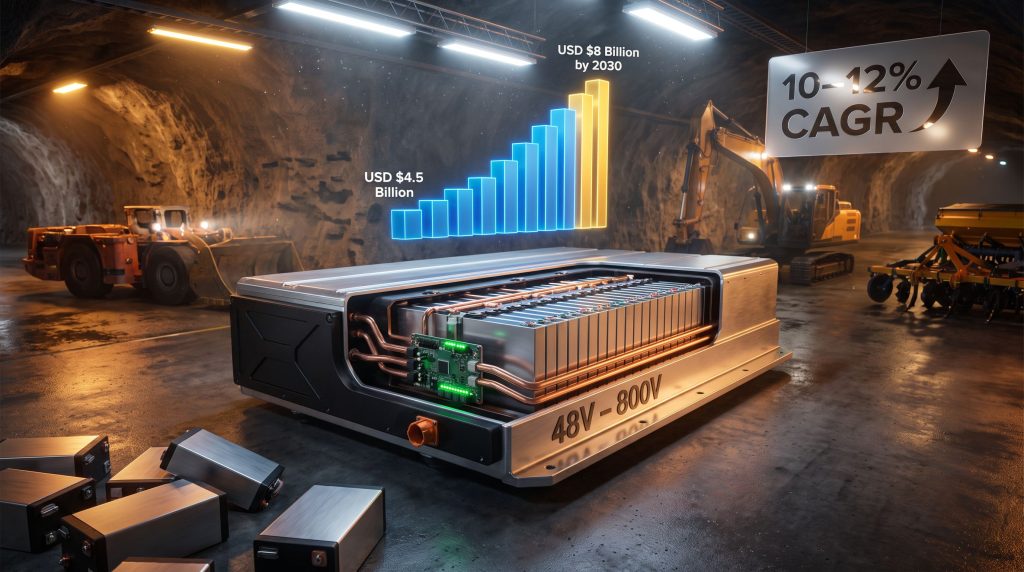
Revenue generated from battery packs for off-highway vehicles reached USD $4.5 billion in the most recently reported year, according to market analysts Interact Analysis. That figure is forecast to climb to USD $8 billion by 2030, representing a near-doubling of market value within a five-year window and implying a compound annual growth rate of approximately 10 to 12% per annum.
What is particularly notable about this trajectory is that it is not being driven by consumer preference or government incentive programmes in the way passenger EV adoption has been. Instead, the forces propelling this market are deeply structural:
- Underground mine operators facing ventilation cost pressures linked to diesel particulate matter are finding that electrification of fleets can dramatically reduce airflow requirements, translating into direct operational savings
- Decarbonisation mandates from major mining houses committing to Scope 1 and 2 emissions reductions by specific target years are creating OEM procurement deadlines
- Air quality regulations in underground environments across multiple jurisdictions are tightening, creating compliance-driven demand rather than purely economically-driven demand
- OEM electrification roadmaps from manufacturers such as Caterpillar, Epiroc, and Sandvik are embedding electric drivetrain development into product cycles that will define fleet composition through the 2030s
Furthermore, mining electrification is reshaping procurement priorities across the entire heavy equipment sector, not just underground operations.
The off-highway battery market is not simply a downstream extension of passenger EV trends. It is a structurally distinct industrial segment with its own supply chain dynamics, engineering standards, and procurement cycles that reward specialist capability over scale alone.
Why Off-Highway Applications Demand Entirely Different Engineering
Duty Cycles That Consumer EV Engineers Never Encounter
A passenger EV optimises for energy efficiency across variable driving conditions, with most loads being relatively modest and intermittent. An underground loader operating in a hard rock mine faces a categorically different set of demands. It may spend an entire eight to twelve hour shift under continuous high-torque loading, navigating grades, pulling heavy material, and operating auxiliary hydraulic systems simultaneously.
This distinction matters enormously for battery design. Consumer packs are engineered around average load profiles with occasional peak demands. Industrial packs must sustain high-power output across extended operational windows without thermal degradation compromising performance or safety.
The diversity of machine types compounds this challenge significantly. Consider the range of platforms that fall under the off-highway classification:
- Underground loaders and haul trucks operating in confined, high-humidity tunnel environments
- Surface excavators and wheel loaders working across variable terrain with heavy cyclical loading
- Agricultural tractors and implements requiring seasonal operational reliability across temperature extremes
- Forestry machinery operating in remote locations with limited access to maintenance infrastructure
- Autonomous robotic platforms requiring lightweight, compact power systems with high energy density per unit volume
No single battery architecture can optimally serve all of these applications, which is precisely why the off-highway battery market is developing as a diverse ecosystem of specialised solutions. For instance, electric mining vehicles demonstrate just how varied the engineering requirements can be across different machine classes.
Environmental Resilience: Beyond Standard IP Ratings
Consumer battery packs are engineered to survive rain and road splash. Industrial packs must endure far harsher conditions, and the certification requirements reflect this reality. Off-highway battery packs must meet rigorous design standards that go well beyond what standard automotive testing demands:
- Water and dust ingress protection must be validated against the actual operating environment, not laboratory approximations. Underground mining environments combine high humidity, water seepage, and ultra-fine silica dust simultaneously
- Mechanical shock and vibration tolerance must exceed standard automotive testing protocols. Equipment traversing rough underground roadways or agricultural terrain transmits constant high-amplitude vibration to every onboard component
- Chemical and corrosive atmosphere exposure is common in certain mining applications, requiring enclosure materials and seal compounds that would be unnecessarily expensive in consumer applications
- Operating temperature ranges in outdoor surface mining can span from sub-zero arctic conditions to high-ambient desert environments, requiring thermal management systems engineered to function reliably across ranges that consumer packs never experience
Voltage Architecture and Capacity: The Engineering Backbone
One of the least discussed but most consequential design decisions in off-highway battery systems is the selection of voltage architecture. This choice cascades through motor controller selection, thermal management design, charging infrastructure requirements, and safety system complexity.
| Voltage Platform | Typical Applications | Capacity Range |
|---|---|---|
| 48V | Light equipment, autonomous UGVs, robotics | 5 to 20 kWh |
| 150V to 300V | Medium construction, agricultural machinery | 30 to 80 kWh |
| 300V to 600V | Heavy construction, surface mining equipment | 80 to 160 kWh |
| 600V to 800V | Underground mining trucks, large loaders | 160 to 240 kWh |
Modular architecture is increasingly the preferred approach for manufacturers serving diverse OEM customers. By designing packs that can be combined in series configurations to increase voltage, or in parallel configurations to increase capacity, a single product platform can address multiple machine classes. Modular battery solutions are consequently gaining traction as a practical response to the high power requirements of off-highway electrification. This reduces development cost, simplifies spare parts logistics, and gives OEMs flexibility to adapt power systems as machine requirements evolve.
LFP vs. NMC: The Chemistry Decision That Shapes Everything Downstream
Battery chemistry selection is not merely a technical specification. It determines safety risk profile, service life economics, thermal management complexity, and end-of-life recycling obligations. In off-highway applications, this decision carries additional weight because maintenance access is often limited and the consequences of battery failure are operationally and physically severe.
| Attribute | Lithium Iron Phosphate (LFP) | Nickel-Manganese-Cobalt (NMC) |
|---|---|---|
| Safety Profile | Superior, lower thermal runaway risk | Moderate, more reactive under stress |
| Cycle Life | 3,000 to 6,000+ cycles | 1,000 to 2,000 cycles |
| Energy Density | Lower (Wh/kg) | Higher (Wh/kg) |
| Cost per kWh | Lower and declining | Higher |
| Cold Temperature Performance | Reduced output | Better retained |
| Best Fit | Mining, forestry, heavy construction | Space-constrained, high-density applications |
LFP chemistry is capturing dominant share in heavy off-highway applications for reasons that extend beyond simple cost comparison. In underground mining environments, where a thermal event inside a sealed tunnel carries catastrophic consequences for personnel and equipment, the inherently more stable electrochemical structure of LFP is not merely a commercial preference but a safety imperative.
The phosphate-based cathode material is significantly less prone to the exothermic decomposition reactions that can trigger thermal runaway in NMC systems under abuse conditions such as overcharge, mechanical damage, or extreme heat.
A less widely appreciated consequence of this chemistry divergence is its impact on battery management system design. LFP cells exhibit a notably flat voltage discharge curve compared to NMC, meaning that state-of-charge estimation algorithms must be considerably more sophisticated to accurately track remaining capacity. This is not a trivial engineering challenge in heavy equipment applications where operators need reliable range and endurance information to schedule shift handovers and charging cycles.
The choice between LFP and NMC in underground mining is ultimately a risk management decision as much as an engineering one. The lower energy density of LFP is an acceptable trade-off when the alternative is deploying a chemistry with higher thermal runaway probability in a confined space.
Competitive Landscape: How Leading Manufacturers Differentiate
System Providers Across the Voltage Spectrum
| Manufacturer | Voltage Range | Capacity Range | Cooling Type | Primary Segments |
|---|---|---|---|---|
| Eleo (Yanmar) | 50V to 720V | Scalable multipack | Configurable | General off-highway, low-volume OEMs |
| Turntide | 44V to 500V | 4.5 to 8 kWh per unit | Air or liquid | Construction, agriculture, marine, rail |
| HAWE Mattro | 100V to 800V | 30 to 240 kWh | Integrated heater and cooling | Traction, hydraulics, space-critical builds |
| IONCOR | Scalable | High-density modular | Configurable | Mining, forestry, material handling |
| Vanguard | 48V | 5 to 20 kWh | Ruggedised | Autonomous UGVs, extreme terrain robotics |
What separates market leaders from commodity suppliers in this segment goes well beyond specification sheets. Three factors are increasingly decisive in procurement:
- Serviceability under part number simplification: Packs designed so that field technicians can replace or repair using a single part number, without requiring specialist laboratory equipment, dramatically reduce total cost of ownership for operators running remote fleets
- Telematics integration: BMS platforms that communicate directly with machine telematics and fleet management systems are moving from a premium feature to a baseline procurement expectation, particularly among large mining house customers
- OEM co-development willingness: The off-highway sector is characterised by highly bespoke machine geometries. Manufacturers that can adapt pack dimensions and mounting configurations to match an OEM's spatial constraints command significant pricing power relative to those offering only standard catalogue products
The next major ASX story will hit our subscribers first
A Step-by-Step Integration Framework for Engineers and Procurement Teams
Selecting the right battery pack for an off-highway application involves a sequential decision process that, when executed properly, significantly reduces the risk of costly mismatches between power system capability and operational demand.
Step 1: Define the duty cycle with precision
Calculate average power draw across a full operational shift, identify peak load events such as winching or hydraulic actuation that require surge capacity, and determine the minimum operational hours between charge events based on scheduling constraints.
Step 2: Calculate energy capacity with appropriate buffers
Apply the core formula: Required Energy (kWh) = Average Power (kW) x Operating Hours + Reserve Buffer. LFP systems typically operate at 80 to 90% usable depth of discharge. Add a contingency of 15 to 20% for peak load events and cold-weather performance reduction across the battery service lifetime.
Step 3: Confirm voltage architecture compatibility
Match battery voltage platform to motor controller and drivetrain specifications before any other supplier selection criteria. Mismatches here are expensive to rectify post-procurement.
Step 4: Validate environmental and safety compliance
Confirm IP rating adequacy for the specific operating environment, verify vibration and shock testing compliance beyond standard automotive protocols, and assess thermal management capacity for the ambient temperature range at the deployment site.
Step 5: Model total cost of ownership over machine service life
Compare capital cost against projected fuel and maintenance savings, factor in battery replacement cycles relative to machine lifespan, and evaluate supplier warranty terms and spare parts availability in the operating region. A pack that appears cheaper at purchase but requires replacement after half the machine's service life represents a substantially worse economic outcome than a more expensive, longer-lasting alternative.
What Testing Standards Actually Require
Off-highway battery validation substantially exceeds the requirements applied to passenger vehicle certification. Several testing requirements are worth understanding in detail:
- Pulse testing validates performance under repeated high-current events, simulating the start-stop load cycles that heavy equipment experiences dozens of times per shift. A pack that performs well under steady-state discharge but degrades rapidly under pulse loading will fail in practice long before laboratory degradation predictions suggest it should
- Vibration and shock testing must replicate the actual spectral profile of the intended platform, not generic automotive road vibration standards. Underground haul roads can generate vibration signatures significantly more destructive than highway surfaces
- Drop testing simulates mechanical shock during maintenance handling, including scenarios where packs are removed and reinstalled in confined underground spaces where precision handling is difficult
- Thermal cycling validation must cover the actual temperature range of the deployment environment, including the thermal gradients created by aggressive fast-charging followed by cold ambient parking
As underground mining fleet electrification accelerates, regulatory bodies in key mining jurisdictions are developing battery-specific safety standards for mobile equipment. Procurement teams should actively monitor evolving compliance frameworks in their operating regions to avoid specification decisions today that create certification barriers tomorrow.
Emerging Technologies Reshaping the Off-Highway Battery Market
Three Structural Innovations With Near-Term Deployment Significance
1. Swappable Battery Architecture
Battery swap systems eliminate charging downtime by replacing depleted packs with fully charged units in minutes rather than hours. This is particularly compelling for continuous-operation underground mining where equipment cannot be idle during charging windows. The primary constraint on adoption is the absence of standardised pack form factors across OEM platforms, a coordination problem that requires industry-level agreement rather than individual manufacturer action.
2. Megawatt-Scale Charging Infrastructure
High-power charging systems capable of delivering megawatt-scale energy transfer are entering commercial deployment, compressing charging windows to the point where swap systems may become unnecessary for certain applications. The infrastructure investment required is substantial and favours greenfield mine developments where electrical systems can be designed around electrified fleets from the outset. In addition, renewable energy for mines is increasingly being integrated into these site-level electrical systems, reducing dependence on diesel generation.
3. Predictive Battery Health Monitoring
Advanced BMS platforms now integrate with fleet management systems to deliver real-time state-of-health data at the cell level. Predictive maintenance in mining identifies cells approaching failure before they cause operational disruptions, enabling planned maintenance rather than emergency interventions. An underappreciated secondary benefit is that this data feeds directly into mine planning, allowing shift schedulers to align charging cycles with operational requirements rather than treating charging as an unplanned interruption.
The Structural Barriers That Are Slowing Adoption
Despite the growth trajectory, the path to USD $8 billion is not without friction. Several adoption barriers remain structurally significant:
- Total cost of ownership uncertainty remains the most cited obstacle. Many operators lack validated degradation models for their specific duty cycles, making long-term financial modelling less reliable than operators require for capital budgeting decisions
- Grid capacity constraints at remote mine sites and agricultural operations represent a physical infrastructure barrier that cannot be resolved by battery technology improvements alone
- OEM development timelines in heavy equipment are measured in years to decades, meaning electric variants of many machine classes remain years from commercial availability regardless of operator demand
- High-voltage workforce skills gaps are consistently underestimated in transition planning. Retraining maintenance workforces for high-voltage systems requires not just technical training but regulatory licensing in most jurisdictions, creating a bottleneck that procurement-focused electrification plans frequently fail to anticipate
- Interoperability standardisation gaps create integration complexity for mixed-fleet operators who cannot afford to maintain separate tooling, training, and spare parts ecosystems for incompatible battery platforms from multiple manufacturers
Frequently Asked Questions: Battery Packs for Off-Highway Vehicles
What voltage do off-highway battery packs typically operate at?
Off-highway battery systems span a wide range depending on application class. Light equipment and autonomous platforms commonly use 48V systems, while heavy-duty mining and construction machinery increasingly operates on 300V to 800V architectures to deliver the power density required for sustained high-torque applications.
Why is LFP chemistry preferred for mining and construction equipment?
Lithium Iron Phosphate offers a superior safety profile, longer cycle life, and lower cost per kilowatt-hour compared to NMC alternatives. In underground mining environments, LFP's electrochemically more stable structure makes it the preferred choice where thermal event risk must be minimised. Consequently, shifts in the battery raw materials market are also influencing chemistry preferences, as LFP's reduced reliance on cobalt and nickel provides supply chain resilience.
How is capacity calculated for an off-highway battery application?
Capacity is determined by multiplying average power draw by required operating hours, then adding a reserve buffer for peak loads and depth-of-discharge limitations. A standard engineering approach includes a 15 to 20% contingency margin for cold-weather performance reduction and service life degradation.
What is the difference between modular and fixed battery pack designs?
Modular packs allow multiple units to be combined in series or parallel configurations, enabling adaptation to diverse machine sizes and energy requirements. Fixed designs are optimised for specific applications but offer limited flexibility for future reconfiguration or capacity upgrades.
Are swappable battery packs commercially available for heavy mining equipment?
Swappable systems are advancing toward commercial deployment, with several manufacturers and mining operators running active pilots, particularly for underground loaders and haul trucks. Widespread adoption remains constrained by the absence of standardised pack form factors across OEM platforms.
Strategic Outlook: Key Themes Defining the Path to 2030
The market's trajectory from USD $4.5 billion to USD $8 billion by 2030 reflects a structural shift in how mining and heavy industry conceptualise energy management, moving from fuel logistics toward integrated electrical ecosystems. Several themes will define how this transition unfolds:
- LFP consolidation is expected to accelerate as cost parity with diesel-powered alternatives improves and safety regulations around underground mobile equipment tighten
- Underground mining as the lead adopter segment will continue to pull the market forward, given the direct financial incentive that ventilation cost savings represent when diesel-powered machines are removed from underground environments
- Supply chain localisation pressure will grow as operators running remote facilities demand regional manufacturing and service infrastructure capable of supporting operations without multi-week lead times for critical components
- Integration with hybrid renewable microgrids is an emerging design requirement, as mine sites developing solar and wind infrastructure need mobile equipment battery systems that can interact with site-level energy management platforms
- Standardisation pressure from operators will intensify as large mining houses with diversified equipment fleets push OEMs and battery manufacturers toward common interface and communication standards that reduce ecosystem complexity
The growth ahead is real, but it will be captured by manufacturers and suppliers who understand that battery packs for off-highway vehicles are not merely scaled-up consumer products. They are precision-engineered industrial systems, and the market will reward those who treat them as such.
This article contains forward-looking market forecasts and projections sourced from industry analysts. Such forecasts are subject to change based on macroeconomic conditions, regulatory developments, and technology evolution. Nothing in this article constitutes investment advice. Readers should conduct independent due diligence before making any investment or procurement decisions.
For further coverage of mining fleet electrification trends and power infrastructure developments, readers can explore related industry analysis published by Mining Magazine at miningmagazine.com.
Want to Track the ASX Mineral Discoveries Powering the Electrification Revolution?
As demand for battery-grade commodities and mining electrification infrastructure accelerates toward a USD $8 billion market by 2030, Discovery Alert's proprietary Discovery IQ model delivers real-time alerts the moment significant ASX mineral discoveries are announced — turning complex data across 30+ commodities into clear, actionable opportunities for traders and long-term investors alike. Explore historic discovery returns on Discovery Alert's dedicated discoveries page to see what major finds have delivered, and begin a 14-day free trial to position yourself ahead of the market.