July 23, 2026
Argentina's emerging role in the global american minerals argentina rare earths landscape represents a strategic opportunity that extends far beyond traditional lithium extraction. The country's geological diversity encompasses significant rare earth element (REE) deposits that position it strategically within global supply chain discussions. Understanding the technical aspects of these resources requires examining both proven reserves and potential formations across multiple provinces, where decades of geological surveys have identified economically viable concentrations of these strategic elements.
The relationship between geological formation types and REE concentration patterns reveals why certain Argentine provinces have attracted international mining attention. Furthermore, the development of a comprehensive critical minerals strategy demonstrates how Argentina is positioning itself as a key player in the global transition away from concentrated supply sources.
Argentina's Rare Earth Landscape: A Comprehensive Resource Assessment
Geological Distribution Across Key Provinces
Argentina's rare earth element deposits span multiple geological provinces, each presenting distinct characteristics that influence extraction methodologies and economic viability. The northern provinces of Salta and Jujuy contain the highest concentration of identified REE resources, primarily hosted within sedimentary sequences that formed during specific geological periods.
San Luis province represents another significant geological domain where rare earth elements occur in association with granitic intrusions and associated alteration zones. These formations typically exhibit higher grade concentrations but require different processing approaches compared to sedimentary-hosted deposits.
The Santiago del Estero region and Valle Fértil area present unique geological environments where rare earth elements occur in placer deposits and weathered granitic terrains. These deposit types often feature more readily extractable rare earth concentrations, though total resource tonnages may be lower than sedimentary-hosted systems.
Beyond terrestrial deposits, Argentina's continental shelf contains ferromanganese crust formations that host rare earth elements in marine environments. Consequently, the implementation of advanced 3D geological modelling techniques becomes crucial for accurately mapping these offshore resources that represent a longer-term extraction opportunity as deep-sea mining technologies advance.
Resource Quantification and Grade Analysis
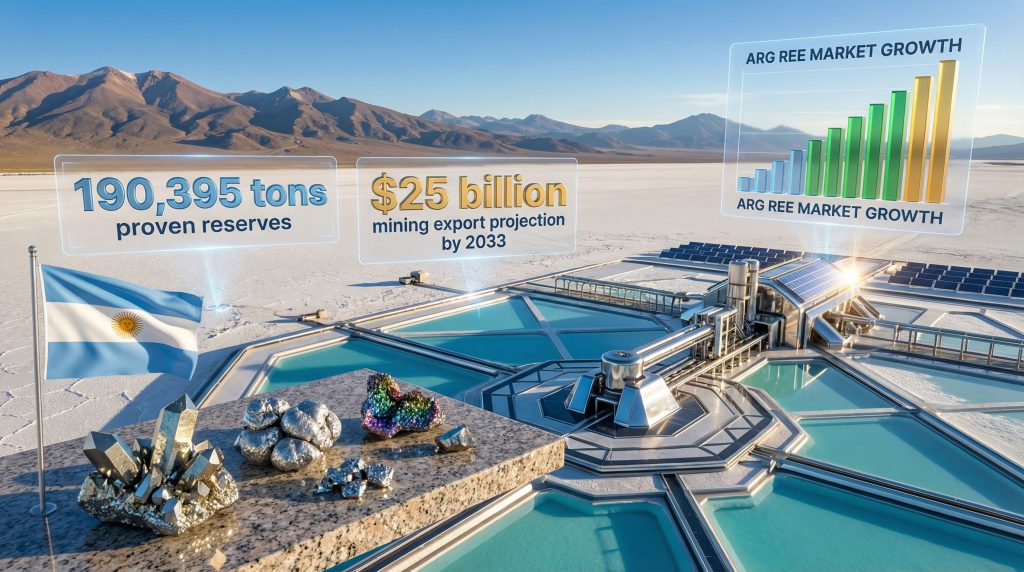
Current geological assessments indicate Argentina possesses 190,395 tons of proven rare earth reserves alongside approximately 3.3 million tons of potential resources requiring additional exploration and delineation. This resource base excludes clay-hosted deposits, which represent a separate category of REE resources that may require specialized processing technologies.
The significance of excluding clay deposits from current resource calculations relates to processing complexity and economic viability considerations. Clay-hosted rare earth elements often require acid leaching processes that present environmental and technical challenges, particularly in remote locations where infrastructure limitations exist.
Grade analysis reveals significant variability across different deposit types and geological formations. Sedimentary-hosted rare earth deposits typically contain 0.05% to 0.15% total rare earth oxides (TREO), while granitic-associated deposits may reach 0.2% to 0.4% TREO in higher-grade zones.
Historical production data from the Teodesia mine operations between 1954 and 1956 provides valuable insights into processing recovery rates and operational challenges. These early extraction efforts achieved approximately 65% recovery rates for light rare earth elements, establishing baseline technical parameters for modern extraction planning.
When big ASX news breaks, our subscribers know first
How U.S.-Argentina Critical Minerals Partnerships Shape Market Access?
Bilateral Framework Development
The strategic partnership between the United States and Argentina regarding critical minerals represents a comprehensive approach to supply chain diversification that extends beyond traditional trade relationships. This bilateral framework emphasizes technology transfer, environmental stewardship, and long-term resource security for both nations.
Memorandums of Understanding between U.S. government agencies and Argentine mining authorities establish specific protocols for:
- Joint geological surveys and resource assessment programs
- Technology sharing for environmentally responsible extraction methods
- Workforce development initiatives for specialised mining operations
- Infrastructure development coordination for remote mining regions
Supply chain diversification imperatives drive these partnerships as both countries recognise the strategic vulnerability of depending on concentrated rare earth sources. However, the framework explicitly addresses counter-positioning strategies against dominant market players while maintaining competitive pricing and quality standards, particularly in light of US-China critical minerals rivalry in South America.
Development Finance Corporation (DFC) investment facilitation mechanisms provide structured pathways for American companies to participate in Argentine rare earth development. These mechanisms include risk insurance products, project financing facilities, and technical assistance programs specifically designed for critical minerals projects.
RIGI Investment Incentive Structure
Argentina's Regime for Large Investments (RIGI) framework establishes clear parameters for major mining investments, with specific provisions that benefit rare earth development projects. The $200 million minimum project threshold ensures that only substantial operations qualify for enhanced incentives, promoting serious long-term development rather than speculative exploration activities.
Thirty-year fiscal stability guarantees represent a cornerstone of the RIGI framework, providing investors with predictable tax environments that enable long-term planning for capital-intensive rare earth operations. These guarantees cover corporate income tax rates, mining royalties, and import duty structures.
Key RIGI benefits for qualifying rare earth projects include:
- Accelerated depreciation schedules for processing equipment and infrastructure
- Foreign exchange flexibility for international sales and equipment purchases
- Streamlined permitting processes through single-window approval mechanisms
- Reduced import duties on specialised mining and processing equipment
Comparative analysis with other Latin American mining regimes reveals that Argentina's RIGI framework offers competitive advantages, particularly regarding fiscal stability duration and foreign exchange treatment. For instance, Chile's mining investment frameworks typically provide shorter stability periods, while Peru's systems offer less comprehensive tax benefit packages.
Which U.S. Mining Companies Are Positioning for Argentine REE Opportunities?
Current American Mining Presence
Newmont Corporation's Cerro Negro gold operations demonstrate successful American mining company operations in Argentina's challenging geological and regulatory environment. This operational precedent establishes important technical and logistical frameworks that could facilitate rare earth project development in similar remote locations.
SSR Mining's active projects in Jujuy and Salta provinces, particularly base metals exploration initiatives, create strategic positioning opportunities for rare earth development. The company's existing infrastructure, permitting experience, and regional relationships provide significant advantages for potential REE project expansion.
American minerals companies with existing Argentine operations possess valuable insights into:
- Local workforce development strategies for specialised mining operations
- Environmental permitting navigation through provincial and federal agencies
- Infrastructure logistics for equipment transportation and power supply
- Community engagement protocols for sustainable mining development
Strategic positioning patterns indicate that experienced operators recognise the synergies between existing base metals operations and potential rare earth development. Moreover, the growing US presence in Argentina's mining sector demonstrates how shared infrastructure, combined permitting processes, and integrated logistics systems reduce overall project development costs and timelines.
Sector Expansion Indicators
Argentina's 61 active lithium projects provide extensive infrastructure foundations that directly benefit rare earth development initiatives. The extensive Argentina lithium market insights reveal how shared road networks, power transmission systems, and water management facilities reduce capital requirements for new REE operations in similar geographical regions.
The presence of 35 copper projects across relevant provinces creates additional operational synergies, particularly regarding processing technologies and metallurgical expertise. Copper extraction and rare earth processing share similar acid leaching and solvent extraction techniques that enable technology transfer opportunities.
Cross-commodity operational efficiencies emerge when mining companies operate multiple project types within similar geological environments. These efficiencies include:
- Shared environmental monitoring systems across project sites
- Combined transportation logistics for equipment and personnel
- Integrated waste management systems for multiple commodity streams
- Consolidated community development programs serving regional populations
Technology transfer opportunities between lithium, copper, and rare earth operations accelerate learning curves and reduce technical risks. Companies with existing South American critical minerals experience demonstrate measurably faster project development timelines compared to new market entrants.
What Are the Economic Projections for Argentina's REE Development?
Export Revenue Forecasting
Economic modelling indicates Argentina's mining sector could generate $25 billion in annual export revenues by 2033, with rare earth elements contributing an increasingly significant portion of this total. Current projections suggest REE exports could represent 8-12% of total mining revenues within this timeframe, depending on global market development and production scaling.
Rare earth contribution calculations consider both concentrate exports and potential value-added processing within Argentina. Downstream processing facilities could increase per-ton export values by 300-500% compared to unprocessed concentrate sales, creating substantial economic multiplier effects.
Argentina's positioning as a regional leader in copper and lithium markets provides important precedents for rare earth development trajectories. Successful scaling of lithium operations from exploration to full production demonstrates the country's capacity to develop critical minerals sectors efficiently.
Critical minerals portfolio diversification benefits extend beyond direct export revenues to include:
- Enhanced geopolitical influence in global supply chain discussions
- Technology sector development through domestic value-added processing
- Regional economic development in previously underutilised provinces
- Export revenue stability through commodity diversification strategies
Investment Flow Analysis
$20 billion in U.S. Treasury backing mechanisms supports American private sector investment in Argentine critical minerals development. These mechanisms include direct lending facilities, risk insurance products, and loan guarantees specifically designed for strategic minerals projects.
Private sector capital allocation trends indicate increasing investor interest in geographically diversified rare earth supply chains. Pension funds, sovereign wealth funds, and specialised mining investment vehicles actively seek exposure to non-Chinese rare earth development opportunities.
Offtake agreement structuring for Argentine rare earth projects typically involves:
- Long-term price mechanisms tied to international rare earth oxide benchmarks
- Volume commitments scaled to production capacity development phases
- Quality specifications aligned with end-user manufacturing requirements
- Force majeure provisions addressing operational and political risk factors
Risk mitigation through bilateral partnerships enables more favourable financing terms compared to standalone project development. Government-to-government frameworks provide additional security layers that reduce political risk premiums for private investors.
What Operational Challenges Face American REE Companies in Argentina?
Technical and Environmental Compliance
Resource grade variability management presents significant challenges for Argentine rare earth operations, particularly given the geological diversity across different deposit types. Grade control protocols must account for natural variation in sedimentary-hosted deposits, where REE concentrations can fluctuate by 40-60% across relatively short distances.
Environmental permitting complexity in Argentina requires navigation through multiple regulatory levels, including federal environmental agencies, provincial mining authorities, and local municipal governments. Coordination between these entities typically extends permitting timelines to 18-24 months for comprehensive rare earth operations.
Processing technology requirements vary significantly based on deposit characteristics and target rare earth element profiles. Acid leaching systems for sedimentary deposits require different environmental controls compared to physical concentration methods used for placer-type formations.
Tailings management standards for rare earth operations must address both radioactive elements naturally associated with REE deposits and chemical reagents used in processing. These requirements often necessitate specialised containment systems that increase capital costs by 15-20% compared to conventional base metals operations.
Human Capital and Infrastructure Constraints
Skilled workforce availability represents a critical constraint for rare earth development in Argentina's remote provinces. Specialised metallurgical engineers, environmental technicians, and processing equipment operators require extensive training programs that typically span 12-18 months for full competency development.
Training program development needs encompass both technical skills and safety protocols specific to rare earth processing. Partnership programs with Argentine technical universities provide structured pathways for workforce development while building local capacity for long-term operations.
Transportation infrastructure requirements for remote rare earth operations include:
- All-weather road access capable of supporting heavy equipment transportation
- Power transmission systems adequate for energy-intensive processing operations
- Water supply infrastructure meeting both operational and environmental requirements
- Communications systems enabling real-time operational monitoring and control
Power supply reliability considerations often require backup generation systems and grid connection redundancy. Remote locations may necessitate on-site power generation using natural gas or renewable energy systems, adding $50-100 million to project capital requirements.
How Does Argentina's REE Potential Compare Globally?
Resource Quality Benchmarking
Grade comparisons between Argentine rare earth deposits and global benchmarks reveal competitive advantages in specific geological environments. Sedimentary-hosted Argentine deposits typically contain 0.05-0.15% TREO, comparable to many Chinese ionic clay deposits that currently dominate global production.
Processing complexity analysis relative to Mountain Pass operations in California indicates that Argentine deposits generally require less complex separation processes for light rare earth elements. However, heavy rare earth extraction may require additional processing steps that increase operational costs.
Logistical advantages over African rare earth sources include:
- Shorter shipping distances to North American and European markets
- Established port infrastructure through existing mining export facilities
- Political stability providing predictable operational environments
- Existing trade relationships facilitating commercial transactions
Geopolitical stability premiums associated with Argentine rare earth sources reflect investor preferences for democratic governance structures and established legal frameworks. These premiums typically translate to 10-15% higher valuation multiples for comparable resource bases.
Market Positioning Analysis
Supply chain proximity to U.S. markets creates significant competitive advantages for Argentine rare earth producers. Transportation cost savings of $200-400 per ton compared to Asian sources provide meaningful economic benefits for long-term supply contracts.
Processing capability development potential in Argentina could support downstream value-added manufacturing, particularly for permanent magnet precursor materials and specialty chemical products. Domestic processing development could increase export values by 300-500% compared to concentrate sales.
Value-added manufacturing opportunities include:
- Rare earth metal production for aerospace and defence applications
- Permanent magnet manufacturing for renewable energy systems
- Specialty chemical production for catalyst and petroleum refining industries
- Electronic materials manufacturing for semiconductor and consumer electronics sectors
Strategic reserve contribution capacity positions Argentina as a potential supplier for U.S. government stockpiling initiatives. Current rare earth reserve requirements suggest potential government purchase commitments of 5,000-10,000 tons annually for strategic purposes.
The next major ASX story will hit our subscribers first
What Investment Strategies Are Emerging for Argentine REE Projects?
Risk Assessment Framework
Macroeconomic volatility considerations for Argentine investments require sophisticated hedging strategies that address currency fluctuation, inflation impacts, and fiscal policy changes. Historical analysis indicates that commodity-linked revenue streams provide natural hedges against peso devaluation during economic instability periods.
Currency stability mechanisms increasingly utilise dollar-denominated sales contracts combined with local cost indexing to maintain operational profitability during exchange rate volatility. These mechanisms typically reduce investment returns by 2-3% annually but significantly decrease cash flow variability.
Political risk insurance options through Development Finance Corporation, Export-Import Bank, and private insurers provide coverage for:
- Expropriation protection against government asset seizure
- Currency inconvertibility coverage for foreign exchange restrictions
- Political violence protection covering civil unrest and terrorism risks
- Breach of contract coverage for government agreement violations
Regulatory compliance pathways require ongoing monitoring of environmental regulations, mining law modifications, and tax policy changes. Legal advisory relationships with established Argentine law firms specialising in mining provide essential regulatory navigation support.
Financial Structuring Models
Joint venture partnership structures between American companies and Argentine operators provide risk sharing mechanisms while leveraging local expertise and relationships. Typical structures involve 60-40% to 70-30% foreign-domestic ownership ratios, depending on project scale and local partner capabilities.
Staged development financing allows investors to minimise capital exposure during early project phases while retaining expansion options as operations demonstrate commercial viability. Phase 1 investments typically focus on resource delineation and pilot processing, requiring $50-100 million in initial capital.
Technology licensing arrangements enable access to proven rare earth processing technologies while reducing development timelines and technical risks. Licensing fees typically represent 2-5% of gross revenues but provide significant operational risk mitigation benefits.
Revenue sharing mechanisms with local communities and provincial governments create stakeholder alignment while addressing social licence requirements. These arrangements typically allocate 1-3% of gross revenues to community development funds and educational programs.
Future Outlook: Argentina's Role in Global REE Supply Security
Strategic Importance Projections
Clean energy transition demand drivers indicate that global rare earth consumption could increase by 400-600% by 2040, primarily driven by permanent magnet requirements for wind turbines and electric vehicle motors. The energy transition in critical minerals demonstrates how Argentine production capacity development must align with these demand trajectories to capture optimal market positioning.
Defence sector requirements for high-performance rare earth elements continue expanding as military technologies become increasingly sophisticated. Domestic supply chain preferences in defence procurement create premium market opportunities for trusted supplier relationships.
Technology sector supply chain resilience initiatives by major manufacturers actively seek geographically diversified rare earth sources. Long-term supply agreements with technology companies typically offer price premiums of 10-20% above spot markets in exchange for guaranteed delivery commitments.
Geopolitical supply diversification imperatives drive government policies supporting non-Chinese rare earth development. Tax incentives, loan guarantees, and regulatory support create favourable investment environments for strategic minerals projects.
Development Timeline Expectations
Exploration to production phases for Argentine rare earth projects typically require 7-10 years from initial resource identification to commercial production. Accelerated development pathways through existing infrastructure utilisation could reduce timelines to 5-7 years for well-positioned projects.
Infrastructure development requirements vary significantly based on project location and scale. Remote operations may require $200-500 million in infrastructure investments, while projects near existing mining operations could leverage shared facilities.
Market entry timing considerations suggest that 2030-2035 represents the optimal window for Argentine rare earth production to capture growing market demand while avoiding oversupply conditions. The broader mining industry evolution indicates that early mover advantages in established markets typically persist for 5-8 years before competitive pressures intensify.
Competitive positioning windows for american minerals argentina rare earths remain favourable through 2035, provided that development timelines align with global supply-demand fundamentals. Strategic partnerships with end-users established during development phases create sustainable competitive advantages for long-term operations.
Investment Disclaimer: The projections, forecasts, and financial analyses presented in this article are based on current market conditions and available data. Rare earth element investments involve significant technical, political, and market risks. Currency fluctuations, regulatory changes, and commodity price volatility can substantially impact investment returns. Potential investors should conduct independent due diligence and consult with qualified financial advisors before making investment decisions regarding Argentine rare earth projects or related securities.
Looking for Strategic Exposure to Argentina's Rare Earth Potential?
Discovery Alert's proprietary Discovery IQ model delivers real-time alerts on significant mineral discoveries across the ASX, including rare earths and critical minerals opportunities that could benefit from Argentina's emerging strategic partnerships with US companies. Explore how major mineral discoveries have generated substantial returns by visiting Discovery Alert's dedicated discoveries page, then begin your 14-day free trial today to position yourself ahead of the market with instant notifications powered by advanced AI technology.