
June 5, 2026
Why Capital Certainty Is the Rarest Commodity in Emerging Market Resource Investment
For decades, the fundamental challenge facing large-scale resource investment in Latin America has not been geological scarcity or technical complexity. It has been the reliability of the rules. Fiscal frameworks that shift mid-project, currency controls that trap returns, and administrative environments where permits can be renegotiated under political pressure have systematically compressed risk-adjusted returns and redirected capital toward jurisdictions with more predictable governance. Argentina has historically embodied this challenge more acutely than most.
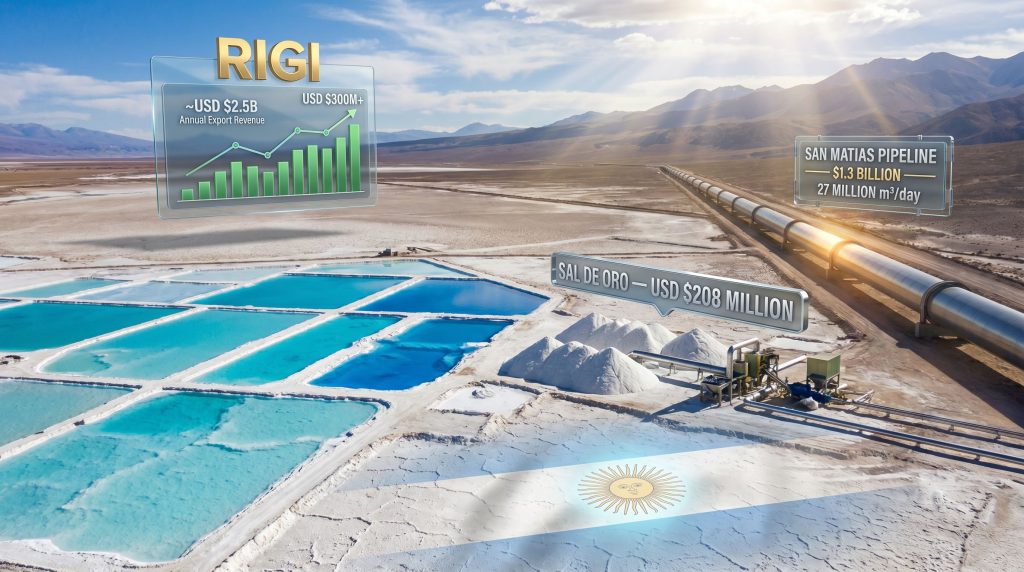
That context makes the country's RIGI framework and its most recent approvals — covering a USD $1.3 billion gas pipeline and a USD $208 million lithium project expansion — particularly significant. These are not routine tax concessions. They represent a structural attempt to reframe Argentina's relationship with long-duration foreign capital, at a moment when the global lithium market and demand for hydrocarbons are reshaping resource investment hierarchies worldwide.
Furthermore, Argentina tax breaks for gas pipeline and lithium project activity signal that the current administration is prepared to offer contractually enforceable fiscal commitments to attract the scale of capital these sectors require.
When big ASX news breaks, our subscribers know first
Understanding What Argentina's RIGI Regime Actually Is
The Régimen de Incentivo para Grandes Inversiones, known by its acronym RIGI, was introduced under Argentina's current administration as a purpose-built mechanism to attract large-scale, long-duration investment across strategic sectors. Its defining characteristic is legal enforceability. Unlike discretionary tax holidays that governments can unilaterally modify, RIGI grants qualifying investors contractual rights that cannot be worsened by subsequent legislative changes for the duration of the incentive period.
This stability clause architecture is critical. For projects with capital recovery horizons spanning 15 to 30 years, the ability to lock in a fiscal framework at the point of investment commitment substantially changes the risk calculus. It removes one of the primary deterrents that has historically kept institutional capital and project finance lenders at arm's length from Argentine resource development.
What Projects Must Demonstrate to Qualify
RIGI is not open to all investments. Qualifying criteria are designed to filter for projects with genuine macroeconomic significance. Key eligibility conditions include:
- Minimum investment thresholds that vary by sector, reaching up to USD $600 million for oil and gas project classifications
- Demonstrated capacity to generate foreign currency export revenues on a sustained basis
- Evidence of meaningful employment creation and long-term economic contribution
- Project viability across eligible sectors including hydrocarbons, mining, forestry, energy infrastructure, and technology
Sectors such as lithium brine extraction and gas transportation infrastructure sit firmly within the eligible universe, which explains why both recent approvals fit cleanly within the framework's design intent. For a more detailed breakdown of the RIGI framework's legal provisions, Argentina's foreign ministry has published the full English-language documentation.
The Full Fiscal Incentive Package
| Benefit Category | RIGI Provision |
|---|---|
| Corporate Income Tax | Reduced rate applied to qualifying project income |
| Capital Expenditure VAT | Exemptions on eligible capex items |
| Depreciation | Accelerated schedules improving early-stage cash flows |
| Tax-Loss Carryforwards | No expiration limit on carried losses |
| Export Duties | Phased exemptions following a defined transition window |
| Import Duties | Full exemptions on imported capital goods and equipment |
| Foreign Exchange Access | Special provisions for profit repatriation and debt servicing |
The combination of front-loaded depreciation benefits, unlimited loss carryforwards, and import duty relief on capital equipment is particularly relevant for capex-intensive projects. A gas pipeline or lithium processing facility requires enormous upfront equipment investment before a single dollar of export revenue is generated. RIGI's design acknowledges this cash flow reality.
The San Matias Pipeline: Unlocking Vaca Muerta's Export Ceiling
The Bottleneck Problem That Makes Pipelines More Valuable Than Wells
Argentina's Vaca Muerta formation is among the most geologically significant unconventional hydrocarbon resources on earth. Estimates place its technically recoverable shale gas reserves at approximately 308 trillion cubic feet, a figure that positions it as the second-largest shale gas resource outside the United States. The Neuquén Basin, where Vaca Muerta sits, also contains substantial tight oil accumulations across stacked pay zones.
The geological endowment is not in question. What has constrained Vaca Muerta's commercial translation into export revenues is midstream infrastructure — specifically pipeline takeaway capacity. Without sufficient pipeline to move gas from the wellhead to coastal export terminals or domestic distribution hubs, upstream drilling programmes simply cannot convert geological resource into monetisable production at scale.
In resource economics, this is sometimes called the takeaway constraint problem, and it is a dynamic well understood by investors in North American shale basins where pipeline bottlenecks repeatedly created regional price dislocations.
San Matias Pipeline: Project Data Summary
| Metric | Data Point |
|---|---|
| Total Project Investment | USD $1.3 billion |
| Daily Gas Transport Capacity | 27 million cubic metres |
| Source Formation | Vaca Muerta shale, Neuquén Basin |
| Projected Annual Export Revenue | ~USD $2.5 billion |
| Incentive Framework | RIGI approval |
Economy Minister Luis Caputo's announcement framed the San Matias pipeline explicitly as a hard-currency revenue mechanism. The projected $2.5 billion in annual export revenues represents a meaningful contribution to Argentina's foreign exchange position, particularly given the country's ongoing external debt obligations and persistent current account management pressures. Argentina's approval of TGS's RIGI scheme for a related gas pipeline expansion further illustrates how energy transition pressures are driving the government's infrastructure strategy.
For a sovereign borrower managing significant external liabilities, recurring hard-currency export income from energy infrastructure has a direct relationship to debt serviceability and credit market perception. Pipeline approvals under RIGI are therefore simultaneously industrial policy and macroeconomic stabilisation tools.
What the Shale Gas Value Chain Looks Like at This Scale
It is worth understanding that Vaca Muerta's gas is not a single commodity stream. The formation produces wet gas with associated liquids, meaning pipeline infrastructure also enables the separation and export of natural gas liquids including ethane, propane, and butane. These liquids command premium pricing in petrochemical feedstock markets and add an additional revenue dimension that simple daily cubic metre figures do not capture.
The full export value potential of expanded Vaca Muerta pipeline capacity therefore likely exceeds headline gas export projections when liquids monetisation is factored in.
Sal de Oro and POSCO: The Strategic Logic Behind South Korean Lithium Investment in Argentina
Argentina's Position in Global Lithium Supply Geography
Argentina occupies a critical position within what geologists and supply chain analysts refer to as the Lithium Triangle — a region spanning northwestern Argentina, northern Chile, and southwestern Bolivia that collectively hosts more than 50% of the world's identified lithium reserves. The Argentina lithium brine market is predominantly concentrated in high-altitude salt flats known as salares across the provinces of Salta, Jujuy, and Catamarca.
Brine-based lithium extraction operates differently from hard-rock spodumene mining as practised in Australia. Lithium-enriched brines are pumped from subsurface aquifers into large evaporation ponds where solar energy concentrates lithium chloride over several months. Chemical processing then converts it into battery-grade lithium carbonate or lithium hydroxide. Furthermore, innovations in direct lithium extraction are increasingly being evaluated alongside conventional evaporation methods to improve recovery rates and shorten production timelines.
The quality of Argentine brine deposits varies considerably across salares. Key parameters that determine brine project economics include:
- Lithium grade (measured in milligrams per litre of brine)
- Magnesium-to-lithium ratio, which affects processing complexity and cost
- Potassium concentration, which can either supplement or complicate extraction depending on market conditions
- Aquifer recharge rates, which affect the sustainability of long-term pumping programmes
Projects with low magnesium-to-lithium ratios and high brine grades are generally considered highest quality because they require less reagent input and produce a more straightforward purification process. These technical factors are rarely visible in headline investment announcements but are the variables that sophisticated project finance lenders scrutinise most closely.
Sal de Oro Project: Core Investment Metrics
| Metric | Data Point |
|---|---|
| Project Operator | POSCO (South Korea) |
| Total Expansion Investment | USD $208 million |
| Incremental Annual Production | 23,000 metric tonnes of lithium carbonate |
| Estimated Annual Revenue Impact | Over USD $300 million |
| Incentive Framework | RIGI approval |
POSCO's involvement in Argentine lithium reflects a broader strategic repositioning by South Korean industrial conglomerates. The company has systematically built a portfolio of battery materials assets across multiple continents as part of a long-term vertical integration strategy linking upstream mineral production to downstream cathode material supply for electric vehicle battery manufacturers.
Why Asian Battery Supply Chains Are Diversifying Into Argentina
The concentration of lithium supply in Chile and Australia has created supply chain diversification pressures for Asian battery manufacturers and EV producers. Chilean production operates under a royalty framework with state enterprise involvement, while Australian hard-rock spodumene requires energy-intensive conversion processing before it can be used in battery manufacturing.
Argentina's brine operations, particularly under a RIGI-stabilised fiscal framework, offer an alternative supply profile: lower political concentration risk and direct carbonate production without additional conversion steps. Consequently, the broader debate around critical minerals and energy security is amplifying demand for exactly the kind of supply chain certainty that RIGI-approved projects can provide.
This supply chain logic helps explain why Argentina tax breaks for gas pipeline and lithium project development matter beyond their domestic fiscal implications. They signal to global battery industry procurement teams that Argentine lithium projects carry a more bankable risk profile.
Comparing RIGI to Peer Nation Investment Regimes
| Country | Framework | Key Features | Sector Focus |
|---|---|---|---|
| Argentina | RIGI | Tax stability clauses, FX access, duty exemptions, unlimited loss carryforward | Mining, energy, infrastructure |
| Chile | Mining Royalty Framework | Profit-sharing royalty tiers | Copper, lithium |
| Australia | Resource rent tax structure | Profit-based levy with offsets | Broad resources |
| Canada | Flow-Through Share System | Tax deduction pass-through to investors | Junior mining |
| Indonesia | IUPK Special Licences | Long-term concessions with export controls | Nickel, bauxite |
What distinguishes RIGI structurally is its combination of stability enforcement and front-loaded cash flow improvement. Most peer regimes are profit-sharing or royalty-based, meaning they extract value from projects during the production phase. RIGI instead provides capital cost relief during the investment phase — a design more aligned with the actual risk profile of projects where capital is at risk for years before revenues materialise.
In addition, energy transition pressures in peer jurisdictions such as Canada have complicated investor confidence in recent years, making Argentina's structured approach comparatively attractive for certain categories of long-duration capital.
Risks That RIGI Cannot Fully Neutralise
Legal frameworks provide necessary but not sufficient conditions for investment success. Several risk dimensions remain active for RIGI-approved projects:
- Sovereign risk persistence: Argentina's institutional history means residual political risk must be priced into any long-duration investment, notwithstanding RIGI's stability provisions
- Currency convertibility: While RIGI includes specific FX access mechanisms, the broader peso environment remains subject to macroeconomic pressures that can create operational frictions
- Implementation friction: The gap between legislative approval and practical benefit delivery has historically been a recurring challenge in Argentine regulatory administration
- Community and environmental considerations: Lithium brine extraction in Argentina's northwest provinces operates near indigenous territories and sensitive high-altitude wetland ecosystems; social licence and environmental approval processes add timeline variables that RIGI cannot insulate projects from
- Commodity price cycles: Both lithium carbonate and natural gas prices are subject to global demand and supply dynamics that can materially alter project economics regardless of the fiscal framework
Scenario Analysis: RIGI Project Outcome Variables
| Scenario | Key Driver | Likely Impact |
|---|---|---|
| Sustained Milei-era fiscal reform | Political continuity | Positive for investor confidence |
| Lithium price recovery from 2024 lows | Global EV demand trajectory | Upside for Sal de Oro economics |
| Gas price softening in export markets | Global LNG supply dynamics | Moderate pressure on San Matias revenues |
| Peso devaluation acceleration | Macro instability | Partially offset by USD-denominated exports |
| Community or legal challenge | Project-specific approval risk | Construction timeline delays |
| Regulatory implementation delay | Administrative capacity | Deferred capex deployment |
The next major ASX story will hit our subscribers first
The Compounding Macroeconomic Logic of Multiple RIGI Approvals
Viewed individually, each RIGI approval represents a single project investment decision. Viewed collectively, however, a growing portfolio of RIGI-approved projects begins to function as a structural shift in Argentina's export revenue architecture. The San Matias pipeline and Sal de Oro expansion together represent potential annual export revenues exceeding $2.8 billion once fully operational.
When combined with other RIGI-eligible projects across the Vaca Muerta and Lithium Triangle pipeline, the aggregate hard-currency export increment becomes significant relative to Argentina's current account dynamics. Rating agencies and multilateral lending institutions assess sovereign debt capacity in part through projected export revenue trajectories. A credible and growing RIGI project portfolio therefore creates indirect positive feedback into Argentina's cost of sovereign borrowing.
The sequential approval of both energy infrastructure and critical minerals projects within the same policy communication also signals deliberate export diversification strategy. Argentina is not positioning itself as a single-commodity play. The concurrent development of gas export capacity and lithium carbonate production creates a more resilient hard-currency income base — one less vulnerable to any single commodity price cycle. Moreover, the trajectory of the global lithium market suggests that Argentina tax breaks for gas pipeline and lithium project investment are arriving at a strategically opportune moment.
Frequently Asked Questions: Argentina Tax Breaks for Gas Pipeline and Lithium Project
What is Argentina's RIGI investment framework?
RIGI is Argentina's large investment incentive regime that provides qualifying projects with a legally binding package of tax, customs, and foreign exchange benefits. These include reduced corporate income tax rates, VAT exemptions on capital expenditure, accelerated depreciation, unlimited tax-loss carryforward provisions, and relief from both import and export duties.
Which specific projects have received the most recent RIGI approvals?
The San Matias gas pipeline, representing a USD $1.3 billion investment, and POSCO's Sal de Oro lithium project expansion at USD $208 million both received RIGI approval as announced by Argentina's Economy Ministry.
What is the San Matias pipeline's transport capacity and revenue projection?
The pipeline is engineered to move 27 million cubic metres of gas per day sourced from the Vaca Muerta shale formation, with annual export revenue potential estimated at approximately USD $2.5 billion.
What lithium production volumes does the Sal de Oro expansion target?
The POSCO-operated expansion is projected to contribute an additional 23,000 metric tonnes per year of lithium carbonate, generating estimated annual revenues exceeding USD $300 million.
Are other lithium projects in Argentina pursuing RIGI approval?
Multiple lithium operations across Argentina's northwest provinces have applied for or received RIGI inclusion, including expansion activities at Cauchari-Olaroz and projects within the Rincón area of Salta province, reflecting the regime's function as an investment aggregation mechanism for the sector.
What is the minimum investment threshold for RIGI in oil and gas?
For oil and gas projects, RIGI qualification thresholds can reach up to USD $600 million depending on the classification and scope of the proposed investment.
Disclaimer: This article is intended for informational purposes only and does not constitute financial, investment, or legal advice. All forecasts, projections, and scenario analyses presented are speculative in nature and subject to material change. Readers should conduct independent due diligence and consult qualified advisers before making any investment decisions. Past regulatory frameworks and project outcomes in Argentina do not guarantee future results.
Want to Identify the Next Major Resource Discovery Before the Market Does?
Discovery Alert's proprietary Discovery IQ model delivers real-time alerts on significant ASX mineral discoveries — including critical minerals such as lithium — translating complex geological and market data into actionable investment insights the moment they hit the exchange. Explore why historic mineral discoveries have generated exceptional returns and begin your 14-day free trial today to position yourself ahead of the broader market.