
June 5, 2026
The Hidden Architecture of Value: Why Not All Tangible Assets Are Created Equal
Across financial history, investors have repeatedly made the error of grouping tangible assets together under a single mental category labelled "real assets" or "alternative investments." Gold coins, diamonds, fine art, rare whisky, and vintage watches all share surface-level characteristics: they are physical, finite in some sense, and visually appealing. Yet treating them as functionally equivalent from an investment standpoint has led countless portfolios astray.
The mechanism that separates truly durable stores of value from premium-priced commodities is rarely discussed in mainstream personal finance circles. It operates at the intersection of supply architecture, technological vulnerability, institutional adoption, and monetary heritage. Understanding this mechanism does not require advanced economics training. It does, however, require a willingness to look past marketing narratives that have been decades in the making.
The gold vs diamonds investment debate offers one of the cleanest case studies available for understanding why certain tangible assets endure while others collapse under the weight of their own fragility.
When big ASX news breaks, our subscribers know first
Why Most People Get This Comparison Wrong From the Start
The Luxury Asset Illusion: When Rare and Beautiful Does Not Mean Valuable
Both gold and diamonds tick the intuitive boxes that most people associate with investment-grade assets. They are rare. They are physically beautiful. They command high prices per unit of weight. They carry cultural prestige across diverse societies. These shared characteristics create a powerful cognitive shortcut that causes investors to treat both assets as interchangeable stores of wealth.
This shortcut is dangerously misleading.
Beauty and scarcity are necessary but insufficient conditions for investment-grade value. What actually separates monetary assets from luxury commodities is a combination of factors: the durability of scarcity itself, the depth and transparency of the secondary market, the extent of institutional adoption, and the asset's independence from a single cultural narrative maintaining its value. On every one of these criteria, gold and diamonds diverge dramatically.
How Emotional Purchasing Decisions Masquerade as Investment Strategy
The diamond industry has historically benefited from one of the most effective marketing campaigns ever constructed. The notion that diamond size signals romantic commitment, and that a diamond's value endures forever, was not an organic cultural evolution. It was a deliberate commercial strategy executed over several decades.
The consequence of this campaign is that generations of consumers have made large financial outlays on diamonds while genuinely believing they were building or preserving wealth. As explored in comparative analyses of diamonds vs gold, retail diamond purchases typically return between 20% and 40% of the original purchase price on resale — a figure that does not include the opportunity cost of capital deployed elsewhere.
Purchasing a diamond for personal or emotional reasons is entirely legitimate. However, classifying that purchase as part of an investment strategy is a categorically different decision, and one the data does not support.
The Critical Difference Between a Store of Value and a Luxury Commodity
A store of value must satisfy a specific set of conditions: it must maintain purchasing power over time, it must be liquid enough to convert into other assets when needed, its pricing must be transparent and broadly accepted, and its scarcity must be durable against technological or institutional disruption.
Gold satisfies all four conditions. Diamonds, as will become clear, satisfy none of them reliably.
What Is the Stock-to-Flow Ratio and Why Does It Determine Investment Worth?
Defining Stock-to-Flow in Plain Terms
"Stock-to-flow ratio measures the relationship between the total existing supply of an asset and the rate at which new supply enters the market annually. Assets with a high stock-to-flow ratio — where new supply is small relative to total existing supply — tend to preserve value more reliably over time."
In practical terms, if an asset has a stock-to-flow ratio of 60, it means the entire existing supply would take 60 years to reproduce at current production rates. This structural characteristic creates natural price support by ensuring that no single year's production can meaningfully dilute the value of accumulated holdings.
How Gold's 5,000-Year Accumulated Supply Creates a Natural Price Floor
Gold's stock-to-flow ratio sits at approximately 60:1, derived from roughly 210,000 tonnes of above-ground gold supply against annual mining output of approximately 3,500 tonnes. This ratio has strengthened over millennia because of one critical physical property: gold is indestructible under normal conditions.
- Every ounce of gold ever mined across 5,000 years of human history remains in circulation in some form, whether as monetary bullion, jewellery, industrial components, or central bank reserves.
- Annual new mining output represents approximately 1.6% of total above-ground supply, meaning production shocks have minimal dilutive effect.
- This structural scarcity cannot be replicated through laboratory synthesis using any currently known or commercially viable process.
This is not a coincidence of geology. It reflects a convergence of physical chemistry, historical accumulation, and the economics of extraction that makes gold uniquely resistant to supply disruption. Furthermore, gold as a strategic investment becomes particularly compelling when viewed through this long-term supply lens.
Why Diamonds Fail the Stock-to-Flow Test
The diamond market's structural vulnerabilities become immediately visible when examined through a stock-to-flow lens:
- Historical diamond supply was artificially constrained through concentrated market control rather than genuine geological scarcity, with De Beers managing approximately 80% of global supply for much of the 20th century.
- The emergence of chemical vapour deposition (CVD) and high-pressure high-temperature (HPHT) laboratory production techniques fundamentally altered the flow side of the equation, enabling diamond creation at costs a fraction of traditional mining.
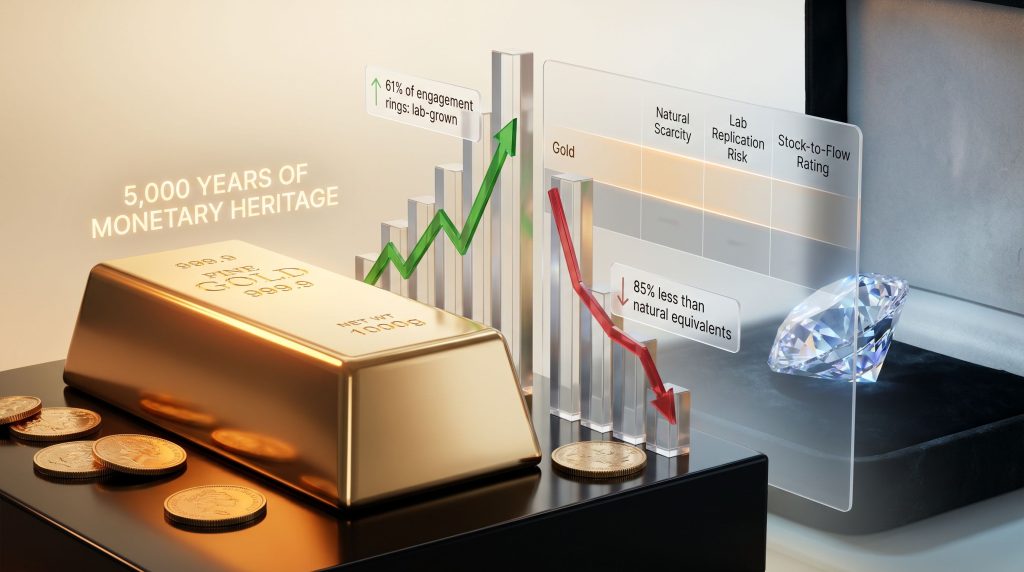
- Lab-grown diamonds now account for 61% of engagement ring purchases in the United States.
- Lab-grown stones retail at approximately 85% less than natural equivalents of comparable quality.
- Both natural and lab-grown diamond prices have declined simultaneously, confirming that technological disruption has compressed the entire category rather than merely substituting one supply source for another.
This simultaneous price compression is a particularly telling signal. When the cheaper alternative undermines the price of the premium product rather than simply capturing market share, it indicates that the perceived premium was never rooted in genuine scarcity.
Stock-to-Flow Comparison Table
| Asset | Natural Scarcity | Supply Controllability | Lab Replication Risk | Stock-to-Flow Rating |
|---|---|---|---|---|
| Gold | Very High | Very Low | None (currently) | Excellent |
| Natural Diamonds | Moderate | Historically Controlled | High (achieved) | Poor |
| Lab-Grown Diamonds | Effectively Unlimited | Low | Already Replicated | Very Poor |
The Collapse of the Diamond Market: What the Data Actually Shows
Natural Diamond Prices Have Hit Their Lowest Point This Century
Natural diamond prices have reached their lowest levels in the 21st century, and the trajectory of decline is not consistent with typical commodity cycles. Cyclical downturns are characterised by supply-demand imbalances that eventually self-correct as marginal producers exit and new investment dries up. What the diamond market is experiencing is fundamentally different in kind.
The price deterioration reflects a structural, permanent shift in supply dynamics driven by laboratory production technology. When a fundamentally cheaper substitute that is chemically identical to the natural product achieves majority market share, the price differential between the natural and synthetic version cannot be sustained through marketing alone.
The De Beers Valuation Collapse as a Market Signal
Perhaps the clearest institutional signal of this structural shift is the valuation write-down of De Beers to $2.3 billion. This is not merely a corporate accounting event. It represents the recognition by sophisticated institutional investors, including Anglo American which held a controlling stake, that the pricing architecture constructed around natural diamonds over several decades has fundamentally eroded.
"When the architect of an asset's perceived value loses confidence in that value, retail investors should treat the signal with the utmost seriousness."
De Beers spent decades constructing the cultural infrastructure that made diamonds appear irreplaceable. Consequently, the write-down represents an institutional admission that this infrastructure can no longer support the valuations it once did.
What Happens When Marketing Becomes the Only Moat
The diamond market provides a textbook example of what occurs when an asset's value proposition rests primarily on cultural conditioning rather than intrinsic monetary utility. Marketing can sustain a premium for extended periods, particularly when supply is controlled and cultural narratives are reinforced through repeated exposure. However, two conditions can rapidly unwind this dynamic:
- A technological breakthrough that removes the supply constraint underpinning the premium.
- A generational shift in cultural values that weakens the narrative itself.
The diamond market is experiencing both simultaneously. Lab-grown technology has eliminated the supply barrier, while younger consumer cohorts are demonstrably more willing to purchase synthetic diamonds than their predecessors, treating chemical and optical equivalence as sufficient grounds for substitution.
Resale Economics: The Diamond Investor's Hidden Problem
The secondary market for diamonds is characterised by structural disadvantages that make meaningful capital recovery difficult:
- Retail diamond resale values typically return 20% to 40% of the original purchase price, reflecting the substantial markup embedded in retail pricing.
- Unlike gold, there is no universally recognised spot price for diamonds, meaning every resale transaction requires individual appraisal.
- Valuation depends on the 4Cs framework: cut, clarity, colour, and carat, creating inherently subjective and inconsistent pricing across different appraisers and markets.
- Institutional buyers in the secondary diamond market are significantly fewer in number compared to gold, reducing competition and consequently depressing realised prices.
- Certification requirements add time and cost friction to the resale process that does not exist in gold markets.
Gold's Price Trajectory: Understanding the Bull Run in Context
From $2,100 to Approximately $3,300+: Mapping the Modern Gold Rally
Gold's multi-year price appreciation from approximately $2,100 to over $3,300 per ounce reflects a convergence of macroeconomic and geopolitical forces that have reinforced gold's monetary safe-haven status. In addition, central bank gold demand has been a primary driver, with official sector purchases reaching historically elevated levels as institutions reduce exposure to the US dollar system.
The demand drivers underpinning this rally include:
- Sustained central bank accumulation as part of reserve diversification strategies, particularly among emerging market central banks.
- Geopolitical fragmentation increasing demand for assets that operate outside bilateral financial relationships.
- Real interest rate dynamics favouring non-yielding assets during periods of elevated inflation relative to cash returns.
- De-dollarisation trends encouraging reserve managers to seek monetary assets with universal recognition.
Why Gold Has Functioned as Money for Over 5,000 Years
Gold's endurance as a monetary metal is not coincidental. It reflects a combination of physical properties that happen to align almost perfectly with the requirements for a functional monetary asset:
- Durability: Gold does not corrode, oxidise, or degrade under any conditions encountered in ordinary use. A gold coin minted two millennia ago remains chemically identical to newly mined bullion today.
- Divisibility: Gold can be transacted in standardised units across virtually any scale, from milligrams to tonnes, with consistent and verifiable purity.
- Portability: Gold's exceptionally high value-to-weight ratio makes it practical to transport and store relative to most alternative monetary commodities.
- Universal recognition: Gold is accepted across cultures, borders, political systems, and monetary regimes without requiring counterparty trust or institutional backing.
No laboratory process currently exists that can economically replicate gold. This reflects the fundamental nuclear chemistry of gold's atomic structure, which requires conditions achievable only in particle accelerators at costs orders of magnitude above gold's market price.
The Monetary Metal Distinction: What Separates Gold From Industrial Commodities
Gold occupies a unique position in the commodity universe because its primary demand driver is monetary and reserve-based rather than industrial. Unlike copper, lithium, or indeed diamonds, gold's value does not depend on any single industrial application remaining economically relevant.
Central banks hold gold as a reserve asset. No central bank holds diamonds, crude oil, copper, or any other industrial commodity as a reserve asset. This institutional recognition of gold's monetary status provides a demand floor that is structurally independent of economic cycles, technological change, or industrial trends. Furthermore, gold's safe-haven role becomes particularly prominent during periods of geopolitical and financial stress.
Gold vs Diamonds Investment: A Side-by-Side Analytical Framework
Liquidity: Which Asset Can You Actually Sell When You Need To?
Liquidity represents one of the most practically important investment characteristics, yet it is routinely overlooked in discussions of alternative assets. The difference between gold and diamonds on this dimension is stark:
- Gold can be sold through bullion dealers, commodity exchanges, ETF redemption mechanisms, and allocated account providers within hours at transparent spot prices.
- Diamond resale requires gemological certification or verification, specialist appraisal, and access to a significantly narrower buyer pool.
- International gold markets operate 24 hours per day across multiple time zones, ensuring continuous price discovery and exit opportunities.
- Diamond secondary markets are fragmented, illiquid, and subject to extended settlement timelines.
Verdict: Gold wins decisively on liquidity across all investor profiles.
Price Transparency: Do You Know What You're Actually Buying?
Price transparency directly affects an investor's ability to assess fair value, time entry and exit decisions, and evaluate portfolio performance objectively:
- Gold trades at a globally recognised spot price updated in real time through regulated exchanges, accessible to retail and institutional investors alike.
- Diamond pricing varies by vendor, certification body, geographic market, and individual stone characteristics, creating persistent information asymmetry that systematically disadvantages buyers relative to informed sellers.
- The absence of a universal diamond spot price means that two stones of nominally identical specifications can command materially different prices depending on the point of sale.
Verdict: Gold offers significantly greater pricing transparency, reducing information risk for investors.
Inflation Hedge Effectiveness
| Metric | Gold | Natural Diamonds | Lab-Grown Diamonds |
|---|---|---|---|
| Historical inflation hedge | Strong | Weak | Very Weak |
| Price trend (recent years) | Strongly Upward | Declining | Declining |
| Institutional adoption | High (central banks) | None | None |
| Resale market depth | Deep and global | Shallow | Very Shallow |
| Supply disruption risk | Low | High (lab replication) | N/A |
| Price transparency | Real-time global spot | Opaque and fragmented | Opaque and fragmented |
Wealth Preservation Over Time: The Long-Term Scorecard
Historical data provides unambiguous guidance on which asset class has demonstrated superior wealth preservation characteristics:
- Gold has maintained purchasing power across multiple centuries and numerous monetary regime changes, including the transition from the gold standard to fiat currency systems, multiple hyperinflationary episodes, and widespread geopolitical disruptions.
- Diamond values have demonstrated clear vulnerability to both technological disruption and shifting cultural preferences, with the current cycle representing the most severe structural challenge the market has faced.
- Investors who allocated to diamonds as a portfolio asset over the past decade have experienced significant capital erosion in real terms, while contemporaneous gold investors have benefited from one of the metal's most sustained bull markets in recent history.
The next major ASX story will hit our subscribers first
Is There Any Investment Case Left for Diamonds?
Niche Scenarios Where Diamonds May Still Hold Appeal
It would be intellectually dishonest to argue that diamonds hold zero investment appeal under any circumstances. According to specialist investment assessments, a narrow set of scenarios exists where diamond-related allocations may offer some merit:
- Vivid fancy coloured diamonds (particularly pink, blue, and red stones from sources like the now-closed Argyle mine in Western Australia) operate in a separate collector market with distinct supply dynamics and a much smaller pool of competing synthetic alternatives. The Argyle mine's 2020 closure permanently reduced the supply of vivid pink diamonds, creating genuine geological scarcity for this specific subcategory.
- Ultra-rare certified stones with exceptional provenance and grading records may offer asymmetric upside for specialist buyers with deep market knowledge, though this represents speculative niche collecting rather than conventional investment.
- Emotional and aesthetic value for personal use remains entirely legitimate and should not be dismissed, but this constitutes consumption rather than investment.
The Distinction Between Consumption and Investment
"Purchasing a diamond for personal enjoyment, as a gift, or as a symbol of commitment is a legitimate and meaningful consumer decision. Purchasing a diamond with the expectation of capital appreciation or portfolio growth is a fundamentally different proposition, and one that current market data does not support for the vast majority of stones."
The confusion between these two decisions has cost retail investors substantial capital over multiple decades. Recognising the distinction, however, allows consumers to make diamond purchases freely for their legitimate emotional purposes without simultaneously deceiving themselves about the financial implications.
When Diamonds Make Sense: A Decision Framework
| Goal | Recommended Asset |
|---|---|
| Long-term wealth preservation | Gold |
| Inflation hedging | Gold |
| Fast and transparent resale | Gold |
| Jewellery with emotional significance | Diamonds |
| Speculative rare collectible exposure | Select rare fancy diamonds only |
| Portfolio diversification anchor | Gold |
| Reserve asset status | Gold |
| Yield generation through leasing | Gold |
How to Structure a Gold-Based Investment Strategy
Physical Gold: Bullion Coins and Bars
Physical gold ownership through sovereign mint products represents the most direct form of monetary metal exposure:
- Coins produced by recognised sovereign mints, including the Australian Gold Kangaroo (Perth Mint), the American Gold Eagle (US Mint), and the Britannia (Royal Mint), carry standardised purity guarantees and command high recognition in secondary markets globally.
- Gold bars from accredited refiners offer lower premiums per ounce relative to coins but may carry marginally higher resale friction for smaller retail investors.
- Storage and insurance costs must be factored into total return calculations, as these represent ongoing expenses that erode nominal returns over time.
- Home storage, bank vault arrangements, and specialist third-party custodians each present distinct risk and cost profiles that warrant careful assessment.
Gold ETFs and Allocated Accounts
Understanding the distinction between physical gold vs ETFs is essential before committing capital, as each structure carries a different risk and cost profile:
- ASX-listed products such as ETFS Physical Gold (ASX: GOLD) provide Australian investors with direct price exposure backed by physical gold held in secure vaulting.
- The Perth Mint Certificate Programme offers allocated and unallocated gold storage with the backing of a government-owned institution.
- ETF structures suit investors prioritising liquidity and low entry costs, though they involve counterparty exposure that physical ownership does not.
Gold as a Yield-Generating Asset: The Leasing Model
One of the less widely understood aspects of gold's monetary character is its capacity to generate returns denominated in additional gold ounces rather than fiat currency. This represents a structurally distinct return mechanism that sets gold apart from conventional commodities.
Physical gold can be deployed through structured leasing arrangements where returns are paid in additional ounces of gold rather than cash. This mechanism:
- Preserves full monetary metal exposure without requiring conversion to fiat currency at any stage.
- Generates compounding returns denominated in the asset itself, meaning the investor's gold position grows in ounce terms over time.
- Operates as a fundamentally different return profile compared to dividend-paying equities or interest-bearing cash deposits, both of which are denominated in depreciating fiat currencies.
- Reflects gold's genuine monetary status: unlike diamonds, which cannot be leased in equivalent fashion due to their lack of fungibility and absence of a transparent spot market, gold's standardised purity and universal recognition make it suitable for institutional lending and leasing frameworks.
This yield-generating capability is directly attributable to gold's monetary heritage. Diamonds, because they lack the fungibility and institutional market infrastructure required for lending, cannot participate in equivalent return-generating mechanisms. This further reinforces the distinction between gold as money and diamonds as a commodity.
Key Considerations Before Buying Gold
- Verify dealer credentials: Purchase only from established bullion dealers, licensed financial product providers, or directly from recognised sovereign mints to avoid counterfeit risk.
- Understand storage options: Assess home safes, bank vault storage, and third-party custodian services against your specific risk tolerance, insurance capacity, and cost constraints.
- Consider appropriate allocation size: Most portfolio construction frameworks suggest allocating 5–15% of total portfolio value to hard assets including gold, though this varies by investment objective and risk profile.
- Monitor primary price drivers: Central bank policy direction, real interest rates, and US dollar strength are the three most important macro variables driving gold price movements.
- Distinguish between physical and paper exposure: Understanding the difference between physically allocated gold and gold-linked financial instruments is essential for assessing counterparty risk accurately.
Those looking to buy gold in Australia have access to several high-quality options, including Perth Mint products, ASX-listed ETFs, and allocated account services through specialist providers.
Frequently Asked Questions: Gold vs Diamonds Investment
Is gold a better investment than diamonds?
For the overwhelming majority of investors, gold offers superior investment characteristics across every measurable dimension: higher liquidity, transparent global pricing, stronger resale value retention, institutional backing through central bank reserve holdings, and a proven multi-century track record as a monetary store of value. Diamonds face structural headwinds from lab-grown supply competition, lack a deep and transparent secondary market, and depend on subjective cultural narratives to sustain their premium — all of which make them unsuitable as a primary investment vehicle for most portfolios.
Why have diamond prices fallen so sharply in recent years?
The primary driver is the rapid market penetration of lab-grown diamonds, produced through CVD and HPHT processes at costs significantly below natural mining. Lab-grown diamonds now represent 61% of engagement ring purchases in the United States at approximately 85% lower cost than natural equivalents. This technological disruption has effectively removed the supply constraint that historically supported natural diamond prices, resulting in simultaneous price declines across both market segments.
Can diamonds ever recover their investment value?
While ultra-rare fancy coloured diamonds — particularly those from now-exhausted sources like the Argyle mine — may retain collector appeal due to genuine geological scarcity, the broad natural diamond market faces permanent structural pressure. A meaningful price recovery would require either a dramatic reduction in lab-grown production capacity or a significant cultural reassessment of natural diamond premiums. Neither development appears probable given current technological trajectories and shifting generational attitudes toward synthetic alternatives.
What makes gold different from other commodities as an investment?
Gold's distinction rests on its monetary heritage rather than industrial utility. Unlike copper, lithium, or industrial diamonds, gold has functioned as a reserve asset and medium of exchange across thousands of years and dozens of distinct monetary systems. Its supply cannot be replicated through laboratory synthesis at economically viable costs, and it is held by central banks globally as a reserve asset. No other commodity shares this institutional status, which provides gold with a demand floor structurally independent of economic cycles or technological disruption.
How much of a portfolio should be allocated to gold?
Portfolio allocation varies by investment objective, time horizon, and risk profile. Conservative frameworks typically suggest 5–10% in hard assets including gold, while more inflation-conscious or macro-hedging strategies may advocate for 10–20%. Individual financial circumstances vary significantly, and professional financial advice should be sought before making allocation decisions.
What is the best way to invest in gold in Australia?
Australian investors can access gold through multiple channels: the Perth Mint (physical bullion, coins, certificates, and allocated accounts), ASX-listed ETFs such as ETFS Physical Gold (ASX: GOLD), gold mining equities listed on the ASX, allocated account services through specialist providers, and structured leasing arrangements that generate returns paid in additional gold ounces.
Key Takeaways: The Investment Verdict
Summary of Core Findings
The gold vs diamonds investment comparison, when examined rigorously, resolves clearly in gold's favour across every meaningful investment criterion:
- Stock-to-flow dynamics at approximately 60:1 for gold versus effectively unlimited for lab-grown diamonds fundamentally separate these assets as investable propositions.
- Laboratory diamond technology has permanently altered the natural diamond supply equation, removing the artificial scarcity that previously sustained pricing.
- Gold's monetary status, backed by 5,000 years of cross-cultural adoption and active central bank reserve accumulation, provides a value foundation that diamonds have never possessed.
- Resale liquidity and price transparency strongly favour gold across all investor profiles, from retail to institutional.
- Yield-generating capability through gold leasing provides an additional return dimension unavailable to diamond holders due to diamonds' lack of fungibility and institutional market infrastructure.
- Diamond purchases are best understood as consumption decisions carrying legitimate emotional value, not capital appreciation strategies.
"The gold versus diamonds debate ultimately resolves into a question of monetary heritage versus manufactured scarcity. Gold earned its monetary status through millennia of organic, cross-cultural adoption across diverse civilisations and political systems. Diamond pricing was constructed through one of history's most effective commercial campaigns, and that campaign is now confronting the one force it was never designed to withstand: a cheaper, chemically identical alternative available to anyone willing to walk into a jewellery store."
This article is intended for general informational and educational purposes only. It does not constitute financial advice, investment recommendations, or a solicitation to buy or sell any asset. Past performance of any asset class does not guarantee future results. Investors should seek independent professional financial advice tailored to their individual circumstances before making any investment decisions.
Want to Know Which ASX Mineral Discoveries Could Deliver Gold-Level Returns?
While gold's monetary credentials make it a compelling portfolio anchor, the real wealth-creation potential often lies in discovering the next major ASX mineral find before the broader market takes notice. Discovery Alert's proprietary Discovery IQ model delivers real-time alerts the moment significant ASX mineral discoveries are announced, turning complex geological data into actionable investment insights — explore the historic returns generated by major mineral discoveries and begin your 14-day free trial to position yourself ahead of the market.