June 5, 2026
Argentina's RIGI Framework: Rewriting the Rules for Energy and Critical Minerals Investment
The global race to secure battery materials and clean energy infrastructure has fundamentally changed how resource-rich nations compete for capital. Historically, jurisdictions with world-class geology but unpredictable governance frameworks struggled to convert their underground wealth into productive investment. Argentina has long exemplified this paradox, and the introduction of Argentina tax breaks for gas pipeline and lithium project approvals under the Régimen de Incentivo para Grandes Inversiones (RIGI) marks a deliberate attempt to reverse that dynamic by restructuring the risk calculus for large-scale investors.
When big ASX news breaks, our subscribers know first
Understanding RIGI: Argentina's Large-Investment Incentive Architecture
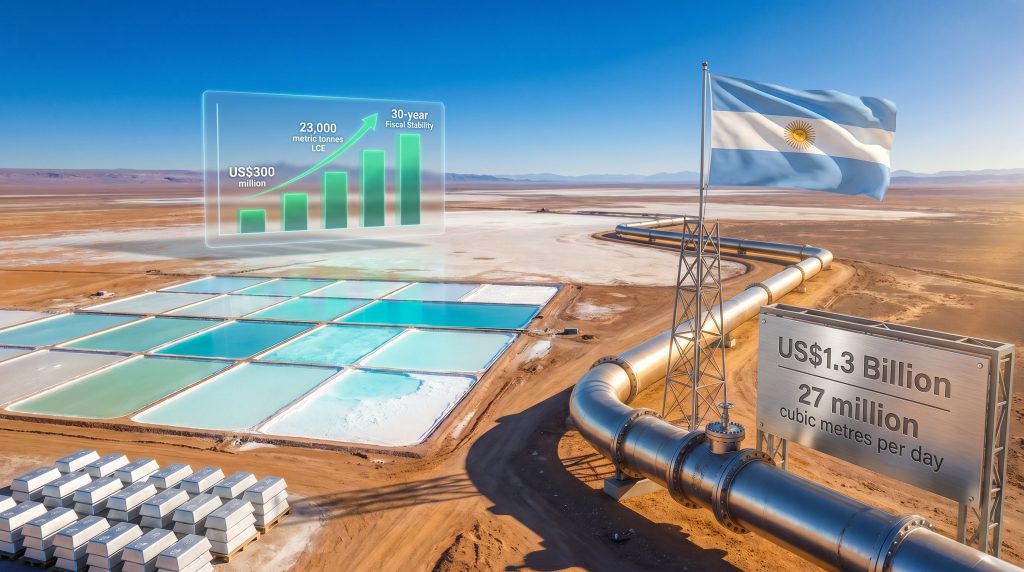
RIGI is not a narrow, sector-specific subsidy programme. It is a cross-industry fiscal architecture designed to systematically reduce the risk-adjusted cost of capital for qualifying large-scale projects. Two of its most significant recent approvals illustrate the framework's ambition: a US$1.3 billion gas pipeline serving the Vaca Muerta shale formation, and a US$208 million expansion of POSCO's Sal de Oro lithium carbonate operation.
Core Eligibility Conditions and Benefit Structure
To qualify for RIGI, projects must be structured as standalone investment vehicles or clearly defined joint ventures with documented capital commitments. Minimum thresholds vary by category, reaching as high as US$600 million for major infrastructure designations, though lower thresholds apply in certain qualifying structures. Both greenfield developments and material capacity expansions of existing operations are eligible.
The fiscal benefit package is broad and commercially significant:
| Incentive Category | RIGI Benefit |
|---|---|
| Corporate Income Tax | Reduced to 25% for qualifying projects |
| VAT on Capital Expenditures | Full exemption |
| Import Duties on Capital Goods | Exempt |
| Export Duty Relief | Available under qualifying conditions |
| Fiscal Stability Guarantee | Up to 30 years |
The 30-year fiscal stability provision is arguably RIGI's most commercially powerful feature. For capital-intensive projects with payback horizons measured in decades, locking in tax treatment removes a risk premium that would otherwise inflate discount rates and suppress investment returns.
How RIGI Compares to Argentina's Existing Mining Protections
Argentina's legacy mining framework already offered competitive baseline protections that many jurisdictions cannot match. Furthermore, these provisions created a foundation upon which RIGI could build:
- A 3% royalty cap on production value under the Mining Investment Law
- 30-year fiscal stability provisions within the mining sector specifically
- Import duty relief on capital goods for qualifying mining operations
RIGI effectively extends comparable or superior protections to energy infrastructure and large-scale industrial projects that previously operated under far less predictable conditions. For the gas sector in particular, this represents a qualitative shift in investment certainty. Detailed guidance on the full RIGI incentive framework is available through Argentina's official foreign affairs channels.
The San Matias Pipeline: Infrastructure as the Gateway to Vaca Muerta's Potential
Project Parameters and Strategic Rationale
The San Matias pipeline approval represents one of the most strategically significant infrastructure decisions under RIGI to date. The project's core parameters establish its economic significance:
- Total capital investment: US$1.3 billion
- Designed daily transport capacity: 27 million cubic metres of natural gas
- Resource origin: Vaca Muerta shale formation
- Projected annual export value: approximately US$2.5 billion
At projected capacity, the pipeline would generate export revenues nearly twice its construction cost on an annual basis — a revenue-to-capital ratio that few infrastructure projects can match.
Why Pipeline Capacity Is the Critical Constraint for Vaca Muerta
Vaca Muerta's geological credentials are extraordinary. The formation ranks among the top four shale gas reserves globally and sits within the top ten for shale oil, according to assessments from the U.S. Energy Information Administration. However, for years, production growth has been systematically constrained not by resource scarcity but by midstream infrastructure limitations.
Without sufficient pipeline capacity, wellhead production cannot be transported, processed, or exported, creating a structural gap between what the geology can deliver and what the market actually receives. This is a well-understood phenomenon in unconventional resource development.
The Permian Basin in Texas experienced similar bottlenecks during its growth phase, and the resolution of pipeline constraints there directly correlated with accelerating production curves and improving operator economics. Argentina's situation has an additional layer of complexity: unlike Texas, the endpoint for much of Vaca Muerta's export potential is a liquefied natural gas (LNG) terminal, meaning infrastructure delays compound into export revenue losses across the entire supply chain.
| Metric | Vaca Muerta Estimate |
|---|---|
| Shale Gas Reserve Ranking | Top 4 globally |
| Shale Oil Reserve Ranking | Top 10 globally |
| Current Monetisation Rate | Significantly below geological potential |
| Primary Bottleneck | Midstream pipeline capacity |
The San Matias approval signals that Argentina is treating export-oriented infrastructure as the primary mechanism for converting geological endowment into hard currency earnings. This is a meaningful strategic shift from previous policy cycles.
Sal de Oro: POSCO's Lithium Carbonate Expansion and What It Reveals About Argentina's Battery Materials Play
Expansion Economics and Production Profile
South Korean industrial conglomerate POSCO's Sal de Oro lithium operation has secured RIGI approval for a US$208 million capacity expansion. The strategic metrics of this expansion are compelling:
- Additional annual production: 23,000 metric tonnes of lithium carbonate equivalent (LCE)
- Estimated annual revenue contribution: in excess of US$300 million at prevailing market prices
- Implied revenue-to-capital ratio: approximately 1.44 times annually
- Simplified payback horizon: under one year at full production capacity
- Extraction method: brine-based, consistent with Argentina's Lithium Triangle geology
These economics are substantially stronger than those achievable from hard-rock spodumene mining in Western Australia, where capital costs per tonne of LCE are typically higher and processing requires an additional conversion step to battery-grade lithium carbonate or hydroxide.
Brine vs. Hard Rock: The Geological Advantage Argentina Holds
Understanding why lithium brine extraction carries structural cost advantages requires a brief look at the geology. Argentina's lithium deposits sit within high-altitude salt flats called salares, where ancient evaporation processes have concentrated lithium-bearing brines over millions of years.
Hard-rock operations, by contrast, mine solid spodumene ore that must be crushed, concentrated, and then chemically converted in a separate processing step before it can be used in battery manufacturing. This additional conversion stage adds cost, energy consumption, and carbon intensity to the supply chain.
Brine operations in the Lithium Triangle region typically achieve:
- Lower cash operating costs per tonne of LCE compared to hard-rock peers
- Simpler processing infrastructure requirements at the mine site
- Lower carbon intensity per unit of production
- Extended resource life given the vast subsurface brine volumes available
The trade-off is longer evaporation times, significant water management requirements, and sensitivity to altitude and climate conditions. The Argentina lithium brine market offers comparable geological settings across multiple provinces, with the Puna plateau rivalling Chile's Atacama region in brine quality.
RIGI Lithium Applications: The Broader Pipeline
Sal de Oro is not an isolated case. In addition, at least five lithium production facilities have formally applied for RIGI inclusion, demonstrating broad sector engagement with the framework:
- Sal de Oro expansion (POSCO Argentina) — Salta province
- Rincón project — straddling Salta and Catamarca provinces
- Hombre Muerto Oeste — Catamarca province
- Additional applicants currently under ministerial review
This clustering of applications across Salta and Catamarca reflects the distribution of Argentina's highest-quality salar deposits, where lithium brine grades and evaporation conditions are most favourable.
How RIGI Changes the Risk-Adjusted Return Framework for International Capital
The Pre-RIGI Risk Premium Problem
Before RIGI, international investors evaluating Argentine resource projects were forced to embed significant risk premiums into their financial models to account for a constellation of structural uncertainties:
- Currency and repatriation risk arising from Argentina's history of capital controls and peso devaluation
- Regulatory instability from frequent policy changes affecting royalty rates, export duties, and tax treatment
- Sovereign risk premium applied as a baseline discount across all Argentine investment decisions
- Export restriction risk particularly relevant for energy commodities where domestic supply obligations have historically taken priority over export revenue
RIGI directly addresses several of these concerns. The 30-year fiscal stability guarantee insulates qualifying projects from future tax policy changes. Furthermore, import duty exemptions reduce upfront capital deployment costs, and export duty relief improves the economics of converting production into hard currency receipts.
Competitive Positioning Against Regional Peers
| Country | Key Incentive Mechanism | Fiscal Stability | Royalty Structure |
|---|---|---|---|
| Argentina (RIGI) | Tax reduction + import/export relief | Up to 30 years | 3% cap (mining) |
| Chile | Standard mining tax + royalty reform | Limited provisions | Progressive royalty scale |
| Bolivia | State-controlled model | Limited | State revenue participation |
| Australia | Standard corporate tax framework | No special lock-in | State-based royalty regimes |
Within this competitive landscape, Argentina's combined offer positions it favourably within the global lithium market, particularly for brine projects where the country's geological endowment already provides a natural cost advantage.
Qualification Pathway: How Projects Secure RIGI Approval
Step-by-Step Approval Process
- Project structuring — The investment must be organised as a qualifying standalone vehicle or defined joint venture with fully documented capital commitments
- Threshold assessment — Total investment must meet the applicable minimum, reaching up to US$600 million for major infrastructure
- Regulatory submission — Formal application lodged with Argentina's Economy Ministry including complete project documentation
- Ministerial review — Economy Ministry evaluates strategic alignment, projected export contribution, and fiscal impact modelling
- Formal certification — Approved projects receive RIGI status, activating the applicable benefit package
- Ongoing compliance — Projects maintain reporting obligations throughout the benefit period to preserve RIGI status
RIGI approval is not automatic or formulaic. Economy Minister Luis Caputo's office retains discretionary authority over which projects receive certification, creating a de facto prioritisation mechanism within the formal framework. Projects with stronger export revenue profiles and clear strategic alignment appear to receive faster consideration.
The next major ASX story will hit our subscribers first
Risks That RIGI Cannot Eliminate
Structural Vulnerabilities Persist Beyond Fiscal Reform
Despite the framework's structural strengths, several material risk factors remain outside RIGI's scope and warrant careful consideration from investors:
- Macroeconomic instability — Argentina's inflation trajectory and currency dynamics remain structurally challenging
- Political continuity risk — A 30-year stability guarantee is only as durable as the institutional capacity of successive governments to honour commitments
- Commodity price exposure — Neither natural gas nor lithium carbonate prices are locked in, and lithium in particular has experienced significant volatility since its 2022 peak
- Infrastructure execution risk — Large projects in remote Argentine provinces face substantial construction and logistics challenges
- Water management complexity — Brine operations must navigate shared water resources in high-altitude ecosystems where regulatory scrutiny is increasing
The lithium price environment deserves particular attention. Lithium carbonate prices surged above US$80,000 per tonne in late 2022 before retreating sharply through 2023 and 2024. Consequently, revenue projections for RIGI-approved projects assume price recovery that, while plausible given long-term EV demand trajectories, is not guaranteed within any specific timeframe. Technologies such as direct lithium extraction may, however, further improve project economics as the sector matures.
This article is informational in nature and does not constitute financial or investment advice. Resource project economics are inherently subject to commodity price volatility, regulatory changes, and execution risks. Readers should conduct independent due diligence before making investment decisions.
The Geopolitical Context: Why POSCO's Investment Reflects a Global Supply Chain Realignment
POSCO's decision to deploy US$208 million into an Argentine brine operation under the Argentina tax breaks for gas pipeline and lithium project framework is not simply a corporate capital allocation decision. It reflects a broader strategic imperative among Asian industrial groups to diversify lithium supply chains away from single-source dependency.
Chinese companies currently dominate lithium chemical processing globally, controlling the majority of conversion capacity that transforms raw lithium material into battery-grade carbonate and hydroxide. For South Korean battery manufacturers and their materials suppliers, securing upstream production outside Chinese-controlled processing networks has become a strategic priority.
Argentina's RIGI framework, combined with the inherent cost advantages of brine extraction, offers a pathway to achieve that diversification while maintaining competitive production economics. The OECD's assessment of Argentina's energy transition opportunities further underscores the country's potential as an anchor in a restructured Western and allied-nation battery supply chain — a role with strategic implications that extend well beyond the economics of any individual project.
Want To Capitalise On The Next Major Mineral Discovery Before The Broader Market Does?
Discovery Alert's proprietary Discovery IQ model delivers real-time alerts on significant ASX mineral discoveries across critical minerals including lithium, instantly transforming complex geological and market data into actionable investment insights for both short-term traders and long-term investors. Explore how historic mineral discoveries have generated substantial returns and begin your 14-day free trial today to position yourself ahead of the market.