August 13, 2026
The Technology Gap That Unlocked 30 Billion Barrels
For most of the past century, the limiting factor in global oil production was not the volume of hydrocarbons trapped underground, but humanity's capacity to reach them. The story of unconventional resource development is, at its core, a story about shrinking that gap between what exists geologically and what can be extracted economically. Vaca Muerta's revised Argentina Vaca Muerta oil estimate is one of the most striking recent demonstrations of that principle in action.
When the U.S. Energy Information Administration published its 2013 international shale assessment, the drilling database for Vaca Muerta was thin. Operators had barely begun to test the formation at scale. A decade later, the picture looks fundamentally different, and the numbers reflect it.
When big ASX news breaks, our subscribers know first
From 16 Billion to 30 Billion: Unpacking the Arithmetic of Recoverability
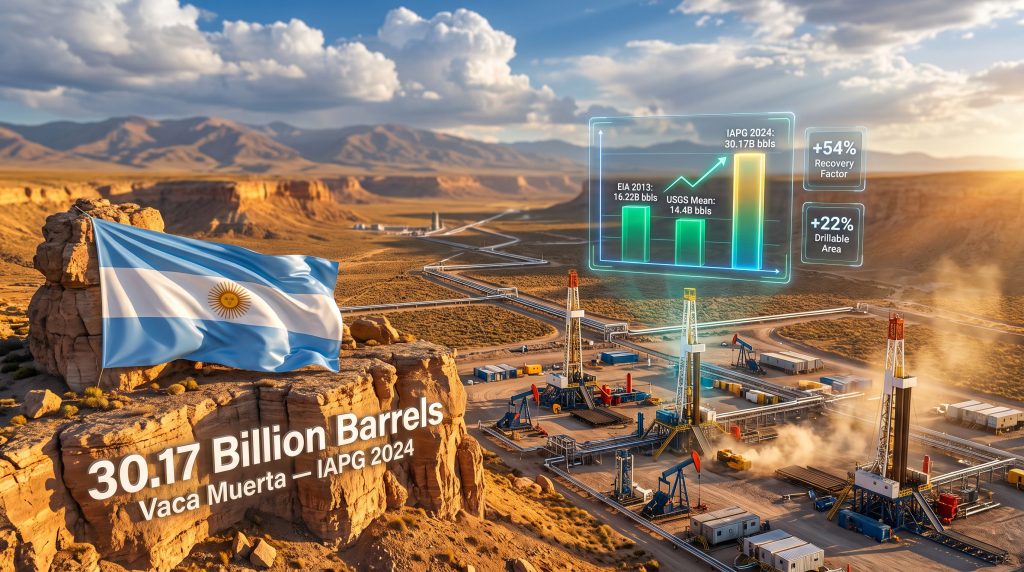
The Argentine Institute of Oil and Gas (IAPG) has published a revised technical study placing the formation's technically recoverable oil at 30.17 billion barrels. That figure nearly doubles the EIA's 2013 baseline of 16.22 billion barrels, and understanding why it changed is more instructive than the headline number itself.
Three structural factors drove the revision upward simultaneously, and their combined effect compounded rather than simply added together:
-
Geographic expansion of the drillable footprint (+22%): Areas in southern Mendoza and Río Negro provinces that were previously excluded from productive assessments have now been reclassified as commercially viable. A decade of real-world subsurface data gave geoscientists the confidence to extend the productive boundary.
-
Recognition of additional stratigraphic pay zones: Operators identified more productive rock intervals within the vertical column of the formation. This effectively multiplies the recoverable resource per surface acre, since multiple layers can be targeted from a single pad location.
-
Improved recovery factor (+54%): This is the most technically significant driver. The share of oil that can realistically be extracted from the rock using current methods has risen by more than half, reflecting genuine advances in well architecture, horizontal drilling precision, and hydraulic fracturing design.
A 54% improvement in recovery factor is not a rounding adjustment. It reflects a fundamentally better understanding of how Vaca Muerta's rock responds to stimulation, accumulated through thousands of wells drilled since the EIA's initial assessment.
The IAPG study was conducted at the request of Argentina's energy secretariat, with direct input from major operators including YPF, Chevron, Vista Energy, and Pan American Energy, as well as university researchers and government technical specialists. The collaborative methodology gives the revised estimate more operational credibility than a purely theoretical exercise would carry.
Understanding the Resource Classification Hierarchy
One of the most persistent sources of confusion in energy reporting involves treating different resource classification categories as interchangeable. They are not, and conflating them produces wildly different impressions of what any given formation actually holds.
| Classification | Definition | Vaca Muerta Figure |
|---|---|---|
| Total geological resource (oil) | All hydrocarbons believed to exist in the rock, regardless of extractability | ~661 billion barrels (historical) |
| Repsol YPF company estimate (2012) | Company-reported pre-development reserve figure | 22.5 billion barrels |
| EIA technically recoverable (2013) | Volume extractable with technology available at the time | 16.22 billion barrels |
| USGS undiscovered recoverable (mean) | Probabilistic estimate for unconfirmed resources | 14.4 billion barrels |
| IAPG revised technically recoverable (2024) | Volume extractable with current technology and knowledge | 30.17 billion barrels |
The critical distinction for any reader evaluating coverage of the Argentina Vaca Muerta oil estimate is this: numbers in the hundreds of billions refer to total geological potential, which includes oil that may never be economically accessible regardless of technological progress. The 30.17 billion barrel figure sits in the technically recoverable category, meaning it reflects what current methods can actually extract. Proved reserves, which represent the subset that is economically viable at current prices and costs, would be a substantially smaller number again.
Furthermore, understanding how these crude oil price trends interact with recoverable estimates is essential for any investor assessing the formation's commercial potential.
The reader's first question when encountering any Vaca Muerta figure should always be: which classification category does this number belong to? Without that context, comparisons between different estimates are essentially meaningless.
How Vaca Muerta's Rock Quality Sets It Apart
Not all shale is created equal. The geological properties that make a formation commercially attractive vary considerably across unconventional plays worldwide, and Vaca Muerta possesses several characteristics that place it in the top tier.
The formation's organic richness is exceptional. Total organic carbon (TOC) content in the most productive intervals exceeds levels found in many North American plays, providing the raw material for high per-well production rates. The rock is also unusually thick compared to many comparable formations, with productive intervals extending across a substantial vertical column that allows operators to target multiple zones from a single surface location.
Thermal maturity across the formation varies in a way that is actually advantageous: the oil window, gas-condensate window, and dry gas window are all present within the formation's geographic extent, meaning different operators can target different hydrocarbon types depending on their infrastructure and market access. This heterogeneity within a single formation is relatively uncommon and adds flexibility to development planning.
Brittleness of the rock, a property that determines how effectively hydraulic fracturing creates the network of fractures needed to produce oil and gas, is also favourable in Vaca Muerta's primary productive intervals. High silica content in certain zones makes the rock respond well to modern fracturing techniques, which partially explains why recovery factor improvements have been so pronounced.
Where Argentina Sits in the Global Unconventional Hierarchy
With a revised technically recoverable estimate of 30.17 billion barrels, Vaca Muerta's standing in the global unconventional landscape becomes clearer when placed alongside comparable formations.
| Formation | Country | Approx. Technically Recoverable Oil | Development Status |
|---|---|---|---|
| Permian Basin | United States | 70+ billion barrels (total resource base) | Mature, high output |
| Bazhenov | Russia | ~74 billion barrels (EIA estimate) | Early-stage, infrastructure-constrained |
| Silurian-Devonian (China) | China | ~32 billion barrels (EIA estimate) | Developing |
| Vaca Muerta | Argentina | 30.17 billion barrels (IAPG 2024) | Developing, scaling rapidly |
| Eagle Ford | United States | Varies by sub-play | Mature |
The Bazhenov formation in Russia may hold more theoretical resource potential, but it remains largely undeveloped due to extreme infrastructure limitations and geopolitical constraints on technology transfer. China's unconventional plays face significant development challenges related to geology and water availability. Vaca Muerta, by contrast, has the advantage of a decade of active development and a growing base of operational knowledge from world-class operators.
What separates Vaca Muerta from many high-resource-potential formations is the combination of favourable rock properties and demonstrated commercial productivity. The revised estimate is not a theoretical projection based on analogues from other basins. It is grounded in actual well performance data collected across the Neuquén Basin over years of intensive drilling. For a broader view of how this feeds into the global LNG supply outlook, the implications for Atlantic Basin trade flows are considerable.
The Infrastructure Constraint: Where the Bottleneck Actually Sits
A resource estimate, however compelling, is only as valuable as the infrastructure available to monetise it. Argentina's core challenge is not proving that the oil exists, nor even proving it can be extracted. The challenge is moving hydrocarbons from the Neuquén Basin to markets willing to pay for them.
Several critical infrastructure gaps must be addressed for the revised Argentina Vaca Muerta oil estimate to translate into export revenue:
-
Pipeline capacity from the basin to the coast: Existing midstream infrastructure creates a throughput ceiling that constrains how quickly production can grow. Multiple pipeline expansion projects are at various stages of planning and construction.
-
LNG export terminal development: Argentina has been advancing proposals for liquefied natural gas export facilities that would allow Vaca Muerta gas to reach Atlantic Basin markets, particularly European buyers seeking supply diversification. These are complex, capital-intensive projects with long development timelines.
-
Atlantic coast crude terminals: Oil export infrastructure requires upgrades to accommodate volumes that significantly exceed current export capacity.
From an infrastructure investor's perspective, the revised technically recoverable resource base functions as a reserve-backing signal. A larger confirmed resource reduces long-term supply risk and strengthens the financial case for funding pipeline and LNG projects that require decade-long payback horizons.
The macroeconomic imperative driving Argentina's focus on Vaca Muerta development is hard to overstate. Argentina faces a structural shortage of foreign currency that has been a persistent source of economic instability. Hydrocarbon exports represent one of the most direct and scalable pathways to generating the hard currency the economy requires.
The next major ASX story will hit our subscribers first
Operators, Economics, and What the Recovery Factor Improvement Means for Acreage Holders
A 54% improvement in the technically recoverable fraction does not affect all operators equally. Its financial implications scale with the size of undeveloped acreage inventory, the cost structure of existing operations, and the degree to which an operator's well economics were already being modelled using conservative recovery assumptions.
The primary operators shaping Vaca Muerta's development trajectory each bring different strengths to the formation:
-
YPF: As Argentina's state-controlled energy company and the formation's dominant operator, YPF sits at the centre of every major infrastructure and export initiative. Its development programme sets the pace for the broader basin.
-
Chevron: Among the earliest international majors to commit substantial capital to Vaca Muerta through its joint venture with YPF, Chevron's long-term presence signals sustained institutional confidence in the formation's economics.
-
Vista Energy: A pure-play Vaca Muerta operator with a demonstrated track record of strong per-well productivity, Vista has been particularly effective at translating the formation's geological quality into operational performance metrics.
-
Pan American Energy: Holding extensive acreage across the Neuquén Basin, Pan American is a significant independent operator whose scale gives it meaningful exposure to any upward revision in recoverable volumes.
When recovery factor improves, the effective cost per barrel of production declines for existing well stock and future drilling programmes alike. More oil produced from each wellbore spreads fixed drilling and completion costs across a larger output base, improving the economics of the entire acreage position. For operators with large inventories of undrilled locations, the revised estimate materially increases the net present value of their undeveloped resource base. In addition, the broader commodity price impact on operator profitability is a key variable investors should monitor closely.
Geopolitical Dimensions: Non-OPEC Supply and Atlantic Basin Dynamics
Argentina's position outside the OPEC+ production framework is a strategically important detail that often receives insufficient attention in coverage of the Argentina Vaca Muerta oil estimate. Because Argentina is not subject to quota constraints, production growth from Vaca Muerta flows freely into global supply, unencumbered by the coordination mechanisms that govern output from major OPEC producers.
As Vaca Muerta scales toward its potential, the formation's contribution to global non-OPEC supply becomes an increasingly material variable for oil market analysts. OPEC's market influence and its quota strategies will inevitably be tested as Argentine volumes grow, particularly given that historical data shows periods of strong non-OPEC supply growth have consistently complicated OPEC's ability to manage price levels.
For European energy buyers in particular, a large-scale Argentine LNG export capacity would represent a meaningful diversification option. Europe's active pursuit of supply alternatives following the disruptions of 2022 has created sustained demand for reliable, long-term LNG supply contracts from politically stable, accessible sources. Argentina's Atlantic coast geography gives it natural logistical advantages for European supply routes compared to many Pacific Basin LNG exporters.
Investors and analysts should, however, apply appropriate caution to the most optimistic projections. Argentina's history includes episodes of policy discontinuity, currency controls, and regulatory changes that have periodically disrupted the investment environment for energy companies. Sustaining the regulatory and fiscal stability required to attract the scale of capital Vaca Muerta's development demands will be an ongoing challenge, separate from the geological and technological questions the revised estimate has already addressed.
WTI and Brent oil futures will also serve as important pricing benchmarks as Argentine export volumes increase, directly influencing the commercial returns operators can achieve from the basin.
Frequently Asked Questions
What is the current Argentina Vaca Muerta oil estimate?
The most recent technically recoverable oil estimate for Vaca Muerta is 30.17 billion barrels, published by the Argentine Institute of Oil and Gas following a comprehensive study incorporating data from major operators, university researchers, and government specialists. This figure nearly doubles the 16.22 billion barrel estimate the EIA published in 2013.
Why did the estimate nearly double?
Three factors combined to drive the increase: a 22% expansion of the area classified as suitable for commercial drilling, identification of additional productive rock layers within the formation's vertical column, and a 54% improvement in the technically recoverable fraction, reflecting advances in well design, horizontal drilling, and hydraulic fracturing accumulated over a decade of active operations.
Does the revised estimate mean new oil was discovered?
No. Argentine officials have been explicit on this point: the revised figure does not reflect the discovery of previously unknown oil deposits. It represents a recalibration of how much of the existing resource can be extracted using current technology and the operational knowledge accumulated through years of drilling activity.
What infrastructure is needed to export Vaca Muerta production at scale?
Monetising the revised resource base requires expanded pipeline capacity from the Neuquén Basin, upgraded crude export terminals on Argentina's Atlantic coast, and the development of LNG export facilities capable of serving European and Asian markets. McKinsey's analysis of integrating Vaca Muerta's energy value chain highlights the complexity and scale of investment required to unlock this potential.
How does Vaca Muerta compare to the Permian Basin?
The Permian Basin in the United States remains the world's most productive unconventional province. However, Vaca Muerta's revised technically recoverable estimate of 30.17 billion barrels firmly positions it among the global tier-one unconventional formations. Unlike the Permian, Vaca Muerta is still in a relatively early development phase, which means the incremental production growth potential ahead of it is proportionally larger.
Key Takeaways
-
The revised Argentina Vaca Muerta oil estimate of 30.17 billion barrels nearly doubles the EIA's 2013 figure of 16.22 billion barrels, driven by expanded drillable geography, additional productive layers, and a 54% improvement in recovery factor.
-
The revision reflects technology and knowledge gains from a decade of active drilling, not the discovery of previously unknown underground resources.
-
Vaca Muerta's geological quality, including high organic richness, favourable rock brittleness, and thick productive intervals across multiple stratigraphic zones, underpins its status as a globally significant unconventional formation.
-
Infrastructure development, particularly pipeline capacity, LNG export terminals, and Atlantic coast crude facilities, remains the critical bottleneck between the revised resource estimate and export revenue generation.
-
Argentina's position outside the OPEC+ framework means Vaca Muerta production growth contributes to global non-OPEC supply without quota constraints, with long-term implications for Atlantic Basin price dynamics.
-
Investors should distinguish carefully between total geological resources, technically recoverable volumes, and proved reserves when evaluating competing Vaca Muerta figures, as these categories can differ by an order of magnitude.
This article is intended for informational purposes only and does not constitute investment advice or a solicitation to buy or sell any financial instrument. Forecasts, resource estimates, and projections referenced herein involve inherent uncertainty and should not be relied upon as guarantees of future outcomes.
Want to Identify the Next Major Resource Discovery Before the Market Does?
Discovery Alert's proprietary Discovery IQ model delivers real-time alerts on significant ASX mineral discoveries, transforming complex resource data into clear, actionable investment insights — just as technological advances have transformed Vaca Muerta's recoverable potential. Explore how historic mineral discoveries have generated substantial returns and begin your 14-day free trial today to position yourself ahead of the broader market.