August 13, 2026
The Quiet Scramble for Central Africa's Mineral Crown
The global race to secure critical mineral supply is no longer fought purely at the mine face or on commodity exchanges. Increasingly, it is won or lost through the depth of institutional relationships that trading houses maintain with sovereign governments, state enterprises, and regulatory bodies in resource-rich nations. Nowhere is this dynamic more consequential than in the Democratic Republic of Congo, a country whose DRC mineral wealth has transformed it from a peripheral frontier market into a central pillar of the global energy transition.
Against this backdrop, the decision by Trafigura to appoint Hervé Otschudi as Executive Director of its DRC operations carries significance that extends well beyond a routine personnel announcement. When one of the world's largest commodity trading firms creates a dedicated country-level executive mandate, backed by a candidate with over two decades of in-country experience, it is communicating something deliberate about strategic intent, competitive priorities, and long-term market positioning.
When big ASX news breaks, our subscribers know first
Why the DRC's Mineral Position Is Structurally Irreplaceable
The DRC's role in global critical mineral supply chains cannot be overstated. The country accounts for roughly 70% of global cobalt production, according to data from the United States Geological Survey, while also ranking as one of Africa's largest copper producers. The Kamoa-Kakula copper complex, located in the DRC's Lualaba Province, has emerged as one of the highest-grade large-scale copper discoveries in recorded mining history.
Initial resource grades at Kamoa-Kakula have been reported above 6% copper, a figure that dwarfs average global copper mine grades of around 0.5% to 1%.
Cobalt's structural importance to the energy transition is equally pronounced. The metal is a critical input in lithium-ion battery cathodes, particularly in nickel manganese cobalt (NMC) chemistries used across electric vehicle (EV) platforms. As EV adoption accelerates globally, demand for cobalt is forecast by the International Energy Agency to increase significantly through the 2030s, reinforcing the DRC's position as a supply-critical jurisdiction that no serious battery metals trader can afford to ignore.
The Geopolitical Tension Beneath the Surface
What makes the DRC commercially complex is the layered competition playing out between Western trading houses, Chinese operators, and African state enterprises for influence over its resources. Chinese-affiliated firms have maintained a dominant presence in DRC copper and cobalt operations for years, controlling significant offtake volumes and refining capacity. Furthermore, this concentration of downstream processing power outside the DRC has increasingly prompted resource nationalism discussions within the country.
Policymakers are exploring how to retain more value domestically, a dynamic further complicated by the ongoing US-China cobalt rivalry for access to Congolese supply. For Western commodity traders, this environment presents both risk and opportunity. The risk lies in regulatory unpredictability, infrastructure constraints, and shifting mining codes. The opportunity lies in positioning credible, locally embedded leadership that can navigate these pressures with institutional fluency rather than relying on externally managed, rotating executive structures.
Trafigura Appoints DRC Executive Director: Unpacking the Strategic Logic
The appointment of Hervé Otschudi as Trafigura appoints DRC executive director represents a structural upgrade in how the company manages its Central African footprint. His profile is notable not simply for its duration but for its specific institutional texture.
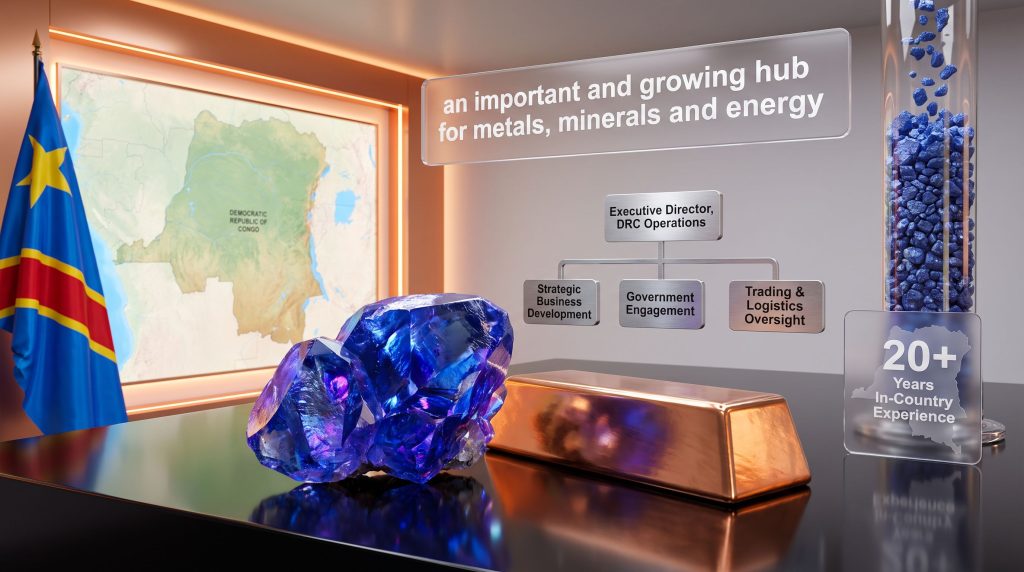
Otschudi is a Congolese national with more than 20 years of experience spanning commodities, mining, and financial services within the DRC. Critically, he previously served as a business development advisor to the board of Gécamines, the DRC's state-owned mining company. That advisory role is commercially significant in ways that are not immediately obvious from a headline reading.
Understanding Gécamines and Why Proximity to It Matters
Gécamines occupies a unique dual role in the DRC's mining landscape. It functions simultaneously as an operational mining entity, a joint venture partner in a number of the country's largest mining projects, and a regulatory counterpart whose positions on fiscal terms, local content, and royalty structures directly shape the commercial viability of third-party operations.
| Experience Dimension | Detail |
|---|---|
| Years of In-Country Experience | 20+ years |
| Nationality | Congolese national |
| Prior Institutional Role | Business development advisor to Gécamines board |
| New Role | Executive Director, DRC Operations, Trafigura |
| Scope of Responsibility | Strategic business development, government engagement, trading and logistics oversight |
Board-level advisory experience at a state mining enterprise of Gécamines' complexity provides a form of institutional intelligence that is genuinely difficult to replicate through conventional executive recruitment. Understanding how state enterprise boards weigh commercial proposals, what political pressures influence their decision-making, and how to frame partnership structures in ways that align with sovereign interests — these are capabilities built over years of embedded engagement rather than months of due diligence.
Advisory proximity to a state mining company's board represents one of the most underappreciated forms of commercial intelligence available to a commodity trading house operating in a resource-rich developing economy. It compresses years of relationship-building into pre-existing institutional credibility.
In his new capacity, Otschudi will oversee Trafigura's full suite of DRC activities: trading operations across energy, metals and minerals, along with associated logistics infrastructure. The integration of logistics within the mandate is worth noting. In the DRC, infrastructure constraints — including river transport bottlenecks, road quality limitations, and border crossing complexity — represent genuine competitive differentiators for operators who have solved them compared to those who have not.
The Commercial Architecture of Embedded Local Leadership
Trafigura's decision to establish a dedicated country-level executive director role rather than managing the DRC through a broader regional structure signals a deliberate prioritisation decision. The distinction matters operationally.
Step-by-Step: How Localised Leadership Translates Into Commercial Outcomes
-
Institutional Relationship Mapping – Identifying government ministries, regulatory agencies, and state enterprises with decision-making authority over trading licences, logistics corridors, and offtake access.
-
Government Engagement Architecture – Designing structured engagement channels that maintain regulatory goodwill across political cycles, not merely during licensing processes.
-
Offtake and Supply Agreement Development – Using institutional relationships to negotiate preferential access to mineral supply at competitive commercial terms, particularly in a market where supply allocation is increasingly politicised.
-
Logistics and Infrastructure Coordination – Working directly with local authorities and operators to optimise multi-modal supply chains across the DRC's geographically demanding terrain.
-
Risk Intelligence and Scenario Planning – Leveraging on-the-ground knowledge to identify regulatory shifts, mining code amendments, and political transitions before they crystallise into commercial disruptions.
Comparing Leadership Models: Embedded vs. Regional Structures
| Strategic Dimension | Embedded Local Leadership | Regional Hub Model |
|---|---|---|
| Government Relationship Depth | High, direct ministerial and institutional access | Moderate, managed through regional intermediaries |
| Commercial Agility | High, faster on-the-ground decision-making | Lower, subject to regional approval chains |
| Regulatory Navigation | Strong, local knowledge reduces compliance risk | Variable, dependent on third-party advisors |
| Supply Chain Intelligence | Deep, indigenous networks and operational familiarity | Limited, external perception may constrain access |
| Crisis Response Capability | Rapid, established local trust | Delayed, reliant on seconded personnel |
The table above illustrates why the embedded model is increasingly favoured by trading houses operating in institutionally complex African markets. It is not a soft organisational preference but a hard commercial calculus. However, the effectiveness of this model ultimately depends on the individual's depth of institutional relationships — precisely the area where Otschudi's background is most compelling.
What Trafigura's Africa Strategy Communicates to the Market
Trafigura's leadership and Metals and Minerals global head Gonzalo de Olazaval characterised the DRC as "an important and growing hub for metals, minerals and energy", framing Otschudi's appointment as a reflection of the company's long-term commitment to the country and the customers it serves across the region. That framing, carefully chosen for a public announcement, carries signals directed at multiple audiences simultaneously: government counterparts, competing trading houses, mining company partners, and logistics operators.
For institutional partners, the appointment signals that Trafigura is not managing the DRC as a transactional market but as a long-duration strategic investment requiring dedicated senior leadership. For competing trading houses, it raises the competitive bar for relationship depth and in-country credibility. For mining operators seeking reliable offtake and logistics partners, it signals operational stability and institutional continuity.
Moreover, the timing of this appointment is noteworthy given ongoing discussions around the DRC cobalt export ban and the evolving Congo minerals partnership with the United States — both of which are reshaping the commercial landscape for traders operating in the region.
The Broader Signalling Effect on DRC Market Maturity
There is a lesser-discussed dynamic at work in appointments of this type. When a globally significant commodity trading house formalises a senior executive role for a single country, it functions as a form of market maturity signal. It suggests the market has crossed a threshold of commercial scale and complexity that warrants dedicated institutional architecture rather than opportunistic management.
This signalling effect can influence other international firms evaluating DRC market entry or expansion. Logistics developers, infrastructure financiers, and downstream processors observe the behaviour of leading trading houses as a proxy for their own risk assessments. A Trafigura commitment of this visibility can, over time, contribute to a more formalised and investable commercial ecosystem in the country's minerals sector.
Frequently Asked Questions: Trafigura's DRC Executive Director Appointment
Who has Trafigura appointed as its DRC Executive Director?
Trafigura has appointed Hervé Otschudi to serve as Executive Director of its Democratic Republic of Congo operations. Otschudi is a Congolese national with more than two decades of experience across commodities, mining, and financial services in the DRC. He previously served as a business development advisor to the board of Gécamines, the country's state-owned mining company.
What does this role cover operationally?
The Executive Director mandate encompasses strategic business development across the DRC, including direct engagement with government bodies and institutional partners. The role also encompasses oversight of Trafigura's complete in-country operations: trading activities across energy, metals and minerals, and associated logistics functions.
Why is the DRC strategically important to Trafigura?
The DRC holds a structurally irreplaceable position in global critical mineral supply chains, particularly for copper and cobalt, two commodities foundational to the energy transition. Trafigura's multi-commodity exposure in the country, combined with integrated logistics capabilities, makes the DRC one of its most commercially significant African operating environments.
What is Gécamines and why does proximity to it matter commercially?
Gécamines is the DRC's state-owned mining company, functioning as both an operational entity and a joint venture partner in major mining projects. Its board-level positions on fiscal terms, royalties, and local content directly shape the commercial landscape for third-party operators. Executives with direct advisory experience at Gécamines possess institutional intelligence that is extremely difficult to replicate through conventional market entry processes.
What does this appointment signal about the DRC's trajectory as a critical minerals market?
The creation of a dedicated country-level executive director role by a major global commodity trader reflects a deliberate strategic escalation. It suggests that the DRC's commercial complexity and strategic importance in the critical minerals landscape have reached a level that demands embedded, senior, locally credentialed leadership rather than management through broader regional structures.
The next major ASX story will hit our subscribers first
Key Takeaways for Investors and Industry Observers
-
Trafigura appoints DRC executive director in the form of Hervé Otschudi, reflecting a structural upgrade in how the company manages its most strategically significant Central African operations.
-
Otschudi's combination of 20+ years of DRC-specific experience and board-level advisory proximity to Gécamines represents a rare institutional profile in one of the world's most commercially complex mining jurisdictions.
-
The DRC's dominance in global cobalt supply, accounting for approximately 70% of world output, combined with its growing copper production capacity, makes it a non-negotiable market for any commodity trader with serious energy transition exposure.
-
Embedded, locally credentialed leadership is rapidly transitioning from a competitive advantage to a prerequisite for sustained commercial success in the DRC and comparable resource-rich African markets.
-
The appointment carries a market maturity signalling effect that extends beyond Trafigura itself, with potential downstream implications for infrastructure investment, logistics development, and the formalisation of mineral supply chains in Central Africa.
Disclaimer: This article contains forward-looking observations and market analysis based on publicly available information as of the date of publication. Readers should conduct their own due diligence before making any investment or commercial decisions based on the information presented here. Commodity market conditions, regulatory frameworks, and geopolitical dynamics are subject to change.
Want to Stay Ahead of the Next Major Mineral Discovery?
Discovery Alert's proprietary Discovery IQ model delivers real-time alerts on significant ASX mineral discoveries, transforming complex mineral data into clear, actionable insights for both short-term traders and long-term investors. Explore why major mineral discoveries can generate substantial returns by visiting Discovery Alert's dedicated discoveries page, and begin your 14-day free trial today to secure your market-leading edge.