
August 13, 2026
The Structural Funding Gap That Shapes Junior Gold Development
Every junior gold developer faces the same fundamental tension: the assets that attract institutional capital are hard-rock deposits requiring years of work and hundreds of millions of dollars to prove and build, yet the capital needed to get there consistently outpaces what small-cap balance sheets can sustain. The conventional solution, repeated equity placements at discounted prices, is a blunt instrument that erodes per-share value, misaligns management incentives, and punishes long-term shareholders who believed in the project before the dilution began.
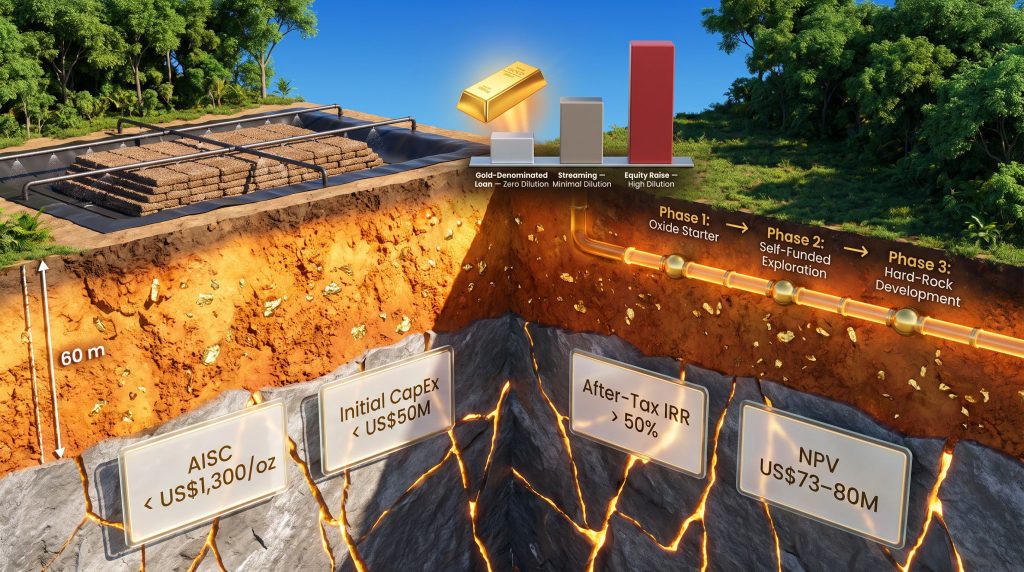
The growing response to this tension is not a new financing instrument in the abstract sense. It is a geological sequencing insight repackaged as a capital strategy: mine the near-surface oxide material first, generate early cash flow through a low-capex heap-leach starter, then use that cash to fund the hard-rock exploration that major institutions actually want to see. This is oxide bridge financing for junior gold developers, and it is gaining serious traction in the current elevated gold price environment.
When big ASX news breaks, our subscribers know first
What Oxide Bridge Financing Actually Is
The Geological Logic Behind the Capital Strategy
The foundation of oxide bridge financing is a geological reality that exists across many gold districts worldwide. Primary hard-rock gold deposits, the high-grade targets that attract institutional attention, are typically buried beneath a thick blanket of weathered near-surface material. In tropical and subtropical provinces with deep historical weathering, this oxide or saprolite layer can extend anywhere from 40 to 80 metres below surface, sometimes deeper.
That weathered material has characteristics that make it remarkably cheap to mine. It requires no drilling or blasting to extract. It does not need crushing or grinding to process. In mining terminology, this is called free-dig material, and when it is amenable to heap-leach recovery, the capital expenditure required to build a processing circuit drops dramatically compared to a conventional hard-rock milling operation.
Core Concept: Oxide bridge financing converts this geological accident into a financing strategy. The cheap-to-mine oxide cap becomes a starter operation. The starter generates cash flow. That cash flow funds the exploration of the hard-rock resource underneath, avoiding equity dilution throughout.
How the Financing Mechanism Works
The debt instrument that makes this possible is a gold-denominated loan, sometimes called a gold loan or metal-linked project debt. Unlike a conventional bank facility repaid in cash on a fixed schedule, a gold loan is denominated in ounces. Repayment tracks production output rather than share price performance, which means the lender's return is aligned with the mine's actual delivery of metal.
This structure has a critical shareholder-friendly consequence: no new equity is issued, no share register is expanded, and the exploration upside that drives long-term value creation stays with existing investors rather than being sold to new equity holders at a discount. Furthermore, understanding the broader gold price outlook is essential for evaluating how comfortably these gold loans can be serviced across different market scenarios.
The three-phase architecture of a well-structured oxide bridge strategy looks like this:
| Phase | Objective | Financing Mechanism | Dilution Risk |
|---|---|---|---|
| Phase 1: Oxide Starter | Reach cash flow quickly | Gold-linked project debt | Minimal to zero |
| Phase 2: Self-Funded Exploration | Define hard-rock resource | Internal cash flow | None |
| Phase 3: Hard-Rock Development | Full mine build | Project finance or streaming | Managed |
The Economics That Determine Whether the Model Holds
Margin Thresholds and Debt Serviceability
Lenders extending gold-denominated credit against an oxide starter operation are not doing so on geological faith. They need the economics to demonstrate convincing debt service capacity across a range of gold price scenarios. In practice, the benchmarks that specialist precious metals lenders apply when evaluating oxide bridge candidates are relatively consistent:
- All-in sustaining cost (AISC) below approximately US$1,300 per ounce at the life-of-mine level
- After-tax internal rate of return (IRR) above 50% at a conservative base-case gold price
- Initial capital expenditure generally below US$50 million to keep the facility within gold-denominated debt parameters
- Net present value (NPV) materially exceeding the loan principal, ideally at a ratio of 1.5 times or greater
- Oxide mine life of at least five to six years to ensure full loan amortization within the starter operation
A real-world example from the Tapajós Gold Province in Brazil illustrates how these thresholds translate into an actual project. Cabral Gold's (TSXV: CBR | OTCQX: CBGZF) Cuiú Cuiú Phase 1 operation, for which a Preliminary Feasibility Study was released on July 29, 2025, targets saprolite and blanket oxide material down to approximately 60 metres depth across the MG, Central, and Machiche deposits. The PFS set initial capital at US$37.7 million, life-of-mine AISC at US$1,210 per ounce, and average annual production at approximately 18,500 ounces over a 6.2-year mine life.
At a base-case gold price of US$2,500 per ounce, the study projects a 78% after-tax IRR and a US$73.9 million NPV5%, comfortably exceeding the initial capital requirement. The gold price sensitivity embedded in that study is striking: after-tax IRR swings from approximately 59% at US$2,250 per ounce to 151% at US$3,500 per ounce. That spread has direct implications for how aggressively the company can fund its exploration program from starter cash flow, depending on where gold trades during the critical early production window.
The financing itself closed on November 26, 2025, structured as a US$45 million senior secured gold loan from Precious Metals Yield Fund, with a 39-month term and principal denominated in gold ounces. For those interested in how comparable gold developers are timing their market entry, the parallels with this structure are instructive.
Comparing Oxide Bridge Financing to Alternative Capital Structures
| Financing Option | Typical Size Range | Dilution Impact | Repayment Structure | Best Fit |
|---|---|---|---|---|
| Gold-denominated loan | US$30-70M | None | Gold ounces or cash equivalent | Oxide starter with strong PFS |
| Conventional bridge loan | US$10-70M | None | Cash, fixed schedule | Pre-project financing gap |
| Equity placement | Uncapped | High | No repayment | Early-stage exploration |
| Streaming agreement | US$20-100M+ | Minimal | Ongoing percentage of production | Long-life assets |
| Royalty financing | US$5-30M | Minimal | Percentage of revenue | Smaller capital requirements |
Streaming arrangements deserve particular attention in this comparison. While they provide larger upfront capital without dilution, they permanently reduce revenue per ounce across the entire mine life. A gold loan repaid over 36 to 48 months carries no such permanent cost: once the loan is amortized, the full production economics revert to the company. For projects where the hard-rock resource beneath the oxide cap has the potential to be a multi-decade asset, that distinction is significant.
The Tapajós Province as a Case Study in Geological Suitability
Why Deeply Weathered Districts Create Ideal Oxide Bridge Conditions
The Tapajós Gold Province in Pará state, Brazil, is one of the most instructive geological settings for understanding why oxide bridge financing works where it does. Brazil's Agência Nacional de Mineração has estimated the province produced between 30 and 50 million ounces of placer gold between 1978 and 1995, a scale of historical artisanal and small-scale mining that points to extensive, deep weathering across the district. Cuiú Cuiú itself contributed an estimated 2 million ounces of that historical placer output.
The relationship between that placer history and the oxide blanket is not coincidental. Placer gold concentrations require the physical and chemical weathering of primary hard-rock sources over geological timescales. The thicker and more widespread the saprolite profile, the larger the primary gold system that was being weathered. Consequently, a district with 30 to 50 million ounces of historical placer production is implicitly signalling the presence of a substantial primary hard-rock endowment beneath the weathered surface.
That geological context is reinforced by the presence of GMining Ventures' Tocantinzinho mine nearby, currently Brazil's third-largest open-pit gold operation, which reached commercial production in September 2024 and produced approximately 177,000 ounces in 2025. District-scale operational precedent of that scale validates both the geological potential and the infrastructure conditions required for heap-leach processing in the region.
Cabral Gold secured its Full Mining License for Cuiú Cuiú in March 2026, and by July 2026 the project stood approximately 85% complete in construction. The dry circuit was already processing ore at that stage, while the absorption-desorption-recovery (ADR) plant, built in Perth, Western Australia, had shipped to Brazil for on-site assembly.
The Risks That Investors Cannot Ignore
Execution Risk Is Concentrated, Not Distributed
The oxide bridge model compresses capital requirements and accelerates the path to cash flow, but it simultaneously concentrates execution risk into a narrow construction and commissioning window. Several specific risk factors deserve careful investor attention:
- Rainy season construction timing: Tropical mining regions experience pronounced wet seasons that can disrupt earthworks, delay civil construction, and affect heap-leach pad preparation on critical path timelines.
- ADR plant commissioning: The ADR circuit, which handles the gold recovery from pregnant leach solution, is typically the last component to commission in a heap-leach flowsheet and the most technically sensitive. Delays to the ADR unit delay first gold pour regardless of how efficiently the upstream mining and leaching are performing.
- International equipment logistics: Specialised processing equipment manufactured overseas requires careful coordination of shipping, customs clearance, and on-site assembly. Any breakdown in this chain extends construction timelines and increases holding costs.
- Grade and recovery variance: If mined ore grades or heap-leach recovery rates fall short of feasibility assumptions, monthly gold production drops below model projections, reducing the cash flow available for both debt service and exploration funding.
The Hard-Rock Resource Remains an Open Question
Perhaps the most underappreciated risk in the oxide bridge structure is that investors are simultaneously underwriting two separate bets. The first is that the starter operation performs as engineered. The second is that the larger hard-rock resource beneath the oxide cap is genuinely there at a scale worth having.
At Cuiú Cuiú, Cabral Gold completed assaying on a 165-hole, 5,767-metre reverse circulation (RC) infill drilling programs at the MG deposit on July 21, 2026. This work was specifically designed to upgrade the existing resource classification ahead of mining, not to expand the exploration thesis. The company simultaneously had six drill rigs testing four additional targets across the district, work that management has described as dependent on starter operation cash flow for its continuation.
Investor scenario framework for gold price sensitivity:
- Bear case (US$2,250/oz): Reduced free cash flow from the starter operation; exploration drilling pace slows; hard-rock resource definition timeline extends.
- Base case (US$2,500/oz): Model performs as designed; exploration funded internally; resource estimate expanded on schedule.
- Bull case (US$3,500/oz): Accelerated debt repayment; surplus cash deployed to aggressive district-scale drilling; hard-rock preliminary economic assessment advanced ahead of schedule.
What a Viable Oxide Bridge Candidate Looks Like
The Screening Framework That Lenders and Investors Apply
Not every oxide deposit is capable of supporting oxide bridge financing for junior gold developers. The following checklist reflects the practical criteria applied by gold-denominated lenders and sophisticated equity investors when evaluating candidates:
Geological Requirements:
- Confirmed saprolite or oxide blanket with minimum 40-metre vertical extent
- Free-dig material amenable to heap-leach recovery without crushing or grinding circuits
- Preliminary Feasibility Study or better completed and independently verified
- Oxide resource supporting a minimum five-year mine life at target production rates
- Larger primary hard-rock resource indicated beneath the oxide cap, providing the exploration rationale for the two-stage strategy
Financial Requirements:
- Initial capital expenditure below US$50 million
- Life-of-mine AISC below US$1,300 per ounce at base-case gold pricing
- After-tax IRR above 50% at base-case gold price
- NPV materially exceeding initial capital, ideally at 1.5 times or greater
- Debt service coverage ratio sustainable at gold prices 20% below the base case
Structural Requirements:
- Full mining licence or equivalent regulatory approval secured before construction begins
- No material permitting conditions outstanding that could interrupt construction sequencing
- Management team with prior oxide heap-leach commissioning experience
- Clear and funded exploration pipeline to deploy cash flow from the starter phase
A thorough feasibility study is non-negotiable in this context, as lenders will scrutinise every assumption underpinning the economic model before committing capital. In addition, careful drill results interpretation at the resource definition stage can significantly influence both the lender's confidence and the terms of the facility.
The next major ASX story will hit our subscribers first
The Broader Industry Outlook for Oxide Bridge Financing
Why Current Market Conditions Are Accelerating Adoption
The combination of elevated gold prices and growing institutional preference for non-dilutive structures has created unusually favourable conditions for oxide bridge financing for junior gold developers to gain traction. At gold prices in the US$2,500 to US$3,500 per ounce range, the operating margins achievable from a well-structured oxide heap-leach starter are wide enough to support debt service comfortably while still generating meaningful exploration cash flow.
The emergence of specialist precious metals yield funds as a distinct lender category is equally important. These vehicles are specifically structured to provide gold-denominated project debt to junior developers, and their investment mandates align naturally with the risk and return profile of oxide bridge transactions. They provide a source of non-dilutive capital that did not exist at scale even a decade ago. However, understanding the full spectrum of junior mining risks and rewards remains essential before committing capital to any such strategy.
| Scenario | Gold Price Environment | Oxide Bridge Adoption | Key Risk |
|---|---|---|---|
| Accelerated adoption | US$2,800-3,500/oz | High: strong margins attract lenders | Execution risk at scale |
| Steady growth | US$2,300-2,800/oz | Moderate: selective deals close | Lender selectivity increases |
| Constrained market | Below US$2,000/oz | Low: margins insufficient for debt service | Forced equity raises |
The Proof-of-Concept Milestones That Will Define the Model's Future
Whether oxide bridge financing becomes a mainstream capital strategy for junior gold developers depends almost entirely on whether early adopters demonstrate that their starter operations deliver the production economics their feasibility studies projected. For Cabral Gold specifically, the record starts building with commercial production targeted for the fourth quarter of 2026.
The milestones that matter most are:
- Commercial production commencement on schedule and within the US$37.7 million capital budget
- Quarterly production results versus PFS assumptions on grade, recovery rates, and AISC
- Exploration drilling results from the six-rig program testing four additional Tapajós district targets
- Updated resource estimate expanding from three to six modelled deposits by year-end 2026
- Preliminary Economic Assessment on the underlying hard-rock resource, currently planned for 2027, as the ultimate test of whether Phase 1 funded what the geological model suggested was there
The profit margin on oxide material processed through a free-dig heap-leach circuit at current gold prices is the engine that drives the entire strategy. If that margin materialises as engineered at Cuiú Cuiú, it will not just validate one project. It will establish a template that junior developers across deeply weathered gold districts worldwide — including those reviewing advanced gold projects in Australia — will study carefully.
Frequently Asked Questions: Oxide Bridge Financing for Junior Gold Developers
What is oxide bridge financing for junior gold developers?
It is a capital sequencing strategy in which a developer uses a low-cost, near-surface oxide heap-leach starter operation to generate early cash flow, then deploys that cash to fund hard-rock exploration and potentially a larger mine build, structured through gold-denominated project debt to avoid equity dilution.
How does a gold-denominated loan differ from a conventional bridge loan?
A gold loan is repaid in gold ounces or a cash equivalent tied directly to metal production, aligning repayment obligations with the mine's physical output. A conventional bridge loan requires cash repayment on a fixed schedule regardless of production performance, creating refinancing risk if construction is delayed.
What economics are typically required for an oxide bridge financing to be viable?
Lenders generally require after-tax IRR above 50% at base-case gold pricing, AISC below approximately US$1,300 per ounce, initial capital under US$50 million, and an NPV that comfortably exceeds the loan amount. A minimum oxide mine life of five to six years is needed to fully amortize the facility within the starter operation.
What are the biggest risks of the oxide bridge model?
The primary risks are construction and commissioning execution, grade and recovery performance versus feasibility assumptions, gold price sensitivity during the early production window, and the fundamental uncertainty that the hard-rock resource the starter is meant to fund still has to be found and defined.
How does oxide bridge financing compare to streaming for junior developers?
Streaming provides larger upfront capital but permanently reduces revenue per ounce across the mine life. A gold loan carries no such permanent cost: once amortised, the full production economics revert to the company. For projects with multi-decade hard-rock potential beneath the oxide cap, that distinction can represent a very significant difference in long-term value retention.
This article is intended for informational purposes only and does not constitute financial advice. Junior mining investments carry significant risk, including the possibility of total loss of capital. Readers should conduct their own due diligence and consult a qualified financial adviser before making any investment decisions. Forward-looking statements, financial projections, and feasibility study figures referenced in this article are subject to material risks and uncertainties.
Want to Spot the Next Major ASX Mineral Discovery Before the Market Does?
Discovery Alert's proprietary Discovery IQ model delivers real-time alerts on significant ASX mineral discoveries, instantly translating complex geological and financial data into actionable investment insights for both short-term traders and long-term investors — explore the historic returns major discoveries have generated and begin your 14-day free trial today to position yourself ahead of the market.