August 13, 2026
When Zinc Price Cycles Meet Operational Discipline: Understanding the Earnings Mathematics of Focused Miners
The base metals mining sector operates within a deceptively simple financial framework: a producer's earnings are largely the product of commodity price multiplied by volume, minus costs. Yet the reality of how these variables interact reveals a far more dynamic and non-linear relationship. When a single-commodity miner achieves cost stability while commodity prices rise, the earnings amplification can be dramatic. This is the financial story currently unfolding for Titan Mining Corporation, a TSX- and NYSE-listed zinc producer whose Q2 2026 results delivered a masterclass in operational leverage.
Understanding how Titan Mining earnings gains are supported by zinc prices requires looking beyond the headline numbers and into the structural mechanics of zinc price realisation, concentrate economics, and the compounding effect of simultaneous volume and price growth.
When big ASX news breaks, our subscribers know first
The Mechanics of Zinc Price Realisation: Why the Numbers on Paper Are Never the Numbers in Your Pocket
Spot zinc prices quoted on the London Metal Exchange rarely reflect the actual price a miner receives. Between the LME benchmark and a miner's realised revenue sits a series of deductions that fundamentally shape profitability.
Treatment charges (TCs) are the fees paid by miners to zinc smelters for processing zinc concentrate into refined metal. These charges fluctuate based on concentrate supply and demand dynamics. When mines produce abundant concentrate, smelters gain negotiating leverage and push TCs higher. Conversely, when concentrate supply tightens, miners hold the advantage and TCs fall.
Payability factors further reduce realised prices. Smelters typically pay miners for only a percentage of the contained zinc in the concentrate, not 100%, to account for processing losses and their own margin.
Provisional pricing adds another layer of complexity. Zinc concentrate shipments are often invoiced at a provisional price at the time of delivery, with final settlement occurring weeks or months later based on the prevailing spot price during a specified quotational period. This sequencing means that rising spot prices in one quarter can flow through to earnings in the next, creating a lag effect that investors must track carefully.
The practical consequence of all these factors is that a 7% rise in the spot zinc price does not produce a 7% rise in miner revenue. It can produce significantly more, particularly when TCs are simultaneously declining, as has been observed in the current zinc market cycle. Furthermore, understanding commodity prices and miner earnings helps contextualise why these non-linear relationships matter so much to investor returns.
Q2 2026 Financial Results: Dissecting Titan Mining's Record Performance
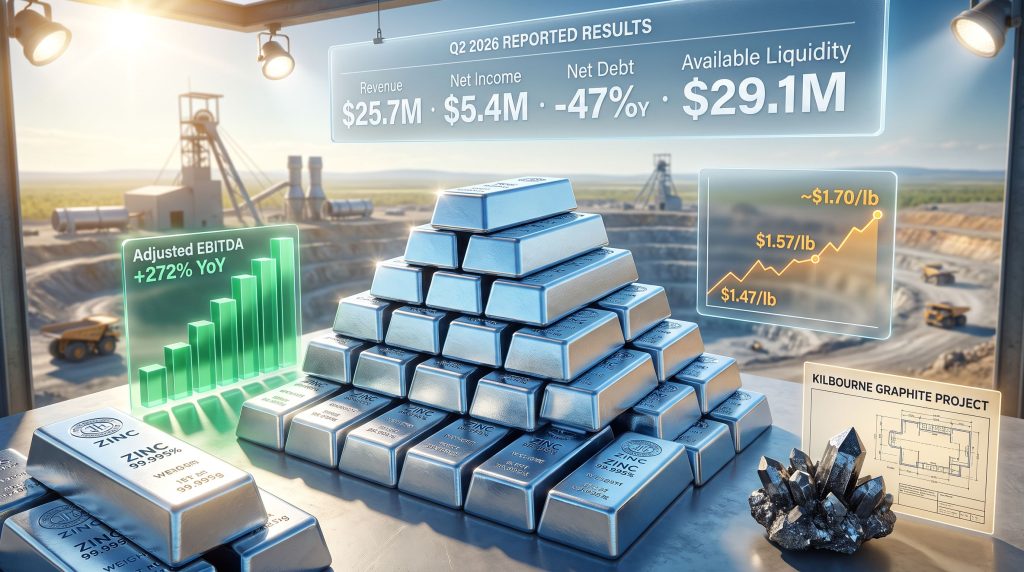
The Q2 2026 reporting period ending June 30 produced a set of financials that illustrate operating leverage in action. The numbers deserve careful examination.
| Financial Metric | Q2 2026 Result | Year-on-Year Change |
|---|---|---|
| Revenue | $25.7 million | Significant increase |
| Net Income | $5.4 million | vs. $500,000 in Q2 2025 |
| Earnings Per Share (EPS) | $0.06 | N/A |
| Adjusted EBITDA | $9.6 million | +272% year-on-year |
| Operating Cash Flow (pre-working capital) | $4.9 million | +156% quarter-on-quarter |
| Net Debt | $12.8 million | -47% year-on-year |
| Available Liquidity | $29.1 million | N/A |
Several dynamics within these figures deserve individual analysis.
EBITDA Growth Dramatically Outpacing Revenue Growth
Revenue grew substantially year-on-year, yet EBITDA expanded by 272%. This mathematical relationship is the signature of operating leverage. When a meaningful portion of a mine's cost base is fixed, additional revenue from higher prices or volumes flows disproportionately to earnings.
Fixed costs at a zinc mine include items such as underground development, equipment depreciation, administration, and permitting compliance. These costs do not increase because zinc prices rise. The result: incremental revenue from price appreciation carries a far higher margin than the mine's average margin, pulling overall EBITDA margins upward.
Net Income Recovery: A Near-Tenfold Increase
Net income of $5.4 million compared to $500,000 in Q2 2025 represents approximately a 980% increase. This magnitude of improvement reflects not only the zinc price recovery but also the effect of lower interest costs as net debt declined, and reduced depreciation pressure as prior capital investments mature.
Balance Sheet Repair as an Earnings Quality Signal
Institutional investors evaluating mining companies during commodity upswings apply a specific quality test: is rising cash flow being used to strengthen the balance sheet, or to fund speculative expansion? Titan's 47% reduction in net debt to $12.8 million combined with $29.1 million in available liquidity signals disciplined capital allocation. This matters because it positions the company to pursue the Kilbourne graphite project from a position of financial strength rather than necessity.
Empire State Mine: Single-Asset Concentration and Its Implications
All of Titan's zinc production originates from the Empire State Mine, located near Gouverneur in northern New York State. This is a region with a long history of zinc mining, and the Empire State Mine itself has geological characteristics that make it operationally distinct from many other zinc operations globally.
The mine operates in what is known as a skarn-type zinc deposit, formed through the metasomatic replacement of carbonate rocks by zinc-bearing hydrothermal fluids. These deposits typically feature relatively consistent grade profiles but can present variable mineralisation at the margins, requiring careful mine planning to maintain steady mill feed quality.
Q2 2026 payable zinc production reached 17.5 million pounds, a 13% increase compared to the same quarter in the prior year and a result that surpassed the internal mine plan. Full-year 2026 production guidance stands at 62 million to 66 million payable pounds. In addition, cut-off grade economics play a central role in determining which ore zones are economically viable to extract at any given zinc price level.
The interaction between production outperformance and rising zinc prices creates compounding earnings benefits that are particularly powerful in single-commodity operations where there are no offsetting commodity price movements to dilute the effect.
The deliberate sequencing of higher-grade ore zones during periods of favourable pricing is a recognised mine planning strategy. When geologists and mine planners identify zones with above-average zinc grades, scheduling their extraction during price peaks maximises the revenue yield per tonne of rock moved. This strategic scheduling, while not always disclosed in detail by miners, is a standard practice that sophisticated analysts look for when production beats mine plan during price upswings.
The Risks of a Single-Asset Model
Concentration in one operation is a double-edged characteristic. On the upside, every cent of zinc price improvement flows directly and entirely to the income statement without dilution from underperforming assets. On the downside, any operational disruption at Empire State Mine, whether from geological challenges, equipment failure, or regulatory issues, would immediately and completely eliminate revenue. Investors in focused zinc producers must weigh this concentration risk against the earnings leverage it enables.
Zinc Price Trajectory and What Post-Quarter Movements Mean for Forward Earnings
| Period | Zinc Price Reference | Significance |
|---|---|---|
| Q1 2026 Average Realised | $1.47/lb | 22% revenue growth year-on-year |
| Q2 2026 Average Realised | $1.57/lb | +7% quarter-on-quarter; EBITDA quadrupled |
| Post-June 2026 Spot Price | ~$1.70/lb | Four-year high; not yet captured in reported results |
The spot zinc price rise to approximately $1.70/lb after the end of June 2026 is particularly significant because of how provisional pricing mechanisms work. Sales made during Q2 but not yet finally settled will be adjusted toward the higher prices prevailing in July and August, meaning this price improvement will appear in Q3 2026 financial results even without any new sales volumes.
For the second half of 2026, assuming approximately 32 million payable pounds remain within the full-year guidance range, an average realised price of $1.65/lb versus the Q1 baseline of $1.47/lb would generate an incremental revenue contribution from price alone approaching $5.8 million. Relative to the existing full-year EBITDA guidance midpoint of $24 million, this represents a material potential uplift that has not been formally incorporated into guidance.
This scenario is hypothetical and dependent on sustained zinc price levels. Commodity prices are inherently volatile and actual outcomes may differ materially from projections.
Structural Drivers Behind the Zinc Market Recovery
Zinc's four-year price high is not a random market event. Several structural factors have converged to create tighter supply conditions, and understanding global zinc production trends provides important context for interpreting these dynamics:
- Mine depletion and closures: Several major zinc operations globally have either reached end-of-life or curtailed production as ore grades at depth have declined below economic thresholds.
- Extended development timelines: New zinc mines require extensive environmental permitting and infrastructure investment, typically spanning seven to twelve years from discovery to first production. The pipeline of replacement capacity has been undersupplied for years.
- Declining ore grades at mature operations: A widely underappreciated dynamic in the zinc sector is that global average zinc ore grades have trended lower over decades as higher-grade deposits are preferentially exhausted. This grade decline means existing mines produce less zinc per tonne milled even without any operational changes.
- Galvanised steel demand: Zinc's primary industrial application, galvanising steel to prevent corrosion, remains structurally linked to global construction activity and infrastructure investment cycles.
- Emerging battery applications: Zinc-air battery technology and zinc-ion battery chemistries are attracting increasing research attention as alternatives to lithium-ion systems in specific applications, introducing a potential new demand category that is not yet fully priced into long-term zinc market models.
The next major ASX story will hit our subscribers first
The Treatment Charge Cycle: An Underappreciated Earnings Driver
One of the least-discussed factors in Titan Mining earnings gains supported by zinc prices is the simultaneous movement of zinc treatment charges. TCs are not fixed; they are negotiated annually between major miners and smelters, with benchmark settlements influencing mid-market transactions throughout the year.
When zinc concentrate supply tightens, as it has during the current cycle, smelters face competition for limited feed material. Miners gain negotiating leverage, and TC levels fall. The effect on a zinc producer's economics is additive to the price improvement: miners simultaneously receive more per pound of zinc and pay less to have it processed.
This dual benefit, higher realised prices combined with lower processing costs, creates a margin expansion effect that is more powerful than zinc price charts alone suggest. It is a key reason why Titan's EBITDA growth of 272% year-on-year substantially outpaced its production volume increase of 13% and its zinc price increase of 7%.
Kilbourne Graphite: Critical Minerals Optionality at an Existing Operation
Titan is advancing the Kilbourne graphite project, co-located at the Empire State Mine site in New York State. Two customer agreements have been executed, providing early commercial validation of the project's product quality and market relevance. Critical minerals demand driven by the global energy transition is increasingly shaping the strategic value of projects like Kilbourne.
A construction decision is targeted for early 2027, with revenue generation from graphite likely beginning in 2028 at the earliest, subject to construction and commissioning timelines.
Natural graphite's role in lithium-ion battery anodes makes it a designated critical mineral across multiple major jurisdictions. The United States, Canada, and European Union have each identified graphite supply chain security as a strategic priority given that the overwhelming majority of global natural graphite processing currently occurs in China. Domestic producers with established operational infrastructure hold a structural cost advantage over greenfield developers attempting to build processing capacity from scratch.
For Titan, the Kilbourne project's co-location with Empire State Mine means existing roads, power connections, water access, and workforce infrastructure can be leveraged, reducing development capital requirements substantially compared to a standalone graphite project. Titan recently announced 22% revenue growth alongside the expansion of its US critical minerals platform, underscoring the strategic coherence of this approach.
Full-Year 2026 Guidance: On Track and Potentially Conservative
With adjusted EBITDA of $9.6 million delivered in Q2 alone, and full-year guidance set at $20 million to $28 million, Titan entered the second half of 2026 needing only approximately $10.4 million to $18.4 million in combined H2 EBITDA to meet its guidance range. Given the post-June zinc price surge to four-year highs, the upper end of guidance appears well within reach. Furthermore, commodities investment trends suggest that focused producers with strong earnings momentum are attracting renewed institutional interest.
The analytical case for a guidance upgrade strengthens with each week that spot zinc prices hold above $1.65/lb.
Forward-looking guidance figures and price assumptions carry inherent uncertainty. This analysis does not constitute financial advice. Readers should conduct independent research and consult qualified financial advisors before making investment decisions.
Frequently Asked Questions: Titan Mining Earnings and Zinc Market Dynamics
What drove Titan Mining's record EBITDA result in Q2 2026?
Adjusted EBITDA of $9.6 million was driven by a realised zinc price of $1.57/lb, up 7% quarter-on-quarter, combined with a 13% year-on-year increase in payable zinc production to 17.5 million pounds, and stable cost discipline at Empire State Mine.
Why did EBITDA grow so much faster than revenue?
Operating leverage in mining means fixed costs do not rise proportionally with revenue. When zinc prices and production volumes increase simultaneously, the incremental revenue carries a much higher margin than the mine's average, producing outsized EBITDA growth relative to top-line expansion.
How does the post-June zinc price rise affect Titan's future results?
Spot zinc rose to approximately $1.70/lb after Q2 ended. Through provisional pricing settlement mechanisms, this improvement will flow into Q3 and Q4 2026 reported results, representing earnings potential not yet captured in published financials.
What is the Kilbourne graphite project and when might it generate revenue?
Kilbourne is a graphite development project co-located at Empire State Mine. Two customer agreements have been signed, with a construction decision targeted for early 2027. Revenue from graphite would likely begin in 2028 at the earliest. Consequently, Titan Mining earnings gains supported by zinc prices may eventually be complemented by a diversified critical minerals revenue stream.
Why is zinc treatment charge movement important to understand?
Treatment charges are fees paid by miners to smelters for processing zinc concentrate. When concentrate supply tightens and zinc prices rise, TCs typically fall, giving miners a double margin benefit: higher realised prices and lower processing costs simultaneously. This dynamic is among the most underappreciated contributors to margin expansion in the current cycle.
Want to Know When the Next Major ASX Mineral Discovery Hits the Market?
Discovery Alert's proprietary Discovery IQ model delivers real-time alerts on significant ASX mineral discoveries, instantly turning complex mineral data into actionable insights for traders and investors alike — explore historic examples of exceptional discovery returns to understand why timing matters, then begin your 14-day free trial at Discovery Alert to position yourself ahead of the broader market.