
August 7, 2026
Africa's Greenfield Gold Frontier: Why the Dokwe Project Changes the Development Calculus
Across sub-Saharan Africa, the dominant playbook for gold mining development has long been brownfield rehabilitation. Investors and operators alike have favoured the predictability of known mineralisation, existing infrastructure, and partially depreciated processing plants over the geological and financial unknowns of true greenfield exploration. This preference has shaped an entire generation of African gold development strategy, concentrating capital into legacy assets while leaving genuinely new discoveries chronically underexplored.
That calculus is beginning to shift. A combination of elevated gold prices, improving geological databases, and evolving sovereign risk frameworks has created conditions where greenfield projects can once again attract serious institutional attention. The Ariana Resources Zimbabwe gold project, centred on the Dokwe deposit approximately 110 km northwest of Bulawayo, sits at precisely this inflection point.
When big ASX news breaks, our subscribers know first
What Makes Dokwe Structurally Different From Every Other Gold Development in Zimbabwe
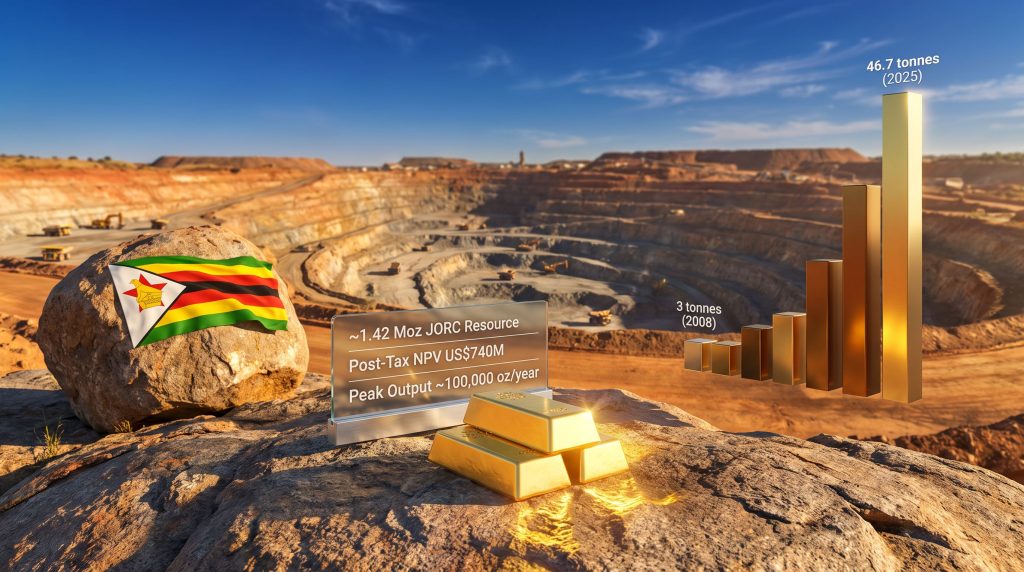
To understand the significance of Dokwe, it helps to first understand what it is not. Zimbabwe's modern gold sector revival, which lifted annual production from a crisis-era nadir of roughly 3 metric tons in 2008 to 46.7 metric tons by 2025, was built almost entirely on reviving and expanding inherited assets. Companies including Caledonia Mining Corporation, Namib Minerals, State-backed Mutapa Gold Resources, and a unit of locally owned Padenga drove that recovery by breathing new life into old mines with known geology and partial infrastructure already in place.
Dokwe breaks from this pattern entirely. It is, by industry characterisation, the first large-scale greenfield gold project to advance through serious feasibility-stage development in Zimbabwe in several decades. There are no legacy shafts to rehabilitate, no inherited processing inefficiencies to correct, and no decades-old engineering assumptions baked into the deposit's design envelope. The project is being built from first principles, which introduces a specific set of risks but also confers significant advantages in terms of mine planning optionality and process design freedom.
The Brownfield Bias and What It Costs the Sector
The structural preference for brownfield assets across African mining is not irrational. Greenfield projects carry exploration risk, longer permitting timelines, higher upfront infrastructure costs, and greater uncertainty around metallurgical behaviour. However, the brownfield-first strategy also systematically undervalues genuinely new geological discoveries, creating pricing inefficiencies that attentive developers can exploit.
When major international operators including Rio Tinto, Delta Gold, and Kinross exited Zimbabwe more than two decades ago amid political and economic deterioration under the Mugabe administration, they left behind not just operational assets but also unexplored geological terrain. The Dokwe discovery reflects what was always possible in Zimbabwe's geology once the investment climate became sufficiently credible to justify systematic exploration expenditure.
Zimbabwe's Gold Sector: A 15-Fold Production Recovery Built on Old Foundations
The arithmetic of Zimbabwe's gold recovery is striking. Production climbing from approximately 3 metric tons to 46.7 metric tons over roughly 17 years represents a more than fifteenfold increase, achieved predominantly through the efforts of mid-tier operators rehabilitating assets that the major miners had abandoned.
What this production trajectory also reveals, however, is the ceiling implicit in a brownfield-only strategy. As legacy assets approach their natural resource limits, the sector's ability to sustain growth momentum will increasingly depend on new discoveries advancing into production. Dokwe's development trajectory is therefore relevant not just as a single project narrative but as a potential template for the next phase of Zimbabwe's gold sector evolution. Furthermore, monitoring the broader gold market outlook helps contextualise why greenfield projects like Dokwe are attracting renewed institutional interest.
Zimbabwe's Current Gold Production Landscape
The country's operating gold producers span a range of ownership structures and operational scales:
- Caledonia Mining Corporation operates the flagship Blanket Mine, one of Zimbabwe's deepest and most mechanised gold operations.
- Namib Minerals has established a significant production footprint through aggressive reinvestment in processing infrastructure.
- Mutapa Gold Resources, with State backing, manages a portfolio of assets concentrated in the country's primary greenstone belts.
- Padenga Holdings operates gold assets through a dedicated mining unit alongside its crocodile farming business, representing one of the more unusual corporate structures in African gold mining.
Dokwe, once in production, would enter this landscape not as a marginal incremental player but as one of the sector's most significant contributors by annual output volume.
Breaking Down the Dokwe Resource and Reserve Metrics
The project's geological credentials anchor the investment thesis. Dokwe carries a JORC-compliant resource of approximately 1.42 million ounces, underpinned by a proven and probable reserve base of approximately 1.13 million ounces. This reserve figure is particularly important because it represents the portion of the resource that has been subject to detailed geological, geotechnical, mining, and economic modelling sufficient to support feasibility-level studies. In addition, understanding how a robust gold resource estimate is constructed helps investors appreciate the rigour behind these numbers.
| Economic and Resource Metric | Value |
|---|---|
| Total JORC Resource | ~1.42 million oz |
| Proven + Probable Reserves | ~1.13 million oz |
| Pre-Tax NPV (10% discount rate) | US$1.056 billion |
| Post-Tax NPV (10% discount rate) | US$740 million |
| Pre-Production Capital Expenditure | ~US$164 million |
| Gold Price Assumption | US$4,250/oz |
| Peak Annual Production | ~100,000 oz/year |
| Project Lifespan | 20 years |
Ariana Resources holds 100% ownership of the Dokwe project, subject to a net smelter return royalty arrangement. Full ownership provides the company with complete exposure to project economics without the complexity of joint venture structures, though it also concentrates development financing risk on a single corporate balance sheet.
Dokwe North and Dokwe Central: A Two-Zone Architecture
The deposit is structured across two principal zones, Dokwe North and Dokwe Central, which together define the project's resource envelope. This two-zone configuration is not uncommon in greenstone-hosted gold deposits across southern Africa, where structurally controlled mineralisation tends to occur in parallel lode systems separated by competent host rock. Understanding the individual behaviour of each zone under mining and processing conditions is a key focus of ongoing technical work, particularly as the company advances toward a definitive feasibility study.
Active drilling programmes aimed at extending mineralisation beyond the current resource envelope suggest that the 1.42 million ounce figure may not represent the deposit's ultimate geological potential, though any expansion would require formal resource estimation updates before being incorporated into mine planning.
How the Prefeasibility Study Models Dokwe's Production Architecture
The revised prefeasibility study for Dokwe envisions a 20-year project lifespan structured in two sequential phases. The first 12 years involve active open-pit mining operations, during which ore is extracted, processed, and converted into gold doré. The subsequent 8-year period transitions to stockpile processing, where lower-grade material accumulated during the active mining phase is fed through the processing plant as the open pit approaches depletion.
This two-phase structure is a well-established approach in open-pit gold mining, allowing operators to maintain plant utilisation and revenue generation well beyond the point at which active mining ceases. It effectively extends the economic life of processing infrastructure without requiring additional capital investment in new mining fronts.
Peak annual production is modelled at approaching 100,000 ounces per year, with total life-of-project gold production targeted at approximately 1.06 million ounces over the 20-year span. This output profile would position Dokwe among the more significant gold producers on the African continent once operational.
The Metallurgical Advantage: Gravity Recovery as a Risk Mitigant
One of the most technically significant aspects of the Dokwe project is its metallurgical profile. A substantial proportion of the gold within the deposit is amenable to gravity recovery, a processing approach that uses differential density to separate gold from waste material without the need for chemical leaching at the primary recovery stage.
Gravity recovery circuits are generally simpler to operate, less capital-intensive to construct, and carry lower environmental risk profiles than cyanide leach or pressure oxidation circuits. For a greenfield project in a developing jurisdiction, this metallurgical characteristic meaningfully reduces both capital expenditure requirements and operational complexity, while also simplifying the environmental permitting pathway for processing infrastructure.
For investors assessing project risk, the gravity recovery profile at Dokwe represents a genuine technical differentiator compared to refractory or semi-refractory deposits, where gold is locked within sulphide mineral matrices requiring more intensive and costly treatment methods.
What the Project Economics Actually Tell Investors
At a gold price assumption of US$4,250 per ounce, the prefeasibility study returns a pre-tax net present value of US$1.056 billion and a post-tax NPV of US$740 million at a 10% discount rate. The pre-production capital requirement is estimated at approximately US$164 million. Consequently, reviewing the current gold price forecast is essential for understanding whether this base case assumption remains credible.
The relationship between these figures warrants careful analysis. A post-tax NPV of US$740 million against a capital cost of US$164 million implies a capital efficiency ratio of approximately 4.5 times, which compares favourably to many peer African gold development projects at similar stages of study maturity.
Several variables will influence these outcomes materially:
- Gold price trajectory – The study uses US$4,250/oz as its base case, which is broadly consistent with elevated but not extreme gold price assumptions at the time of study. Any sustained decline toward US$2,500 to US$3,000/oz would compress NPV significantly.
- Capital cost inflation – Infrastructure and construction costs in southern Africa have risen materially across the sector. Any cost growth beyond the US$164 million estimate would reduce project returns.
- Permitting and regulatory timelines – Delays in securing mining permits or environmental approvals could push first production beyond the 2028 target, increasing holding costs.
- Exchange rate and fiscal regime – Zimbabwe's monetary history introduces currency and taxation risk that international investors will price carefully.
Disclaimer: All financial projections and NPV figures referenced here are drawn from prefeasibility-level study outputs and should not be interpreted as guarantees of future performance. Prefeasibility studies carry inherent uncertainty, and actual project outcomes may differ materially from modelled scenarios.
The next major ASX story will hit our subscribers first
The 2027 to 2028 Development Timeline: Milestones and Risks
The near-term development pathway for the Ariana Resources Zimbabwe gold project rests on two critical milestones. The first is the completion of a definitive feasibility study targeted for the first quarter of 2027. Unlike the prefeasibility study, which establishes project viability within a broader range of confidence, a definitive feasibility study is designed to provide the level of technical and economic certainty required to support a final investment decision and secure project financing.
The second milestone is first gold production in 2028, a target that, while aspirational in its current framing, is not implausible given the study timeline. The sequence from definitive feasibility study completion in early 2027 through final investment decision, financing arrangement, construction procurement, and plant commissioning to first pour within approximately 12 to 18 months would require disciplined execution across every development workstream simultaneously.
A capital raise in 2026 is intended to fund ongoing study work and exploration drilling, ensuring continuity in technical programmes without interrupting the feasibility study timeline. The ongoing drilling activity serves a dual purpose: supporting resource definition for mine planning purposes while testing the deposit's potential to grow beyond its current boundaries.
Is Zimbabwe Now a Viable Destination for Long-Term Gold Investment?
The political context surrounding Zimbabwe's investment climate cannot be separated from any serious analysis of the Dokwe project. The departure of Rio Tinto, Delta Gold, and Kinross from Zimbabwe was not driven by geological disappointment. The country's greenstone belts have always been prospective. Those exits reflected a sovereign risk assessment that concluded the operating environment had become incompatible with the long-term capital commitments that large-scale mining requires.
The administration that took office in 2017 following the transition from Robert Mugabe's four-decade rule has pursued a markedly different posture toward foreign investment in the mining sector. This shift in orientation has encouraged a gradual re-engagement from international capital, though the pace of that re-engagement has been measured rather than exuberant. For instance, safe-haven gold investment dynamics at the global level have further incentivised developers to press forward with credible projects in emerging jurisdictions.
Risks That Remain Relevant for Zimbabwe Project Developers
International developers evaluating Zimbabwe must still account for a specific risk architecture that differs from more established mining jurisdictions:
- Monetary and fiscal instability – Zimbabwe's currency history is a persistent concern for operators converting gold revenues into investable capital.
- Regulatory continuity – Policy settings that appear favourable today could be subject to revision, particularly around royalty rates, indigenisation requirements, or repatriation restrictions.
- Infrastructure constraints – Power supply reliability and road network quality in mining regions remain genuine operational considerations.
- Institutional capacity – The speed and predictability of permitting and environmental approval processes can significantly affect project timelines.
The fundamental question for greenfield developers in Zimbabwe is not whether the geology justifies the investment, because the geological case at Dokwe is strong. The central question is whether the fiscal and regulatory framework will remain sufficiently stable over a 20-year production horizon to protect the economics modelled at the feasibility stage.
Dokwe's Competitive Position in the African Gold Development Pipeline
Described as the largest undeveloped gold deposit currently identified in Zimbabwe, Dokwe occupies a distinctive position in the broader African gold development pipeline. While the continent hosts a number of multi-million-ounce undeveloped deposits, the combination of reserve size, metallurgical simplicity, favourable project economics at current gold prices, and an improving sovereign environment gives Dokwe a specific profile that is difficult to replicate elsewhere in the region.
For investors seeking exposure to African gold development at the pre-production stage, the project's reserve base of 1.13 million ounces, combined with a post-tax NPV that significantly exceeds its pre-production capital requirement, represents a capital efficiency argument that warrants serious consideration alongside the sovereign risk factors that any Zimbabwe-exposed investment necessarily carries.
Frequently Asked Questions: Ariana Resources Zimbabwe Gold Project
What Is the Dokwe Gold Project and Where Is It Located?
Dokwe is a greenfield gold development project situated approximately 110 km northwest of Bulawayo, Zimbabwe's second-largest city. It is described as the first large-scale greenfield gold project to reach feasibility-stage development in Zimbabwe in several decades.
How Many Ounces of Gold Does the Dokwe Project Contain?
The project holds a JORC-compliant total resource of approximately 1.42 million ounces and a proven and probable reserve base of approximately 1.13 million ounces.
When Will Ariana Resources Begin Producing Gold From Dokwe?
First gold production is targeted for 2028, contingent on the successful completion of a definitive feasibility study in Q1 2027, followed by a positive final investment decision and construction execution.
What Is the Estimated Capital Cost to Build the Dokwe Mine?
Pre-production capital expenditure is estimated at approximately US$164 million based on the revised prefeasibility study.
What Makes Dokwe a Greenfield Project?
Unlike the brownfield assets that have driven Zimbabwe's gold production recovery since 2008, Dokwe involves developing a deposit with no legacy mining infrastructure, meaning all facilities must be designed and constructed from the ground up rather than adapted from existing operations.
What Is the Expected Annual Gold Production at Peak Output?
The prefeasibility study models peak annual production approaching 100,000 ounces, sustained during the active open-pit mining phase of the project's 20-year life.
Key Variables That Will Determine Dokwe's Trajectory
Three factors above all others will shape whether the Ariana Resources Zimbabwe gold project delivers on its modelled potential. First, the definitive feasibility study must confirm and ideally improve on the economic metrics established at the prefeasibility stage. Second, the regulatory and permitting environment in Zimbabwe must remain stable and predictable enough to support a final investment decision by mid-2027. Third, gold prices must remain sufficiently elevated to maintain the project's capital efficiency argument through the construction and ramp-up period.
If all three conditions align, Dokwe has a credible pathway to becoming one of the most significant new gold mines commissioned anywhere on the African continent in the coming decade, and a meaningful demonstration that Zimbabwe's mining sector can attract and retain large-scale international greenfield capital for the first time in a generation.
For ongoing coverage of African gold sector developments and Zimbabwe mining investment dynamics, Mining Weekly provides regular reporting on regional resource sector activity.
Want to Catch the Next Major Gold Discovery Before the Market Does?
Discovery Alert's proprietary Discovery IQ model scans ASX announcements in real time, instantly identifying significant mineral discoveries across gold and 30+ other commodities — visit the Discovery Alert discoveries page to see how historic finds have generated extraordinary returns, and begin your 14-day free trial to position yourself ahead of the broader market.