Arika Resources Ltd
- ASX Code: ARI
- Market Cap: $36,047,623
Arika Resources Confirms Shallow Gold Continuity Across 2.5km Strike at Yundamindra
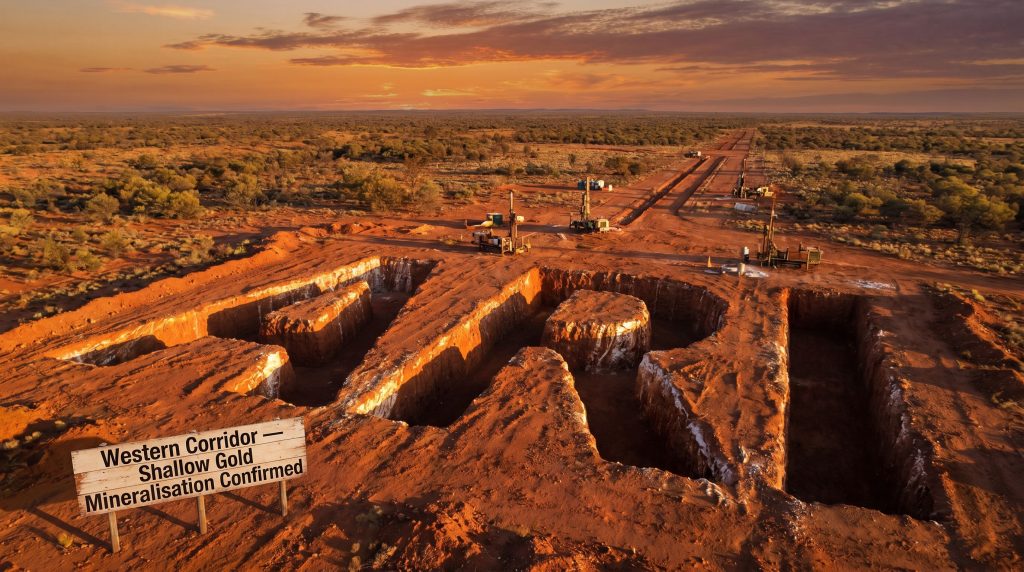
Arika Resources Limited (ASX: ARI) has released a significant exploration update from its Yundamindra Gold Project in Western Australia, confirming that the Arika Resources Yundamindra gold project shallow gold continuity across 2.5km strike is now established along the Western Corridor. The results come from 100 RC holes totalling 14,752 metres drilled since January 2026, and they do more than confirm historical gold occurrences.
Furthermore, they establish a coherent, expandable mineralised system with multiple structures, high-grade internal intervals, and a further 10 kilometres of untested strike remaining.
"These excellent results are consistent with our strategy to rapidly advance the Yundamindra Gold Project towards a maiden Mineral Resource Estimate, while continuing to unlock the broader potential of the district. Considering that we have so far drilled only 2.5km of a broader 10km prospective strike extent, the growth opportunity at Yundamindra is immense."
— Justin Barton, Managing Director, Arika Resources
When big ASX news breaks, our subscribers know first
What the Drilling Has Actually Proven
The core achievement of this drilling programme is deceptively straightforward: Arika set out to demonstrate continuity of gold mineralisation across several known historical occurrences, and it succeeded decisively.
The drilling was deliberately designed as a proof-of-concept — stepping out aggressively from known mineralisation to test whether the string of historical gold workings along the "Yellow Brick Road" (Western Corridor) could be connected into a single coherent mineralised trend. The answer is yes.
Mineralisation has now been confirmed as continuous from Queen of Poland in the north, through Landed at Last F1, Main, and F0, down to Golden Treasure Deeps in the south — a total strike of 2.5 kilometres. Critically, every structure tested remains open in all directions, and the broader Yellow Brick Road corridor extends for at least a further 10 kilometres without systematic modern drilling.
The geological setting adds further confidence. Gold mineralisation at Landed at Last and Pennyweight Point is hosted within a structurally predictable interaction between granite and mafic-ultramafic lithologies, with quartz veining. The system is complex but not chaotic, and the repeatability of intercepts across multiple holes on multiple structures suggests the geology is behaving consistently.
The Numbers: A Systematic Look at the Results
The intercepts span four distinct zones within Landed at Last, plus early-stage results from Pennyweight Point. The tables below summarise the headline results by zone.
Landed at Last — Queen of Poland Zone
| Hole ID | From (m) | Length (m) | Grade (g/t Au) | Notable High-Grade Internal |
|---|---|---|---|---|
| 26AYRC051 | 69 | 27 | 0.99 | 1m @ 8.44 g/t Au from 50m |
| 26AYRC104 | 62 | 11 | 1.76 | 7m @ 2.47 g/t Au from 66m |
| 26AYRC113 | 69 | 23 | 0.91 | 1m @ 3.57 g/t Au from 70m |
| 26AYRC115 | 75 | 20 | 0.66 | 1m @ 3.37 g/t Au from 77m |
| 26AYRC120 | 69 | 23 | 0.91 | 1m @ 3.13 g/t Au from 88m |
Landed at Last — Main Zone
| Hole ID | From (m) | Length (m) | Grade (g/t Au) | Notable High-Grade Internal |
|---|---|---|---|---|
| 26AYRC137 | 107 | 15 | 0.96 | 1m @ 7.96 g/t Au from 117m |
| 26AYRC143 | 156 | 10 | 1.41 | 2m @ 5.72 g/t Au from 159m |
| 26AYRC135 | 114 | 5 | 1.45 | 1m @ 5.64 g/t Au from 115m |
| 26AYRC055 | 90 | 11 | 0.78 | 5m @ 1.15 g/t Au from 92m |
| 26AYRC053 | 75 | 10 | 0.99 | — |
Landed at Last — F1 Zone
| Hole ID | From (m) | Length (m) | Grade (g/t Au) | Notable High-Grade Internal |
|---|---|---|---|---|
| 26AYRC131 | 80 | 61 | 0.70 | 2m @ 6.75 g/t Au from 87m |
| 26AYRC031 | 32 | 12 | 0.76 | 4m @ 1.91 g/t Au from 32m |
| 26AYRC031 | 153 | 41 | 0.49 | 1m @ 4.09 g/t Au from 154m |
| 26AYRC047 | 93 | 15 | 0.77 | 4m @ 1.74 g/t Au from 102m |
| 26AYRC049 | 49 | 3 | 2.94 | 1m @ 8.44 g/t Au from 50m |
Landed at Last — F0 Zone
| Hole ID | From (m) | Length (m) | Grade (g/t Au) | Notable High-Grade Internal |
|---|---|---|---|---|
| 26AYRC041 | 32 | 27 | 0.35 | 4m @ 1.16 g/t Au from 40m |
| 26AYRC037 | 85 | 14 | 0.44 | 1m @ 1.67 g/t Au from 85m |
| 26AYRC039 | 126 | 4 | 1.78 | 2m @ 2.90 g/t Au from 126m |
Pennyweight Point — Florin (Cross-Cutting E-W Structure)
| Hole ID | From (m) | Length (m) | Grade (g/t Au) | Notable High-Grade Internal |
|---|---|---|---|---|
| 26AYRC016 | 90 | 5 | 0.84 | 1m @ 3.10 g/t Au from 91m |
| 26AYRC017 | 18 | 7 | 0.64 | 2m @ 1.25 g/t Au from 18m |
Several features stand out across this dataset:
- Most intercepts are shallow — the majority commence between 11m and 107m downhole, which is highly relevant for potential future open-cut mining scenarios
- Multiple structures are intersected within single traverses — the longest drill traverse identified separate mineralised lodes above and below the main Landed at Last structure, pointing to additive ounce potential
- High-grade spikes are consistent — virtually every broader low-grade interval contains a tighter higher-grade core, characteristic of orogenic gold systems, supporting the potential for higher-grade underground mining scenarios
Understanding the Geology: Why Orogenic Gold Matters to Investors
What Is Orogenic Gold Mineralisation?
Orogenic gold deposits form during major geological events where deep crustal fluids, carrying dissolved gold, migrate upward along structural pathways — faults, shear zones, and contacts between different rock types. At Yundamindra, the key structural control is the contact between a large hornblende-granodiorite batholith and surrounding mafic-ultramafic rocks.
Gold is deposited when these fluids intersect favourable chemical or structural traps, often in association with quartz veining. The system is complex but structured, and the repeatability of results across drilling traverses confirms the geology is responding predictably.
Why Does This Matter for Investors?
Orogenic gold systems are the source of some of Australia's largest gold deposits. The Laverton Greenstone Belt — where Yundamindra sits — hosts multiple world-class examples:
| Deposit | Contained Gold (Moz) | Approximate Distance from Yundamindra |
|---|---|---|
| Sons of Gwalia | >10 Moz | ~65km west |
| Sunrise Dam | ~8 Moz | ~65km west |
| Wallaby | ~7 Moz | ~20–30km east |
| Laverton Belt Total (est.) | >28 Moz | — |
These deposits are analogues that demonstrate the endowment potential of the regional geological setting. Arika has not made any resource estimate at Yundamindra to date. However, the confirmation of multiple, continuous, open-ended gold structures across a 2.5km strike in a belt of this pedigree is an important step toward establishing a meaningful resource inventory.
Key Terms Explained
- RC Drilling (Reverse Circulation): A drilling method using compressed air to push rock chips back up to surface through the drill rods — fast, cost-effective, and well-suited to shallow exploration in weathered terrain.
- Strike Extent: The horizontal length along which a mineralised structure has been identified or traced — a key measure of potential scale.
- g/t Au: Grams of gold per tonne of rock. Higher grades within broader lower-grade envelopes are common in orogenic systems.
- Bottle Roll Leach (LeachWELL): A metallurgical test measuring how much gold can be recovered using cyanide leaching — an early indicator of process suitability.
- Mineral Resource Estimate (MRE): A formal, JORC-compliant estimate of the quantity and grade of mineralisation within a defined rock volume. A maiden MRE is a significant value-defining milestone.
A New Discovery Within the Discovery: Parallel Structures
One of the more consequential findings from this programme is not in the headline intercepts — it is in what the drilling revealed structurally. The longest cross-sectional traverse completed to date identified a series of previously unrecognised gold mineralised structures above and below the main Landed at Last lode.
These parallel and cross-cutting lodes had not been mapped or targeted prior to this campaign. Their identification means the mineralised system is wider and more complex than previously understood, with the potential for additional ounces not captured in the main lode intercepts reported here. The company has indicated these newly identified structures will be specifically targeted when drilling resumes in June 2026.
What Comes Next: Catalysts and Timeline
Arika has entered a planned drilling break to allow thorough assessment of the significant assay database generated since January. Drilling is scheduled to resume in June 2026.
| Upcoming Activity | Expected Timing | Significance |
|---|---|---|
| Drilling resumes at Yundamindra | June 2026 | Extension of Western and Eastern Corridors; testing of newly identified parallel structures |
| Metallurgical testwork results | To be reported once complete | Confirms gold recovery potential — key input for resource studies |
| Continued resource-definition drilling | Ongoing into 2026 field season | Building toward maiden Mineral Resource Estimate |
| Targeting of newly identified parallel lodes | From June 2026 onwards | Additional ounce potential from structures above and below main lode |
| First-pass testing of additional targets | 2026 field season | Early-stage exploration of the broader Yellow Brick Road corridor |
The maiden Mineral Resource Estimate remains the stated near-term objective, and the current drilling is explicitly designed to support that goal.
The Investment Thesis: Size, Shallowness, and Scale
The Yundamindra investment case rests on three interlinked propositions, all of which were advanced — not undermined — by this announcement.
1. The System Is Large and Remains Open
Only 2.5 kilometres of a minimum 10-kilometre prospective strike has been systematically tested. The structures tested to date remain open in all directions — at depth, along strike to the north and south, and on parallel lodes. The comparison to nearby world-class deposits is not a claim of equivalence; rather, it is a statement about the regional setting's proven gold endowment.
2. The Mineralisation Is Shallow
Most intercepts reported here begin between 11 metres and 107 metres below surface. Shallow, continuous gold mineralisation is the foundation of economic open-cut mining. Shallow projects typically carry lower development cost profiles and faster paths to production compared with deep underground-only systems. The presence of higher-grade cores within broader envelopes also preserves optionality for selective higher-grade mining scenarios.
3. The Company Is Drilling Toward a Definable Resource
Arika is not in the early-concept phase. Two rigs have completed 100 holes and nearly 15,000 metres since January. The company has confirmed structural continuity, identified the geological controls on mineralisation, commenced metallurgical testwork, and articulated a clear pathway to a maiden MRE. Each successive drilling phase is converting open-ended geological potential into drill-defined mineralisation that can be formally classified.
In addition, key differentiating factors are worth noting:
| Factor | Detail |
|---|---|
| Project ownership | 80% (moving to 100%, subject to completion conditions) |
| Location | 65km SW of Laverton, WA — within a proven >28Moz gold belt |
| Drilling pace | 100 RC holes / ~14,752m in four months |
| Mineralisation depth | Predominantly shallow (commencing 11m–107m) |
| Prospective strike (tested) | 2.5km |
| Prospective strike (total) | Minimum 10km additional untested extent |
| Metallurgical testwork | Underway — results pending |
The next major ASX story will hit our subscribers first
Why Investors Should Follow Arika Resources
The Arika Resources Yundamindra gold project shallow gold continuity across 2.5km strike represents a transition from a project defined by historical workings into one defined by modern, systematic drilling. This update represents a material step in that transition — confirming structural continuity, identifying new mineralised zones, and establishing the baseline for a maiden resource estimate.
The key attraction for investors is not a single intercept or a single prospect, but the combination of scale, shallowness, and exploration immaturity in a world-class gold address. The Western Corridor alone spans at least 12.5km of prospective strike, of which only 2.5km has been tested to any meaningful standard.
The Eastern Corridor (Red Brick Road) adds further prospectivity. Furthermore, the discovery of multiple previously unknown parallel lodes within already-drilled traverses suggests the system continues to reveal itself with increased drilling density.
With drilling scheduled to resume in June 2026 and metallurgical results pending, the second half of 2026 should deliver further material newsflow. The maiden Mineral Resource Estimate, when it arrives, will represent the first formal quantification of a system that has been producing gold since before 1899 and has never been comprehensively explored with modern techniques.
Arika Resources has confirmed continuous shallow gold mineralisation across a 2.5km strike at Yundamindra — with multiple structures, high-grade internal intervals, and a further 10km of untested prospective ground ahead. With drilling resuming in June 2026 and a maiden Mineral Resource Estimate as the stated near-term target, the project is entering an active value-definition phase in one of Australia's most proven gold addresses.
Want to Be First When the Next Major ASX Gold Discovery Hits the Market?
Discovery Alert's proprietary Discovery IQ model scans ASX announcements in real time, instantly converting complex mineral data into actionable insights — so subscribers are positioned ahead of the broader market when significant gold discoveries like those emerging from Western Australia's proven greenstone belts are announced. Explore Discovery Alert's discoveries page to understand how historic ASX mineral discoveries have generated substantial returns, and begin your 14-day free trial today to secure a genuine market-leading edge.