July 23, 2026
The Economics of Doing Less, Better: Why Brownfield Beats Greenfield in Today's Mining Cycle
Across the global mining industry, a quiet but significant strategic shift is underway. Rather than committing capital to entirely new discoveries with unknown geological risk, uncertain permitting timelines, and infrastructure costs that routinely blow past initial estimates, major operators are increasingly turning back to assets they already own. The logic is straightforward: known ore bodies, existing processing infrastructure, and established community relationships reduce the uncertainty premium that makes greenfield development so capital-intensive.
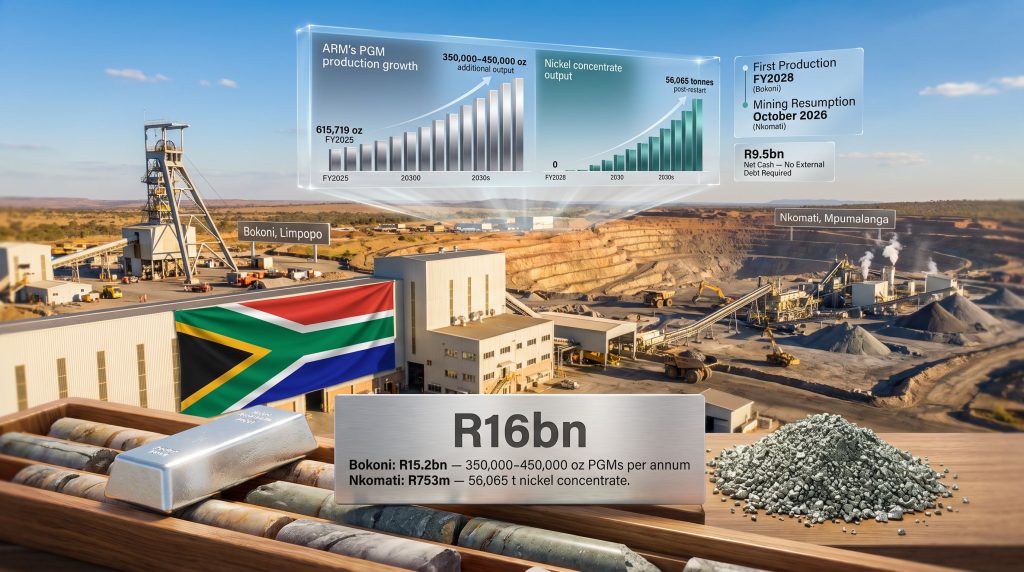
African Rainbow Minerals is among the most prominent examples of this trend in 2026. The company's board has sanctioned a combined capital programme totalling approximately R15.95 billion across two previously dormant South African assets, Bokoni in Limpopo and Nkomati in Mpumalanga. The ARM restart of Bokoni and Nkomati mines represents one of the most consequential brownfield reinvestment decisions in South African mining in recent memory, and it reflects a carefully timed bet on recovering commodity fundamentals across both the platinum group metals and nickel markets.
When big ASX news breaks, our subscribers know first
Bokoni Platinum Mine: Rebuilding for Scale, Not Just Production
Why Sub-Scale Processing Is the Fastest Route to Unprofitability
The suspension of Bokoni in June 2025 was not driven by exhausted reserves or deteriorating geology. The ore body remained intact. The problem was throughput. At 60,000 tonnes per month, the existing concentrator could not generate sufficient volume to spread fixed costs across enough recoverable metal, making the operation economically marginal even in periods of reasonable platinum pricing. This is a well-understood dynamic in PGM mining: unit costs in underground operations are heavily sensitive to throughput, and below a certain threshold, the numbers simply do not work regardless of the prevailing spot price.
ARM's solution is structural rather than incremental. Rather than simply refurbishing the existing plant and resuming operations at the same scale, the company is building an entirely new 120,000 tonne per month concentrator alongside the refurbished original facility. Once both units are operational, combined processing capacity reaches 180,000 tonnes per month, tripling the asset's throughput potential and fundamentally repositioning its cost structure.
Bokoni Project Specifications at a Glance
| Parameter | Detail |
|---|---|
| Total Capital Commitment | R15.2bn (approx. US$927m) |
| Feasibility Study Completion | June 2026 |
| Development Timeline | 7-year phased programme |
| Existing Plant Capacity (Refurbished) | 60,000 tonnes per month |
| New Concentrator Capacity | 120,000 tonnes per month |
| Combined Throughput Capacity | 180,000 tonnes per month |
| New Concentrator Commissioning | FY2030 |
| Refurbished Plant First Production | FY2028 |
| Steady-State PGM Output Target | 350,000–400,000 oz per annum |
| Steady-State Target Year | 2032 |
The Phased Ramp-Up: From Refurbished Plant to Full Capacity
The project timeline is deliberately staged to manage capital deployment risk. The refurbished 60,000 tonne per month plant is expected to deliver first production in ARM's FY2028, providing an early revenue stream before the more capital-intensive new concentrator comes online. That new facility is targeted for commissioning in FY2030, with the combined operation reaching steady-state output of between 350,000 and 400,000 PGM ounces per annum from 2032 onwards.
This phased approach carries a specific financial logic. By generating cash flow from the refurbished plant before the larger capital draw for the new concentrator peaks, ARM reduces the net funding requirement at any single point in the programme. Given the company's current R9.5 billion net cash position, both projects can proceed without equity dilution or external debt, an unusual position of strength for a development programme approaching US$1 billion in total scale.
Profitable PGM mining at scale demands processing infrastructure that can absorb the full weight of fixed underground operating costs. Below a critical throughput threshold, even high-grade ore cannot generate acceptable returns. The Bokoni expansion is, at its core, an exercise in crossing that threshold permanently.
Nkomati Nickel Mine: A Capital-Efficient Restart With Built-In Demand Security
From Care and Maintenance to Open-Pit Production in Months
Nkomati's situation differs from Bokoni in almost every meaningful dimension. Where Bokoni requires a seven-year capital programme and entirely new concentrating infrastructure, Nkomati is an open-pit operation with existing plant infrastructure that can be refurbished and returned to production within a matter of months. The total capital requirement of R753 million (approximately US$46 million) is a fraction of the Bokoni commitment, reflecting both the simpler mining method and the less capital-intensive processing requirements of an open-pit nickel operation.
Plant refurbishment is scheduled to begin in July 2026, with mining operations expected to resume as early as October 2026. According to ARM's official announcement, the annual production target is 56,065 tonnes of nickel concentrate, a meaningful volume for a single open-pit asset.
Nkomati Project Specifications at a Glance
| Parameter | Detail |
|---|---|
| Total Capital Commitment | R753m (approx. US$46m) |
| Mining Method | Open-pit |
| Annual Nickel Concentrate Target | 56,065 tonnes |
| Plant Refurbishment Start | July 2026 |
| Mining Resumption Target | October 2026 |
| Offtake Partner | Boliden (Sweden) |
| Destination Smelter | Harjavalta, Finland |
| Previous Care and Maintenance Entry | 2021 |
| ARM Ownership | 100% (sole owner from July 2025) |
The Nornickel Exit and What It Changed
Nkomati was previously operated as a joint venture, with Russian mining giant Nornickel holding a significant stake. Nornickel's exit from the partnership in July 2025 transferred full ownership to ARM, simplifying the governance structure and giving ARM unilateral control over the restart timeline and capital allocation decisions. From an operational standpoint, sole ownership removes the coordination friction inherent in joint ventures and asset sales, particularly relevant when market conditions demand speed of execution.
The geopolitical context of Nornickel's exit is also worth noting. Russian mining companies have faced increasing difficulty maintaining international partnerships and accessing Western financial infrastructure in the post-2022 environment. ARM's consolidation of Nkomati's ownership was, in that context, as much a function of broader geopolitical realignment as it was a deliberate commercial strategy.
The Boliden Offtake Agreement: Demand Certainty as a De-Risking Mechanism
A critical element differentiating the Nkomati restart from a purely speculative production resumption is the conditional offtake agreement ARM has secured with Boliden, the Swedish mining and smelting company. Under the terms of this arrangement, nickel concentrate from Nkomati will be supplied to Boliden's Harjavalta smelter in Finland, one of Europe's primary nickel processing facilities.
For ARM, this agreement serves two purposes simultaneously. It provides forward revenue visibility that strengthens the investment case, and it connects Nkomati's output directly to European industrial supply chains that are under increasing pressure to source materials outside of Russian-dominated supply networks. That structural demand from European processors seeking supply chain diversification represents a genuine and durable tailwind for African nickel producers with established logistics and processing relationships.
Commodity Context: Why Platinum and Nickel Prices Created This Window
PGMs: Resilience Beyond the EV Headwind Narrative
The dominant narrative around platinum group metals over the past several years has been defined almost entirely by the anticipated decline in autocatalyst demand as battery electric vehicles displace internal combustion engines. This framing, while not inaccurate in its long-term direction, has consistently underestimated the pace of transition and overstated the near-term demand destruction. Furthermore, understanding platinum and palladium dynamics is essential context for evaluating the Bokoni investment case.
Platinum prices rose approximately 14% over the 12 months preceding ARM's announcement, with spot prices reaching as high as US$2,773 per ounce in January 2026. Several structural factors underpin this resilience:
- Hybrid vehicles, which still use autocatalysts, are growing their share in markets where full electrification infrastructure is lagging
- Platinum's growing role in hydrogen fuel cell technology creates a demand vector entirely independent of the traditional automotive cycle
- South African supply disruptions, including ongoing energy constraints and operational suspensions, have kept global PGM supply tighter than anticipated
- Substitution of palladium by platinum in autocatalyst formulations has been accelerating as the palladium premium has moderated
Nickel's Supply Discipline and the Indonesia Factor
Nickel price momentum toward two-year highs reflects a more straightforward supply-demand dynamic. Indonesian nickel supply, which accounts for the majority of global nickel production, has been subject to production controls that have tightened the global supply balance. At the same time, demand from stainless steel production remains robust, and battery-grade nickel demand from the electric vehicle supply chain continues to grow, even as the chemistry mix within battery packs evolves.
The dual demand profile for nickel, spanning industrial applications in stainless steel and superalloys as well as battery inputs, gives the metal a broader base of structural support than commodities exposed to a single end market.
Milestone Comparison: Bokoni vs. Nkomati
| Milestone | Bokoni (PGMs) | Nkomati (Nickel) |
|---|---|---|
| Board Approval | July 2026 | July 2026 |
| Feasibility Study | June 2026 | Prior to July 2026 |
| Construction / Refurbishment Start | 2026 | July 2026 |
| First Production | FY2028 | October 2026 |
| New Concentrator Commissioning | FY2030 | Not applicable |
| Steady-State Production | 2032 | Near-term post-restart |
| Annual Output Target | 350,000–400,000 oz PGMs | 56,065 t nickel concentrate |
ARM's Production Profile: What These Restarts Actually Add
Contextualising the Output Against ARM's Existing PGM Base
ARM produced 615,719 PGM ounces across its operations in the financial year ending June 2025. The addition of 350,000 to 400,000 ounces from Bokoni at steady state would represent an increase of roughly 55 to 65 percent in the company's total PGM output, a transformational uplift rather than a marginal addition.
This scale of production growth carries significant implications for ARM's revenue profile, its weighting within PGM-focused investment indices, and its ability to negotiate more favourable terms across its supply chain. Larger producers typically achieve better pricing on consumables, contractor services, and logistics. The unit economics of Bokoni at 180,000 tonnes per month are substantially more attractive than the sub-scale operation ARM was running before suspension.
Capital Discipline: The R9.5bn Buffer That Changes the Risk Equation
The fact that ARM held approximately R9.5 billion in estimated net cash as of the end of June 2026 is not a minor footnote. For a mining company committing to a combined programme of nearly R16 billion, the capacity to self-fund without dilutive equity raises or debt covenants fundamentally changes the risk profile of both projects. ARM retains full economic leverage to any commodity price upside that emerges during the development period, without the interest expense drag that would accompany a debt-funded programme.
The next major ASX story will hit our subscribers first
Key Risks Investors and Stakeholders Should Understand
No mining development programme of this scale is without material execution risk. The following categories merit close attention:
- Capital cost escalation over a seven-year programme is historically common in South African underground mining, where energy costs, labour agreements, and imported equipment pricing can shift materially.
- Commodity price cyclicality means that PGM and nickel prices at the time of commissioning may look very different from today's levels. A sustained price correction would pressure project economics.
- Workforce mobilisation at scale in the Limpopo and Mpumalanga regions requires careful management of community relations, skills availability, and labour regulatory compliance.
- EV adoption acceleration beyond current industry consensus could compress PGM autocatalyst demand faster than projected, although the structural demand from hydrogen fuel cells and hybrid vehicle penetration provides a meaningful offset.
- Operational rehabilitation risk at Nkomati, where plant infrastructure has been idle since 2021, carries technical uncertainty around equipment condition and commissioning timelines. In addition, permitting risk in mining remains a consideration for any operational changes that require regulatory sign-off.
The post-announcement share price reaction to ARM's capital commitment reflected the market's instinct to price execution risk into a near-US$1bn programme before a single tonne of ore has been processed. This scepticism is rational, but it also tends to create asymmetric opportunity if management delivers on its stated milestones.
The Brownfield Premium: Why Existing Assets Outperform Greenfield in the Current Cycle
The ARM restart of Bokoni and Nkomati mines sits within a broader industry pattern that has been building since the commodity price lows of 2023 and 2024. ARM's strategic commitment to South African assets mirrors BHP's submission of a US$1.5 billion plan to reopen its Cerro Colorado copper mine in Chile, reflecting exactly the same logic: known geology, existing permits, and established infrastructure dramatically reduce the capital and time required to reach first production compared to a new development.
For South Africa specifically, where new mining permitting can be protracted and socio-economic baseline requirements are demanding, the case for rehabilitating existing operations is even stronger. Bokoni and Nkomati already have established relationships with surrounding communities, existing environmental impact assessments, and operational histories that inform realistic cost modelling. These are not trivial advantages.
Frequently Asked Questions: ARM Restart of Bokoni and Nkomati Mines
What is the total capital ARM has committed across both projects?
ARM's combined capital commitment is approximately R15.95 billion, comprising R15.2 billion for the Bokoni PGM expansion and R753 million for the Nkomati nickel restart.
When will Bokoni begin producing PGMs again?
The refurbished 60,000 tonne per month plant is expected to deliver first production in ARM's FY2028, with the new concentrator commissioned in FY2030 and steady-state output reached in 2032.
Why was Nkomati placed on care and maintenance in 2021?
Nkomati was suspended due to a combination of rising operational costs and weak prevailing nickel prices, which made continued production uneconomic at the time.
Who is Boliden and why does the offtake agreement matter?
Boliden is a Swedish mining and metals company operating one of Europe's leading nickel smelters at Harjavalta in Finland. The conditional offtake agreement provides Nkomati with a secured downstream processing pathway, reducing the commercial uncertainty typically associated with mine restarts.
Does ARM need to raise external financing for these projects?
Based on its estimated R9.5 billion net cash position, ARM has indicated capacity to fund both projects internally without requiring debt financing or equity raises.
What happened to Nornickel's stake in Nkomati?
Nornickel exited its joint venture interest in Nkomati in July 2025, leaving ARM as the sole owner and providing unilateral control over the restart process.
How does the EV transition affect the long-term case for PGM investment?
Battery electric vehicles do not require autocatalysts, which is the primary end market for PGMs. However, hybrid vehicles, which are growing their share in markets with incomplete EV infrastructure, still use emission control systems. Additionally, platinum's emerging role in hydrogen fuel cell technology creates a demand growth vector that is structurally independent of the internal combustion engine cycle.
What the ARM Restart Decision Signals for South African Mining
The ARM restart of Bokoni and Nkomati mines carries significance that extends beyond the company itself. It signals that capital is returning to South African mining assets at meaningful scale, that PGM and nickel market fundamentals are viewed as sufficiently supportive to justify multi-year development commitments, and that the brownfield rehabilitation model is increasingly the preferred framework for value creation in the current cycle.
Key takeaways from this investment decision include:
- The Bokoni redevelopment will triple processing throughput, moving from 60,000 to 180,000 tonnes per month, fundamentally repositioning the asset's unit cost structure
- Nkomati's restart is structurally de-risked by a downstream offtake agreement connecting South African nickel output to European smelting infrastructure
- ARM's strong net cash position allows both projects to proceed without dilutive financing, preserving full upside exposure for existing shareholders
- The dual-commodity structure, PGMs at Bokoni and nickel at Nkomati, gives ARM exposure to two distinct demand growth vectors across emission control, hydrogen technology, and battery and industrial applications
- Market pricing of execution risk at announcement provides a potentially asymmetric entry point for investors who believe ARM can deliver on its stated timeline
This article contains forward-looking statements and financial projections derived from publicly available company announcements. Commodity price forecasts and production timelines are inherently uncertain. Readers should not interpret this content as financial advice and are encouraged to conduct independent research before making investment decisions.
Want to Track the Next Major ASX Mineral Discovery Before the Market Moves?
Discovery Alert's proprietary Discovery IQ model delivers real-time alerts on significant ASX mineral discoveries — instantly translating complex geological and commodity data into actionable investment insights, whether you're focused on PGMs, nickel, or beyond. Explore historic examples of major discoveries and their market returns, then start your 14-day free trial at Discovery Alert to position yourself ahead of the broader market.