August 25, 2026
When a Producing Mine Drills Into the Unknown: What Depth Tells Us About a Deposit's True Scale
Large-scale gold deposits rarely reveal their full extent at the surface. The history of mining is punctuated by examples where early resource estimates were eventually dwarfed by the reality beneath the drill bit. Understanding how mineralisation behaves at depth, and what geological signals distinguish a deposit with genuine vertical extent from one that simply fades below economic thresholds, is one of the most consequential analytical challenges in the resource sector.
It is also one of the least visible to retail investors, who tend to focus on headline grades and total ounces while overlooking the structural clues embedded in lithology descriptions, alteration assemblages, and the depth at which mineralisation was stopped by equipment limits rather than by geology.
The Artemis Gold Blackwater mine drill results released from the 2026 resource expansion program offer a compelling case study in exactly this kind of deep-system analysis. Furthermore, interpreting drill results correctly is what separates informed investors from those who react purely to headline numbers.
When big ASX news breaks, our subscribers know first
A Producing Asset With an Expanding Geological Footprint
Situated roughly 160 kilometres southwest of Prince George in central British Columbia, Blackwater is no longer purely an exploration story. The mine achieved its first gold and silver pour in January 2025 and declared commercial production on May 1, 2025, placing it firmly in the category of operating asset rather than development project.
This distinction matters enormously for interpreting drill results. At a greenfield project, every new intercept is speculative by nature, subject to questions about metallurgical recovery, infrastructure viability, and permitting timelines. At a producing mine, however, expansion drilling is evaluated against a fundamentally different set of benchmarks.
New tonnes found below or adjacent to an existing reserve pit shell can potentially be incorporated into an already-functioning mining operation without requiring new processing capital or new permits for core infrastructure.
The current Mineral Reserve at Blackwater stands at 334.3 million tonnes grading 0.75 g/t gold, containing 8.0 million ounces of the metal. This sits within a broader Measured and Indicated resource of 596.8 million tonnes at 0.61 g/t gold for 11.7 million ounces total. The 2026 expansion program has been specifically designed to push both figures higher by testing ground that had never previously been drilled.
The 2026 Resource Expansion Program: Structure and Intent
Program Design and Scale
The program targets approximately 25,000 metres of diamond drilling under an initial budget of $10 million. Two drill rigs began operating on two-shift rotations in the second quarter of 2026, and a third rig has since been mobilised to site following the strength of early results, signalling management's confidence in what the initial holes have uncovered.
The three open directions being tested are the northern extent, the northwestern extension, and the depth dimension of the Blackwater deposit. Of these, the depth component carries perhaps the highest geological and economic significance, given that the first two reported holes were stopped by equipment constraints rather than by the absence of mineralisation.
| Parameter | Detail |
|---|---|
| Total Planned Metres | ~25,000 m |
| Initial Budget | $10 million |
| Drill Rigs at Launch | 2 (two-shift operation) |
| Rigs After Early Results | 3 |
| Open Directions Tested | North, Northwest, Depth |
| Upcoming Milestone | Mineral Reserve update planned later in 2026 |
Why the Drilling Depth Threshold Is Strategically Important
Most open-pit gold deposits are economically constrained at depth by stripping ratios and haulage costs. As a pit gets deeper, the cost of extracting ore relative to waste increases exponentially. However, the value calculation changes fundamentally when a deposit proves capable of sustaining economic gold grades well beyond 1,000 metres below surface, because those zones may ultimately be amenable to underground mining methods that carry entirely different cost structures.
Blackwater's 2026 program has now demonstrated that meaningful gold grades persist at depths exceeding one kilometre, which opens a potential future pathway that was not previously part of the project's economic model. The cut-off grade economics for underground extraction differ markedly from open-pit benchmarks, which could reframe what constitutes viable mineralisation at these depths.
First Drill Hole: BWDD-26-0001 and What It Reveals
Unpacking the Intercepts
The first drill hole reached a depth of 913 metres before being halted, not because mineralisation had ended, but because the equipment had reached its operational limits within an active high-grade zone grading above 1 g/t gold. This is a rare and significant qualifier. Holes stopped by geology are common; holes stopped by equipment within mineralisation indicate that the system extends further than currently demonstrated.
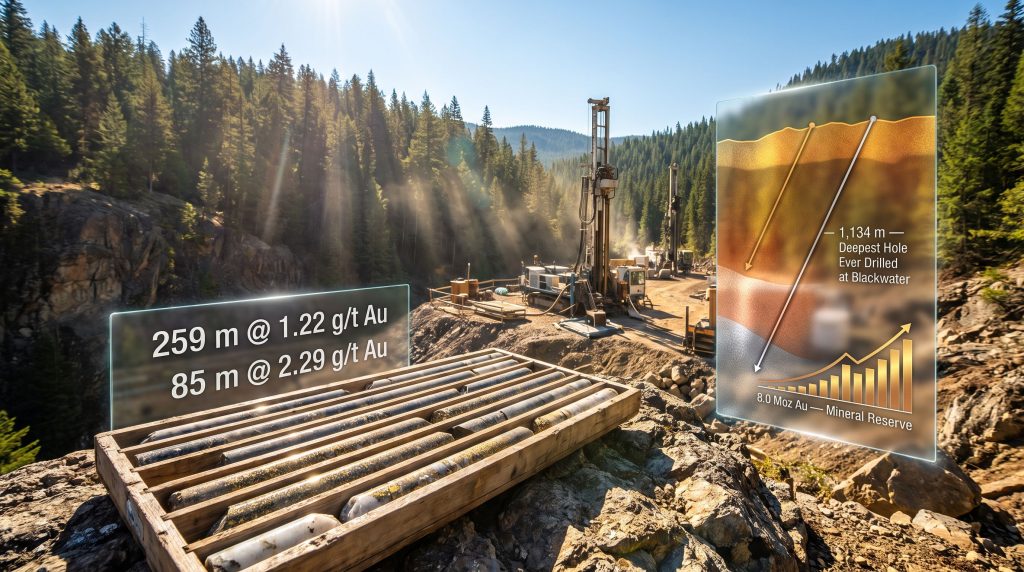
The primary intercept was 259 metres at 1.22 g/t gold from 309 metres downhole. Nested within that interval was a high-grade sub-zone of 85 metres at 2.29 g/t gold from 371 metres. For context, Blackwater's existing reserve grade is 0.75 g/t gold, meaning these deep intercepts come in at grades materially above the current mining cut-off.
From 309 metres to the end of hole, the geological log describes continuous mineralisation associated primarily with felsic volcanics and andesites, the same lithological package that hosts the main Blackwater orebody. This consistency is geologically meaningful. It suggests that the deep extension is not a separate, anomalous zone, but a continuation of the same system that has already proven itself at the surface. Analysing gold drilling results in this geological context is essential for understanding what the intercepts actually represent.
Alteration and Sulphide Signatures: Reading the Mineralising System
The alteration assemblage identified in BWDD-26-0001 includes quartz-sericite alteration that becomes locally intense in the higher-grade zones. This style of alteration is a well-recognised pathfinder in volcanic-hosted gold systems, indicating that hydrothermal fluids rich enough in gold-transporting compounds to cause pervasive wall-rock alteration passed through these zones repeatedly.
The sulphide assemblage is notably diverse: pyrite, sphalerite, pyrrhotite, galena, and chalcopyrite are all present. This polymetallic signature is not simply a curiosity. It indicates a hydrothermal system of sufficient temperature, pressure, and chemical complexity to precipitate a range of ore-forming minerals simultaneously, which is characteristic of large, long-lived mineralising events rather than brief, localised fluid pulses.
A high-silver zone was also intersected near surface within the existing reserve pit shell, adding near-term resource optionality. Furthermore, from 736 metres downward, elevated silver and base metal values add a new dimension to the economic profile of the deep system.
Second Reported Drill Hole: BWDD-26-0003 and the Deepest Penetration at Blackwater
A New Depth Record for the Property
BWDD-26-0002 was terminated due to technical drilling complications and was subsequently redrilled as BWDD-26-0003. The redrilled hole reached a total depth of 1,134 metres, establishing it as the deepest drill hole ever completed on the Blackwater property. Mineralisation was confirmed from the bedrock surface all the way down to 1,016 metres, an almost uninterrupted column of gold-bearing rock more than a kilometre tall.
| Drill Hole | Total Depth | Primary Intercept | High-Grade Sub-Interval | Notable Deep Zone |
|---|---|---|---|---|
| BWDD-26-0001 | 913 m | 259 m @ 1.22 g/t Au (from 309 m) | 85 m @ 2.29 g/t Au (from 371 m) | Elevated Ag + base metals from 736 m |
| BWDD-26-0003 | 1,134 m | 191 m @ 0.95 g/t Au (from 163 m) | 93 m @ 1.33 g/t Au (from 228 m) | 16 m @ 25.6 g/t Ag, 0.22% Cu, 0.41 g/t Au (from 1,000 m) |
The Geological Transition at Depth
Between 386 metres and 963 metres, the mineralised zones in BWDD-26-0003 were geologically similar in character to those encountered in BWDD-26-0001, with elevated gold, silver, and zinc throughout. Then, at 1,101 metres, a sharp contact with an intrusive granodiorite was encountered. The hole was stopped just 32 metres into this intrusive body, meaning the nature of mineralisation immediately below and adjacent to this contact is entirely unknown.
The deep intercept between 1,000 and 1,016 metres averaged 25.6 g/t silver, 0.22% copper, and 0.41 g/t gold over 16 metres. The combination of elevated silver, copper, and gold at this depth may indicate proximity to a heat source or fluid conduit, a common feature at the margins of intrusive contacts in porphyry and related gold-silver systems.
In disseminated gold deposits of this scale, broad and consistent mineralisation through volcanic host rocks often signals a bulk-tonnage system of genuine depth. The appearance of copper enrichment near an intrusive contact introduces the possibility of a porphyry-style overprint at depth, which would represent a qualitative change in the system's character rather than simply more of the same.
The Polymetallic Question: Is Zinc an Undervalued Asset at Blackwater?
Both of the first two holes returned elevated zinc values within the main mineralised zones, and the processing plant at Blackwater currently generates no revenue from zinc. This is a not-uncommon situation at polymetallic mines, where the primary circuit is designed around the dominant metal and by-products with more complex metallurgy are either sold as concentrates or discarded in tailings.
Artemis has initiated metallurgical testwork specifically to evaluate whether a zinc recovery circuit could be engineered into the existing processing infrastructure or added as a downstream step. The economics of this question are worth understanding carefully:
- Zinc recovery would require either a flotation circuit capable of separating zinc sulphides or a modification to the existing process route
- The capital cost of adding zinc recovery at a large-scale operation is not trivial, but it could be justified if zinc grades and tonnage are sufficient
- By-product credits reduce a mine's all-in sustaining cost (AISC), which directly improves margins at any given gold price
- Copper, which appears in elevated concentrations at depth in BWDD-26-0003, may also become a future by-product consideration as the deeper resource is better characterised
The current Blackwater model already incorporates silver as a by-product. In addition, adding zinc and potentially copper would shift the project's economic profile meaningfully and could make lower-grade mineralisation economically viable that would not otherwise meet the cut-off.
The next major ASX story will hit our subscribers first
Comparing 2026 Deep Drilling to Blackwater's Historical Record
A Different Depth Range Entirely
Earlier grade-control drilling at Blackwater, including programs that supported mine sequencing decisions, returned some visually striking intercepts. Historical results from near-surface work included intervals such as 12 metres at 17.5 g/t gold and 45 metres at 5.6 g/t gold, which reflect the high-grade pockets that characterise the shallow portions of the deposit and were used to optimise the early mining sequence.
The 2026 program, however, operates in an entirely different vertical domain. These holes are not testing the same ground as prior programs. They are probing geological territory that had never been penetrated before, which means every result from this program is genuinely new information about the extent of the Blackwater system.
The fact that both initial holes returned intervals grading above the current reserve benchmark at depths beyond 900 metres suggests that Blackwater's grade profile does not deteriorate sharply with depth, at least not within the range tested so far. This is atypical. Many large open-pit gold deposits show a progressive grade decline below the optimal pit shell, which is what limits their economic depth. Blackwater's apparent grade persistence challenges that assumption.
True Width Considerations: The Technical Caveat Every Investor Should Understand
Artemis has disclosed clearly that the orientation of mineralised zones at depth has not yet been determined, which means true widths cannot currently be calculated. Drill intercept widths are the lengths measured along the core, which may overstate or understate the actual thickness of the mineralised body depending on the angle at which the hole intersected the zone. Understanding true widths vs apparent widths is consequently one of the most important concepts for investors evaluating these intercepts.
In disseminated deposits like Blackwater, where gold is spread broadly through the host rock rather than confined to narrow, steeply dipping veins, the discrepancy between drill width and true width is typically modest. The company has noted that drill widths are not expected to be materially higher than true widths, but this must be confirmed as the geometry of the deep mineralised zones becomes better understood through additional holes from different orientations.
For investors assessing resource expansion potential, this distinction matters. A 259-metre intercept in a steeply dipping vein system might represent only a few tens of metres of true width. In a flat-lying or gently dipping disseminated system, that same 259 metres could genuinely reflect 200+ metres of bulk ore, which would represent an enormous addition to the resource model.
Regional Exploration: A District-Scale Opportunity Beyond the Pit
The Broader Land Package
A parallel regional exploration program launched in October 2025 adds a second dimension to the growth story. This program targets prospective areas across Artemis's broader tenement holdings, with a planned scope of 15,000 to 25,000 metres across up to 150 drill holes testing more than 30 identified targets.
The strategic logic here is compelling. Each of these targets sits within trucking distance of the existing Blackwater processing facility. This matters because the capital cost of establishing a new gold mine is dominated by processing infrastructure. Satellite deposits that can feed an already-built mill represent a fundamentally different economic proposition than standalone discoveries that would require their own processing plants.
By the end of Q2 2026, 33 holes totalling approximately 5,100 metres had been completed across six targets in the Top Lake and Van Tine areas, with drilling having subsequently resumed. Results from this work are pending.
Why District-Scale Exploration Changes the Investment Thesis
A mine that also functions as a platform for regional discovery offers investors two distinct value creation pathways simultaneously:
- Near-term cash flow from the operating mine, which funds ongoing exploration without requiring equity dilution
- Long-term resource optionality from both deposit extension and regional satellite discovery
This dual structure is relatively rare among mid-tier gold producers and creates a compounding dynamic where operational success funds the very exploration that could materially increase the project's long-term mine life. For context, a definitive feasibility study for any satellite discovery would benefit enormously from the existing processing infrastructure already in place at Blackwater.
Key Catalysts and Questions for the Months Ahead
What to Monitor
With only the first two holes of a 25,000-metre program reported, the pipeline of forthcoming results is substantial. Investors and analysts following the Artemis Gold Blackwater mine drill results story should monitor the following:
- Additional assay releases from the 2026 expansion program, which will progressively define the geometry and grade continuity of the deep zones
- The Mineral Reserve update planned for later in 2026, which will be the first formal test of whether expansion drilling translates into a larger stated reserve
- Metallurgical testwork outcomes for zinc recovery, which could materially alter the project's cost structure
- Regional exploration results from Top Lake and Van Tine, which may introduce entirely new discovery potential into the conversation
- Any indication of mineralisation behaviour below the granodiorite contact encountered at 1,101 metres in BWDD-26-0003
Critical Open Questions
- Does gold mineralisation continue beyond the intrusive contact at depth, or does the granodiorite represent a geological boundary to the system?
- Can the high-grade sub-intervals in both holes be connected laterally, and how does their strike orientation affect the geometry of a future underground resource?
- What does the copper-silver enrichment at 1,000 metres indicate about the nature of the fluid system at depth?
- Will zinc metallurgy prove viable at the grades and volumes intersected, and how would a zinc recovery circuit affect the AISC profile?
Frequently Asked Questions: Artemis Gold Blackwater Drill Results
What were the key intercepts from the first two holes of the 2026 program?
BWDD-26-0001 returned 259 metres at 1.22 g/t gold from 309 metres depth, including a high-grade sub-interval of 85 metres at 2.29 g/t gold. BWDD-26-0003 intersected 191 metres at 0.95 g/t gold from 163 metres, with a 93-metre zone at 1.33 g/t gold within that.
How deep has the Blackwater deposit now been confirmed?
Mineralisation has been confirmed to a vertical depth of at least 1,016 metres in BWDD-26-0003, which reached a total drilled depth of 1,134 metres, making it the deepest hole ever completed on the property.
What is Blackwater's current stated gold reserve?
The project holds a Mineral Reserve of 334.3 million tonnes at 0.75 g/t gold for 8.0 million ounces, within a broader Measured and Indicated resource of 596.8 million tonnes at 0.61 g/t gold for 11.7 million ounces.
Is Blackwater currently in production?
Yes. Commercial production was declared on May 1, 2025, following the first gold and silver pour achieved in January 2025.
What other metals does Blackwater produce or could produce?
Silver is currently recovered as a by-product. Metallurgical testwork is underway to evaluate the potential for zinc recovery. Deep drilling has also identified elevated copper values, which could eventually become a third by-product stream depending on the outcome of further technical work.
How large is the total 2026 drilling effort?
The resource expansion component plans approximately 25,000 metres of diamond drilling at an initial budget of $10 million. A separate regional program targets 15,000 to 25,000 metres in up to 150 holes across more than 30 identified targets. Investors seeking broader context on how programs of this scale are evaluated can refer to the British Columbia Ministry of Energy and Mines for regulatory and geological background, or consult the World Gold Council for industry benchmarks on large-scale gold deposit development.
This article is intended for general informational purposes only and does not constitute financial advice or a solicitation to buy or sell securities. Mining exploration and resource expansion programs involve inherent risks and uncertainties. Forward-looking statements, including projections about resource growth, mineral recovery, and future reserve updates, are subject to material risks that could cause actual outcomes to differ significantly from those anticipated. Readers should conduct their own due diligence and consult a qualified financial adviser before making investment decisions.
Want to Know When the Next Major ASX Mineral Discovery Hits the Market?
Discovery Alert's proprietary Discovery IQ model scans ASX announcements in real time, instantly identifying significant mineral discoveries and turning complex geological data into actionable investment insights — the kind of deep-system analysis that separates informed investors from those reacting to headlines. Explore historic discoveries and the substantial returns they have generated, then begin your 14-day free trial at Discovery Alert to position yourself ahead of the broader market.