
July 16, 2026
Seasonal Calendars, Structural Headwinds, and the Asian Scrap Price Cycle
Every commodity market carries within it a rhythm shaped by geography, climate, and industrial habit. For ferrous scrap traded across Asia, that rhythm produces one of the most consistently weak demand windows of the year during the northern hemisphere summer. Monsoon rains, summer electricity rationing, maintenance shutdowns at electric arc furnace mills, and regional public holidays do not arrive independently. They converge simultaneously across multiple import markets, compressing procurement activity just as seaborne supply pipelines remain well stocked from cargoes contracted weeks earlier.
The result is a predictable but powerful seasonal trough that commodity analysts and steel market participants have come to expect. What makes July 2026 particularly instructive is that this seasonal softening has been amplified by a set of structural and geopolitical forces that extend well beyond the calendar. Understanding how these layers interact is essential for anyone tracking Asian ferrous scrap prices through the second half of the year.
When big ASX news breaks, our subscribers know first
What Is Happening to Asian Ferrous Scrap Prices in July 2026?
A Regional Price Snapshot
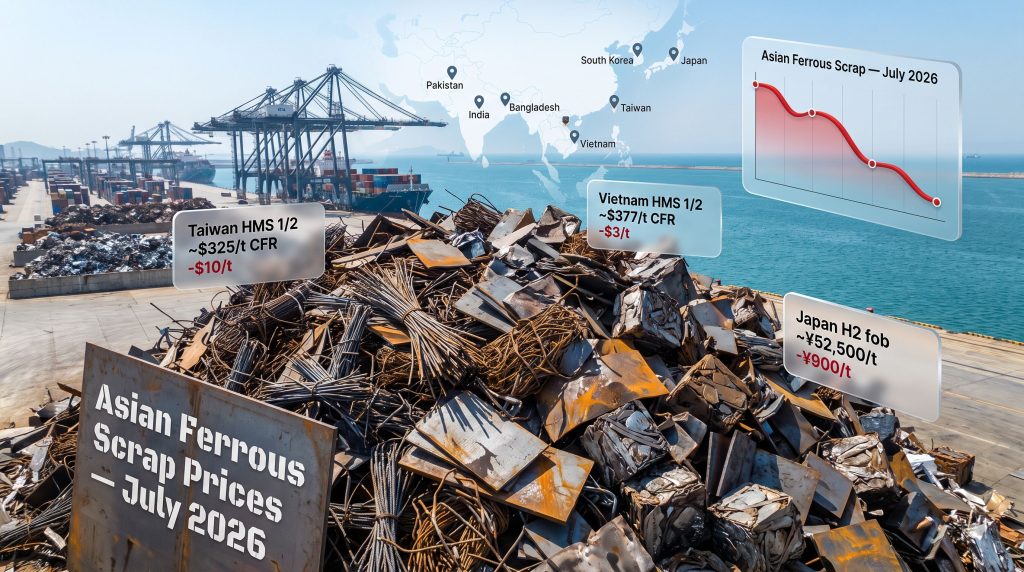
Across every major Asian import destination, ferrous scrap benchmarks have softened during the first half of July 2026. The degree of correction varies by market, but the directional signal is consistent. The table below captures the key price levels and month-on-month movements as reported by Argus Media.
| Import Market | Grade/Specification | Price Level (July 2026) | Month-on-Month Change |
|---|---|---|---|
| Taiwan | HMS 1/2 80:20 CFR containerised | ~$325/t CFR | -$10/t |
| Vietnam | HMS 1/2 80:20 CFR | ~$377/t CFR | -$3/t |
| Vietnam | Japanese H2 CFR | $362-365/t CFR | -$5/t |
| India | Shredded scrap CFR Nhava Sheva | $360-365/t CFR (offers) | Bids $5-10/t below offers |
| Pakistan | UK/EU shredded scrap CFR Qasim | ~$371/t CFR | -$1/t |
| Bangladesh | UK/EU shredded scrap CFR Chattogram | ~$365/t CFR | -$1/t |
| China (East) | Heavy melt scrap >6mm ex-VAT del | Yn2,177/t (~$320/t) | -Yn36/t (-$5.32/t) |
| Japan (export) | H2 fob Japan | ~¥52,500/t | -¥900/t |
Taiwan has registered the sharpest correction in percentage terms, with containerised HMS 1/2 80:20 CFR prices falling $10/t to approximately $325/t by 15 July, according to Argus data. To contextualise that decline, Taiwan's domestic rebar price had reached a two-year high of NT$18,500/t in the week of 18–22 May 2026, before retreating sharply to NT$17,000/t by mid-July as downstream demand deteriorated. This rebar price trajectory matters because it serves as a leading indicator of mill profitability and, by extension, willingness to procure raw materials.
In Vietnam, some domestic scrap benchmarks have touched levels not recorded since early 2021, highlighting the depth of the current demand pullback relative to recent history. Japan's Kanto export tender, one of the most closely watched leading indicators for regional price direction, declined by ¥1,998/t ($12.32/t) to ¥52,508/t fas during the same period. For a broader perspective on how global commodity tariffs are shaping the broader trading environment for industrial materials, including ferrous scrap, this context is increasingly relevant.
Market-by-Market Analysis: Why Asian Ferrous Scrap Prices Ease Further in July
Taiwan: Electricity Rationing and Demand Deterioration
Taiwan's ferrous scrap market operates under a constraint that is unique in the regional context. Each year, from approximately May through October, the Taiwanese grid authority imposes electricity rationing measures to manage peak summer demand. For electric arc furnace steelmakers, which are entirely dependent on electrical power to melt scrap, this creates a direct and measurable production ceiling. Mills typically reduce output by 20 to 30 percent during this period to manage rising energy costs, and that reduction flows immediately into contracted scrap procurement volumes.
The interaction between energy restrictions and the broader demand environment has proven particularly damaging in mid-2026. After benefiting from rising imported scrap prices tied to US-Iran conflict-related energy cost inflation earlier in the year, Taiwanese mills found themselves caught between elevated input costs and a sharp reversal in finished steel prices. With rebar falling from its May peak and energy restrictions constraining production, buying appetite for seaborne scrap contracted significantly.
Vietnam: Monsoon Procurement Behaviour and the Hand-to-Mouth Dynamic
Vietnamese steelmakers represent one of the most significant seaborne scrap import destinations in Southeast Asia, but their procurement behaviour changes markedly during the June-to-August monsoon period. Reduced construction activity across the country directly suppresses demand for steel rebar and structural products, which in turn reduces the urgency for mills to maintain forward scrap inventory positions.
A critical but less widely understood dynamic in this market is the strategic prioritisation of domestic scrap sourcing during periods of weak demand. Vietnamese mills actively shift their raw material mix toward locally generated scrap when seaborne prices create unfavourable landed cost economics relative to steel selling prices. This substitution effect reduces effective import demand without any formal policy change, creating a soft market floor that can persist for weeks.
The hand-to-mouth purchasing strategy that Vietnamese mills adopt during the monsoon season is not simply a response to uncertainty. It reflects a deliberate working capital management approach: mills limit forward cargo commitments to avoid holding high-cost inventory in a falling price environment, relying instead on ample arrivals of previously booked cargoes to cover near-term production requirements.
Japan: Export Tender Mechanics and the Half-Month Divergence
Japan occupies a structurally distinct position in the Asian ferrous scrap system. As the dominant seaborne scrap exporter in the Asia-Pacific region, Japan's domestic consumption patterns and export tender outcomes effectively set the price floor for the broader regional market. The Kanto export tender, which aggregates offers from steel mills in the greater Tokyo industrial region, is particularly closely monitored as a forward-pricing signal.
The July 2026 tender's decline of ¥1,998/t cascaded directly into the Argus H2 fob Japan assessment, which fell by ¥900/t to approximately ¥52,500/t. The softening reflects two simultaneous forces: subdued overseas buying interest during the regional rainy season, and reduced domestic EAF consumption as mills enter summer maintenance schedules.
What is particularly noteworthy is the intra-month divergence that emerged in July. While first-half export offers weakened in line with the tender outcome, second-half Japanese export offer levels recovered to approximately $269/t, representing a gain of around $24/t from the early July lows. This partial reversal suggests that Japanese exporters may have found a floor in the short term, though whether this signals the beginning of a broader regional price recovery remains contested. Furthermore, world scrap prices more broadly have continued to stagnate heading into mid-year, reinforcing the cautious regional outlook.
South Asia: Holiday Disruptions, Monsoon Logistics, and Bid-Offer Spreads
India, Pakistan, and Bangladesh present a slightly different demand dynamic than East and Southeast Asian markets, but the directional pressure on Asian ferrous scrap prices has been consistent across all three.
In Pakistan, the Muharram holiday period compounds the logistical disruptions already created by monsoon season, effectively reducing the number of active buying days in July and suppressing import transaction volumes. The practical effect on price discovery is significant: with fewer active buyers in the market, sellers face downward pressure even when underlying fundamentals do not fully justify the discounts being offered.
India's scrap import market is displaying a textbook illiquidity signal. Seller offers for shredded scrap CFR Nhava Sheva are sitting at approximately $360–365/t, while buyer bids remain $5–10/t below those levels. A persistent bid-offer spread of this magnitude is not simply a price negotiation. It reflects a fundamental disagreement between buyers and sellers about near-term price direction, with buyers adopting a wait-and-see posture that prevents transaction volumes from normalising.
Bangladesh's price movement has been more contained, with UK and EU-origin shredded scrap CFR Chattogram declining by only $1/t to approximately $365/t, but the directional alignment with India and Pakistan underlines the regional synchronisation of demand weakness across South Asian import markets.
China: EAF Margin Compression and Early Stabilisation
China's domestic ferrous scrap market operates largely independently of the seaborne trade, given the country's structural preference for domestically generated material over imported cargoes. However, Chinese EAF production rates exert an indirect influence on regional scrap availability and pricing dynamics. The China steel market outlook remains a critical variable in understanding how domestic production constraints reverberate across Asian scrap benchmarks.
During the first half of July 2026, the Argus heavy melt scrap assessment for East China fell by Yn36/t ($5.32/t) to Yn2,177/t, reflecting negative EAF operating margins driven by weak finished steel demand and widespread wet weather suppressing construction activity. Production curtailments at Chinese EAF mills reduced domestic scrap consumption, which in theory could have freed up additional material for export markets. In practice, this offset was limited, as China's scrap export market remains structurally constrained.
An important signal emerged in mid-July: as Chinese steel prices began to recover, a subset of mills with depleted scrap inventories moved to rebuild their stock positions. This restocking impulse, while modest, was noted as an early stabilisation indicator and may prove relevant to broader regional price direction if it gathers momentum through late July and August.
The Structural Forces Amplifying the Correction
Cargo Pipeline Overhang: Why Prices Stay Depressed Longer Than Expected
One of the least visible but most operationally significant factors in Asian seaborne scrap markets is the cargo pipeline. When mills are active buyers, they typically contract cargoes weeks in advance of delivery. When demand then softens rapidly, as it has during July 2026, these previously contracted cargoes continue to arrive at port, creating a temporary supply glut that delays the need for fresh procurement orders.
This pipeline effect explains why scrap price corrections in Asian import markets often persist for longer than the initial demand shock would suggest. Even after the underlying fundamentals stabilise, mills simply do not need to buy until port inventories are drawn down. In Vietnam particularly, ample arrivals of pre-booked cargoes have reinforced the hand-to-mouth procurement posture that mills have adopted during the monsoon period.
Currency Effects on Landed Scrap Economics
Currency movements add a layer of complexity to headline CFR price assessments that is often underappreciated by market observers. The competitiveness of Japanese-origin scrap relative to US or European material is partly determined by the trajectory of the Japanese yen. A weaker yen, all else equal, makes Japanese-origin material more attractive on a landed cost basis for buyers in Taiwan, Vietnam, and Korea, while simultaneously reducing yen-denominated export revenue per tonne.
For South Asian buyers, local currency movements against the US dollar directly affect the landed cost in domestic currency terms, influencing mill procurement decisions in ways that are not captured by headline CFR figures alone. Periods of local currency weakness can effectively raise the domestic cost of imported scrap even when CFR prices are flat or declining, further suppressing buying appetite. This dynamic is one of several drivers of commodity market volatility that market participants must account for when assessing risk exposure.
The Geopolitical Variable: US-Iran Conflict and Energy Cost Dynamics
The US-Iran military conflict that unfolded in the first half of 2026 introduced an energy cost inflation premium into scrap prices across the region. Higher crude oil prices flowed through into shipping costs, electricity tariffs, and general industrial production costs, providing a supporting floor for ferrous scrap benchmarks even as seasonal demand weakened. The US-China trade war has, in addition, contributed to broader supply chain uncertainty that continues to influence procurement decisions across Asia.
The interim ceasefire agreement reached in mid-June 2026 partially unwound that geopolitical risk premium. US inflation data for June 2026, as reported by the Bureau of Labor Statistics, showed the energy price index easing to an annual rate of 15.7 percent from 23.5 percent in May, following the partial reopening of the Strait of Hormuz. This normalisation removed a key support factor from scrap prices at precisely the moment when seasonal demand was also weakening.
Critically, fighting resumed in subsequent weeks and crude prices moved sharply higher again. This renewed escalation reintroduces the energy cost and supply chain uncertainty factors that could support scrap price floors through the second half of July and into August. The geopolitical variable in this market cycle is therefore genuinely two-directional, capable of accelerating either a price recovery or a further correction depending on how the conflict trajectory evolves.
The convergence of seasonal demand weakness, a post-ceasefire unwinding of geopolitical risk premiums, Chinese export market pressure, and seaborne cargo pipeline overhangs has produced the current multi-market price correction. No single factor is sufficient to explain the depth or breadth of the move.
How the Asian Seaborne Scrap Trade System Works
Grade Specifications and Why They Matter
Understanding which grades dominate Asian import markets is foundational to interpreting price signals correctly. The three most widely referenced ferrous scrap grades in seaborne Asian trade are:
- HMS 1/2 (Heavy Melt Scrap) in an 80:20 blend ratio: A combination of heavier gauge (HMS 1) and lighter gauge (HMS 2) ferrous scrap, priced on a CFR basis for containerised or bulk shipments.
- Japanese H2 grade: A Japanese-origin specification with well-defined thickness and composition requirements, highly valued by Asian EAF mills for its consistency and relatively high metallic content.
- Shredded scrap: Processed through industrial shredders to produce high-density, homogeneous ferrous material with predictable chemical composition, particularly favoured in South Asian markets.
Each grade carries different pricing premiums depending on metallic content, residual tramp element levels, origin, and the specific furnace chemistry requirements of the importing mill. Japanese H2 typically commands a premium over HMS 1/2 in Asian markets due to its cleaner metallurgical profile and consistent sizing. For further context on how these benchmarks fit within the global crude steel outlook, the relationship between scrap grade premiums and finished steel production economics is particularly instructive.
Japan's Structural Export Role
Japan generates large volumes of obsolete ferrous scrap from its mature industrial and consumer economy, including end-of-life vehicles, appliances, and construction demolition material. With domestic EAF steelmaking capacity unable to absorb all available generation, Japan has historically been a net exporter of ferrous scrap to the broader Asia-Pacific region. This structural export role makes Japanese export tender outcomes and fob price movements among the most important leading indicators for the entire regional market. Independent ferrous scrap market data from specialist price reporting agencies provides additional granularity on these grade-level dynamics.
Competing Origins: Atlantic Basin vs. Pacific Basin
South Asian buyers in India, Pakistan, and Bangladesh occupy a geographic position that allows them to source from both Atlantic-basin origins (US, UK, continental Europe) and Pacific-basin origins (Japan, Australia). This geographic flexibility creates a natural competitive tension between origin regions that helps establish efficient price discovery in these markets. When Atlantic-basin shredded scrap prices are competitive on a freight-adjusted landed cost basis, they can displace Japanese-origin material and vice versa, providing South Asian mills with structural optionality that East and Southeast Asian buyers do not have to the same degree.
Scenarios for Q3 2026: What Happens Next?
The near-term trajectory for Asian ferrous scrap prices will be shaped by how three key variables resolve over the coming six to eight weeks.
Scenario 1: Seasonal Base Case Recovery
- Monsoon season concludes across South and Southeast Asia in September–October, historically triggering a construction rebound.
- EAF mills in Taiwan, Japan, and Vietnam resume normal operating rates following summer maintenance.
- Port inventories normalise, triggering a fresh round of seaborne procurement as mills rebuild working stocks.
- Prices stabilise and trend modestly higher through Q3.
Scenario 2: Prolonged Bear Case
- Chinese finished steel exports remain elevated, continuing to suppress regional steel prices and compress EAF margins in Taiwan and South Korea.
- Cargo pipeline overhangs persist beyond the monsoon season, delaying procurement normalisation.
- Weak global construction demand and elevated real interest rates suppress end-use steel consumption in key markets.
- Prices remain range-bound or drift lower through August and September.
Scenario 3: Geopolitical Bull Case
- Renewed escalation in the US-Iran conflict drives energy costs sharply higher, restoring a cost-push support floor under scrap prices.
- Shipping route disruptions reduce effective seaborne scrap availability faster than seasonal demand recovery alone would tighten the market.
- The late-July recovery in Japanese export offer levels proves to be a genuine leading indicator of broader regional price firming.
Key Indicators to Monitor Through Q3 2026
| Indicator | Why It Matters | Monitoring Frequency |
|---|---|---|
| Japan Kanto Export Tender | Primary leading benchmark for Asian scrap price direction | Monthly |
| Taiwan HMS 1/2 CFR containerised | East Asian import demand signal | Weekly |
| Vietnam HMS 1/2 CFR | Southeast Asian mill procurement barometer | Weekly |
| China EAF utilisation rates | Domestic scrap consumption and finished steel output signal | Weekly |
| India shredded scrap bid-offer spread | South Asian buyer confidence and market liquidity measure | Weekly |
| Japanese H2 fob Japan | Japanese export competitiveness vs. Atlantic-basin origins | Weekly |
| Crude oil price trajectory | Geopolitical risk premium and energy cost signal | Daily |
The next major ASX story will hit our subscribers first
FAQ: Asian Ferrous Scrap Prices in July 2026
Why are Asian ferrous scrap prices easing further in July 2026?
The price softening reflects a combination of seasonal forces including monsoon rains across South and Southeast Asia, summer electricity restrictions reducing EAF output in Taiwan by 20–30 percent, and maintenance shutdowns at Japanese mills. These seasonal factors have been compounded by elevated Chinese finished steel export volumes suppressing regional steel prices, cargo pipeline overhangs delaying fresh procurement, and the partial unwinding of geopolitical risk premiums following the US-Iran ceasefire in mid-June.
Which market has experienced the steepest scrap price decline?
Taiwan recorded the largest absolute decline, with containerised HMS 1/2 80:20 CFR prices falling approximately $10/t to around $325/t during the first half of July. Vietnam has experienced some of the most notable benchmark levels in years, with certain domestic scrap price assessments touching multi-year lows not seen since early 2021.
Is the Japanese scrap market diverging from the broader Asian trend?
Japan's market softened in the first half of July, consistent with the regional trend, but second-half export offer levels recovered to approximately $269/t, around $24/t above the early July lows. This intra-month divergence warrants monitoring as a potential early indicator of broader regional price stabilisation. Consequently, Asian steel scrap prices may continue to face limited support in Q3 as tepid demand and export challenges weigh on sentiment.
What does hand-to-mouth purchasing mean in the scrap market context?
Hand-to-mouth purchasing refers to a procurement strategy where mills buy only what they need for immediate production requirements rather than building forward inventory positions. In the context of Vietnam's monsoon season, this approach allows mills to avoid holding high-cost scrap inventory during a period of falling prices and weak steel demand, while ample arrivals of previously contracted cargoes ensure continuity of supply.
What is the outlook for Asian ferrous scrap prices through Q3 2026?
The consensus view points toward range-bound conditions with a modest upward bias as seasonal demand normalises post-monsoon. However, a sustained recovery requires improvement in finished steel demand, reduction in Chinese export volumes, and normalisation of EAF operating rates. Renewed geopolitical escalation in the Middle East represents the primary upside risk to this base case outlook.
Disclaimer: This article contains forward-looking scenarios and price trajectory assessments that are based on publicly available market data and analytical frameworks. These projections involve inherent uncertainty and should not be construed as investment advice. Commodity markets are subject to rapid change, and readers should conduct independent due diligence before making any commercial or financial decisions based on the information contained herein.
Ready to Capitalise on the Next Major Commodity Discovery Before the Broader Market?
While ferrous scrap price cycles and seasonal demand troughs reward those who track industrial signals closely, the most transformative returns in commodities often come from being first to act on a significant mineral discovery — and Discovery Alert's proprietary Discovery IQ model delivers real-time ASX discovery alerts the moment they are announced, turning complex geological data into clear, actionable insights. Explore how historic discoveries have generated substantial market returns on Discovery Alert's dedicated discoveries page, then begin a 14-day free trial to ensure the next major find never catches you off guard.