May 13, 2026
The Hidden Architecture of Asia's LPG Dependency
Energy security conversations in Asia tend to focus on crude oil and natural gas. Yet for hundreds of millions of households across the Indo-Pacific, liquefied petroleum gas is the fuel that actually lights the stove every morning. It is the energy commodity that sits closest to daily life, closest to food preparation, and closest to household budgets. Asian LPG demand and Hormuz disruption are, for most of the region, inseparably linked through a single, narrow corridor at the entrance to the Persian Gulf.
The Strait of Hormuz, at its narrowest point roughly 33 kilometres wide, functions as the circulatory valve for a substantial portion of the world's traded LPG. When that valve is impaired, the consequences do not stay neatly contained within commodity trading floors or energy ministry briefing rooms. They ripple outward into homes, factories, petrochemical plants, and food markets across an entire hemisphere.
Understanding why Asian LPG demand and Hormuz disruption are so fundamentally intertwined requires looking beyond the current crisis and examining the structural choices made across decades of energy procurement that prioritised cost efficiency over supply resilience. Furthermore, broader oil and gas supply dynamics compound the region's vulnerability in ways that are rarely discussed alongside LPG-specific analysis.
When big ASX news breaks, our subscribers know first
The Strait of Hormuz as a Global LPG Chokepoint
Why a Single Waterway Controls Asia's Cooking Fuel Supply
The geography of global LPG production is not evenly distributed. The Persian Gulf states, particularly Saudi Arabia, the United Arab Emirates, Kuwait, and Qatar, collectively represent one of the most concentrated zones of hydrocarbon extraction on earth. As associated gas from oilfields and natural gas liquids processing facilities, LPG production in the Gulf is vast, consistent, and cost-competitive.
For Asian buyers, particularly those in South and Southeast Asia, proximity and economics made Gulf-sourced LPG the default procurement strategy across the 1980s, 1990s, and 2000s. Shorter voyage distances meant lower freight costs. Established supply relationships with national oil companies created long-term contracting certainty. The Saudi Aramco Contract Price, known universally in the industry as the Saudi CP, became the reference benchmark against which virtually all Asian LPG cargoes were priced.
This created a system that was highly efficient under stable geopolitical conditions and deeply fragile under stress.
The Concentration Problem
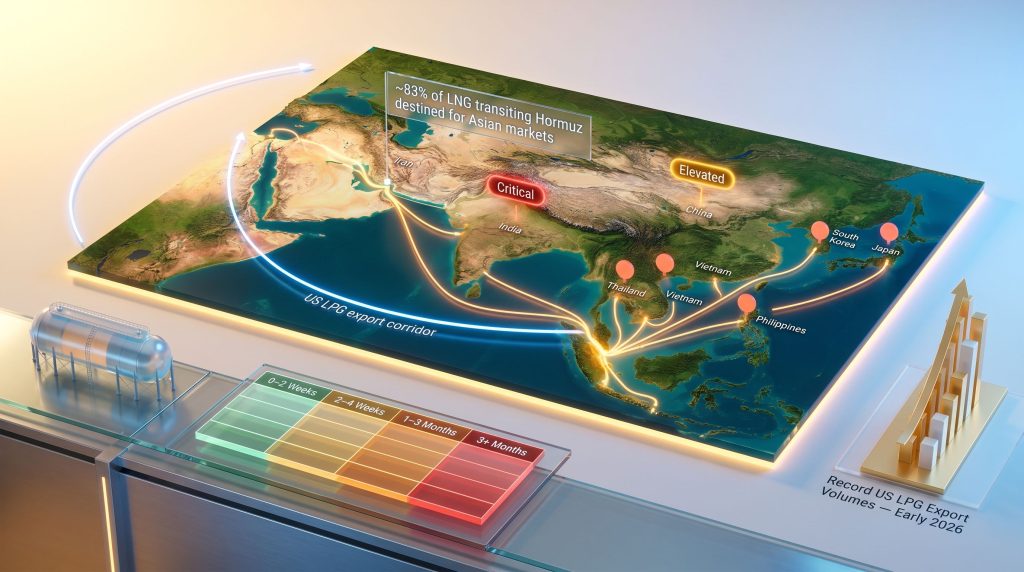
Approximately 84% of crude oil transiting the Strait of Hormuz and an estimated 83% of LNG moving through the waterway is destined for Asian markets. For LPG specifically, the strait serves as the primary export corridor connecting Gulf producers to their largest customer base. No alternative export route exists at sufficient scale to compensate for Hormuz closure in the short term.
The absence of redundancy is not an accident. It reflects decades of rational procurement decisions by individual buyers, each optimising for their own cost structures, without a coordinating framework to manage collective supply risk. The result is a region-wide dependency that no single national energy policy could easily have prevented, but which coordinated regional frameworks might have mitigated. Asian energy import pressures have, however, been building steadily even before the current disruption period.
What Does a Hormuz Closure Actually Mean for Asian LPG Markets?
From Price Volatility to Physical Shortage: The Two-Stage Disruption Model
Market disruptions in commodity markets typically progress through two distinct phases. The first is financial, characterised by spot price spikes, freight rate surges, and speculative positioning as traders respond to perceived scarcity. The second is physical, where actual cargo availability tightens, buyers cannot secure replacement volumes at any price, and consumption must adjust downward.
For LPG, the transition from financial to physical disruption occurs faster than in crude oil markets, partly because LPG storage infrastructure in most Asian countries is considerably less developed than crude oil tank capacity. LNG supply trends illustrate a comparable pattern of infrastructure vulnerability across the broader gas complex.
The table below illustrates how disruption duration shapes the progression of market impacts:
| Disruption Duration | Primary Impact | Secondary Impact | Market Response |
|---|---|---|---|
| 0 to 2 Weeks | Spot price spike | Freight rate surge | Emergency inventory drawdown |
| 2 to 4 Weeks | Supply tightness | Demand rationing begins | US barrel substitution accelerates |
| 1 to 3 Months | Physical shortages | Manufacturing disruption | Permanent trade route reconfiguration |
| 3+ Months | Structural supply gap | Power tariff increases | Long-term sourcing diversification |
The Critical Threshold: Why Disruptions Exceeding One Month Trigger Structural Shifts
Short-term disruptions, those lasting two weeks or less, can typically be absorbed through existing inventory buffers and spot market substitution without triggering behavioural changes at the buyer level. Beyond four weeks, however, procurement teams face decisions that extend beyond the immediate crisis. Long-term contracts must be renegotiated. Terminal infrastructure must be reconfigured to handle different cargo specifications. Freight relationships with non-Gulf shipping operators must be established.
These are not decisions that can be easily reversed once made. Once an Asian refiner or LPG importer establishes a sourcing relationship with a US exporter and invests in terminal modifications to accommodate different cargo compositions, that relationship tends to persist well beyond the initial crisis.
The displacement of established supply chains is not simply a temporary rerouting. Each month of sustained disruption increases the probability that new sourcing relationships will become permanent features of the market architecture.
India's LPG Crisis: The Anatomy of a Supply Shock
How India's Gulf Dependency Became Its Greatest Energy Vulnerability
India imports a substantial majority of its LPG requirements, with the Gulf region historically supplying the dominant share of those volumes. This dependency reflects both India's limited domestic LPG production capacity relative to population size and the economics that made Gulf sourcing the lowest-cost procurement option for state-owned energy companies managing politically sensitive retail fuel prices.
The political economy of LPG in India is distinct from most other Asian markets. Cooking gas subsidies have historically been central to household welfare policy, meaning that retail price increases carry significant social and political consequences. This political sensitivity constrained investment in supply diversification precisely because diversification would have required accepting higher average procurement costs.
Household-Level Consequences
When Gulf supply corridors are disrupted at scale, the household consequences in India manifest rapidly. Documented impacts during prolonged supply disruptions include:
- Cylinder prices surging to 2,500 to 3,000 rupees on informal markets, compared to subsidised official retail prices
- Emergency rationing protocols activated in major urban centres including Mumbai
- Documented shifts to firewood and kerosene as substitute fuels among lower-income households
- Associated health and environmental risks from indoor biomass combustion, including elevated respiratory disease burden
The return to biomass is not merely an economic inconvenience. It represents a reversal of decades of clean cooking progress and carries measurable public health costs that extend well beyond the duration of the supply disruption itself.
The PDH Margin Pressure Compounding India's Industrial LPG Exposure
Beyond household consumption, LPG disruption creates a secondary industrial pressure point through propane dehydrogenation, or PDH, facilities. These plants use propane as a feedstock to produce propylene, a critical petrochemical building block used in plastics, packaging, and automotive components. When LPG supply tightens and propane prices rise, PDH margins compress or turn negative, forcing plants to reduce utilisation rates or shut down entirely.
This adds an industrial production dimension to what might initially appear to be a purely household energy problem.
India's structural reliance on Middle Eastern LPG, built over decades of cost-optimised procurement, leaves virtually no short-term substitution pathway at scale. The shift to US barrels is viable in theory, but elevated freight costs and limited terminal infrastructure create a meaningful lag between policy intent and physical delivery.
China's Strategic Position: Inventory Buffers and PDH Vulnerabilities
How China's Strategic Buffer Differentiates Its Risk Profile
China enters the current disruption period in a fundamentally different position from India. Strategic LPG storage holdings are estimated to provide a buffer of roughly five to eight months of consumption, offering a meaningful window during which procurement strategy can be adjusted without triggering immediate physical shortages.
This storage depth did not emerge by accident. Following earlier periods of energy market volatility, Chinese state energy planners systematically invested in expanding strategic storage capacity across multiple commodity categories. The LPG buffer represents that longer-term risk management philosophy applied to a commodity that might otherwise be considered secondary to crude oil and natural gas.
PDH Sector Exposure
Despite its stronger buffer position, China is not insulated from disruption impacts. The country hosts one of the world's largest concentrations of PDH capacity, much of it built during a period when cheap Gulf propane made the economics of propane-to-propylene conversion highly attractive. According to reporting by Mysteel, geopolitical turmoil had already begun slashing China's LPG imports during the April to May period. When propane prices rise sharply due to supply disruption, those PDH margins come under severe pressure simultaneously across a large number of facilities, amplifying the economic impact of the supply shock well beyond the direct LPG market.
Comparing China and India's Adaptive Capacity
| Factor | China | India |
|---|---|---|
| Strategic Storage Depth | 5 to 8 months | Low |
| Gulf Import Dependency | High | Very High |
| PDH Sector Exposure | Very High | Moderate |
| US Barrel Substitution Capacity | Moderate | Limited short-term |
| Overall Crisis Resilience | Elevated | Critical |
Which Asian Economies Face the Greatest Exposure?
Risk Tiering: A Country-by-Country Vulnerability Assessment
The combination of import dependency, storage depth, and substitution capacity produces very different risk profiles across the Indo-Pacific region. The framework below illustrates the relative vulnerability of major Asian LPG consuming nations:
| Country | LPG Import Dependency | Strategic Storage Depth | Substitution Capacity | Overall Risk Tier |
|---|---|---|---|---|
| India | Very High | Low | Limited short-term | Critical |
| China | High | Moderate to High | Moderate | Elevated |
| Thailand | High | Low | Limited | High |
| South Korea | High | Moderate | Moderate | High |
| Philippines | High | Very Low | Very Limited | High |
| Vietnam | Moderate to High | Low | Limited | High |
| Australia | Moderate | Low | Moderate | Moderate to High |
| Japan | High | High (government reserves) | Moderate | Moderate |
Japan's relatively lower overall risk tier despite high import dependency reflects the country's government-mandated strategic energy reserve system, which provides a meaningful buffer comparable in concept to China's storage position, though administered through different institutional mechanisms.
Why Terminal Infrastructure Gaps Limit Rapid Diversification
One of the less-discussed constraints on diversification speed is the physical limitation of receiving terminal infrastructure across Southeast Asia. LPG import terminals are engineered to handle specific cargo sizes, pressures, and chemical specifications. US LPG cargoes, which often have different propane-butane composition ratios compared to Gulf cargoes, may require terminal modifications before they can be efficiently processed.
These modifications take time and capital investment. In the short term, they represent a genuine physical constraint on how quickly US supply can substitute for Middle Eastern volumes, even when the commercial motivation to diversify is strong.
The next major ASX story will hit our subscribers first
The US LPG Surge: Can American Exports Fill the Middle East Void?
Record US LPG Export Volumes and Their Constraints
American LPG export infrastructure, particularly the network of facilities along the US Gulf Coast, has expanded dramatically over the past decade, driven by the shale gas revolution and the associated growth in natural gas liquids production. Export terminal capacity that barely existed fifteen years ago now positions the United States as a major global LPG supplier.
However, capacity and utilisation are not the same thing. While US terminals have expanded, the logistics chain connecting American supply to Asian demand involves significantly longer voyage distances than Gulf-to-Asia trade routes. A very large gas carrier, or VLGC, travelling from the US Gulf Coast to Japan or South Korea covers roughly two to three times the nautical distance of a comparable voyage from the Persian Gulf.
Freight Rate Dynamics and Delivered Cost Implications
Longer voyages have two compounding effects on delivered LPG costs for Asian buyers:
- Higher absolute freight costs per tonne shipped, reflecting greater fuel consumption and longer vessel occupation periods
- Reduced effective cargo availability, because vessels are occupied on longer voyages rather than completing multiple shorter round trips
Both effects push up the delivered cost of US LPG into Asian markets relative to Gulf supply, even before accounting for any cargo specification differences. This cost premium is not static. It narrows when US LPG benchmark prices (often referenced against Mont Belvieu in Texas) are sufficiently below Gulf benchmarks, and it widens when freight markets tighten due to vessel demand exceeding supply.
The Butane Premium Shift
A less visible but commercially important consequence of the current disruption involves the repricing of butane premiums in Asian markets. The Saudi CP benchmark has historically anchored butane pricing assessments across the region. When Middle Eastern supply is disrupted and US barrels, which typically have a higher propane-to-butane ratio, become the marginal supply source, the benchmark anchoring mechanism itself comes under stress. Price discovery becomes more complex, derivatives hedging becomes more difficult, and the cost of managing price risk increases for all market participants.
How Are Asian LPG Pricing Benchmarks Being Restructured?
The Saudi CP system functioned efficiently for decades precisely because Gulf supply was abundant, reliable, and dominant enough to serve as a credible price reference for the entire region. A disruption of sufficient severity and duration challenges that dominance in ways that extend beyond the physical supply disruption itself. Understanding current LPG pricing benchmarks is consequently more important than ever for market participants navigating this period of uncertainty.
Alternative price discovery mechanisms, including greater reference to US Mont Belvieu pricing, freight-adjusted delivered assessments, and regional spot market benchmarks in Singapore and Japan, may gain institutional weight as buyers and sellers seek stable reference points for contract negotiations and derivatives hedging. Benchmark transitions in commodity markets can take years to complete and create significant transitional risk for participants whose contracts reference the legacy benchmark.
Will the Trade-Flow Rerouting Be Temporary or Permanent?
The answer depends heavily on how long the disruption persists and what infrastructure investments are triggered during the disruption period. Three distinct scenarios capture the plausible range of outcomes:
Scenario A: Rapid Normalisation (Disruption Resolves Within 90 Days)
- Gulf flows resume; US barrels retreat to a supplementary rather than primary supply role
- Spot premiums compress as Middle Eastern supply re-enters the market
- Benchmark pricing reverts toward Saudi CP anchoring
- Structural vulnerabilities remain unaddressed, creating conditions for a repeat episode
Scenario B: Extended Disruption (3 to 6 Month Closure)
- Permanent contracting relationships established between Asian buyers and US exporters
- Infrastructure investment accelerates at Asian receiving terminals to accommodate US cargo specifications
- Regional storage expansion becomes an active policy priority across Southeast Asia
- The Saudi CP retains formal benchmark status but loses some of its price-setting authority
Scenario C: Structural Realignment (Disruption Exceeds 6 Months or Recurs)
- Fundamental redesign of Asian LPG procurement strategy at national and corporate levels
- US and potentially Australian supply sources elevated to co-primary status alongside Gulf volumes
- Demand destruction in price-sensitive markets creates lasting consumption suppression, particularly among lower-income household users
- New benchmark frameworks emerge to reflect a genuinely multipolar LPG supply landscape
The Argus Media podcast series covering Asian LPG demand and Hormuz disruption, published in May 2026, noted that the Strait of Hormuz closure had by that point entered its third month, placing current market conditions firmly within the transition zone between Scenarios B and C. Furthermore, the oil market disruption occurring in parallel has complicated price discovery across the broader energy complex, adding another layer of uncertainty for LPG buyers and sellers alike.
What Structural Reforms Does Asia's LPG Sector Need?
Strategic Storage Expansion: The Policy Gap
Japan's government-mandated LPG reserve system represents the regional gold standard for strategic storage policy. Most Southeast Asian nations operate with minimal or no formal LPG strategic reserve frameworks, relying instead on commercial inventory held by importers and distributors. The gap between Japan's reserve depth and the storage positions of countries like the Philippines, Vietnam, and Thailand is substantial and represents a critical policy vulnerability.
Terminal Infrastructure as a Geopolitical Risk Tool
Investment in LPG receiving terminal capacity and flexibility, including the ability to handle multiple cargo specifications from diverse source origins, is arguably the single most effective medium-term resilience investment available to import-dependent economies. Terminals that can accept both Gulf and US specification cargoes interchangeably eliminate the switching lag that currently constrains diversification speed.
The Five Structural Lessons Emerging From the Current Crisis
- Lesson 1: Geographic supply concentration creates non-linear risk. Small incremental increases in dependency do not produce proportional increases in vulnerability until a threshold is crossed, at which point even moderate disruptions become catastrophic
- Lesson 2: Strategic storage depth is the single most effective short-term resilience mechanism available to import-dependent economies, as demonstrated by the contrast between China's and India's crisis response capacity
- Lesson 3: Terminal infrastructure investment consistently lags policy ambition across most of Southeast Asia, creating a structural implementation gap that cannot be closed quickly during a crisis
- Lesson 4: Household energy security and industrial feedstock supply face fundamentally different disruption timelines, with household impacts materialising within weeks and industrial cascades developing over months
- Lesson 5: US LPG export growth provides a genuine structural alternative to Gulf supply, but freight economics and terminal infrastructure gaps constrain its substitution speed in ways that policy ambition alone cannot overcome
Frequently Asked Questions: Asian LPG Demand and Hormuz Disruption
What Percentage of Asia's LPG Supply Transits the Strait of Hormuz?
The Gulf region supplies the majority of Asian LPG imports, with the strait serving as the sole viable export route for those volumes. The precise percentage varies by country but represents the dominant supply source for most of South and Southeast Asia. As S&P Global has reported, Asia's LPG scramble as Middle East flows stall illustrates precisely how concentrated this dependency has become.
How Long Can China and Japan Sustain LPG Supply From Strategic Reserves Alone?
China's estimated strategic buffer of five to eight months provides the most substantial reserve capacity in the region. Japan's government-mandated reserve system also provides meaningful depth, though specific operational figures are managed under national energy security protocols.
Why Are Indian Households Experiencing LPG Shortages More Rapidly Than Other Asian Nations?
India combines high Gulf dependency with low strategic storage depth and limited short-term capacity to switch to alternative supply sources. The absence of a formal strategic LPG reserve and the constraints on terminal infrastructure reconfiguration mean that supply disruptions translate to household impact faster than in countries with deeper buffers.
What Is the Realistic Timeline for US LPG Exports to Meaningfully Substitute for Middle Eastern Volumes in Asia?
Physical substitution at scale requires terminal modifications, new contracting relationships, and additional vessel capacity on the longer trade route. Industry analysts generally estimate a minimum of several months before US barrels can fill a meaningful proportion of the gap left by disrupted Gulf flows, and full substitution at equivalent delivered costs may not be achievable under current infrastructure configurations.
How Does the Hormuz Disruption Affect LPG-Derived Petrochemical Feedstocks Like Propylene?
Propane dehydrogenation facilities use propane as a feedstock to produce propylene. When LPG supply tightens and propane prices rise, PDH margins compress, reducing propylene output. This affects downstream polymer, packaging, and automotive component manufacturers, creating a supply chain cascade that extends well beyond the energy sector.
Are There Alternative Shipping Routes That Bypass the Strait of Hormuz for LPG Tankers?
Alternative routing via the Suez Canal or around the Cape of Good Hope is theoretically possible but involves substantially longer voyage distances, higher freight costs, and reduced effective cargo availability. No overland pipeline route exists at sufficient capacity to substitute for tanker flows through the strait. These alternatives are practical only as high-cost emergency measures, not as structural solutions.
Readers seeking ongoing price assessments, market commentary, and analytical depth on Asian LPG markets can access Argus Media's dedicated LPG and NGL coverage at argusmedia.com. Their publications, including Argus International LPG and the Argus LPG Outlook, provide the price benchmarks and market intelligence that underpin physical and derivatives market activity across the Indo-Pacific.
This article contains forward-looking scenario analysis and market commentary intended for informational purposes. Commodity markets involve significant uncertainty, and actual market outcomes may differ materially from the scenarios described. Readers should seek professional advice before making investment or procurement decisions based on this content.
Want to Stay Ahead of the Next Major Resource Discovery Reshaping Global Energy Markets?
Discovery Alert's proprietary Discovery IQ model delivers real-time alerts the moment significant ASX mineral discoveries are announced — transforming complex resource data into clear, actionable investment insights across 30-plus commodities, including those at the heart of Asia's energy transition. Explore how historic mineral discoveries have generated substantial returns and begin your 14-day free trial today to position yourself ahead of the broader market.