May 13, 2026
The Structural Shift Reshaping How Australia Extracts Value From Its Resources
For decades, the dominant narrative around Australian mining was straightforward: dig it up, ship it out. Raw commodities left Australian shores in bulk carriers bound for Asian smelters and processors, with the lion's share of value-adding activity occurring offshore. The 2026-27 Federal Budget signals something more architecturally significant than a spending package. It represents a deliberate pivot in how the federal government positions Australia's resource endowment within global supply chains, moving the policy dial from extraction toward processing, from volume toward strategic value, and from reactive fiscal management toward long-range industrial planning.
Understanding the Australia federal budget support for mining sector requires looking beyond individual line items and examining the cumulative logic connecting tax stability, green metals investment, critical minerals stockpiling, and regulatory reform into a single coherent industrial policy framework.
When big ASX news breaks, our subscribers know first
Mining's Place at the Centre of Australia's Fiscal Architecture
Australia's mining sector occupies a position in the national economy that few industries in any country can match. It functions simultaneously as the nation's largest goods export earner, a dominant contributor to consolidated revenue through company income tax, a foundational employer in regional communities with limited economic alternatives, and increasingly, a strategic asset in geopolitical relationships with allied trading partners.
The sector's fiscal contribution extends beyond direct taxation. State governments in Western Australia, Queensland, and the Northern Territory rely heavily on mineral royalties to fund infrastructure, healthcare, and education. When the federal budget's architecture supports mining sector confidence, the downstream effect on state fiscal capacity is proportionally significant. The Northern Territory's 2026-27 infrastructure program, valued at AU$4.25 billion, is substantially underpinned by mining royalties and the broader economic activity mining operations generate within the territory.
A Sector Navigating Genuine Complexity
The 2026-27 budget landed at a moment of unusual tension for the sector. Global commodity price volatility, heightened geopolitical risk affecting critical mineral supply chains, domestic energy cost pressures, and a regulatory approval system widely acknowledged as inadequate to the pace of project development combined to create genuine uncertainty for capital allocators.
Exploration and mining support services expenditure averaged AU$486 million per quarter in the year to March 2024, representing a 25% increase that signals continued sector expansion. However, growth in exploration activity only translates into mine development if project approval pathways are functional, skilled labour is available, and the fiscal environment is predictable. The budget addresses each of these structural constraints directly.
What the Sector Sought and What It Received
Industry advocacy ahead of the budget centred on three primary themes: protection of existing tax settings, acceleration of environmental approval processes, and targeted support for facilities at risk of closure or transition disruption. The 2026-27 Federal Budget addressed all three, while extending the policy scope to encompass green metals transformation and critical minerals supply chain strategy. Furthermore, Australia green metals leadership has become a central pillar of the government's broader industrial ambitions.
Fiscal Certainty as a Competitive Weapon
When capital allocators compare Australia against resource-rich competitor jurisdictions, sovereign risk sits near the top of the evaluation criteria. The history of Australian mining tax policy includes the 2012 introduction and subsequent political turbulence surrounding the Minerals Resource Rent Tax, an episode that demonstrated how abrupt fiscal policy change can create lasting investor hesitation even after the policy itself is reversed.
Against that historical backdrop, the government's explicit commitment to leaving mining tax settings unchanged in 2026-27 carries weight that exceeds the specific financial impact of the decision. It communicates continuity to the global capital community at a moment when competing jurisdictions in Africa, South America, and Southeast Asia are actively courting resource investment.
The message from the Minerals Council of Australia was unambiguous: fiscal stability in the 2026-27 Federal Budget demonstrates the government's recognition that a stronger mining sector directly underpins the national services Australians depend on, including Medicare, education, defence, and infrastructure. Tania Constable, CEO of the Minerals Council of Australia, framed unchanged tax settings as the government standing behind the nation's largest taxpayer during a period of global economic uncertainty.
Permanent Instant Asset Write-Off: Supply Chain Impact
One of the most practically significant measures for businesses operating within the mining ecosystem is the permanent instant asset write-off for small businesses. Previously subject to annual renewal, the uncertainty of this provision created friction in capital planning cycles for contractors, equipment suppliers, and specialist service providers. Making it permanent removes that friction.
Key features of the measure include:
- Applies to small businesses operating throughout the mining supply chain
- Eliminates the year-to-year uncertainty that disrupted equipment replacement and upgrade decisions
- Complements the two-year loss carry-back provision available to companies with turnover up to AU$1 billion
- Creates a more predictable cost environment for the tens of thousands of SMEs providing services to major mining operations
Where the Budget Capital Is Flowing: Green Metals
The largest single investment commitment in the budget's mining-related measures is the combined federal and Queensland state government package supporting the Boyne Island aluminium smelter. The financial architecture of this investment is worth examining closely because it demonstrates a leverage model that multiplies public capital through private investment.
| Investment Component | Value |
|---|---|
| Federal Government Commitment | AU$1 billion |
| Queensland State Government Match | AU$1 billion |
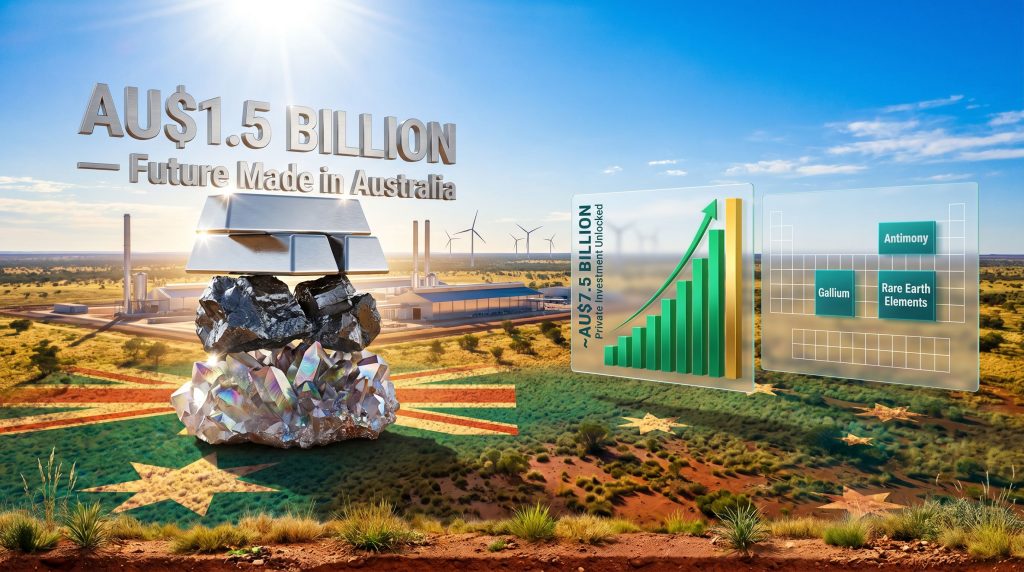
| Projected Private Investment Unlocked | ~AU$7.5 billion |
| Operational Certainty Horizon | Through to 2040 |
| Transition Objective | Renewable-powered operations |
The AU$2 billion in combined public investment is projected to unlock approximately AU$7.5 billion in associated private capital, representing a leverage ratio of roughly 3.75x. This kind of public-private leverage model has precedent in comparable industrial transition projects internationally, where renewable energy integration into energy-intensive manufacturing requires the risk-reduction certainty that only government co-investment can provide. In addition, the green metals innovation fund further reinforces this commitment to transforming domestic industrial capacity.
Aluminium smelting is among the most energy-intensive industrial processes in any economy. The Boyne Island facility's transition to renewable power is not a straightforward operational upgrade. It requires renegotiation of power supply agreements, capital investment in grid connection and potentially dedicated renewable generation capacity, and operational modifications to accommodate renewable energy intermittency. The government investment creates the financial foundation for that complexity to be managed without threatening facility viability.
Whyalla and Liberty Bell Bay: Industrial Communities at Stake
The AU$222.6 million allocation for Whyalla Steelworks operations reflects a different policy logic from the Boyne Island investment. Where Boyne Island represents transition support, Whyalla represents continuity protection for a regional industrial hub where the steelworks functions as the economic anchor for an entire community.
Beyond Whyalla, the budget extends support to workers at the Liberty Bell Bay manganese smelter during an ownership transition period. Both measures reflect recognition that the human geography of industrial closure is not easily reversed. When a major industrial employer exits a regional community, the downstream effects on local businesses, property values, and population retention can persist for decades.
Future Made in Australia: The Policy Architecture
Both the Boyne Island investment and the broader green metals program sit within the Future Made in Australia framework, which allocates AU$1.5 billion toward domestic green metals production capacity. This framework also encompasses the Critical Minerals Production Tax Incentive, operational from 2027-28, covering the processing and refining of 31 designated critical minerals domestically.
The significance of the processing incentive extends beyond the tax benefit itself. Australia has historically exported a large proportion of its mineral wealth as unprocessed ore, with processing value captured offshore. A production tax incentive calibrated to domestic refining changes the economic calculus for operators deciding where to locate processing facilities, potentially anchoring more of the value chain within Australian borders.
The broader commitment framework underpinning these measures extends to a decade-long AU$22.7 billion commitment that also encompasses the Hydrogen Production Tax Incentive, signalling that the green metals and critical minerals investment is a sustained policy direction rather than a single-budget initiative.
Australia's Critical Minerals Strategic Reserve: Strategic Logic Explained
The formalisation of the critical minerals strategic reserve in the 2026-27 budget represents one of the most strategically consequential measures in the package, yet it is also one of the least immediately visible to mainstream economic analysis.
The core strategic problem the reserve addresses is supply concentration risk. For a range of minerals essential to advanced manufacturing, defence systems, and the clean energy transition, global production and processing is geographically concentrated in ways that create systemic vulnerability for importing nations. When a single country controls the majority of global supply for a material with no near-term substitute, the importing nation faces an asymmetric dependency that can be weaponised during periods of geopolitical tension.
| Mineral | Primary Application | Strategic Rationale |
|---|---|---|
| Antimony | High-tech manufacturing, flame retardants | Heavily concentrated in Chinese supply chains |
| Gallium | Semiconductors, defence electronics | Critical for advanced military and communications systems |
| Rare Earth Elements | EV motors, wind turbines, defence optics | Essential for green energy and national security infrastructure |
The AU$150 Million Stockpiling Mechanism
Drawing from the broader AU$5 billion Critical Minerals Facility, the budget allocates AU$150 million specifically for selective stockpiling of priority minerals. The operational logic of strategic stockpiling is not simply about hoarding physical material. It serves several functions simultaneously:
- Price insulation: Maintaining a domestic reserve reduces exposure to spot price volatility driven by geopolitical events or export restrictions by producer nations
- Supply chain resilience: Provides a buffer period during which domestic industries can source alternative supply or develop substitutes without operational disruption
- Allied nation credibility: Positions Australia as a dependable supplier to partner nations within the high-visibility global economy, complementing existing bilateral mineral agreements with the United States, Japan, and the European Union
- Signal to markets: Communicates to mining investors that demand for Australian critical minerals and energy security has sovereign backing at the national level
A critical but underappreciated dimension of strategic stockpiling is that the location of reserve storage and the governance protocols for mobilising reserves in crisis conditions are as strategically important as the financial allocation itself. Without transparent drawdown criteria and storage infrastructure, a financial stockpiling commitment risks becoming a bookkeeping entry rather than an operational capability.
The antimony inclusion in the initial priority list is particularly notable given developments within Australian mining. Larvotto Resources recently delivered the first antimony ore to surface at the Hillgrove project in New South Wales ahead of commissioning, highlighting that domestic antimony production capacity is genuinely emerging at a moment when the government is simultaneously formalising demand through the strategic reserve.
AI-Assisted Environmental Approvals: The Regulatory Bottleneck Problem
The Environment Protection and Biodiversity Conservation (EPBC) Act approval process has functioned as one of the most consistently cited structural constraints on Australian mining project timelines. The backlog of applications awaiting assessment has grown to encompass thousands of projects, including mining developments and over 5,000 kilometres of critical transmission infrastructure required to support the energy transition.
The fundamental problem is not regulatory rigour but processing capacity. Environmental assessment at the required depth of analysis is analytically intensive, and the volume of applications consistently exceeds the throughput of the manual assessment framework. Consequently, the mining permit reforms reshaping global expectations around approval timelines have added further pressure on Australian regulators to modernise their systems.
How the AU$105.9 Million AI Deployment Works
The budget allocates AU$105.9 million to integrate artificial intelligence into the EPBC Act assessment pipeline. The technical application of AI in environmental assessment is more specific than the term "AI assistance" might suggest. In regulatory contexts, AI tools are typically deployed to:
- Classify and triage incoming applications by complexity, urgency, and completeness
- Cross-reference submissions against existing biodiversity databases and heritage registers to identify standard-condition projects eligible for faster processing
- Generate draft assessment frameworks for assessors to review rather than construct from scratch
- Flag applications requiring specialist ecological or heritage review before they queue into the standard assessment pathway
- Process the estimated 26,000 residential developments caught in the same backlog alongside mining and transmission projects
The Minerals Council of Australia has been vocal about regulatory processing speed as a primary constraint on investment deployment. The AI investment directly addresses this advocacy. However, as engineering and consulting firm WSP has noted in its budget analysis, the determining factor for whether these allocated funds translate into real-world project acceleration will be implementation speed and the quality of AI training on existing regulatory data.
AU$47.6 Million for Single-Track Assessment Pathways
Parallel to the AI investment, the budget allocates AU$47.6 million for bilateral assessment agreements between the Commonwealth and state governments. The operational effect of these agreements is significant: rather than navigating separate federal and state environmental assessment processes with potentially overlapping requirements and divergent timelines, project proponents follow a single consolidated pathway.
For large-scale greenfield mining developments requiring multi-jurisdictional sign-off, the reduction in duplicated effort represents a material reduction in project development cost and timeline uncertainty.
The next major ASX story will hit our subscribers first
Solving the Structural Workforce Deficit
Labour availability is increasingly identified as a binding constraint on mining sector growth. The challenge is structural rather than cyclical. Mine construction and operations require specific trade certifications and occupational licences that take years to obtain through standard domestic pathways, creating a lag between sector growth signals and labour supply response.
Accelerated Migrant Tradesperson Licensing
The budget accelerates skills recognition and occupational licensing for qualified tradespeople arriving from overseas. The policy change reduces the time between a qualified worker arriving in Australia and becoming productively employed in mining operations. For trades in critical shortage, this compression of the lag between arrival and deployment could meaningfully reduce project timeline slippage driven by labour unavailability.
The exploration and mining support services expenditure data, averaging AU$486 million per quarter with a 25% increase in the year to March 2024, demonstrates the pace of sector expansion. Skills pipeline investment needs to scale at a comparable rate or project delivery timelines will be constrained not by capital availability or regulatory approval, but by the simple inability to deploy a qualified workforce at pace.
Budget Architecture Over Time: How 2026-27 Compares
Viewing the 2026-27 measures in isolation understates their significance. The budget represents the latest layer in an escalating federal commitment to the mining and resources sector that has shifted from reactive to strategically proactive over the past decade.
| Budget Measure | Prior Position | 2026-27 Position |
|---|---|---|
| Mining Tax Settings | Unchanged across multiple cycles | Confirmed unchanged |
| Critical Minerals Facility | Established in prior budget | Strategic Reserve formalised; AU$150M stockpile added |
| Environmental Approvals | Manual process, significant backlog | AI-assisted pipeline; AU$105.9M allocated |
| Asset Write-Off for SMEs | Temporary, subject to annual renewal | Made permanent |
| Green Metals Investment | Emerging policy commitment | AU$1.5B via Future Made in Australia |
The Subsidies Debate: Balancing the Ledger
Any complete analysis of Australia federal budget support for mining sector requires acknowledging the ongoing public debate about resource sector concessions. Historical estimates place the combined value of federal and state concessions to mining at approximately AU$7 billion annually in earlier years, encompassing fuel tax credits, accelerated depreciation provisions, and research and development concessions.
Critics, including the Australia Institute, argue these concessions represent a diversion of public resources. The counterargument from industry and many economists is that mining's total tax contribution through royalties, company income tax, and indirect economic activity substantially exceeds the value of fiscal concessions, generating the consolidated revenue that funds Medicare, the NDIS, education, and defence.
The subsidies debate is often framed as binary, but the underlying economics are more nuanced. A mining sector that receives targeted fiscal support while generating substantially larger tax revenue flows produces a net positive fiscal outcome for the government, provided royalty and company tax collection frameworks remain robust and are not eroded by aggressive transfer pricing or profit-shifting arrangements.
What Industry Analysis Reveals
The Minerals Council of Australia's response to the budget emphasised the connection between mining sector fiscal health and public service funding capacity, a framing that positions mining not as a beneficiary of government support but as a contributor to national resilience whose continued strength serves public interests.
Consulting firm WSP characterised the energy, mining, and metals sectors as among the primary beneficiaries of the 2026-27 budget, with the critical qualifier that implementation speed will ultimately determine whether the financial allocations translate into tangible project acceleration or remain as policy commitments awaiting operational delivery.
The Northern Territory budget provides a concrete illustration of the downstream fiscal cascade. Its AU$4.25 billion infrastructure program is materially dependent on the mining royalty base and the broader economic multiplier effects of operational mines. Federal budget support for mining sector health flows directly into state and territory fiscal capacity to fund schools, hospitals, and roads in resource-dependent regions. The 2026-27 budget speech delivered by Treasurer Jim Chalmers made clear that resources remain central to Australia's long-term economic strategy.
Short, Medium, and Long-Term Implications
Immediate Impacts
- No new tax burden preserves active investment pipelines and prevents capital reallocation to competitor jurisdictions
- Direct capital injection into aluminium, steel, and manganese operations protects regional industrial employment at facilities with limited substitutes in their local economies
- AI-assisted approval processes begin addressing the regulatory backlog that has deferred project timelines across the sector
Medium-Term Structural Changes
- Domestic processing capacity for 31 designated critical minerals incentivised from 2027-28 begins shifting Australian resource exports toward higher-value processed materials
- The formalised Strategic Reserve positions Australia credibly within allied supply chain architecture, potentially strengthening bilateral trade relationships
- Boyne Island creates a documented, funded model for renewable energy transition at energy-intensive facilities that other operators can reference and adapt
Long-Term Strategic Repositioning
The cumulative effect of sustained fiscal stability, domestic processing incentives, strategic reserve development, and regulatory modernisation is a resource sector positioned to capture more economic value from Australia's endowment rather than surrendering the value-adding margin to offshore processors. The budget's architecture, viewed across its full scope, reflects a deliberate and documented policy evolution consistent with the broader Australia federal budget support for mining sector direction established over multiple budget cycles.
Frequently Asked Questions
Did the 2026-27 Federal Budget introduce any new taxes on the mining sector?
No. The 2026-27 Federal Budget explicitly maintained existing tax settings for the mining sector, with no new levies, royalty adjustments, or windfall profit taxes introduced.
What is the Critical Minerals Strategic Reserve?
It is a government stockpiling mechanism drawing from the AU$5 billion Critical Minerals Facility, with AU$150 million specifically allocated in 2026-27 for selective stockpiling of priority minerals including antimony, gallium, and rare earth elements where global supply is geographically concentrated.
How does AI improve the environmental approval process for mining?
The AU$105.9 million allocation funds AI integration into the EPBC Act assessment process to triage, classify, and process applications at scale, reducing the backlog of mining projects, transmission infrastructure applications, and residential developments awaiting regulatory decisions.
Which minerals qualify for the Critical Minerals Production Tax Incentive?
The incentive covers 31 designated critical minerals when processed or refined domestically, becoming operational from the 2027-28 financial year as part of the Future Made in Australia policy framework.
How does the Boyne Island investment support the green energy transition?
The combined AU$2 billion in public investment (federal and Queensland state matched) is designed to transition the Boyne Island aluminium smelter to renewable energy operations, securing the facility through to 2040 and unlocking an estimated AU$7.5 billion in associated private investment.
This article is intended for informational purposes only and does not constitute financial advice. Forecasts, projected investment figures, and policy outcomes referenced throughout are based on announced budget measures and publicly available industry analysis. Actual outcomes may differ materially from projections depending on implementation timelines, commodity price movements, and broader economic conditions. Readers should consult qualified financial or legal advisers before making investment decisions.
Want to Capitalise on the Next Major Australian Mineral Discovery?
As Australia's 2026-27 budget accelerates critical minerals exploration and domestic processing, the opportunities emerging across the ASX are moving faster than ever — and Discovery Alert's proprietary Discovery IQ model ensures subscribers receive real-time alerts the moment a significant discovery is announced, turning complex mineral data into actionable insights. Explore historic examples of exceptional discovery returns and begin your 14-day free trial today to position yourself ahead of the market.