
May 13, 2026
The Hidden Architecture of Russia's Wartime Energy Economy
The global oil market operates on a foundational assumption: headline production figures reflect economic reality. In wartime, that assumption breaks down. When a nation simultaneously extracts petroleum at industrial scale while its coastal terminals burn, the gap between what is pumped from the ground and what reaches foreign buyers becomes the most consequential number that never appears in official statistics.
Russia's energy sector in 2026 presents exactly this kind of analytical puzzle. With Russia oil output flat amid Ukraine drone attacks dominating energy market coverage, the surface-level narrative of production stability conceals a more structurally complex story involving export chokepoints, data opacity, a China-oriented gas pivot, and the compounding question of whether repeated temporary disruptions eventually crystallise into permanent capacity loss.
When big ASX news breaks, our subscribers know first
Understanding the Production-Export Divide
Why Wellhead Figures Mislead in a Wartime Context
The most important distinction in assessing Russia's current oil sector performance is one that aggregate statistics actively obscure: the difference between extraction capacity and export throughput. These two variables, often treated as interchangeable in peacetime market analysis, have fundamentally decoupled under the pressure of Ukraine's sustained infrastructure campaign.
Russia's West Siberian production basins, which account for the bulk of national output, sit hundreds of kilometres from the Baltic and Black Sea coastal terminals that serve as the primary conduit for seaborne crude exports. Drone strikes cannot reach the wellhead with the same precision or frequency with which they can target a coastal storage tank farm. The result is a system where oil continues flowing from the ground at near-normal rates while the downstream machinery needed to monetise that production is being systematically degraded.
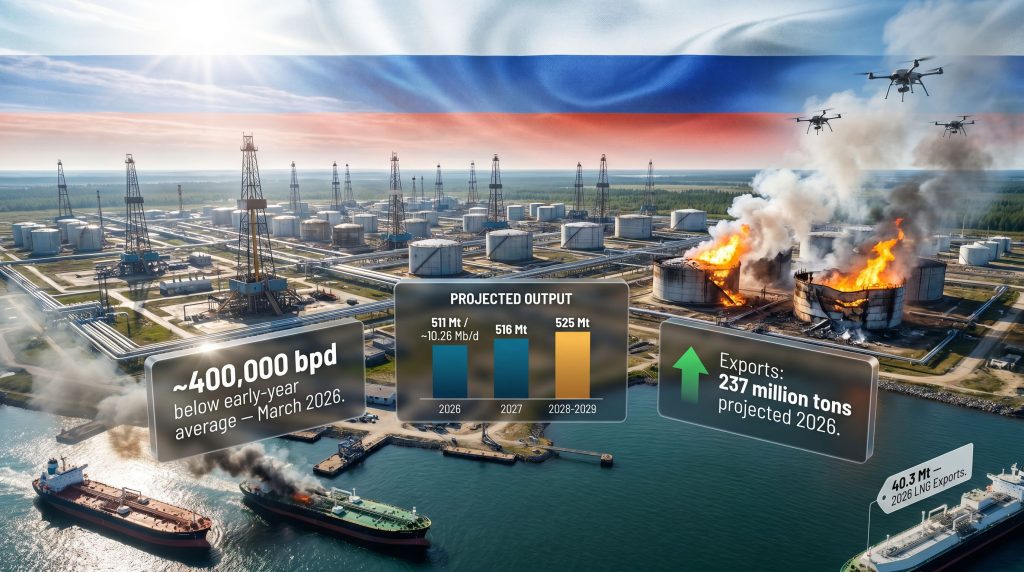
This matters enormously for interpreting the Russia's Economy Ministry's base-case projection of approximately 511 million tons of crude oil and condensate output in 2026, equivalent to roughly 10.26 million barrels per day (Bloomberg/Rigzone, May 13, 2026). That figure reflects extraction capacity, not revenue-generating capacity. The two are not the same thing in a system where coastal export terminals are under active attack. For broader context on crude oil price trends in 2025, these dynamics have already begun reshaping global market expectations.
The Condensate Calculation and the Data Opacity Problem
A further layer of analytical complexity involves condensate, a very light petroleum liquid that has historically accounted for approximately 10 percent of Russia's total petroleum output (Bloomberg/Rigzone, May 13, 2026). When Russia's Economy Ministry reports combined crude and condensate figures, and when independent organisations like OPEC report crude-only data, the resulting discrepancy can appear larger than the underlying production reality warrants.
OPEC market influence on data interpretation is particularly relevant here: OPEC data for Q1 2026 recorded Russian crude-only production averaging 9.19 million barrels per day, a figure that excludes condensate volumes entirely (Bloomberg/Rigzone, May 13, 2026). Reconciling this with the Ministry's 10.26 Mb/d composite figure requires accounting for that roughly 10 percent condensate contribution, but even then, methodological inconsistencies in classification create measurement noise that complicates market signal interpretation.
Compounding this is a deliberate opacity layer. Russia classified the majority of its oil industry data following the February 2022 invasion of Ukraine, making independent verification of extraction rates, storage volumes, and export flows methodologically challenging in ways that were not present during peacetime analysis (Bloomberg/Rigzone, May 13, 2026). For market analysts, this means working with partial datasets and inference-heavy modelling rather than direct verification.
Russia's Own Production Roadmap: What the Numbers Say
Economy Ministry Projections Through 2029
Russia's Economy Ministry published its base-case production outlook in May 2026, presenting a trajectory of modest but consistent growth across the planning horizon. The figures suggest an official expectation that infrastructure disruptions will remain manageable and that upstream capacity will continue expanding despite wartime conditions.
| Year | Projected Output (Million Tons) | Approximate Daily Rate (Mb/d) |
|---|---|---|
| 2026 | 511 | ~10.26 |
| 2027 | 516 | ~10.36 |
| 2028 | 525 | ~10.54 |
| 2029 | 525 | ~10.54 |
Source: Russia Economy Ministry outlook, reported by Bloomberg/Rigzone, May 13, 2026
The 2028–2029 plateau at 525 million tons suggests the Ministry anticipates reaching a natural production ceiling during this period rather than projecting continued open-ended growth. Whether this ceiling reflects geological depletion dynamics, equipment constraints linked to Western technology sanctions, or a deliberate strategic signal is not clarified in the published outlook.
The Export Volume Paradox
Perhaps the most analytically striking element in the Ministry's May 2026 outlook is the combination of infrastructure damage acknowledgement alongside a projected surge in export volumes. The document projects oil exports exceeding 237 million tons in 2026, equivalent to approximately 4.76 million barrels per day, before falling back to 227.4 million tons in 2027 without any explanation for the reversal (Bloomberg/Rigzone, May 13, 2026).
Furthermore, oil sanctions policy shifts in the broader geopolitical landscape add another layer of uncertainty to how these export projections will play out in practice.
The Ministry's simultaneous projection of rising 2026 exports and acknowledged terminal damage raises a question that the document itself does not answer: through what routing mechanism does Russia expect to compensate for degraded Baltic and Black Sea infrastructure?
The unexplained 2027 export decline may reflect delayed recognition that cumulative infrastructure damage will eventually constrain throughput, an anticipated tightening of Western shipping sanctions, or simply a modelling artefact. The absence of official explanation transforms this data point from a statistic into a geopolitical signal worth monitoring.
How Ukraine's Infrastructure Campaign Is Reshaping Export Capacity
The Strategic Logic Behind Terminal Targeting
Ukraine's selection of coastal export terminals as primary strike targets reflects a sophisticated understanding of how Russia's petroleum revenue system actually functions. Because upstream production basins are geographically protected, the most efficient point of leverage is the export infrastructure that converts extracted crude into foreign currency.
The Baltic Sea terminals at Primorsk and Ust-Luga represent particularly high-value targets within this framework. Together, these two facilities handle a substantial share of Russia's seaborne crude exports, positioning them as critical chokepoints in the flow of petrodollars that help fund Kremlin military operations. The Russian oil sanctions impact on shipping and insurance networks has further compounded the pressure on these export corridors. The Black Sea infrastructure at Novorossiysk and the Tuapse refinery complex represents a second axis of vulnerability, particularly relevant for flows directed toward Asian and Middle Eastern buyers.
The Cascade Mechanism: From Storage Tanks to Wellhead Decisions
The operational logic connecting coastal infrastructure damage to upstream production decisions is less intuitive than it might initially appear, and understanding it is essential for assessing the true economic impact of the drone campaign.
When storage tank capacity at an export terminal is destroyed or rendered inoperable, the pipeline system feeding that terminal cannot simply redirect volumes overnight. Operators upstream face a binary choice: continue pumping oil into a system that lacks sufficient outbound capacity, accepting short-term storage constraints and potential pipeline pressure management issues, or implement temporary production curtailments at the wellhead.
The reason operators are reluctant to shut in wells extends beyond immediate revenue loss. Restarting oil production in cold-climate environments like West Siberia involves significant technical and financial costs. Wells that are shut in for extended periods can suffer formation damage, paraffin deposition problems, and pressure decline that permanently reduces productive capacity. This creates a strong institutional bias toward maintaining extraction even when export pathways are compromised, accepting the storage bottleneck rather than the restart cost.
The result is what Reuters reporting describes as a "forced maintenance" dynamic: production curtailments framed publicly as routine spring maintenance activities that were at least partially driven by damaged downstream infrastructure.
Monthly Volatility Behind the Flat Annual Narrative
The annual production figure of approximately 10.26 Mb/d for 2026 creates an impression of stability that monthly data significantly complicates. The period between February and April 2026 saw output reductions of an estimated 300,000 to 400,000 barrels per day relative to the early-year baseline, with the April reduction representing one of the sharpest single-month declines recorded since the early stages of the COVID-19 pandemic when global demand collapsed.
These monthly reductions appear cyclical rather than cumulative in the data, which reflects both Russia's demonstrated repair and adaptation capacity and the geographic depth of its reserve base. However, the critical analytical question this pattern raises is whether repeated temporary disruptions eventually compound into permanent capacity degradation, particularly as sanctioned equipment becomes increasingly difficult to source for repair operations.
Measuring Campaign Effectiveness Against Strategic Thresholds
The Revenue Threshold Problem
Assessing whether Ukraine's energy warfare campaign is achieving its strategic objectives requires establishing what level of sustained production loss would be required to meaningfully constrain Kremlin military expenditure. This threshold analysis reveals a fundamental challenge facing the campaign's architects.
Russia's federal budget relies on oil and gas revenues for close to one-fifth of total receipts (Bloomberg/Rigzone, May 13, 2026). For a country with a GDP measured in the trillions of dollars and fiscal reserves built during high-price periods, a production reduction of 300,000 to 400,000 barrels per day, while operationally significant, does not reach the scale required to create immediate budget crisis conditions. The gap between achievable disruption and strategically decisive disruption remains substantial.
This does not invalidate the campaign's logic. Even sub-threshold disruptions impose costs, divert engineering and repair resources, complicate insurance and shipping logistics, and potentially deter long-term investment in Russian energy infrastructure. The question is whether these effects accumulate toward a decisive threshold or whether Russia's system resilience continuously resets the baseline.
Four Structural Reasons Production Remains Resilient
Several factors explain why sustained permanent production losses have not materialised despite the intensity of the infrastructure campaign:
-
Geographic depth: West Siberian production basins remain physically removed from maritime strike corridors, protecting the upstream extraction system from direct interdiction.
-
Repair velocity: Russian energy operators and state resources have demonstrated faster-than-anticipated facility restoration capability, shortening the window between strike and recovery.
-
Production-export decoupling: The institutional bias against shutting in wells means extraction continues even when export throughput is constrained, preventing upstream capacity degradation.
-
OPEC+ framework incentives: Russia's production commitments within the OPEC+ architecture create institutional and diplomatic incentives to maintain stated output levels, reinforcing the operational push to sustain extraction.
Russia's Natural Gas Sector: The China Pivot as Strategic Insurance
Pipeline Gas and the Eastern Reorientation
While crude oil headlines dominate the Ukraine conflict energy narrative, Russia's natural gas sector is quietly executing a structural reorientation that represents a long-term strategic hedge against Western market closure. Pipeline gas exports are projected to hold flat at 115.5 billion cubic meters in 2026 before rising to 127.5 billion cubic meters by 2029 (Bloomberg/Rigzone, May 13, 2026), with the growth driver almost entirely concentrated in new eastward routing.
The Far Eastern pipeline route to China, scheduled to commence operations in 2027, will initially deliver 10 billion cubic meters annually, scaling to 12 billion cubic meters as the corridor reaches full operational capacity (Bloomberg/Rigzone, May 13, 2026). Separately, Gazprom and China National Petroleum Corporation finalised a commercial agreement to expand Power of Siberia corridor volumes by an additional 6 billion cubic meters per year, building from a current base of 38 billion cubic meters (Bloomberg/Rigzone, May 13, 2026).
These incremental additions, while individually modest relative to the volumes previously directed toward European markets, represent the ongoing construction of an energy relationship with China designed to be structurally durable across multiple geopolitical cycles. In addition, ongoing US-China trade tensions are further reshaping how Chinese energy buyers approach long-term supply diversification decisions.
LNG Ambitions Versus Sanctions Constraints
Russia's liquefied natural gas trajectory tells a story of ambition colliding with technological dependency. LNG exports are projected to reach 40.3 million tons in 2026, representing approximately a one-third increase from 2025 levels, rising further to 66.2 million tons by 2029 (Bloomberg/Rigzone, May 13, 2026). The increase in near-term volumes is partly attributable to expanded loadings from the Arctic LNG 2 project, driven by Chinese demand absorption despite Western sanctions frameworks targeting the project.
| Metric | Current Trajectory | Putin's Original Target |
|---|---|---|
| 2026 LNG exports | 40.3 million tons | N/A |
| 2029 LNG exports | 66.2 million tons | 100 million tons |
| Year-on-year growth (2025–2026) | ~33% | N/A |
| Projected 2029 shortfall | ~34 million tons | 100 million tons |
Source: Bloomberg/Rigzone, May 13, 2026
The gap between Russia's aspirational LNG target and its achievable trajectory is significant. The 100 million ton annual target, referenced publicly by President Putin on multiple occasions, has been pushed back by several years as Western equipment and technology restrictions constrained the Arctic LNG expansion programme (Bloomberg/Rigzone, May 13, 2026). This represents one of the more concrete, measurable successes of Western sanctions policy: not eliminating Russian LNG exports, but capping their growth ceiling well below the level that would have fundamentally repositioned Russia as a dominant global LNG supplier.
The next major ASX story will hit our subscribers first
Global Market Implications and Forward Scenarios
Russia's Role in a Tighter Global Supply Balance
Russia oil output flat amid Ukraine drone attacks has become a defining phrase in 2026 energy market analysis, and consequently, Russia's maintenance of approximately 10.26 million barrels per day positions it as a structurally important swing factor in global crude supply balances. This is particularly significant given that Saudi Arabia's reduced output, linked to Middle East conflict dynamics, has elevated Russia's relative market weight within current production hierarchies (Bloomberg/Rigzone, May 13, 2026). Any sustained reduction in Russian output would tighten global balances more significantly than in historical periods when Saudi spare capacity provided a reliable buffer.
Moreover, the Lowy Institute's analysis of Ukraine's oil war strategy highlights how sustained infrastructure attrition could eventually test the limits of Russia's adaptive capacity in ways that short-term production data does not yet fully capture.
Three Divergent Scenarios for 2027–2029
The range of possible trajectories for Russia's oil production through the end of the decade spans substantially different geopolitical and market outcomes:
Scenario A: Continued Resilience Infrastructure damage remains disruptive but non-cumulative. Russia's repair capacity and geographic depth allow it to achieve the Ministry's 525 million ton target by 2028, with monthly volatility absorbed within annual averages.
Scenario B: Escalating Infrastructure Attrition Repeated strikes on Baltic and Black Sea terminals compound into sustained export capacity losses that can no longer be offset by rapid repair cycles. Wellhead production faces genuine curtailment pressure as storage constraints become chronic rather than episodic.
Scenario C: Sanctions Intensification Additional Western measures targeting shadow fleet operations and payment intermediation networks reduce Russia's effective export revenue without necessarily cutting physical production volumes, achieving financial disruption through commercial rather than physical means.
Disclaimer: The scenarios outlined above are analytical frameworks for assessing possible outcomes, not investment advice or forward-looking guidance. Energy market conditions, geopolitical developments, and policy changes can materially alter any projected trajectory. Readers should not base investment decisions on scenario analysis of this nature without independent professional advice.
Frequently Asked Questions
How much oil does Russia produce per day in 2026?
Russia's Economy Ministry projects combined crude oil and condensate output of approximately 511 million tons for 2026, equivalent to roughly 10.26 million barrels per day. Independent OPEC tracking data for Q1 2026 recorded crude-only production averaging 9.19 million barrels per day, a figure that excludes condensate volumes (Bloomberg/Rigzone, May 13, 2026).
Have Ukrainian drone strikes permanently reduced Russian oil output?
As of mid-2026, available data does not support a conclusion of permanent production reduction. Monthly output cuts of an estimated 300,000 to 400,000 barrels per day have been recorded following major infrastructure strikes, but these reductions have demonstrated temporary characteristics. The primary documented impact has been on export logistics infrastructure rather than upstream extraction capacity.
Why does Russia continue producing oil despite damaged export infrastructure?
Russia's production basins in West Siberia are geographically separated from coastal export terminals. Beyond the geographic factor, restarting oil production once wells have been shut in involves significant technical costs and potential permanent reservoir damage, particularly in cold-climate formations. This creates a strong operational preference for maintaining extraction even when export bottlenecks temporarily constrain shipment volumes.
What is Russia's LNG export target and is it achievable?
Russia originally targeted 100 million tons of LNG exports per year by the end of the decade, a goal announced publicly by President Putin. Western sanctions have significantly constrained this ambition, with current Ministry projections placing 2029 exports at approximately 66.2 million tons, representing a shortfall of roughly 34 million tons against the original target (Bloomberg/Rigzone, May 13, 2026).
What is the significance of the Far Eastern gas pipeline to China?
The Far Eastern route to China, scheduled to launch in 2027, represents a structural component of Russia's long-term energy reorientation away from European markets. Initial annual capacity of 10 billion cubic meters, scaling to 12 billion cubic meters, combined with the Power of Siberia expansion agreement, signals Russia's strategic intent to make the China relationship a durable commercial foundation rather than a temporary wartime adjustment (Bloomberg/Rigzone, May 13, 2026).
Key Analytical Takeaways
-
Russia's 2026 oil production is projected at approximately 10.26 Mb/d under the Economy Ministry's base case, a figure that conceals significant monthly volatility driven by export infrastructure disruption.
-
The central analytical lens for understanding the headline stability is the production-export decoupling dynamic: extraction continues at near-normal rates while coastal terminal capacity is actively degraded.
-
Ukraine's infrastructure campaign has demonstrably disrupted export throughput, particularly at Baltic Sea terminals, but has not yet translated this disruption into sustained upstream production losses. With Russia oil output flat amid Ukraine drone attacks remaining the prevailing pattern, the cumulative trajectory warrants close monitoring.
-
Russia's natural gas sector is expanding through a China-oriented pivot, with new pipeline routes and volume agreements providing partial compensation for the Western market closures that followed the 2022 invasion.
-
The LNG growth trajectory has been effectively capped by Western technology restrictions, with Russia's 2029 projected output of 66.2 million tons falling approximately 34 million tons short of President Putin's stated 100 million ton target.
-
The trajectory through 2027–2029 will depend critically on whether infrastructure damage accumulates cumulatively or continues to be absorbed through Russia's demonstrated repair and adaptation capacity.
Want To Stay Ahead Of The Energy Shifts Reshaping Global Commodity Markets?
Discovery Alert's proprietary Discovery IQ model delivers real-time alerts on significant ASX mineral discoveries, instantly translating complex commodity dynamics into actionable investment opportunities — explore how historic discoveries have generated substantial returns and begin your 14-day free trial today to position yourself ahead of the market.