July 25, 2026
Understanding Venezuela's Historical Approach to Energy Sector Control
Resource-rich nations frequently face complex decisions about foreign investment participation versus domestic control over strategic assets. Venezuela's experience with oil sector governance illustrates how different approaches to asset nationalization in Venezuela can produce vastly different outcomes for both foreign investors and national production capacity.
The trajectory of Venezuela's energy sector demonstrates two distinct phases of government control expansion, each with fundamentally different implementation strategies and economic consequences. Furthermore, these historical patterns now shape how international oil companies assess investment opportunities in the country, reflecting broader industry evolution trends across resource-rich nations.
The 1976 Systematic Nationalization Framework
Venezuela's first major oil sector nationalization occurred in 1976 during Carlos Andrés Pérez's presidency, affecting proven crude oil reserves estimated at approximately 14 billion barrels. This systematic approach established PDVSA as the state-owned enterprise while implementing a structured compensation mechanism for international oil companies.
The government distributed approximately $1.0-1.2 billion in compensation among U.S. oil majors, including Standard Oil of New Jersey (Exxon), Gulf Oil, Mobil Oil, and Texaco. This compensation framework, while representing only a fraction of the estimated $5+ billion in affected investments, established legal precedent for orderly transition processes.
Key characteristics of the 1976 approach included:
- Establishment of clear legal frameworks before implementation
- Maintenance of technical cooperation agreements with former operators
- Preservation of production capacity and export relationships
- Integration of international expertise through service contracts
The Chávez-Era Confrontational Restructuring Campaign
The 2000s marked a dramatic shift toward unilateral asset seizures across multiple economic sectors. Beginning in April 2007, PDVSA announced mandatory majority stake acquisition requirements, demanding minimum 60% control in all oil joint ventures.
This confrontational approach produced immediate resistance from major international operators. ExxonMobil and ConocoPhillips refused compliance and withdrew from operational control, while Chevron, Total, and Statoil renegotiated their positions under the new terms.
However, the broader nationalization campaign extended beyond oil into telecommunications, electricity, mining, and agriculture sectors, affecting overall energy security challenges across the region:
| Sector | Year | Primary Target | Current Status |
|---|---|---|---|
| Oil Joint Ventures | 2007 | ExxonMobil, ConocoPhillips | Ongoing arbitration disputes |
| Telecommunications | 2005-2006 | CANTV (Verizon subsidiary) | State-controlled operations |
| Electricity Generation | 2007 | AES Corporation facilities | Infrastructure deterioration |
| Gold Mining | 2011 | Crystallex International | $1.2B arbitration award issued |
| Agriculture | 2003-2010s | 2,000+ private estates | Reduced productivity outcomes |
The production consequences of this approach became evident rapidly. Venezuela's oil output declined from approximately 3.2 million barrels per day in 2007 to 2.7 million bpd by 2008, representing a 16% year-over-year decrease.
This downward trajectory continued, with production falling to 0.4-0.8 million bpd by 2020. Venezuela's oil industry has shown how state control over petroleum resources can lead to operational challenges when implemented without adequate technical expertise.
When big ASX news breaks, our subscribers know first
Investment Protection Mechanisms in High-Risk Environments
International oil companies operating in jurisdictions with asset nationalization in Venezuela history require sophisticated risk mitigation frameworks. Venezuela's track record has prompted industry-wide reassessment of protection mechanisms and contractual structures.
Physical Security Versus Financial Assurance Models
Continental Resources' Harold Hamm articulated a key industry perspective on risk mitigation priorities, emphasising that guarantees against nationalisation should focus on physical security rather than financial assurances. This approach prioritises operational continuity over compensation mechanisms.
Physical security guarantees encompass:
- Infrastructure protection protocols for production facilities
- Personnel safety frameworks in unstable political environments
- Equipment and technological asset safeguarding measures
- Operational continuity assurances during political transitions
In addition, the distinction reflects industry recognition that enforcement of financial compensation agreements against sovereign states remains extremely challenging, as demonstrated by Venezuela's arbitration award payment record.
International Arbitration Framework Limitations
Venezuela's compliance record with international arbitration decisions illustrates the enforcement challenges facing investors. Two major cases demonstrate these limitations:
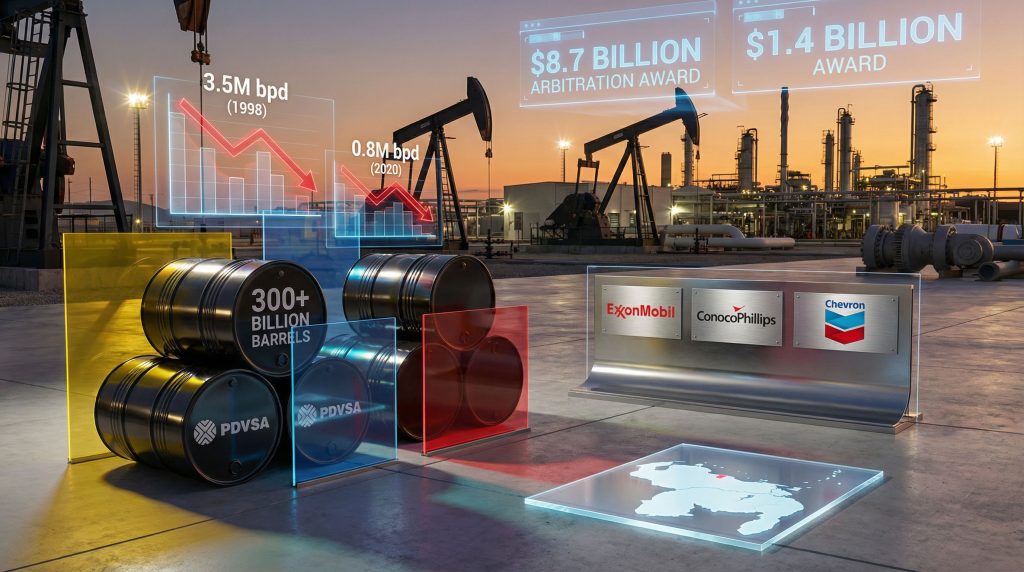
ExxonMobil's ICSID Award (2014): The company received a $1.4 billion award (later increased to $1.6 billion with interest) for 2007 expropriations. However, enforcement efforts through asset attachment in international jurisdictions have achieved only limited recovery due to sovereign immunity protections.
ConocoPhillips' UNCITRAL Award (2019): The $8.7 billion arbitration victory for expropriation of Petrozuata and Hamaca projects represents one of the largest awards in international arbitration history. Yet enforcement remains severely constrained by similar sovereign immunity obstacles.
As of 2026, the U.S.-Venezuela petroleum industry relationship technically remains governed by bilateral treaties despite deteriorated political relations, though enforcement mechanisms have been compromised by Venezuelan non-compliance with treaty obligations.
Multilateral Institution Guarantee Structures
While no current active coverage exists for new Venezuelan oil investments, the World Bank's Multilateral Investment Guarantee Agency (MIGA) framework demonstrates available protection models:
- Coverage scope: Currency transfer restrictions, expropriation, war/civil disturbance, and breach of contract by host government
- Protection levels: Typically 90% of investment amount
- Claims processing: 2-4 year settlement timelines
- Implementation barriers: Requires Venezuelan government consent and credible commitment to honour claims
Corporate Risk Assessment and Market Psychology
Major oil companies have developed sophisticated frameworks for evaluating political risk in resource-rich jurisdictions. Venezuela's designation as "uninvestable" by ExxonMobil CEO Darren Woods reflects systematic application of these assessment criteria.
Quantifying Venezuela's Resource Potential Against Investment Climate
Venezuela possesses proven crude reserves exceeding 300 billion barrels, representing the world's largest documented reserve base. However, current production capacity has collapsed to 800,000-1.1 million barrels per day from peak levels of 3.5 million bpd in the late 1990s.
Infrastructure restoration requirements present massive capital challenges:
- Estimated restoration cost: $100+ billion for upstream facilities
- Timeline to production recovery: 5-10 years with sustained investment
- Technology transfer requirements: Extensive knowledge gaps following international operator departures
- Pipeline and export infrastructure: Comprehensive modernisation needed
Corporate Governance and Fiduciary Duty Considerations
U.S. publicly traded oil companies must comply with SEC disclosure requirements for material political risks under Regulation S-K Item 1A. Consequently, ESG compliance frameworks increasingly factor expropriation risk into institutional investor assessments, creating additional pressure for conservative risk management approaches.
The petroleum industry's cautious stance reflects broader corporate governance evolution toward comprehensive risk assessment beyond traditional geological and commercial factors. For instance, companies must now integrate investment strategies insights that account for political risk alongside traditional market analysis.
Geopolitical Dynamics and Policy Evolution
The Trump administration's $100 billion investment target for Venezuela reflects strategic energy security considerations beyond commercial returns. However, congressional oversight requirements and political sustainability concerns create additional complexity for corporate decision-making.
Regional Energy Security Implications
Venezuelan production restoration could significantly impact Western Hemisphere energy supply diversification, particularly given ongoing global market impact considerations. Key strategic considerations include:
- Reduced dependence on Middle Eastern imports: Venezuelan heavy crude complements U.S. refining capacity
- Caribbean refining utilisation: Restored production could revitalise regional processing infrastructure
- Competition with Russian and Chinese investments: Geopolitical competition for influence in South American energy markets
- Strategic petroleum reserve implications: Potential for increased emergency supply capacity
Sanctions Relief and Compliance Framework Evolution
U.S. policy mechanisms for sanctions relief require careful navigation of existing legal frameworks while maintaining congressional oversight capabilities. The complexity of unwinding multilayer sanctions creates implementation challenges for potential investors.
Companies must balance commercial opportunities against reputational risks associated with early-stage engagement in politically sensitive environments, especially considering broader trade war market effects.
Comparative Analysis: Learning from Other Resource-Rich Nations
Venezuela's experience provides instructive contrasts with other countries that have implemented resource sector nationalisation policies. These comparative outcomes offer insights for both investors and host governments.
Successful Versus Failed Nationalization Models
Different approaches to state control have produced vastly different outcomes across resource-rich nations:
Norway's Gradual Approach: Statoil's development maintained private sector participation while gradually increasing state ownership. This model preserved technology transfer and production growth.
Brazil's Mixed Ownership Structure: Petrobras combined state control with international capital market access, though recent re-nationalisation attempts have created investor uncertainty.
Kazakhstan's Partnership Framework: Negotiated joint venture structures maintained foreign investment while increasing domestic participation over time.
| Country | Pre-Nationalisation Peak | Post-Policy Low | Recovery Status |
|---|---|---|---|
| Venezuela | 3.5M bpd (1998) | 0.8M bpd (2020) | Continued decline |
| Mexico | 3.4M bpd (2004) | 1.7M bpd (2021) | Partial stabilisation |
| Bolivia | 60 bcf/year (2005) | 35 bcf/year (2015) | Plateau achieved |
Economic Impact Assessment of Asset Nationalization Policies
Venezuela's experience demonstrates the correlation between aggressive state control implementation and production capacity deterioration. The disruption of technology transfer relationships, capital flight, and loss of international market access created compounding negative effects.
Key economic impacts include:
- Production decline acceleration: Technical expertise gaps following international operator departures
- Infrastructure deterioration: Deferred maintenance due to capital constraints
- International market access restrictions: Sanctions and financing limitations
- Domestic economic diversification challenges: Over-reliance on declining oil revenues
International Arbitration and Future Investment Frameworks
Outstanding arbitration awards against Venezuela total billions of dollars, creating complex precedents for future investment protection mechanisms. The limited enforcement success of these awards highlights the need for alternative protection structures.
Creating Credible Commitment Mechanisms
Future investment frameworks require innovative approaches to overcome historical enforcement limitations:
Third-Party Guarantee Models:
- Escrow banking structures: Revenue deposits to international bank accounts with conditional release mechanisms
- Commodity revenue collateral: Natural resource royalties pledged as investment guarantee backing
- Insurance-backed frameworks: Private political risk insurers providing coverage independent of Venezuelan government payment capacity
International Oversight Mechanisms:
- Multilateral development bank participation: World Bank or Inter-American Development Bank involvement in contract oversight
- Regional verification systems: Organisation of American States or similar institutions providing independent monitoring
- Technology licensing alternatives: Service contracts minimising asset exposure while maintaining operational participation
The next major ASX story will hit our subscribers first
Potential Restructuring Pathways for Venezuela's Oil Sector
Future Venezuelan oil sector development may require innovative partnership models that address historical asset nationalization in Venezuela concerns while providing credible investment protection mechanisms.
Risk-Mitigated Partnership Structures
Several alternative approaches could potentially address investor concerns while meeting Venezuelan development objectives:
Service Contract Arrangements: Technology licensing and operational services contracts minimise asset exposure while providing technical expertise and capital for infrastructure restoration.
Phased Investment Models: Milestone-based commitment structures allow gradual investment scaling based on demonstrated government compliance with contractual obligations.
Joint Venture Oversight: International institution participation in governance structures could provide additional credibility for contract enforcement.
Infrastructure Requirements and Investment Priorities
Comprehensive sector restoration requires systematic attention to multiple infrastructure components:
- Upstream production facilities: Well workovers, secondary recovery systems, and field development
- Transportation networks: Pipeline integrity restoration and capacity expansion
- Export terminal modernisation: Port facilities and loading infrastructure upgrades
- Refining capacity rehabilitation: Processing facility repairs and environmental compliance updates
The scale of required investment necessitates sustained commitment over multiple years, amplifying the importance of credible protection mechanisms for international participants.
Frequently Asked Questions About Venezuelan Asset Nationalization
Which Companies Have Suffered the Greatest Impact from Venezuelan Nationalizations?
ExxonMobil has experienced repeated nationalisations, first in 1976 and again in 2007, resulting in ongoing arbitration proceedings. ConocoPhillips received the largest arbitration award in history at $8.7 billion for 2007 expropriations, though enforcement remains limited.
Other significantly affected companies include AES Corporation in the electricity sector and Crystallex International in gold mining, which received a $1.2 billion arbitration award in 2016.
What Compensation Have Companies Actually Received?
The 1976 oil nationalisation resulted in approximately $1 billion in compensation payments to U.S. companies, representing partial recovery of investments exceeding $5 billion. However, 2007 expropriations remain largely uncompensated despite successful arbitration awards.
Furthermore, international court enforcement mechanisms have proven inadequate against sovereign defendants, with asset recovery limited by sovereign immunity protections and jurisdictional challenges.
How Could Future Investment Proposals Address Nationalization Risk?
Industry leaders emphasise physical security guarantees over financial assurances, recognising the enforcement challenges associated with monetary compensation agreements. Proposed mechanisms include international arbitration clauses, phased investment approaches to limit exposure, and third-party guarantee structures through multilateral institutions.
However, no proven framework currently exists for providing credible nationalisation protection in the Venezuelan context, requiring innovative approaches for future investment structures.
Disclaimer: This analysis discusses speculative investment scenarios and political risk assessments. Actual investment decisions should incorporate comprehensive due diligence and professional risk assessment. Political and economic conditions in Venezuela remain highly volatile and subject to rapid change.
Ready to Capitalise on the Next Major Mineral Discovery?
Discovery Alert's proprietary Discovery IQ model delivers instant alerts on significant ASX mineral discoveries, turning complex geological data into actionable trading opportunities before the broader market reacts. Begin your 30-day free trial today and position yourself ahead of the curve with real-time insights that have historically identified major discoveries like those from De Grey Mining and WA1 Resources.