August 12, 2026
When Industrial Icons Fall: The Structural Lessons Behind the Liberty Bell Bay Insolvency
The collapse of a nation's sole domestic processor of any critical mineral is rarely a sudden event. It is almost always the final, visible rupture of a system that had been quietly failing for years. The Liberty Bell Bay insolvency requires examining not just the headline numbers, but the layered governance failures, capital management decisions, and regulatory gaps that made the outcome nearly inevitable long before the doors closed.
When big ASX news breaks, our subscribers know first
What Made Liberty Bell Bay Strategically Significant
Situated at Bell Bay in northern Tasmania, Liberty Bell Bay occupied a genuinely unique position within Australia's industrial landscape. As the country's only manganese smelting facility, it represented an irreplaceable node in the domestic processing chain for a mineral that plays a foundational role in steel production, battery technology, and a range of specialised alloys.
Manganese is not a niche commodity. It is the fourth most widely used metal in the world by tonnage, and electrolytic manganese metal of the kind produced at Bell Bay is essential for producing high-strength steel and, increasingly, for cathode materials in lithium-ion batteries. Australia holds some of the world's largest manganese ore reserves, yet the closure of Liberty Bell Bay means the country has lost its capacity to process that ore domestically into higher-value metal products.
For downstream manufacturers, the implications are significant. The loss of a domestic smelting source forces reliance on offshore processing, predominantly in China, which controls an estimated 97% of global electrolytic manganese metal production. That concentration risk was precisely why maintaining domestic capacity had been viewed as strategically important for critical minerals in Australia.
A Financial Deterioration Years in the Making
The EY Parthenon voluntary administrators' report, released on 25 July 2026, confirmed what many industry observers had suspected: the Liberty Bell Bay insolvency was not a sudden crisis. It was the culmination of a multi-year financial decline that accelerated sharply in the final months of operation.
The financial trajectory tells a stark story:
| Financial Indicator | Reported Figure |
|---|---|
| Net loss FY2022-23 | $21 million |
| Net loss FY2024-25 | $80 million |
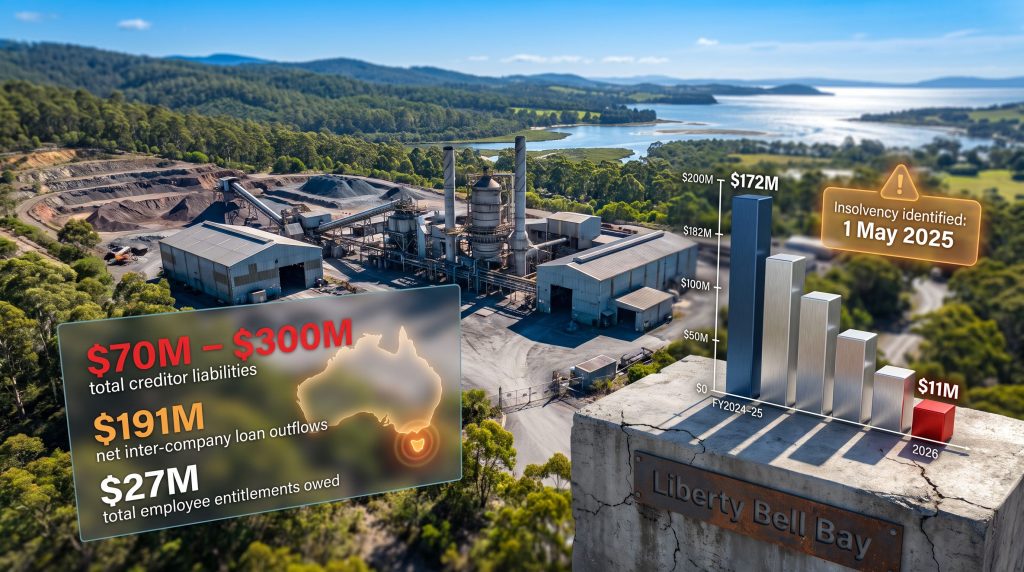
| Revenue FY2024-25 | $172 million |
| Revenue 2026 (partial year) | $11 million |
| Aged payables exceeding 60 days (FY2023-24) | 18% of total payables |
| Aged payables exceeding 60 days (2026) | 86% of total payables |
| Net inter-company loan outflows | $191 million |
| Estimated total creditor liabilities | $70 million – $300 million |
| Total employee entitlements owed | ~$27 million |
| Preliminary insolvent trading claim | ~$25 million (if proven) |
The aged payables figure is particularly revealing to those familiar with corporate distress indicators. When the proportion of bills outstanding beyond 60 days jumps from 18% to 86% within roughly two years, it signals that a company has lost the ability to manage basic operational cash flows. This metric is one of the earliest and most reliable warning signs of impending insolvency, and it was clearly visible well before the administration filing.
The Revenue Cliff and Operating Loss Escalation
The revenue collapse from $172 million in FY2024-25 to just $11 million in 2026 represents a near-total commercial shutdown in real time. This was not a gradual market retreat. It reflects a company that had effectively stopped trading at meaningful scale while still incurring costs, servicing debts, and obligating employee entitlements.
Operating losses had been recorded consistently since the 2022-23 financial year, meaning the business was destroying value for at least three consecutive years before formal administration. Furthermore, commodity price pressures compounded these difficulties. A net loss of $21 million in FY2022-23 ballooning to $80 million in FY2024-25 suggests that interventions during this period, including the Tasmanian government's August 2025 loan, were directed at a business already deep in structural decline rather than one facing a temporary liquidity shortfall.
The $191 Million Inter-Company Loan Question
Perhaps the most consequential finding in the administrators' report concerns the flow of capital out of Liberty Bell Bay through related-party transactions. Administrators confirmed that the net balance of inter-company loans transferred to related entities within the broader GFG Alliance group totalled approximately $191 million.
To contextualise that figure: the total estimated creditor liability for the company sits between $70 million and $300 million. The scale of related-party capital extraction is therefore comparable to, or potentially exceeding, the total amount now owed to creditors including employees, trade suppliers, and the Tasmanian government itself.
The administrators' report noted that outflows of cash to related parties significantly depleted the company's capacity to absorb supply chain disruptions and commodity price fluctuations, both of which are inherent features of operating in the manganese processing sector.
This raises a structural question that goes beyond Liberty Bell Bay specifically: how vulnerable are single-asset operating subsidiaries within large, diversified global conglomerates when capital is pooled at the group level rather than held at the operating entity? The pattern seen here, where a locally operating company is systematically drained of working capital through upstream loan arrangements, is not unique to this case.
Corporate Governance and Related-Party Transaction Oversight
Under the Corporations Act 2001 (Cth), related-party transactions are subject to disclosure and approval requirements, particularly where they may not be on arm's length commercial terms. The distinction between legitimate group treasury management and transactions that constitute uncommercial dealings or preferences is one that courts and regulators examine carefully in insolvency proceedings.
ASIC had already commenced an investigation into individuals connected to the broader corporate group, and the regulator had previously moved to wind up the company due to its failure to lodge annual financial reports for five consecutive years, spanning 2021 to 2025. That reporting failure is itself a significant data point: a company with $172 million in annual revenue operating without public financial disclosure for half a decade represents a systemic compliance gap that, arguably, should have triggered regulatory intervention far earlier.
The Government Loan: Timing, Purpose, and Accountability
The Tasmanian government's decision to extend a $20 million loan to Liberty Bell Bay in August 2025 now sits in uncomfortable proximity to the administrators' finding that the company was likely insolvent from as early as 1 May 2025, three months prior.
Of the total loan, $14 million was directed toward purchasing a single 23,000-tonne ore shipment, effectively funding one input procurement cycle for a smelter already operating at a fraction of its historical capacity. That ore was subsequently not utilised as intended, raising legitimate questions about what solvency assessment, if any, was completed before public funds were committed.
When state governments extend emergency financial support to industrial operators, the absence of mandatory independent solvency verification as a precondition creates material risk that public funds are deployed into enterprises that are already legally insolvent.
The loan decision also highlights a broader policy tension. Governments face genuine pressure to preserve regional employment and strategic industrial capacity, particularly in single-industry communities like Bell Bay. However, extending credit to a business without verified solvency creates compounding liabilities: the loan itself may become irrecoverable, the environmental remediation obligation transfers to the state, and the delay in formal administration can worsen the position of employee and trade creditors.
Who Bears the Remediation Cost?
Industrial smelter sites carry substantial environmental obligations. Soil contamination from heavy metal processing, structural decommissioning, waste stream management, and groundwater monitoring are all standard components of closing a facility of this type. Experts have indicated that, given Liberty Bell Bay's insolvency status, site remediation costs at Bell Bay are likely to fall on Tasmanian taxpayers rather than the company or its parent group.
Under Australian environmental law, when a company cannot fund its own site cleanup, the liability typically reverts to the relevant state government, either directly or through the activation of environmental bonds and regulatory indemnity frameworks. The scale of that liability at a manganese smelter site has not been formally quantified in publicly available documents, but industrial precedents suggest costs can reach tens of millions of dollars depending on site conditions and contamination extent.
The Human Dimension: 200 Workers and $27 Million in Unpaid Entitlements
When the smelter closed on 16 July 2026, approximately 200 workers lost their employment immediately, with no transitional operating period. The financial exposure to those workers is substantial:
| Employee Entitlement Category | Estimated Amount Owed |
|---|---|
| Redundancy and pay in lieu of notice | $22 million |
| Long service leave | $2.5 million |
| Annual leave | $2 million |
| Superannuation arrears | $661,000 |
| Total | ~$27 million |
The $22 million redundancy exposure is by far the largest component, reflecting both the scale of the workforce and the length of service of many employees at what had been a long-standing industrial anchor employer in the region.
The Fair Entitlements Guarantee: What Workers Can Access
Former Liberty Bell Bay employees may be eligible to claim unpaid entitlements through the federal Fair Entitlements Guarantee (FEG) scheme, which operates as a safety net for employees of insolvent employers. Key features of the FEG framework include:
- Coverage for unpaid wages, annual leave, long service leave, and redundancy payments up to legislated caps
- Payment caps that limit redundancy coverage to a maximum of four weeks per year of service, up to a ceiling determined by the applicable modern award or enterprise agreement
- Recovery timelines that can extend to several months from the date of claim submission
- Subrogation rights that allow the government to step into the shoes of employees as creditors in the subsequent liquidation
The practical implication for Liberty Bell Bay workers is that FEG may not cover the full $22 million in redundancy obligations, particularly for long-serving employees whose entitlements exceed statutory caps. The gap between what FEG pays and what was contractually owed represents a real financial loss for affected workers.
Regional Economic Exposure
Bell Bay's industrial precinct is one of northern Tasmania's primary employment hubs, hosting a cluster of energy-intensive industries that benefit from the region's hydroelectric power supply. The loss of the manganese smelter removes a significant anchor employer and disrupts the economic multiplier effect that flows from a major industrial payroll into the local economy through retail, services, and housing markets.
Redeployment of a specialised smelter workforce into equivalent roles within the same region presents a genuine challenge. The skills required for high-temperature manganese processing, including furnace operation, metallurgical quality control, and electrochemical process management, are not broadly transferable to other sectors without retraining investment. In addition, Australia's ambitions around green metals leadership are directly undermined when facilities such as this are lost permanently.
The next major ASX story will hit our subscribers first
Insolvent Trading: Legal Exposure and Director Liability
The administrators' preliminary estimate of an insolvent trading claim of approximately $25 million, if substantiated, carries significant legal consequences under Australian corporate law.
Under the Corporations Act 2001 (Cth), directors owe a duty to prevent a company from incurring debts when it is already insolvent or would become insolvent by incurring those debts. A breach of this duty can expose directors to personal civil liability for the amount of those debts, separate from any criminal liability for dishonest conduct.
In the administration context, the process for investigating and pursuing insolvent trading claims works as follows:
- Administrators investigate the company's financial history and identify the probable date of insolvency onset
- The administrators' report discloses preliminary findings to creditors, including an estimate of any insolvent trading claim
- If the company proceeds to liquidation, the liquidator assumes responsibility for formally assessing and pursuing the claim
- Legal proceedings may be initiated against directors personally, seeking compensation equal to the debts incurred after the insolvency date
- Proceeds recovered flow into the asset pool available for distribution to creditors
The identification of 1 May 2025 as the probable insolvency date means that any debts incurred between that date and the formal administration appointment in March 2026 are potentially subject to the insolvent trading claim. Given the company's reported activities during that period, including ore purchasing and ongoing operational expenditure, the $25 million preliminary estimate is plausible within that timeframe.
What the August 3 Creditors Meeting Will Decide
The creditors meeting scheduled for 3 August 2026 will determine the formal pathway for resolving Liberty Bell Bay's affairs. Creditors will vote on one of three outcomes:
- Return control to directors via a Deed of Company Arrangement (DOCA) if a viable restructuring proposal is presented
- Execute a DOCA under the terms proposed by administrators or a third party
- Wind up the company into liquidation and appoint a liquidator
Given the absence of a viable sale process, the collapse of the proposed transaction that triggered the July closure, and the scale of the liability gap relative to recoverable assets, liquidation is the most probable outcome at the August meeting.
A liquidator, once appointed, would pursue the following recovery avenues:
- The preliminary $25 million insolvent trading claim against directors
- Voidable transaction recoveries, including potential unfair preferences paid to creditors in the six months before administration
- Demands for repayment of the $191 million inter-company loan balance from related entities within the GFG Alliance group
- Realisation of physical assets including plant, equipment, and any remaining ore stockpiles
The realistic recovery rate for creditors is highly uncertain given the wide liability range of $70 million to $300 million and the complexity of pursuing related-party claims across international corporate structures.
Policy Takeaways: Reforming Industrial Support Frameworks
The Liberty Bell Bay insolvency presents Australian policymakers with a clear set of structural lessons. The following comparison illustrates the relative risk profiles of different government intervention models for distressed industrial operators:
| Intervention Type | Risk Profile | Accountability Mechanism | Outcome Precedent |
|---|---|---|---|
| Emergency operational loan | High if solvency not verified | Loan conditions and reporting covenants | Variable, dependent on underlying viability |
| Equity co-investment | Medium, shared upside and downside | Board representation and governance rights | More aligned incentives |
| Workforce transition funding | Low, targeted at people not the entity | Employment outcomes reporting | Generally positive social outcomes |
| Site remediation guarantee | Contingent, activated on insolvency | Environmental authority oversight | Protects public interest but potentially costly |
The case for mandatory independent solvency verification before any public loan is extended to a distressed industrial operator is strengthened considerably by the Liberty Bell Bay experience. Similarly, the five-year gap in financial reporting by a company of this scale and strategic significance points to a need for enhanced real-time disclosure obligations for large private employers operating critical infrastructure.
Furthermore, the broader implications for strategically positioned projects — such as the Chvaletice manganese project — illustrate just how consequential gaps in domestic processing capacity can be when a key facility is permanently lost. ASIC's existing enforcement action against individuals connected to the broader corporate group signals regulatory appetite for accountability. Whether that translates into meaningful outcomes for creditors and the public through the liquidation process remains to be seen.
Frequently Asked Questions: Liberty Bell Bay Insolvency
When did Liberty Bell Bay become insolvent?
Administrators from EY Parthenon identified that the company may have been insolvent from as early as 1 May 2025, more than a year before the smelter's formal closure in July 2026.
How much does Liberty Bell Bay owe to creditors?
The administrators' report estimates total creditor liabilities in the range of $70 million to $300 million, with approximately $27 million owed directly to the company's roughly 200 former employees.
What is the insolvent trading claim and who could be liable?
Administrators have flagged a preliminary insolvent trading claim of approximately $25 million. If substantiated through legal proceedings, this could expose company directors to personal financial liability under Australian corporate law.
What happened to the Tasmanian government's $20 million loan?
The state government extended the loan in August 2025, after the identified insolvency date of May 2025. Of the total, $14 million was used to purchase a 23,000-tonne ore shipment. The loan's status and recoverability will form part of the liquidation process.
What will happen to the 200 workers who lost their jobs?
Former employees may be eligible to claim unpaid entitlements through the federal Fair Entitlements Guarantee (FEG) scheme, subject to eligibility criteria and payment caps. Outstanding entitlements include redundancy payments, leave balances, and superannuation arrears totalling approximately $27 million.
What is the next step in the Liberty Bell Bay administration process?
A creditors meeting is scheduled for 3 August 2026, at which creditors will vote on the company's future. Given the financial position outlined in the administrators' report, liquidation is considered the most likely outcome.
This article is intended for informational purposes only and does not constitute legal or financial advice. Figures cited are drawn from the EY Parthenon voluntary administrators' report and publicly available sources current as of late July 2026. Outcomes in insolvency proceedings are inherently uncertain and subject to change. Readers seeking legal guidance on creditor rights or employee entitlements should consult a qualified professional.
Readers seeking further context on the Liberty Bell Bay situation and its broader implications for Tasmanian industry can explore ongoing coverage available through ABC News at abc.net.au.
Want to Track the Next Major Mineral Discovery Before the Market Moves?
The Liberty Bell Bay collapse is a stark reminder of how quickly strategic mineral processing capacity — and the investment value surrounding it — can be permanently lost. Discovery Alert's proprietary Discovery IQ model delivers real-time alerts on significant ASX mineral discoveries across more than 30 commodities, including manganese and other critical minerals, turning complex data into actionable insights the moment announcements hit the exchange — explore why historic discoveries generate substantial returns and begin your 14-day free trial today to position yourself ahead of the broader market.