August 12, 2026
When Multilateral Finance Meets a Mining Supercycle: Guinea's Structural Moment
Across Sub-Saharan Africa, the relationship between sovereign borrowing, commodity wealth, and institutional reform has rarely produced straightforward outcomes. Economies flush with natural resources have repeatedly demonstrated that abundance alone does not translate into durable development. The more consequential variable tends to be the quality of institutions built to manage that wealth, and the willingness of governments to submit to external accountability frameworks during periods of expansion rather than crisis.
This dynamic is precisely what makes Guinea's current position so analytically interesting. The country is not approaching the International Monetary Fund from a position of fiscal emergency. Instead, it is pursuing a structured engagement at a moment of accelerating economic momentum, anchored by one of the most significant iron ore developments in modern mining history.
The Guinea IMF staff-level agreement reached in August 2026, covering a $425 million program under the Extended Credit Facility, represents something more nuanced than a standard balance-of-payments rescue. It is an attempt to institutionalise fiscal discipline precisely when commodity revenues are beginning to rise, and when the temptation to defer structural reform is at its highest.
When big ASX news breaks, our subscribers know first
Understanding the Extended Credit Facility and Why Guinea Qualifies
Not all IMF lending instruments carry the same terms, conditions, or strategic intent. The Extended Credit Facility occupies a specific position within the Fund's toolkit, designed exclusively for low-income countries experiencing what the IMF characterises as protracted balance-of-payments difficulties.
How ECF Terms Compare to Other IMF Instruments
The distinction between the ECF and its counterparts matters considerably when assessing the nature of Guinea's engagement with the Fund.
| IMF Facility | Target Country Profile | Interest Rate | Repayment Period | Program Length |
|---|---|---|---|---|
| Extended Credit Facility (ECF) | Low-income countries | Concessional (currently 0%) | 5.5 to 10 years | Typically 3 to 4 years |
| Stand-By Arrangement (SBA) | Emerging/advanced economies | Market-based | 3.25 to 5 years | 12 to 24 months |
| Extended Fund Facility (EFF) | Structural reform-intensive economies | Market-based | 4.5 to 10 years | Up to 4 years |
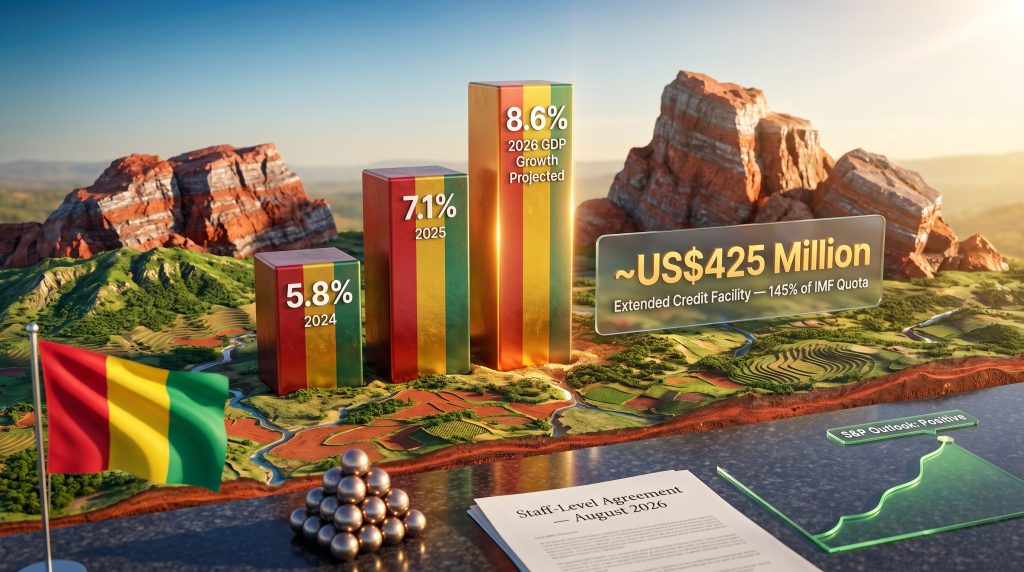
Guinea's access to concessional ECF financing reflects its classification as a low-income economy, but the program's scale is far from routine. The SDR 310.59 million commitment, equivalent to approximately US$425 million at prevailing exchange rates, represents 145% of Guinea's IMF quota. That ratio matters because it signals the Fund's assessment of program ambition relative to the country's economic weight within the institution.
A 41-month duration also places this arrangement toward the longer end of typical ECF engagements across Sub-Saharan Africa, where programs often run between 36 and 48 months. The extended timeline reflects the structural depth of the reforms being embedded into Guinea's fiscal architecture. According to the IMF's programme documentation for Guinea, the country's engagement with the Fund spans several interconnected reform dimensions.
The Approval Pipeline: What Comes Before Any Funds Flow
A critical distinction that frequently escapes broader coverage is the difference between a staff-level agreement and an active IMF program. These are not equivalent milestones.
A staff-level agreement is a technical accord between IMF economists and a member country's finance authorities. It carries no legal enforceability and triggers no disbursement. Funds only flow once IMF management has reviewed the arrangement and the Executive Board has formally voted to approve it.
The sequential stages before Guinea accesses any financing are as follows:
- Staff-level agreement concluded between IMF technical teams and Guinea's Finance Ministry (August 2026 — completed)
- IMF management review and internal endorsement of the program parameters
- Executive Board formal vote, anticipated for September 2026
- Initial disbursement released upon Board approval
- Subsequent tranches unlocked through periodic program reviews, typically every six months
Several variables could affect the timeline between now and Board approval. Governance benchmarks and so-called prior actions — structural measures Guinea must implement before the Board meeting — represent a common source of delay in similar programs across the region. Geopolitical dynamics within the 25-member Executive Board can also introduce friction, particularly when programs involve countries navigating post-transition political environments.
The Reform Architecture: Six Pillars of Structural Commitment
Guinea's Finance Ministry has characterised the program's reform agenda across several interconnected domains. Understanding each pillar separately illuminates the structural complexity the government is committing to over 41 months.
| Reform Pillar | Key Objective | Primary Implementation Challenge |
|---|---|---|
| Domestic Revenue Mobilisation | Broaden tax base beyond mining sector | Scale of informal economy |
| Natural Resource Transparency | Audit, disclose, and govern mining contracts | Institutional capacity and historical opacity |
| Public Financial Management | Strengthen budget execution and controls | Legacy procurement weaknesses |
| Exchange Rate Flexibility | Rebuild foreign exchange reserves | Managing currency transition |
| Anti-Corruption and Governance | Align with IMF safeguards standards | Political economy resistance |
| Private Sector Development | Diversify economic base and create employment | Infrastructure and regulatory gaps |
Fiscal Diversification Beyond Mining Revenue
One of the more technically demanding aspects of the program involves Guinea's attempt to develop a non-mining tax base capable of sustaining public expenditure independently of commodity price cycles. Guinea's informal economy remains substantial, and tax administration capacity has historically been concentrated around the extractive sector rather than distributed across the broader economy.
Building domestic revenue systems that function during periods of iron ore price weakness is not simply a governance priority. It is the difference between fiscal resilience and boom-bust dependency, a pattern that has destabilised resource-rich economies across the continent repeatedly over the past four decades.
Natural Resource Governance as a Debt Sustainability Anchor
The governance conditions embedded within the ECF program are specifically designed to address what economists sometimes call the resource curse paradox: the tendency for natural resource abundance to weaken institutional quality rather than strengthen it. Guinea has significant exposure to this risk given the scale of Simandou relative to its existing economic base.
Transparency frameworks for mining revenue capture, contract disclosure requirements, and sovereign wealth fund considerations all form part of the governance architecture the program is designed to reinforce. Regional comparisons are instructive. Botswana's diamond revenue management through the Pula Fund is frequently cited as a benchmark of how resource wealth can be insulated from short-term political pressures. Ghana's experience with oil revenues following the Jubilee field discoveries provides a more cautionary reference point, where governance commitments proved difficult to sustain as revenues grew.
Simandou: The Variable That Changes Everything
No analysis of Guinea's IMF engagement is complete without understanding the Simandou iron ore project's transformative scale. Simandou is not simply a large mine. It is among the largest undeveloped iron ore deposits globally, and its production ramp-up is already reshaping Guinea's growth trajectory. Furthermore, the iron ore demand outlook for the coming years adds further complexity to Guinea's fiscal planning.
Growth Projections and the Simandou Effect
- 2025 GDP growth (estimated): 7.1%
- 2026 GDP growth (projected): 8.6%
- Average annual GDP growth forecast (2026 to 2029): approximately 10%, per Standard and Poor's
Standard and Poor's revised Guinea's sovereign outlook from stable to positive in March 2026, maintaining the country's B credit rating while signalling conditions that could support an upgrade if reform momentum continues and Simandou delivers on production expectations.
A positive outlook from a major credit rating agency does not constitute an upgrade. It signals that the agency considers an upgrade more likely than not over the following 12 to 24 months, contingent on specified conditions being met.
The practical distinction matters for investors assessing Guinea's sovereign credit trajectory. Moving from B to B+ would represent a meaningful improvement in borrowing costs and would expand the pool of institutional capital eligible to invest in Guinean sovereign instruments.
Why Mining Megaprojects Create Fiscal Complexity
Simandou's contribution to export revenue, employment, and infrastructure development introduces a fiscal management challenge that is less obvious than it might appear. When a single project accounts for a disproportionate share of GDP growth and export earnings, the government's fiscal position becomes highly sensitive to variables outside its control: iron ore prices, shipping logistics, joint venture partner decisions, and global steel demand cycles.
The IMF program's design appears to account for this concentration risk, embedding diversification objectives and exchange rate reserve targets that would provide buffer capacity during commodity downturns. This is structurally sound program design, though implementation will depend on political will that may weaken as Simandou revenues begin flowing.
Guinea in Regional Context: ECF Program Benchmarking
Situating Guinea's program within the broader West African ECF landscape provides useful perspective on both its ambition and its distinctive features. In addition, examining how China steel and iron ore market dynamics influence demand for Simandou's output is essential context for understanding Guinea's macroeconomic position.
| Country | IMF Facility | Approximate Value | Program Focus | Status |
|---|---|---|---|---|
| Guinea | ECF | ~US$425 million | Mining revenue governance, fiscal reform | Staff-level agreement (August 2026) |
| Sierra Leone | ECF | ~US$224 million | Post-conflict fiscal consolidation | Active |
| Liberia | ECF | ~US$270 million | Revenue mobilisation, debt management | Active |
| Senegal | ECF/EFF | ~US$1.8 billion | Fiscal consolidation post-oil discovery | Active |
Note: Program values are approximate figures drawn from publicly available IMF documentation.
Guinea's program stands apart from regional peers in two respects. First, the 145% quota access level signals considerably greater program ambition than is typical for ECF arrangements in the ECOWAS zone. Second, the Simandou variable introduces a growth dynamic with no direct parallel in comparable programs, where the primary challenge is managing fiscal consolidation during periods of constrained growth rather than structuring governance around an accelerating commodity windfall.
The next major ASX story will hit our subscribers first
What IMF Engagement Signals to Capital Markets
The confidence signal function of ECF programs extends well beyond the bilateral relationship between Guinea and the IMF. Active program status typically acts as a prerequisite for unlocking co-financing from multilateral institutions including the World Bank and the African Development Bank, as well as from bilateral development finance partners.
Credit rating agencies have historically treated IMF program engagement as a positive governance signal, not because the programs guarantee success, but because they impose external accountability structures that reduce the probability of sudden fiscal deterioration. For Guinea specifically, sustained program compliance would likely be a necessary condition for the S&P outlook conversion from positive to an actual rating upgrade.
For foreign direct investors in the mining sector, IMF-anchored macroeconomic stability reduces one category of country risk that is difficult to hedge through contractual mechanisms alone: currency unpredictability and sovereign policy reversals. Exchange rate flexibility targets within the program, if delivered, would benefit mining operators whose cost structures are denominated in local currency while revenues accrue in US dollars. Furthermore, the broader critical minerals demand surge globally reinforces the strategic importance of Guinea's mineral governance framework for international investors.
Key Risks That Could Undermine Program Outcomes
Analytical honesty requires acknowledging that IMF program completion rates in Sub-Saharan Africa are not uniformly strong. Programs are frequently renegotiated, paused, or restructured when domestic political conditions shift or when external shocks erode the fiscal space needed to sustain reform commitments.
For Guinea, the primary risk categories include:
- Commodity price volatility: Tariffs and iron ore market disruptions could directly compress Simandou-related fiscal revenues, potentially triggering pressure to relax expenditure discipline
- Political economy resistance: Anti-corruption and governance reforms consistently face the strongest implementation headwinds, particularly in post-transition environments
- Institutional capacity constraints: Guinea's public financial management systems have limited depth, making technically demanding reforms difficult to execute within ambitious timelines
- Climate and agricultural disruptions: Bauxite production and agricultural output, both significant contributors to Guinea's existing economic base, carry exposure to climate-related disruption
- Global monetary conditions: External debt servicing capacity is sensitive to shifts in global interest rates and US dollar strength
There is a structural paradox embedded in resource-rich IMF programs: as commodity revenues rise, the perceived urgency of fiscal reform tends to fall. Political will to comply with program conditions often weakens precisely when compliance matters most, during the period of peak revenue growth.
This paradox is not unique to Guinea. It has played out across multiple African economies following major resource discoveries. The IMF program's multi-year duration and periodic review structure are designed to counteract this dynamic by maintaining external accountability through the revenue cycle rather than just at its beginning. A preliminary agreement on the $425 million program was confirmed by financial reporting across multiple outlets tracking West African sovereign finance.
Frequently Asked Questions
What is a staff-level agreement with the IMF?
A staff-level agreement is a preliminary technical understanding reached between IMF economists and a member country's government. It establishes the policy commitments and financial parameters of a proposed program but carries no legal effect and triggers no disbursement until formally approved by IMF management and the Executive Board.
When will Guinea's IMF program be officially approved?
IMF management and the Executive Board are expected to consider Guinea's program in September 2026. Approval at that stage would authorise the first disbursement under the Extended Credit Facility.
How much could Guinea access under the program?
If the Executive Board approves the arrangement, Guinea could access approximately US$425 million (SDR 310.59 million), equivalent to 145% of its IMF quota, disbursed in tranches across the 41-month program period.
What reforms is Guinea committing to implement?
The program encompasses domestic revenue mobilisation, natural resource transparency, public financial management improvements, foreign exchange reserve rebuilding, exchange rate flexibility, anti-corruption measures, and private sector development initiatives.
Program Summary at a Glance
| Metric | Detail |
|---|---|
| Program Value | ~US$425 million (SDR 310.59 million) |
| IMF Facility Type | Extended Credit Facility (ECF) |
| Program Duration | 41 months |
| Quota Access Level | 145% of Guinea's IMF quota |
| Board Approval Expected | September 2026 |
| 2025 GDP Growth (Estimated) | 7.1% |
| 2026 GDP Growth (Projected) | 8.6% |
| S&P Sovereign Rating | B (Outlook: Positive, revised March 2026) |
| S&P Average Growth Forecast (2026 to 2029) | Approximately 10% per annum |
| Primary Growth Driver | Simandou iron ore project |
This article contains forward-looking projections sourced from IMF program documentation and Standard and Poor's sovereign assessments. Growth forecasts and credit outlook revisions are subject to change based on commodity market conditions, program implementation performance, and broader macroeconomic developments. Nothing in this article constitutes investment or financial advice.
For ongoing coverage of Guinea's economic trajectory, Simandou's development timeline, and West African public finance developments, Ecofin Agency at ecofinagency.com provides detailed sector reporting across African markets.
Want to Position Yourself Ahead of the Next Major Mineral Discovery?
Discovery Alert's proprietary Discovery IQ model delivers real-time alerts on significant ASX mineral discoveries, transforming complex mineral data into actionable investment insights for both short-term traders and long-term investors — explore historic examples of major discovery returns to understand what's possible, then begin your 14-day free trial at Discovery Alert to secure your market-leading advantage.