August 12, 2026
When a 73% Rally Leaves Investors Asking What Comes Next
Few questions in resources investing are more psychologically loaded than whether to buy into a stock after a major run-up. The instinct to wait for a pullback battles constantly with the fear of missing further gains. For investors considering whether to buy Mineral Resources shares in mid-2026, that tension is front and centre — and the data tells a more nuanced story than the headline return might suggest.
Understanding where Mineral Resources sits in the broader ASX resources cycle requires more than a glance at its 12-month chart. It demands a clear-eyed look at commodity fundamentals, operational performance, balance sheet risk, and the structural architecture of the business itself.
When big ASX news breaks, our subscribers know first
What Kind of Business Is Mineral Resources (ASX: MIN)?
Mineral Resources Ltd is not a straightforward mining company. Unlike most ASX-listed resource producers that derive revenue from a single commodity, MIN operates across three structurally distinct segments that together create a business with unusual earnings diversity — and unusual complexity.
- Mining Services — a large-scale contract crushing and mining services operation that generates revenue regardless of commodity prices, creating a degree of earnings insulation not available to pure-play miners.
- Iron Ore — Western Australian export-grade iron ore production, with operations that include the Onslow Iron project, adding a significant new production vector to the portfolio.
- Lithium — hard-rock spodumene production targeting battery-grade markets, primarily through the Mt Marion and Bald Hill operations.
This three-segment structure is worth understanding deeply before deciding whether to buy Mineral Resources shares. The Mining Services division acts as something of an internal shock absorber, generating contracted revenue streams even when commodity prices are under pressure. This is a feature that mega-cap peers like BHP and Rio Tinto simply do not have.
| Feature | Mineral Resources (MIN) | BHP Group (BHP) | Rio Tinto (RIO) |
|---|---|---|---|
| Primary Commodities | Iron Ore + Lithium + Services | Iron Ore + Copper + Coal | Iron Ore + Aluminium + Copper |
| Integrated Mining Services | Yes | No | No |
| Lithium Exposure | Significant | Minimal | Emerging |
| Market Cap Tier | Mid-Large Cap | Mega Cap | Mega Cap |
The integrated services model is not merely a revenue diversifier. It provides MIN with genuine cost advantages at its own mine sites, because the same equipment fleets and technical teams serve both the company's internal operations and third-party clients. This creates scale efficiencies that external contractors cannot easily replicate.
Breaking Down the 72.7% Rally: What Actually Happened?
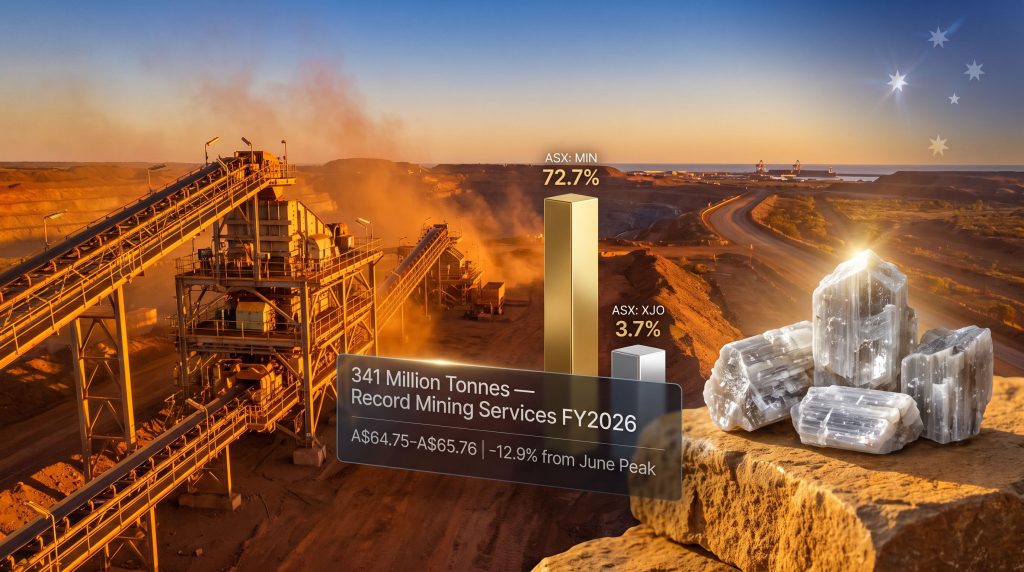
Between August 2025 and August 2026, Mineral Resources shares climbed from approximately $37.50 to a trading range of A$64.75 to A$65.76, delivering a 72.7% total price return. By comparison, the S&P/ASX 200 Index (ASX: XJO) returned just 3.7% over the same period — meaning MIN outperformed the benchmark by a ratio approaching 20 to 1.
That kind of divergence raises an important question: was this a fundamental re-rating, a speculative overshoot, or a combination of both?
The evidence points toward a multi-factor fundamental recovery, not simply momentum-driven speculation. The key drivers included:
- Lithium market stabilisation — After a severe and prolonged downturn in lithium carbonate and spodumene prices that began in late 2022, market conditions began to find a floor through 2025 as supply discipline improved and demand signals from the EV sector held firm.
- Record operational throughput — The Mining Services division delivered record annual volumes in FY2026, demonstrating that the operational engine of the business was performing at a higher level than at any prior point in its history.
- Project milestone delivery — Construction commencements and Final Investment Decisions signalled that the company's growth pipeline was progressing on schedule, giving institutional investors greater confidence in the earnings trajectory.
- Institutional sentiment re-engagement — Cyclical resources companies like MIN tend to attract institutional capital in waves. As lithium sentiment improved and iron ore held relatively firm, fund managers that had reduced exposure during the downturn began rebuilding positions.
Critically, MIN shares are currently trading approximately 12.9% below their recent peak of $74.33, recorded at the 1 June 2026 close. That pullback creates a meaningfully different entry dynamic compared to buying at the top of the cycle.
FY2026 Operational Results: What the Numbers Say
On 29 July 2026, Mineral Resources released its June quarter and full-year operational update. The results were broadly ahead of market expectations, with the company meeting or exceeding volume and cost guidance across all three business divisions — a clean sweep that is rarely achieved simultaneously across multiple commodity segments.
| Business Segment | Key Metric | FY2026 Result |
|---|---|---|
| Mining Services | Annual throughput volume | 341 million tonnes (record) |
| Iron Ore | Quarterly production | 29.5 million tonnes |
| Lithium (SC6 equivalent) | Quarterly production | 559,000 dry metric tonnes |
The 341 million tonne Mining Services result is particularly significant from an analytical standpoint. Throughput volume at this scale reflects not only strong equipment utilisation but also favourable client contract activity across Western Australian mine sites. Furthermore, as MIN deploys more internal production capacity at Onslow Iron, the interplay between external contract revenue and internal throughput will be an important metric for investors to monitor. The latest Onslow haul road update reinforces just how central this infrastructure is to the project's long-term delivery.
Three Project Milestones That Mattered
Three project-level milestones from the quarter also deserved close attention:
- Onslow Iron construction commenced — The Onslow Iron project represents a substantial new iron ore production source for MIN. Construction commencement is a significant de-risking event that shifts the project from development-stage risk to execution-stage risk. In addition, the Onslow transhipper expansion signals growing logistical capacity to support export volumes at scale.
- Bald Hill lithium restart — The recommencement of production at Bald Hill expands MIN's lithium portfolio at a point when market conditions are improving, adding volume leverage to any spodumene price recovery.
- Mt Marion FID — The Final Investment Decision to construct a flotation plant and develop underground lithium mining at Mt Marion upgrades the asset's long-term production profile considerably. Underground mining at Mt Marion will access higher-grade ore bodies that are not accessible from open-pit operations, which has direct implications for concentrate quality and unit economics.
The underground development at Mt Marion is a technically significant step. Hard-rock lithium operations that transition from open-pit to underground typically access ore at higher grades, which can improve the SC6 (6% spodumene concentrate) yield per tonne of ore processed — a key driver of revenue per tonne mined.
MIN shares closed up 4.8% on the day the quarterly results were published, reflecting strong market endorsement of both the operational data and the project pipeline progress.
The Spodumene Concentrate Market: A Primer for Investors
One of the less widely understood aspects of MIN's lithium business is how spodumene concentrate quality affects realised pricing. The benchmark grade for lithium concentrate traded on international markets is SC6, referring to a product containing 6% lithium oxide (Li₂O) by weight.
Producers that consistently achieve SC6 or above command premium pricing relative to those delivering lower-grade material. Understanding the spodumene pricing dynamics is therefore essential context for evaluating MIN's lithium division. MIN's operations, particularly at Mt Marion, have historically produced a blend of concentrate grades, and the planned flotation plant is specifically designed to upgrade the quality of concentrate output.
This is not simply a volume story. Grade improvement directly affects revenue per tonne and can materially change the economics of an operation even without a change in ore throughput rates. Consequently, investors evaluating MIN's lithium segment should watch concentrate grade metrics alongside raw production volume figures as the Mt Marion upgrades progress.
Why Analysts Remain Constructive Despite the Strong Run-Up
Shaw and Partners analyst James Bills maintained a Buy recommendation on Mineral Resources shares in August 2026, grounding his view in three structural investment arguments rather than short-term price momentum.
Commodity exposure to structural megatrends: MIN's dual positioning in iron ore and lithium places the company at the intersection of two of the largest capital allocation cycles of the coming decade — global infrastructure investment and the electrification of transport. Neither of these demand drivers is expected to be short-lived.
Asset quality and integrated business model: The combination of long-life mining assets with an in-house services operation creates cost structures that external contractors cannot easily undercut. The lithium portfolio, as it scales through Bald Hill restarts and Mt Marion upgrades, is positioned to deliver volume growth into a recovering price environment.
Risk-reward asymmetry at current prices: Bills noted that the pullback from MIN's June 2026 peak represents a more favourable entry point for investors with a tolerance for cyclical price swings. At a 12.9% discount to the recent high, the risk-reward calculus shifts in favour of buyers relative to where shares were trading at the cycle peak.
Not all analysts share this view. Morgans has reportedly held a Sell rating with a price target of approximately A$68.00, citing concerns around balance sheet leverage and earnings volatility. The divergence between these views reflects a genuine analytical disagreement about how quickly lithium market conditions will improve and how effectively MIN can execute its concurrent capital projects.
| Broker | Rating | Price Target |
|---|---|---|
| Shaw and Partners (James Bills) | Buy | Not specified (August 2026) |
| Morgans | Sell | A$68.00 |
The next major ASX story will hit our subscribers first
Key Risks Every Investor Should Weigh Before Buying MIN
The 72.7% return over 12 months is compelling, but it should not be allowed to obscure the genuine risk dimensions that attach to Mineral Resources as an investment.
Commodity price cyclicality: Both iron ore and lithium are notoriously sensitive to macro demand cycles. Iron ore pricing is particularly exposed to Chinese steel production trends, which are in turn influenced by property sector activity and infrastructure spending. A sustained downturn in Chinese demand could compress MIN's iron ore revenue quickly.
Concurrent project execution risk: MIN is running multiple major capital projects simultaneously — Onslow Iron construction, Bald Hill restart, and Mt Marion underground development and flotation plant construction. Managing this level of concurrent capital expenditure requires exceptional project management discipline. Cost overruns or schedule delays on any of these projects could weigh heavily on near-term free cash flow.
Balance sheet and leverage: Investors should carefully review MIN's debt levels relative to operating cash flow. Capital-intensive companies managing multiple simultaneous construction projects are inherently exposed to interest rate sensitivity and financing risk if commodity prices deteriorate before projects reach production.
Portfolio concentration: Investors already holding significant ASX resources exposure through BHP, Rio Tinto, or Pilbara Minerals should assess whether adding MIN increases their commodity risk concentration to an uncomfortable level.
⚠️ Risk Callout: Mineral Resources is a cyclical, capital-intensive business operating across volatile commodity markets. The 72.7% 12-month share price return referenced in this article is historical data and is not a reliable guide to future performance. Investors should conduct independent due diligence and consider consulting a licensed financial adviser before making investment decisions.
How to Buy Mineral Resources Shares on the ASX
For investors who have assessed the risk-reward profile and wish to establish a position, the process of buying Mineral Resources shares on the ASX is straightforward.
Step 1: Select a Brokerage with ASX Access
Choose an online broker licensed to operate in Australia that provides access to ASX-listed securities. Options commonly available to Australian residents include CommSec, Stake, SelfWealth, and eToro. Compare brokerage fees, platform features, and minimum deposit thresholds before committing. You can also review MIN's official company profile to better understand the business before selecting your platform.
Step 2: Open and Verify Your Account
Complete the broker's registration process, including identity verification using a driver's licence or passport, in accordance with Australian KYC and AML compliance requirements.
Step 3: Fund Your Account
Deposit funds via bank transfer (BPAY or direct deposit). Ensure your available balance covers the total purchase cost plus applicable brokerage fees.
Step 4: Search for ASX: MIN
Within the broker platform, search for the ticker MIN or the full company name "Mineral Resources Ltd" to locate the correct security.
Step 5: Choose Your Order Type
| Order Type | How It Works | Best Used When |
|---|---|---|
| Market Order | Executes immediately at the prevailing market price | Speed of execution is the priority |
| Limit Order | Executes only at your nominated price or better | Price control is more important than speed |
Step 6: Review and Submit
Verify the quantity, price, and total cost before confirming. Completed trades settle through the ASX's CHESS system on a T+2 basis.
Most Australian brokers set a minimum trade value of $500, though some platforms support smaller amounts or fractional share purchases for eligible securities.
FAQs: Buying Mineral Resources Shares
What is the ASX ticker for Mineral Resources?
Mineral Resources Ltd trades under the ticker symbol MIN on the Australian Securities Exchange.
What price range did MIN shares trade in during August 2026?
MIN shares traded between approximately A$64.75 and A$65.76 during 11-12 August 2026, sitting roughly 12.9% below the 1 June 2026 closing high of $74.33.
Does Mineral Resources pay dividends?
Mineral Resources has paid dividends historically, though distributions vary considerably with the earnings cycle given the company's commodity price exposure. Investors should review the current dividend history and payout ratio via the ASX announcements platform before factoring income into an investment thesis.
Can international investors buy MIN shares?
Some international brokerage platforms with ASX market access — including eToro and Stake — allow non-Australian residents to purchase ASX-listed securities. Eligibility depends on the investor's country of residence and the specific markets supported by the chosen broker.
What is the minimum investment needed to buy MIN shares?
The minimum depends on the chosen broker's requirements. Most Australian platforms set a minimum trade value of $500, though this varies between providers.
Key Takeaways for Investors Considering MIN
- MIN delivered a 72.7% share price return over the 12 months to August 2026, versus just 3.7% for the ASX 200.
- The company achieved record Mining Services throughput of 341 million tonnes in FY2026, alongside strong production results across iron ore and lithium.
- Three major project milestones were achieved in the June quarter: Onslow Iron construction commencement, Bald Hill restart, and the Mt Marion FID for a flotation plant and underground development.
- The planned Mt Marion flotation plant upgrade is designed to improve spodumene concentrate grade toward the SC6 benchmark, with direct implications for revenue per tonne.
- MIN is currently trading approximately 12.9% below its recent June 2026 peak, which some analysts view as a more attractive entry point relative to buying at the cycle high.
- Analyst views are mixed, ranging from Buy at Shaw and Partners to Sell at Morgans, reflecting genuine disagreement about the pace of lithium recovery and project execution risk.
- Investors should assess commodity price cyclicality, balance sheet leverage, and concurrent project execution risk before deciding to buy Mineral Resources shares.
This article contains general information only and does not constitute personalised financial advice. Mineral Resources Ltd (ASX: MIN) shares carry investment risk, including the potential loss of capital. Past performance is not indicative of future results. Please consult a licensed financial adviser before making investment decisions.
Want to Catch the Next Major ASX Mineral Discovery Before the Market Does?
Discovery Alert's proprietary Discovery IQ model scans ASX announcements in real time, instantly identifying significant mineral discoveries across more than 30 commodities — from lithium to iron ore — and delivering actionable alerts to subscribers ahead of the broader market. Explore historic discoveries and the returns they generated, then begin your 14-day free trial at Discovery Alert to position yourself at the forefront of the next major find.