August 12, 2026
The Quiet Commodity Reshaping Western Industrial Strategy
Few commodity markets carry the same geopolitical weight as tungsten. Unlike lithium or cobalt, tungsten rarely dominates financial headlines, yet its properties make it functionally irreplaceable across defence manufacturing, semiconductor fabrication, and high-performance engineering. It is extraordinarily dense, maintains structural integrity at temperatures exceeding 3,400 degrees Celsius, and cannot be substituted in many of its critical applications. For investors tracking critical minerals, understanding the strategic importance of tungsten is the essential starting point for evaluating any producer operating outside of China.
That supply architecture has a fundamental imbalance at its core. China controls an estimated 80% or more of global tungsten mine output and dominates the downstream processing and refining stages. This concentration creates a structural pricing dynamic that benefits non-Chinese producers during any period of trade friction, export restriction, or geopolitical realignment. When Chinese supply tightens, prices move sharply, and producers with established Western assets capture an outsized share of that premium. This is the macro environment into which Almonty Industries has delivered its Q2 2026 results, and that context is inseparable from any honest reading of the numbers.
When big ASX news breaks, our subscribers know first
Deconstructing the Almonty Q2 2026 Financial Snapshot
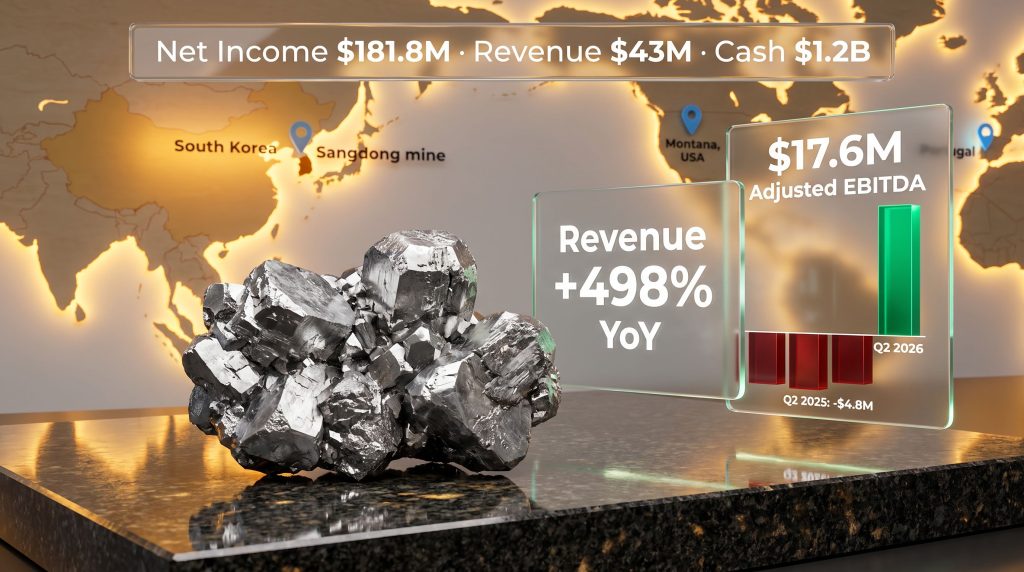
The headline figures from Almonty's second quarter of 2026 demand careful disaggregation. The Almonty Q2 net income gains reported by the company reached $181.8 million, a dramatic reversal from a net loss of $58.2 million in the same quarter of 2025. Revenue surged 498% year-on-year to $43 million, driven by the early commercial production phase at the Sangdong tungsten mine in South Korea. Adjusted EBITDA moved from a loss of $4.8 million to a positive $17.6 million, and diluted earnings per share reached $0.62 against a prior-year figure of negative $0.30.
| Metric | Q2 2026 | Q2 2025 | Movement |
|---|---|---|---|
| Net Income / (Loss) | $181.8 million | ($58.2 million) | +$240 million swing |
| Revenue | $43 million | ~$7.2 million | +498% YoY |
| Adjusted EBITDA | $17.6 million | ($4.8 million) | +$22.4 million |
| Basic EPS | $0.64 | ($0.30) | Turnaround |
| Diluted EPS | $0.62 | ($0.30) | Turnaround |
| Non-Cash Revaluation Gains | ~$173.1 million | n/a | Primary net income driver |
These numbers tell two distinct stories depending on which line items receive analytical attention. The net income figure captures most of the media coverage, but the adjusted EBITDA and revenue trajectory are where operational progress becomes legible.
Why the Net Income Figure Requires Careful Interpretation
Of the $181.8 million net income reported, approximately $173.1 million consisted of non-cash revaluation gains on derivative and warrant instruments. These gains arise when the fair value of financial instruments, such as warrants issued during capital raising rounds, moves in a direction favourable to the company. Critically, they represent an accounting adjustment rather than cash generated from mining operations.
Investors evaluating mining companies in ramp-up phases should treat large non-cash revaluation components with caution. Net income figures dominated by fair value adjustments can create a misleading impression of operational profitability. Adjusted EBITDA and operating cash flow are the more reliable performance signals at this stage of a mine's lifecycle.
Stripping out the non-cash component leaves an operational earnings contribution that is substantially smaller than the headline suggests. This is not unusual for companies transitioning from development to production, but it is analytically important. The warrant and derivative instruments that generated these revaluation gains will also have a dilutive effect on future earnings per share as they are exercised or resolved, adding another layer of complexity for long-term modelling.
Adjusted EBITDA as the Operational Truth
The $22.4 million positive swing in adjusted EBITDA from negative $4.8 million to positive $17.6 million represents the most credible evidence of genuine operational improvement at Sangdong. This metric excludes non-cash accounting items and reflects the underlying cash-generating capacity of the mining operation itself.
For a mine still in its ramp-up phase, achieving positive adjusted EBITDA is a meaningful milestone. It confirms that the operation is generating cash above its operating costs before capital expenditure, depreciation, and financing charges. Sustaining and growing this figure as throughput scales is the central operational challenge for the quarters ahead. Furthermore, Almonty's defence and aerospace push adds an additional demand dimension that could support revenue sustainability well beyond the ramp-up period.
Understanding the 498% Revenue Surge in Context
A near-fivefold increase in revenue is a striking figure, but it requires contextualisation. Almonty's prior-year revenue base was essentially pre-commercial, reflecting a company that had spent more than a decade developing Sangdong toward production readiness. Revenue of approximately $7.2 million in Q2 2025 represented minimal commercial output. The $43 million reported in Q2 2026 reflects the commencement of meaningful commercial production rather than a mature operation firing at full capacity.
This distinction matters for forecasting. A 498% revenue increase from a pre-production baseline is architecturally different from a 498% increase at a mature operation. It signals that the production engine has started, not that it has reached cruising speed. Investors projecting forward revenue should anchor their expectations to throughput progression rather than extrapolating from the growth rate itself.
How Record Tungsten Pricing Amplified Revenue at the Right Moment
Tungsten prices reached historically elevated levels heading into 2026, driven by a convergence of factors that rarely align simultaneously. In addition, the broader critical minerals demand surge has reinforced pricing dynamics across the sector, making this a particularly favourable environment for established producers:
- Supply concentration risk: China's dominant share of global production creates fragility in Western supply chains that buyers are increasingly willing to pay a premium to mitigate.
- Defence sector demand growth: Tungsten is a critical input in armour-piercing ammunition, missile components, and high-performance aerospace alloys. Rising defence budgets across NATO and allied nations have translated directly into increased tungsten procurement, further underscoring defence-critical mineral shortages as a systemic concern.
- Semiconductor and precision engineering demand: Tungsten's use in semiconductor interconnects and cutting tools for precision machining has grown alongside broader advanced manufacturing investment.
- Export policy sensitivity: Periodic Chinese export restrictions on tungsten-related products have historically triggered sharp price spikes in Western spot markets, reinforcing the premium available to non-Chinese producers.
Almonty's timing in ramping up Sangdong into this pricing environment was operationally fortuitous. Each tonne of ore processed during a record-price period generates substantially more revenue than the same tonne would in a normalised market. This amplification effect has meaningfully inflated the dollar value of early production volumes, which is both a genuine financial benefit and a reason for caution when projecting forward revenues against a potentially softer price environment.
Sangdong's Production Architecture: From Ramp-Up to Full Capacity
Sangdong is one of the largest tungsten deposits outside of China, with a geological history that includes significant historical mining activity before the deposit was effectively shut down following the collapse in tungsten prices during the 1980s. The mine's revival under Almonty represents a multi-decade investment thesis built on the expectation that Western demand for non-Chinese tungsten would eventually create the economic conditions necessary for a large-scale restart.
Throughput Targets and the Phase 2 Expansion Pathway
The mine's current ramp-up trajectory targets 640,000 tonnes of ore per year at full Phase 1 capacity. A fully permitted Phase 2 expansion has been planned that would extend annual throughput capacity to up to 1.2 million tonnes per year, effectively doubling the operation's scale.
| Development Stage | Annual Ore Throughput | Status |
|---|---|---|
| Current (Ramp-Up) | Below 640,000 t/y | Active, scaling |
| Phase 1 Full Capacity | 640,000 t/y | Target |
| Phase 2 Expansion | Up to 1.2 million t/y | Fully permitted, contemplated |
The progression from current ramp-up volumes through Phase 1 full capacity and eventually to Phase 2 scale represents a multi-year compounding revenue growth trajectory. Each stage of throughput expansion, combined with ongoing tungsten price dynamics, creates successive revenue uplift opportunities. The capital required for Phase 2 execution is one of the key variables that the company's current cash position is designed to address.
South Korea's Industrial Ecosystem as a Strategic Asset
Sangdong's location within South Korea provides advantages that extend beyond the deposit's geological merits. South Korea hosts one of the world's most advanced industrial manufacturing ecosystems, including leading semiconductor fabrication facilities, precision engineering firms, and a defence industrial base that is itself a significant tungsten consumer.
Proximity to domestic end-users reduces logistics costs and creates natural offtake relationship opportunities that a more remote deposit could not replicate. Furthermore, considerations around critical minerals and energy security increasingly influence how allied nations prioritise supply chain relationships, positioning Sangdong's output as an accessible source of diversification for manufacturers seeking to reduce dependence on Chinese-origin tungsten.
The $1.2 Billion Cash Position: What It Unlocks
Almonty reported $1.2 billion in cash on hand at the end of June 2026. For a company of Almonty's scale, this is an extraordinary liquidity position. In the capital-intensive mining sector, cash availability is frequently the binding constraint on development velocity. Companies with insufficient capital must sequence projects, waiting for one to generate cash before funding the next, compressing returns and extending timelines.
With $1.2 billion available, Almonty can pursue parallel development across its project portfolio rather than sequential staging. This structural advantage matters because tungsten market conditions, pricing windows, and geopolitical tailwinds do not wait for sequential development schedules. According to Almonty's published Q2 2026 financial results, this cash position represents a pivotal moment in the company's transition from developer to multi-asset producer.
The Gentung Project: Building a North American Tungsten Footprint
The Gentung tungsten project, located in Montana, USA, adds a critically important North American dimension to Almonty's asset portfolio. Domestic US tungsten production carries a strategic premium in the context of defence procurement requirements and industrial policy priorities that favour domestically sourced critical minerals. A producing US tungsten operation would serve a market segment that is structurally underserved, given that the United States currently imports the overwhelming majority of its tungsten from non-domestic sources.
Panasquiera Extension: Deepening a Century-Old European Asset
The Panasquiera mine in Portugal holds a place in European mining history as one of the continent's most enduring tungsten operations, with mining activity spanning more than a century. The extension project aims to deepen the reserve base and extend the mine's operational life, preserving a significant European tungsten production node at a time when the EU is actively seeking to build greater critical minerals self-sufficiency.
Portugal's membership in the European Union and its positioning within the EU's broader critical minerals agenda creates a favourable regulatory and commercial environment for the extension project's development, though no specific government support or designation for this project has been confirmed.
Reading the EPS Turnaround Through a Shareholder Lens
Basic earnings per share moved from negative $0.30 to $0.64, while diluted EPS reached $0.62. The dilution gap between basic and diluted EPS reflects the outstanding warrants and derivative instruments that generated the large non-cash revaluation gain in the first place. As these instruments are exercised or expire, their dilutive overhang on future EPS will shift, making the trajectory of warrant resolution a meaningful variable in per-share value modelling.
For EPS improvement to become structurally durable rather than driven by one-time non-cash adjustments, the company needs to demonstrate consistent growth in operational revenue and adjusted EBITDA as Sangdong's throughput scales toward 640,000 t/y and eventually 1.2 million t/y. The earnings base provided by a fully operational Sangdong, combined with contributions from Gentung and Panasquiera as those projects mature, would provide the foundation for sustained per-share value creation. Analysis of Almonty Q2 net income gains must therefore account for both the non-cash and operational components to form an accurate picture of underlying progress.
The next major ASX story will hit our subscribers first
Key Takeaways for Investors Tracking Almonty Q2 Net Income Gains
- Revenue growth is real and operationally meaningful, but the 498% increase reflects a transition from pre-production status rather than a mature revenue run rate.
- The $181.8 million net income is dominated by a $173.1 million non-cash revaluation gain, which does not represent operational cash generation and should not be treated as recurring income.
- Adjusted EBITDA of $17.6 million is the most reliable operational signal, confirming that Sangdong is generating positive mine-level cash contribution during its ramp-up phase.
- The $1.2 billion cash position provides rare strategic flexibility, enabling parallel development of Sangdong, Gentung, and Panasquiera simultaneously.
- Tungsten's structural pricing environment favours non-Chinese producers, but price normalisation from record levels would reduce revenue per tonne and should be factored into forward projections.
- Phase 2 expansion at Sangdong, with permitted capacity of up to 1.2 million tonnes per year, represents the most significant medium-term volume growth catalyst in the portfolio.
- Warrant and derivative resolution will shape the dilution trajectory and future EPS comparability in ways that require ongoing monitoring.
For context on longer-term revenue trends, Almonty's historical revenue data illustrates how dramatically the company's financial profile has shifted since Sangdong entered its commercial production phase, reinforcing the significance of the Almonty Q2 net income gains reported this quarter.
This article is intended for informational purposes only and does not constitute financial advice. Mining investments involve significant risks, including commodity price volatility, operational execution risk, and capital intensity. Readers should conduct independent due diligence and consult a qualified financial adviser before making investment decisions. Forward-looking statements and production targets discussed here are subject to material uncertainty.
Want to Track the Next Major Mineral Discovery Before the Market Does?
Discovery Alert's proprietary Discovery IQ model scans ASX announcements in real time, transforming complex mineral data into actionable insights across more than 30 commodities — giving subscribers an immediate edge in identifying high-potential opportunities like those shaping the critical minerals sector today. Explore historic discoveries and the returns they generated, then begin your 14-day free trial to position yourself ahead of the broader market.