August 9, 2026
The Gap Between Space Wealth and Earth Profit
The history of resource discovery is littered with fortunes imagined and fortunes lost. From the tulip mania of 17th-century Holland to the dot-com boom of the late 1990s, human psychology consistently inflates the value of scarcity narratives before the structural economics catch up. Asteroid gold mining sits squarely within this tradition: a story with genuinely astonishing numbers attached to it, and an economic reality that almost nobody pauses to interrogate carefully.
Understanding why asteroid gold mining economics produce such a dramatic gap between theoretical wealth and practical profit requires working through cost structures, market mechanics, and geological realities that rarely appear in the headlines. The numbers are real. The profits are not — at least not yet, and not in the way most people imagine.
When big ASX news breaks, our subscribers know first
What the $10 Quintillion Figure Actually Represents
Psyche's Composition: What NASA's Mission Confirms
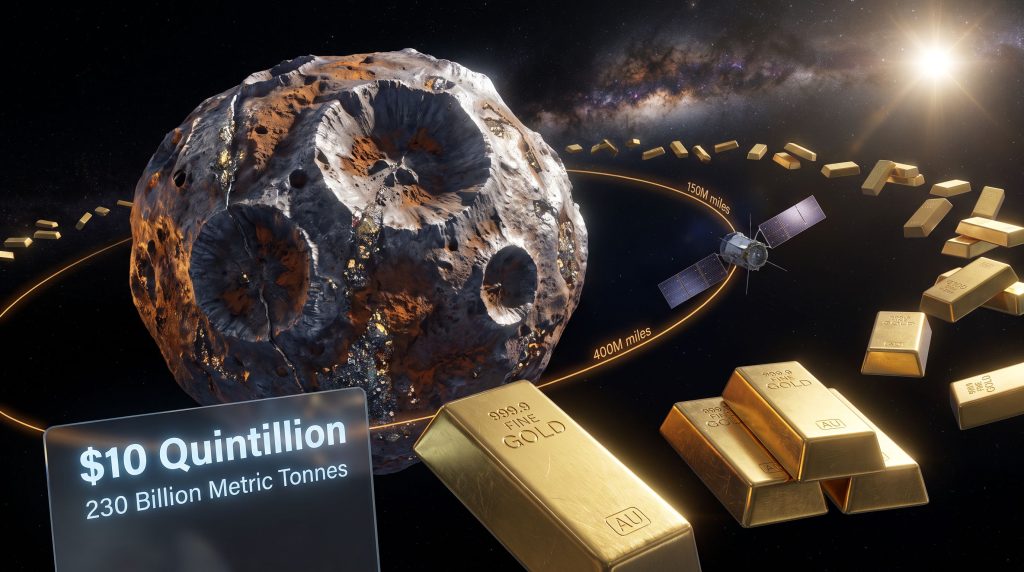
Asteroid 16 Psyche is one of the most scientifically compelling objects in the solar system. Orbiting between 150 and 400 million miles from Earth in the main asteroid belt, this roughly 144-mile-wide metallic body has attracted intense scientific interest precisely because of what it appears to contain. NASA's ongoing Psyche mission, launched in October 2023 and scheduled to reach the asteroid in 2029, is expected to significantly refine current compositional estimates.
According to NASA's own analysis, Psyche is likely composed of a mixture of rock and metal, with metal comprising 30% to 60% of its volume by composition. This determination has been reached through radar observations combined with thermal inertia measurements, which track how rapidly the asteroid gains or releases heat.
The speculative gold figures derive from this starting point. Psyche's estimated mass is approximately 2.3 × 10¹⁹ kilograms. If gold constitutes just 10 parts per million of that total mass — a purely speculative assumption given that the precise composition remains unknown — the implied gold content reaches approximately 230 billion metric tonnes. To contextualise that figure, total gold mined across the entirety of human history amounts to roughly 212,000 metric tonnes of above-ground stock. The asteroid's speculative gold content would represent approximately one million times that accumulated total.
"The $10 quintillion headline figure assumes simultaneous, cost-free delivery of every ounce to a price-stable Earth market. Neither of those conditions has any connection to physical reality."
The Asterank scientific database, which ranks asteroid mining candidates by economic attractiveness, estimates that the ten most commercially viable asteroids could theoretically yield approximately US$1.5 trillion in combined extractable value. That figure, while far smaller than the Psyche headline, remains speculative and similarly dependent on delivery assumptions that do not yet exist in any engineering framework. Furthermore, understanding why gold remains valuable in terrestrial markets helps contextualise just how disruptive asteroid-scale supply could theoretically become.
Three Structural Barriers That Make Asteroid Gold Mining Uneconomical Today
1. The Delivery Problem: Cost Per Gram Tells the Real Story
The most illuminating single data point in the entire asteroid gold mining economics debate is this: NASA's OSIRIS-REx mission returned approximately 60 grams of material from asteroid Bennu at a total mission cost of roughly US$1 billion. That translates to a per-gram recovery cost that renders precious metal extraction nonsensical under any commercial framework operating today.
Joel Sercel, CEO of TransAstra Corporation, one of the more credible commercial space resource ventures currently operating, has stated publicly that developing a full-scale asteroid mining vehicle under commercial processes would require several hundred million dollars. In current and near-term economics, pursuing precious metals from asteroids is not viable because the cost of reaching and returning from asteroids vastly exceeds the recoverable value of anything extracted. For a deeper look at space resource extraction challenges, the engineering barriers extend well beyond simple rocketry.
This is not a pessimistic fringe view. It represents the prevailing position among engineers and economists who work directly in the space resource sector. As noted by economists at Harvard's international review, the theoretical wealth locked in asteroids bears almost no relationship to commercially realisable returns under current or near-term conditions.
2. Microgravity Extraction: No Proven Technology Exists
Terrestrial mining, whether open-cut or underground, benefits from gravity, atmospheric pressure, established infrastructure networks, and centuries of refined engineering practice. None of those advantages exist in deep space.
Asteroid extraction would require:
- Anchoring equipment to a body with near-zero surface gravity
- Processing bulk metallic ore in a vacuum environment with extreme temperature swings
- Operating machinery at distances where real-time remote control is impossible due to signal delay
- Managing ore separation and concentration without the benefit of water, gravity separation, or conventional flotation methods
No proven commercial extraction methodology currently exists for bulk metallic ore processing in deep space. Technology development timelines for viable systems are estimated at 20 to 30 years or longer before meaningful output becomes plausible, even under optimistic assumptions about capital investment and engineering progress.
3. The Market Flooding Paradox
Even setting aside delivery costs, a third barrier is so structurally fundamental that it is often overlooked entirely: successfully delivering large quantities of asteroid gold to Earth would destroy the very value being sought.
Gold's market value is anchored to scarcity. Global annual gold mining output sits at approximately 3,500 metric tonnes, and the total above-ground gold stock accumulated across human history is estimated at roughly 212,000 metric tonnes. The precious metals market, measured by weight, is extraordinarily thin. Academic modelling has found that large-scale delivery of space-sourced gold could reduce prices by 50% or more, depending on delivery volume and timing.
The logical trap is self-defeating: the larger the delivery, the greater the price collapse, and therefore the lower the revenue relative to the enormous cost of extraction and return. Consequently, the economics of asteroid mining advances are far more nuanced than the headline valuations suggest.
Comparing Theory With Reality: An Economic Framework
| Economic Variable | Common Media Assumption | Verified Reality |
|---|---|---|
| In-place resource value | $10 quintillion (Psyche) | Scientifically plausible; economically meaningless |
| Extraction cost | Rarely discussed | Hundreds of millions to billions per mission |
| Return delivery cost | Assumed negligible | Currently the dominant economic barrier |
| Market price impact | Assumed price-stable | 50%+ price collapse likely at scale |
| Commercial timeline | Sometimes implied as near-term | 20 to 30+ years minimum |
| Viable near-term model | Precious metal Earth delivery | In-space water and propellant utilisation |
What Corporate History Reveals About Asteroid Mining Economics
Planetary Resources and Deep Space Industries: A Cautionary Arc
The first serious commercial wave of asteroid mining interest emerged around 2010, when Planetary Resources and Deep Space Industries attracted significant capital and high-profile investor attention, including backing from Google co-founders Larry Page and Eric Schmidt. These were not naive ventures. They employed credible aerospace engineers and operated with genuine technical ambition.
Within a decade, however, both companies had been absorbed by organisations with no connection to asteroid mining. The resources were never seriously disputed. What exhausted investors was the combination of timelines that extended far beyond initial projections and capital requirements that kept expanding without a visible path to commercial returns.
The lesson embedded in that failure is that the fundamental economics of asteroid gold mining are not simply a technology problem waiting for a better rocket. They are a structural challenge involving orbital mechanics, market absorption limits, and the compounding cost of operating in deep space. As Money Metals' analysis confirms, the case for getting rich from asteroid gold is far weaker than the headlines imply.
TransAstra's Strategic Pivot: The In-Space Model
TransAstra Corporation's evolution is instructive. Rather than continuing to target Earth delivery of precious metals, the company has repositioned its commercial thesis around water extraction from near-Earth asteroids. Water can be electrolysed to produce hydrogen and oxygen, which together form rocket propellant. Producing propellant in orbit eliminates the need to launch it from Earth's deep gravity well, which represents a genuinely transformative cost reduction for deep-space missions.
This pivot is strategically significant because it sidesteps both the Earth-delivery cost barrier and the market-flooding problem simultaneously. Propellant consumed in space never enters terrestrial commodity markets and never depresses any Earth-based asset price.
The Asterank Ranking System: Not All Asteroids Are Equal Candidates
One of the less widely understood aspects of asteroid gold mining economics is that raw in-place value is nearly irrelevant to commercial viability. The Asterank scientific database ranks asteroid mining candidates by a profit-to-cost ratio rather than by theoretical resource content.
Under this framework, Psyche ranks poorly despite its enormous headline valuation. Its location deep in the main asteroid belt significantly increases transit time and fuel expenditure compared to near-Earth asteroid targets. The asteroids that rank most attractively for commercial development share three characteristics:
- Proximity to Earth, reducing transit fuel costs and mission duration
- Known metallic or volatile composition, reducing exploration risk
- Materials useful for in-space applications, particularly water and carbon compounds
This distinction matters because it reveals that the public conversation about asteroid gold mining is largely focused on the wrong targets. The scientifically fascinating bodies are not necessarily the commercially logical ones.
The next major ASX story will hit our subscribers first
Space Law and the Regulatory Dimension
A layer of the asteroid gold mining economics discussion that rarely surfaces in popular coverage is the international legal framework governing space resource extraction. The Outer Space Treaty of 1967 established that no nation can claim sovereignty over celestial bodies, creating ambiguity around the ownership of extracted resources. Subsequent national legislation in the United States, Luxembourg, and the United Arab Emirates has attempted to establish that private entities can own resources they extract, without claiming territorial sovereignty over the asteroid itself.
However, a binding international framework governing commercial asteroid mining does not yet exist. This regulatory uncertainty introduces additional risk for long-duration capital commitments, since the legal structure underpinning resource ownership could change materially over the 20 to 30 year development timelines involved.
Gold's Scarcity Premium and the Long-Dated Tail Risk
What Asteroid Mining Means for Gold Investors Today
For investors holding gold as a store of value, inflation hedge, or monetary asset, the prospect of asteroid-derived supply represents a long-dated tail risk rather than an immediate pricing concern. In addition, gold safe-haven demand continues to be driven primarily by geopolitical uncertainty and inflation pressures that operate on entirely different timescales to any plausible asteroid supply scenario.
Several structural buffers make near-term disruption implausible:
- Development timelines extend decades beyond current market pricing horizons
- Even successful initial missions would return small volumes incapable of moving the gold price meaningfully
- Regulatory frameworks and international law would create additional friction between resource extraction and Earth market delivery
- Market participants would have decades of advance visibility into any supply disruption of meaningful scale
Furthermore, gold as a strategic investment retains its core attributes precisely because the conditions required for meaningful asteroid supply disruption remain so distant from current commercial reality.
The more immediate, if marginal, implication for gold markets is that capital flowing into space mining ventures may modestly reduce investment available to terrestrial mining exploration programs, particularly for junior explorers dependent on the same speculative capital pools.
The Realistic Commercial Pathway: What the Next 30 Years Actually Look Like
Stage-by-Stage Development Scenarios
Rather than a single breakthrough moment, commercial asteroid resource utilisation is more likely to follow a staged progression:
- Near-term (2025 to 2035): Continued robotic prospecting missions, refinement of near-Earth asteroid compositional databases, and early-stage in-space propellant demonstrations
- Mid-term (2035 to 2045): First commercial water extraction operations at near-Earth asteroids, propellant depots in cislunar space, gradual reduction of Earth-to-orbit launch costs via reusable vehicles
- Long-term (2045 to 2055+): Possible pilot-scale precious metal returns in small volumes, likely platinum-group metals before gold due to higher value-to-weight ratios, contingent on dramatic cost reductions and a mature orbital economy
Declining launch costs driven by reusable rocket systems represent the most significant near-term variable. Each order-of-magnitude reduction in cost-per-kilogram to orbit meaningfully improves the economic case for the later stages of this progression. As noted by Quartz's analysis of asteroid economics, even platinum-group metals face formidable market absorption challenges before gold extraction ever becomes commercially sensible.
Frequently Asked Questions on Asteroid Gold Mining Economics
How much gold might asteroid Psyche contain?
Speculative modelling based on Psyche's estimated mass of 2.3 × 10¹⁹ kilograms suggests that at a gold concentration of just 10 parts per million, the asteroid could theoretically contain roughly 230 billion metric tonnes of gold. NASA confirms the body is 30% to 60% metal by volume, but precise composition will not be known until the mission arrives in 2029.
Why is asteroid gold mining not commercially viable right now?
Three compounding barriers make it uneconomical: the cost of reaching and returning from deep-space targets far exceeds recoverable metal value; no proven extraction technology exists for microgravity bulk ore operations; and delivering large gold quantities to Earth would collapse the very price that creates the value proposition.
Could asteroid mining crash the gold price?
Academic modelling indicates that large-scale delivery of space-sourced gold could reduce prices by 50% or more depending on volume and timing. The global precious metals market is structurally too thin by weight to absorb asteroid-scale quantities without significant devaluation.
What is the strongest near-term commercial case for asteroid mining?
Industry consensus points to in-space water extraction for propellant production as the most viable near-term application, avoiding both the Earth-delivery cost problem and the market-flooding paradox.
Which asteroids are the best mining targets commercially?
The Asterank database ranks candidates by profit-to-cost ratio. The strongest commercial targets are generally near-Earth asteroids with known volatile or metallic compositions, not main-belt giants like Psyche despite their larger theoretical resource values.
Key Takeaways on Asteroid Gold Mining Economics
- In-place value is not deliverable profit. The $10 quintillion figure attached to Psyche assumes zero delivery cost and a price-stable Earth market, neither of which is achievable.
- The OSIRIS-REx cost benchmark is sobering. Approximately US$1 billion spent to return 60 grams of material illustrates the current cost reality with no ambiguity.
- The market paradox is self-defeating at scale. Sufficient delivery volume to generate meaningful revenue would simultaneously collapse the commodity price that creates that revenue.
- The commercially viable model is in-space, not Earth-delivery. Water extraction for propellant production is where credible near-term economics exist.
- Precious metal returns remain a 20 to 30 year minimum horizon. Investors and analysts should treat asteroid gold as a long-dated optionality position, not an imminent economic solution.
- Gold's scarcity premium faces a tail risk, not an immediate threat. Any supply disruption from space-derived sources would be visible to markets decades in advance and buffered by regulatory, legal, and economic constraints.
Disclaimer: This article is intended for informational and educational purposes only and does not constitute financial, investment, or commodity trading advice. Forecasts, timelines, and cost estimates referenced throughout reflect current industry analysis and are subject to change as technology and market conditions evolve. Readers should conduct independent research before making any investment decisions.
Want to Identify the Next Major Mineral Discovery Before the Broader Market Does?
While asteroid gold remains a multi-decade proposition, significant mineral discoveries are being made right now on Earth — and Discovery Alert's proprietary Discovery IQ model instantly alerts subscribers to significant ASX mineral discoveries, turning complex geological data into actionable investment insights. Explore Discovery Alert's discoveries page to understand how historic finds have generated substantial returns, and begin your 14-day free trial today to position yourself ahead of the market.