August 9, 2026
The Structural Pillars of the Gold Market Are Shifting Beneath Investor Feet
Every major commodity market rests on a set of foundational assumptions. For gold, two of those assumptions have quietly undergone significant change in 2026, yet the broader investment community remains largely focused on surface-level price action rather than the structural mechanics driving it. Central bank gold buying and Fed forward guidance are the two forces now reshaping how gold prices form, and understanding what has actually changed requires stepping back from daily headlines.
The two forces now in play are distinct but interconnected: a fundamental shift in how the U.S. Federal Reserve communicates monetary policy, and a growing recognition that central bank gold demand data is far less reliable than markets have assumed. Together, these developments are reshaping the conditions under which gold and silver prices form.
How the Fed's Communication Overhaul Rewires Gold Price Discovery
Forward Guidance as a Market-Moving Tool
For most of the post-2008 era, the Federal Reserve operated with an unusually transparent communication strategy. Through press conferences, dot plots, and public commentary from senior officials, the Fed effectively telegraphed the future direction of interest rates. This approach, known as forward guidance, gave financial markets the ability to price in anticipated policy changes well before they were implemented.
Gold markets, which are inherently forward-looking, became particularly sensitive to this communication. Because gold carries no yield, its relative attractiveness rises and falls with real interest rate expectations. When the Fed signalled that rates would fall, gold would rally not when rates actually fell, but when the signal was issued.
The December 2023 episode illustrated this dynamic with striking clarity. When a Federal Reserve governor signalled that rate cuts would arrive in 2024, gold markets responded immediately and forcefully, even though actual policy rates remained unchanged for another nine months.
| Event | Approximate Date | Gold Price Behaviour |
|---|---|---|
| Senior Fed official signals 2024 rate cuts | December 2023 | Gold begins rally from ~$2,000/oz |
| Gold surpasses $2,500/oz for the first time | Mid-2024 | New all-time high on anticipation alone |
| First actual rate cut implemented | September 18, 2024 | Markets had already fully priced the move |
A 25% rally in gold over several months was driven almost entirely by verbal anticipation rather than actual policy implementation. Multiple all-time highs were established before a single rate reduction took effect. This illustrates the extraordinary leverage that forward guidance once had over precious metals pricing. Furthermore, the gold and bond dynamics at play during this period reinforced how deeply interconnected monetary signals and gold valuations had become.
The July 2026 FOMC: A Press Conference About Nothing, and Why That Matters
The July 29, 2026 FOMC meeting under Fed Chair Kevin Warsh introduced a deliberate departure from this communication model. Rates were held unchanged, which was broadly anticipated, with markets pricing approximately a 30% probability of a hike in the days preceding the announcement.
What followed the rate decision, however, was the more significant development. In the subsequent press conference, Warsh provided no forward guidance whatsoever. No signals about the September meeting. No directional commentary on the rate path. No dot plot interpretation. The absence of information became the story itself, to the point that one reporter posed a question that captured the mood in the room: if no rate change occurred and no guidance was offered, what was the purpose of holding the press conference?
The response from markets was immediate and revealing. Silver spiked +3% in the minutes following the confirmation of no rate hike, then retraced entirely. Gold followed an identical pattern. Both metals returned to pre-announcement levels within hours, a self-correcting response that would have been nearly impossible under the previous guidance-driven framework.
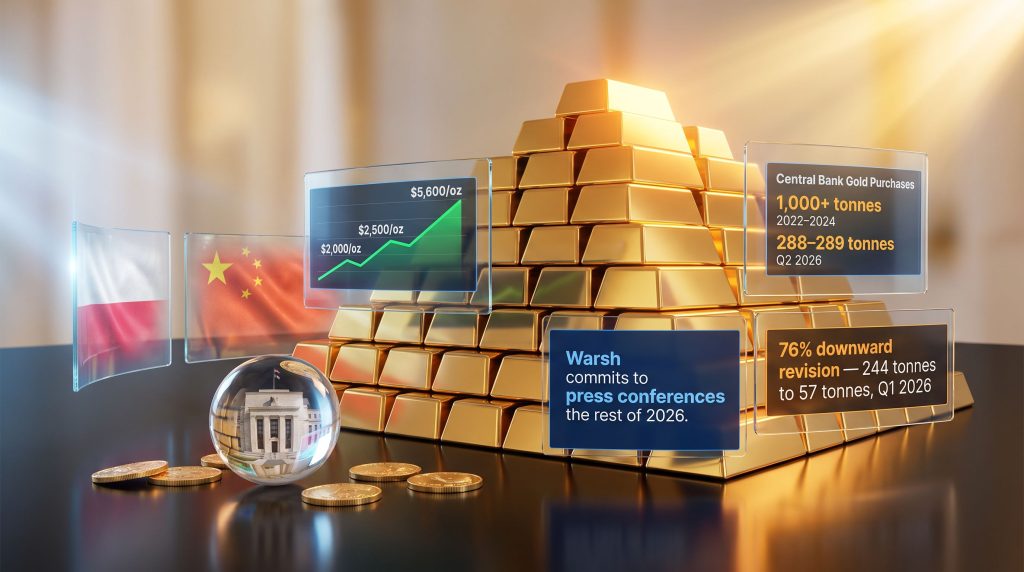
Yahoo Finance captured the moment with a headline noting that Warsh had committed to continuing press conferences through the remainder of 2026, despite providing no actionable market information. The irony was unmistakable, and the implication for precious metals investors is substantial.
What a Guidance-Free Fed Means for Future Gold Rallies
The removal of forward guidance as a policy tool does not make gold less relevant. It does, however, change the timing and character of potential rallies. Consequently, the gold market outlook for H2 2026 demands a more nuanced approach than in prior years.
Under the previous framework, an anticipated rate cut could deliver the majority of gold's price appreciation before the cut occurred. Under Warsh's data-dependent approach, that anticipation phase is compressed or eliminated. Gold would instead be expected to respond more directly to actual rate decisions once implemented.
This has several practical implications for investors:
- Entry timing models built around press conference volatility may need to be recalibrated
- The frequency of large, guidance-triggered rallies is likely to decline
- Conversely, sharp reversals driven by guidance disappointment should also become less common
- Gold's price behaviour may become more tightly correlated with actual economic data releases rather than Fed commentary
It is worth noting that this shift is not universally embraced within the Fed itself. Governor Christopher Waller has publicly argued that forward guidance retains value as a flexible monetary policy instrument. This internal divergence means investors should monitor whether Warsh's approach remains the dominant framework through Q3 and Q4 2026, particularly if economic conditions deteriorate rapidly.
Central Bank Gold Buying: The Data Quality Crisis Hiding in Plain Sight
Sixteen Years of Net Buying, and the Assumptions It Created
Central banks have been net purchasers of gold for 16 consecutive years, according to World Gold Council data. In 2022, 2023, and 2024, annual purchases were each estimated to exceed 1,000 tonnes, representing a structural and sustained accumulation cycle. By 2024, central bank gold reserves accounted for more than 20% of total global gold demand, cementing the sector's reputation as the market's most reliable and price-insensitive buyer base.
The investment thesis built on this foundation was straightforward: central banks buy gold regardless of price, providing a structural demand floor that limits downside and supports long-term price appreciation. That thesis is now facing serious scrutiny.
The Verification Gap That Undermines Reported Figures
A critical and underappreciated problem exists within the central bank gold demand reporting infrastructure. Institutions reporting gold holdings to the IMF have become increasingly unreliable in their disclosures. According to the World Gold Council's reserve survey, in recent reporting periods, an estimated 99% of reported central bank gold purchases were unverified through primary institutional disclosure channels.
This means the World Gold Council has been forced to rely on metal flow analysis and modelled estimates rather than direct verification of reported holdings. The practical consequence is that the central banks and gold prices relationship carries a far wider margin of error than is commonly acknowledged.
Risk Framework: When demand estimates are extrapolated from less than 1% of verified sources, the resulting figures are not merely approximations. They are structurally exposed to large-scale revision.
The Largest Revision in World Gold Council History
The Q1 2026 demand cycle made this risk tangible in an unprecedented way.
| Metric | Initial Estimate | Revised Figure | Change |
|---|---|---|---|
| Q1 2026 central bank gold purchases | 244 tonnes | 57 tonnes | -76% |
| Historical comparison | Above recent quarterly averages | Lowest since Q1 2021 | Significant contraction |
| Reason for revision | Modelled estimate | Non-CB buyers identified | Buyer misattribution |
The 76% downward revision to Q1 2026 central bank gold purchases represents the largest single correction the World Gold Council has ever had to make. The initial 244-tonne estimate appeared broadly consistent with recent purchasing patterns. The revised figure of 57 tonnes told a very different story about who was actually buying gold during one of the most volatile price periods in the metal's history.
An important clarification is necessary here: total gold demand during Q1 2026 did not disappear. The metal was still being absorbed. What changed was the identity of the buyer, and that distinction carries meaningful analytical weight.
Central bank purchases are qualitatively different from private or institutional purchases. Central banks are long-duration holders. They do not trade in and out of positions based on price volatility, nor do they face redemption pressure. Their buying provides a structurally different form of demand support than that offered by investment funds or private buyers, who may exit positions rapidly under adverse conditions.
Q2 2026: Recovery or Statistical Noise?
Following the dramatic Q1 revision, Q2 2026 data showed a rebound in central bank purchasing to approximately 288 to 289 tonnes. Poland and China were identified as among the most active accumulators during this period. However, given the data quality issues outlined above, even this rebound warrants careful interpretation.
The timing of this rebound is analytically significant. Gold prices spiked to approximately $5,600 per ounce during Q1 2026 before retreating. Through Q2, prices declined through the $4,500 to $5,000 range, and it was during this price moderation that central bank buying activity re-emerged.
| Price Range | Period | Central Bank Activity |
|---|---|---|
| ~$4,300/oz | January 2026 | Moderate accumulation |
| Peak ~$5,600/oz | Q1 2026 | Buying declines or misattributed |
| $4,500 to $5,000/oz | Q2 2026 | Buying rebounds to ~288-289t |
Are Central Banks Actually Price-Insensitive? A Rethink
The Conventional Wisdom Under Pressure
The investment case for gold has long included the assumption that central banks buy without meaningful price sensitivity, providing a near-unconditional demand floor. The 2026 data challenges this view directly. Furthermore, the broader question of central bank gold buying and Fed forward guidance working in tandem has become far more complicated than previously assumed.
The buying pattern observed across Q1 and Q2 suggests that central banks may have reduced purchases deliberately during the extreme price spike above $5,000 per ounce and re-engaged as the market corrected. If confirmed by future data, this implies a degree of price awareness in central bank purchasing decisions that has not been adequately modelled by mainstream gold analysts. The IMF's latest research reinforces how significant this structural shift could prove to be.
This creates a strategic gap in the bullish gold narrative. If central bank demand softens materially above $4,500 to $5,000 per ounce, identifying the marginal buyer that drives gold toward $6,000 becomes an open and unanswered question.
The Market Is Now Two-Directional
Beyond price sensitivity, a second structural shift is underway. Several central banks are actively liquidating gold reserves into elevated price environments. With high prices, geopolitical instability, and domestic fiscal pressures converging, some institutions are using gold sales to plug budgetary gaps rather than accumulate further reserves.
Poland represents a particularly instructive case. It is the only central bank globally to have publicly announced a specific gold accumulation target of 700 tonnes. As Poland approaches this self-imposed ceiling, its contribution to global central bank demand will structurally diminish, removing one of the most consistent and transparent buyers from the market.
The scenarios investors should now be stress-testing include:
- Sustained moderate accumulation at prices between $4,000 and $4,800 per ounce as markets stabilise
- Price-triggered demand pullback if gold re-tests $5,000 or above
- Net selling from select central banks facing acute fiscal pressures
- Further data revisions from the World Gold Council as IMF reporting improves or deteriorates
The central bank backstop narrative served as a credible foundation for the gold bull thesis between 2021 and 2024. It should now be treated as a conditional, rather than unconditional, form of support.
Reframing the Investment Case for Precious Metals in H2 2026
A More Demanding Evidence Standard
The structural changes outlined above do not invalidate the long-term case for gold. They do, however, raise the evidentiary bar for gold bulls. Two of the thesis's most prominent pillars, Fed guidance-driven rallies and price-insensitive central bank accumulation, have weakened meaningfully.
Investors who built positioning assumptions around these dynamics need to recalibrate. This means:
- Monitoring actual FOMC policy decisions rather than trading press conference signals
- Scrutinising World Gold Council demand reports with attention to verification methodology, not just headline tonnage figures
- Tracking IMF member reporting improvements that could restore reliability to reserve disclosures
- Watching China's gold reserve reporting, which historically carries significant opacity and periodic large-scale revisions
- Following Poland's reserve disclosures as it approaches its stated 700-tonne accumulation ceiling
Key Variables Shaping Precious Metals Through Late 2026
| Variable | What to Watch | Why It Matters |
|---|---|---|
| Fed forward guidance | Whether Warsh holds the no-guidance framework | Determines if speech-driven rallies can return |
| WGC demand revisions | Q3 and Q4 central bank figures | Establishes whether Q2 rebound was genuine |
| Poland reserve data | Progress toward 700-tonne target | Removes a key transparent buyer from demand pool |
| China reserve reporting | Disclosure cadence and revision patterns | Historically opaque; large revisions possible |
| IMF verification rates | Whether reporting quality improves | Directly affects reliability of all demand data |
The gold market remains structurally supported by genuine long-term forces, including dollar reserve diversification trends, geopolitical fragmentation, and real yield dynamics. However, investors who rely solely on the central bank backstop narrative or who expect forward guidance-driven rallies to return under the current Fed leadership may find themselves positioned for a market that no longer operates as it did between 2022 and 2024.
A more nuanced, data-verified approach to gold and silver positioning is not merely advisable. In the current environment, where central bank gold buying and Fed forward guidance have both undergone significant structural change, it is essential.
Disclaimer: This article is intended for informational purposes only and does not constitute financial advice. Forecasts, projections, and scenario analyses involve inherent uncertainty. Investors should conduct independent research and consult qualified financial advisers before making investment decisions. All data cited reflects publicly available World Gold Council, IMF, and Federal Reserve sources as of the dates referenced.
Ready to Stay Ahead of the Next Major ASX Mineral Discovery?
As gold's structural dynamics continue to evolve and investor attention sharpens on real assets, Discovery Alert's proprietary Discovery IQ model delivers real-time alerts on significant ASX mineral discoveries, transforming complex geological and market data into clear, actionable opportunities — explore historic discovery returns on the Discovery Alert discoveries page to understand what early positioning in major finds has historically meant for investors, then begin your 14-day free trial at Discovery Alert to ensure you're first to act when the next significant discovery is announced.