
July 31, 2026
Round Numbers, Real Signals: Reading the ASX 200 Above 9,000
There is something peculiar about the way equity markets behave around round numbers. From a purely mathematical standpoint, 9,000 points on the ASX 200 carries no more weight than 8,997 or 9,003. Yet decades of market observation confirm that these thresholds act as gravitational fields, attracting attention, triggering algorithmic responses, and reshaping investor psychology in measurable ways. Understanding why the ASX 200 above 9000 on positive copper outlook generated such broad market commentary requires looking beyond the number itself and into the confluence of forces that propelled it there.
The Psychological and Technical Significance of the 9,000 Threshold
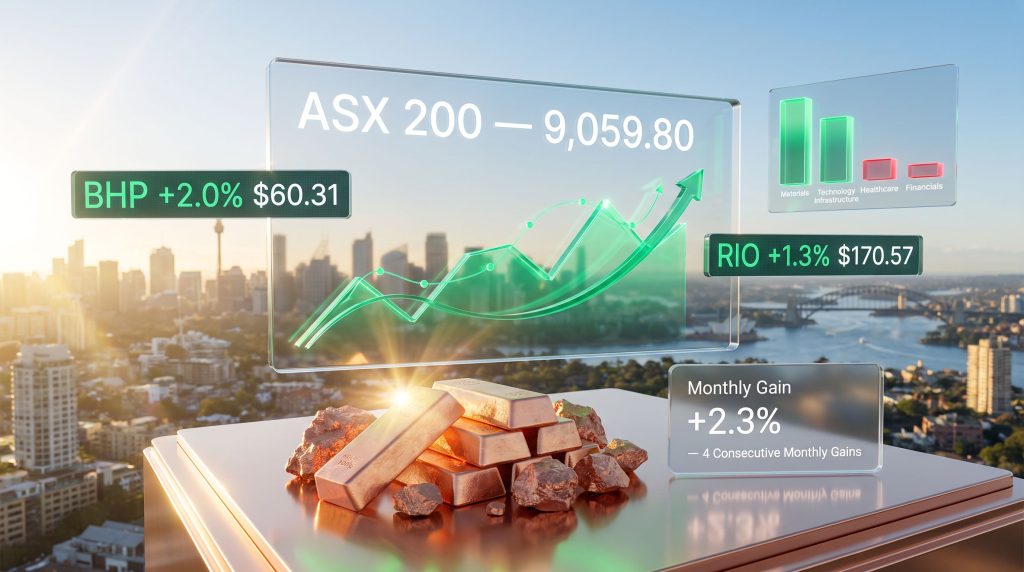
When the ASX 200 reached an intraday peak of 9,059.80 points, it was doing more than printing a new number on a screen. It was confirming that four consecutive months of gains were not simply a relief rally but something with structural underpinning. The index's +2.3% monthly return for the period placed it firmly in momentum territory, a zone where trend-following strategies and institutional rebalancing tend to amplify moves in the prevailing direction.
The closing level of approximately 8,976.8 points, up just 0.1% (9.1 points) on the day, tells a subtler story. Markets that breach major levels intraday but fail to sustain them into the close are often testing resistance rather than confirming a breakout. The gap between the intraday high and the closing print reveals a tension between enthusiasm and conviction, the kind of divergence that technical analysts monitor closely when assessing whether a new trading range has genuinely been established.
| Metric | Value |
|---|---|
| ASX 200 Intraday High | 9,059.80 points |
| ASX 200 Closing Level | ~8,976.8 points |
| Daily Change | +0.1% (+9.1 points) |
| Monthly Gain | +2.3% |
| Consecutive Monthly Gains | 4 months |
For longer-term investors, the four-month consecutive gain streak carries more analytical weight than any single session's performance. Furthermore, sustained directional momentum of this length typically reflects shifting fundamental expectations rather than short-term sentiment alone. Those seeking broader context on ASX market performance during this period will find that commodity pressure has played a central role in shaping index direction.
When big ASX news breaks, our subscribers know first
What Is Driving the Copper Outlook That's Lifting ASX Miners?
The Structural Case for Copper in an AI-Driven Economy
Copper has always been considered an economic barometer, but the demand thesis underpinning its current trajectory is structurally different from past cycles. Historically, copper demand tracked manufacturing output and residential construction. Today, however, a new demand vector has emerged that is simultaneously more durable and less sensitive to traditional economic cycles: the build-out of artificial intelligence infrastructure.
The numbers are striking. A single large-scale hyperscale data centre can require anywhere from 20 to 50 tonnes of copper in its cabling, cooling systems, and power distribution networks alone. Multiply that across the hundreds of facilities currently under construction or in planning stages globally, and the incremental copper demand becomes material at a market-wide level. In addition, electric vehicle adoption and power grid modernisation programs across Europe, North America, and Southeast Asia make the structural demand case compounding rather than merely additive.
Brokers including Macquarie revised their copper price outlooks upward during this period, reflecting growing conviction that the supply side of the copper equation cannot keep pace with these emerging demand vectors. New copper mine development typically carries a 10 to 15-year lead time from discovery to production, meaning the supply response to current demand signals will not arrive quickly enough to prevent price pressure over the medium term. Understanding the copper price growth drivers at play helps clarify why broker upgrades have been so widespread.
Strategists covering the materials sector have described the strength in mining stocks during this period as overwhelmingly driven by commodity dynamics, with copper specifically identified as the primary catalyst reflecting structural demand from the AI economy rather than cyclical industrial activity.
How Global Sentiment Translates Into ASX Mining Gains
The transmission mechanism connecting Wall Street's AI enthusiasm to ASX copper miners is not direct, but it is well-established. US technology earnings beats generate risk-on sentiment globally. South Korean semiconductor and technology stocks, which are deeply integrated into the AI supply chain, tend to react quickly to US tech strength given their direct exposure to chipmaking demand. That South Korean rally then serves as a confirmation signal for commodity markets, reinforcing expectations that AI infrastructure spending is translating into real hardware and power demand, both of which are copper-intensive.
The result was visible in the session's standout performers:
- BHP (ASX: BHP): rose 2.0% to $60.31, its copper assets providing direct leverage to the revised demand outlook
- Rio Tinto (ASX: RIO): gained 1.3% to $170.57, with its diversified portfolio providing copper exposure alongside other bulk commodities
Within the ASX 200, copper-weighted miners outperformed iron ore-heavy peers during this period, a dynamic that reflects the diverging demand profiles of those two commodities. Iron ore demand remains closely tied to Chinese steel production, which faces structural headwinds from a slowing property sector. Copper, by contrast, benefits from green economy and digital infrastructure spending that is geographically diversified. Investors tracking copper market trends will note that the supply crunch narrative is becoming increasingly central to price forecasting.
How Does the Australian Inflation Outlook Reinforce Market Confidence?
June Quarter CPI and the RBA's Rate Hold Calculus
The June quarter Australian inflation data provided the domestic macro backdrop that allowed equity markets to advance without the headwind of rate uncertainty. A cooler-than-expected inflation print reinforced market consensus that the Reserve Bank of Australia would hold the official cash rate steady at 4.35% at its August 10-11 board meeting.
The relationship between rate stability and equity valuations operates through the discount rate applied to future earnings. When rates are expected to remain unchanged, the present value of corporate cash flows stays relatively stable, supporting price-to-earnings multiples across the market. Conversely, rate uncertainty introduces valuation volatility that can suppress investor appetite even when underlying business conditions are sound.
Australia's disinflation trajectory in mid-2025 stood in contrast to more turbulent inflation experiences in parts of Europe and some emerging markets, consequently adding a relative attractiveness dimension to Australian equities for international allocators seeking macro stability.
Capital Flow Dynamics Supporting the ASX
The start of a new financial year in Australia typically generates a fresh wave of institutional investment inflows as superannuation funds deploy new contributions and portfolio rebalancing occurs across managed funds. This structural tailwind was evident in the market's ability to sustain gains during the period despite mixed signals from some individual sectors.
Foreign investor interest in Australian equities has also been supported by the ASX 200's distinct composition relative to US or European indices. With a heavier weighting toward materials, financials, and energy compared to the technology-dominated S&P 500, the ASX offers international investors a form of sector diversification that is difficult to replicate through US-listed securities alone. For a deeper perspective on this dynamic, ASX trading insights from 2025 highlight how global capital flows have been reshaping domestic index behaviour.
Sector-by-Sector Breakdown: Winners and Laggards in the Current Rally
Materials and Resources: The Clear Outperformer
The materials sector led the ASX 200 during this session, driven by the copper narrative detailed above. BHP and Rio Tinto's gains rippled through the index given their combined weighting, and the impact extended into ETF and superannuation fund portfolios that track the ASX 200 passively.
Technology: A Mixed Picture Domestically
The domestic technology sector presented a bifurcated picture that is worth examining carefully:
- NextDC (ASX: NXT): surged 4.5% to $13.36, directly benefiting from the AI data centre narrative as operators of physical computing infrastructure saw their growth outlook reaffirmed by global AI capex trends
- WiseTech Global (ASX: WDS): fell 4.2% to $36.30, illustrating that software-oriented technology companies face a different valuation dynamic where growth expectations are already priced in and any disappointment or profit-taking can be amplified
This divergence highlights a nuanced point that investors in domestic tech often overlook: infrastructure technology and software technology respond to different valuation drivers. Conflating them under a single "tech sector" label, however, can obscure meaningful differences in risk and return profiles.
Energy: Resilience Despite Oil Price Weakness
Crude oil prices fell approximately 2% following signals of geopolitical de-escalation in the Middle East, yet Australian energy stocks held their ground or edged marginally higher:
- Woodside Energy (ASX: WDS): +0.2% to $32.95
- Santos (ASX: STO): +0.1% to $7.84
The resilience of LNG-weighted Australian energy companies to short-term crude oil price movements reflects their contract structures. Australian LNG exports are predominantly sold under long-term contracts with pricing mechanisms that are not always directly tied to spot crude prices, providing revenue predictability that insulates these businesses from daily oil price volatility.
Healthcare: Pressure on the Sector's Heavyweight
CSL (ASX: CSL) fell 3.8% to $123.06 following negative broker coverage, dragging the broader healthcare sector lower. This dynamic illustrates the concentration risk inherent in the ASX 200's healthcare composition, where CSL's market capitalisation means that its movements have an outsized influence on the sector's aggregate performance. The way commodity moves and mining equities diverged from healthcare underperformance during this session underscores how sector rotation can reshape index dynamics rapidly.
Financials: Modest Weakness Amid Broader Optimism
The major banks finished the session in slightly negative territory:
- Commonwealth Bank (ASX: CBA): -0.4% to $177.53
- National Australia Bank (ASX: NAB): -0.5% to $41.33
- ANZ Bank (ASX: ANZ): -0.5% to $37.31
Bank stocks face a nuanced challenge in a rate-hold environment. While stable rates reduce refinancing risk and support credit quality, they also compress the net interest margin expansion that banks typically enjoy during rising rate cycles. With rates at a plateau, revenue growth for major lenders becomes more dependent on volume and fee income than on rate-driven margin expansion.
| Sector | Direction | Key Driver |
|---|---|---|
| Materials / Mining | Strong gain | Copper outlook, AI infrastructure demand |
| Technology (Infrastructure) | Selective gain | Data centre AI tailwinds (NextDC) |
| Technology (Software) | Decline | Profit-taking, valuation pressure (WiseTech) |
| Energy | Flat to marginal gain | LNG contract resilience, crude oil decline offset |
| Healthcare | Weakness | Broker downgrades weighing on CSL |
| Financials | Slight decline | Rate hold, margin compression concerns |
What Notable Corporate Developments Are Reshaping Market Structure?
HSBC's Exit From Australian Retail Banking
HSBC's decision to sell its $36 billion Australian home loan portfolio to Blackstone and wind down its retail banking operations over 18 months carries implications beyond the immediate transaction. It signals a broader trend of global banks retreating from retail lending in markets where scale is insufficient to generate competitive returns, leaving the field increasingly open to domestic incumbents and, importantly, private credit providers like Blackstone itself.
For the Australian mortgage market, this shift is part of a longer-term structural change where institutional private credit is taking on roles previously occupied by traditional bank balance sheets. This evolution has consequences for competition, pricing, and the regulatory perimeter that governs Australian household lending.
Energy Sector Corporate Activity
Origin Energy (ASX: ORG) rose 0.9% to $10.76 after reporting that business electricity volumes grew 7% in the June quarter, attributed to additional demand from data centre customers. This result positions Origin at the intersection of two of the market's most prominent structural themes: energy transition and AI infrastructure, a combination that investors are beginning to price more explicitly into utility valuations.
Rejected Takeover Bids and Shareholder Value
Energy One (ASX: EOL) surged 31.8% to $14.30 after its board rejected a $565 million takeover approach from Norwegian energy software firm Volue, which had proposed paying approximately $17 per share. The board's decision to reject an offer at that premium suggests management believes the company's intrinsic value exceeds what the bid reflected. For investors in mid-cap ASX stocks, contested takeover situations can create short-term price discovery opportunities where the market rapidly reprices to reflect the floor established by the approach.
How Does the Microsoft Surge Connect to ASX Market Sentiment?
A Historic Single-Day Market Cap Event
Microsoft's 16% single-session gain, its largest since October 2008, generated a market capitalisation addition of approximately US$450 billion (A$640 billion) in a single trading day. To contextualise that figure: it exceeds the entire market capitalisation of the majority of ASX 200 companies and represents a volume of wealth creation that is, by any historical measure, extraordinary for a single stock in a single session.
The significance for global markets was not simply the quantum of the move but what it validated. Microsoft's results demonstrated that AI investment at hyperscale is generating measurable revenue growth, transforming AI from a speculative narrative into an earnings-confirmed business reality. That validation has cascading implications for copper demand, power infrastructure, and the broader commodity complex that underpins the ASX 200 above 9000 on positive copper outlook conditions.
The Global Confidence Transmission to Australian Equities
Australian investors do not need direct exposure to US mega-cap technology companies to benefit from the AI capital expenditure cycle. The transmission occurs through:
- Copper demand: Data centres are copper-intensive, and AI capex drives construction of facilities that require significant copper inputs
- Energy demand: AI computing is highly power-intensive, supporting electricity demand growth that benefits Australian LNG exporters and domestic utilities
- Risk sentiment: Validated AI earnings create global risk-on conditions that support commodity-linked equity markets like the ASX
The next major ASX story will hit our subscribers first
What Should Investors Watch in the Week Ahead?
Australian Earnings Season: Key Reports on the Radar
The domestic earnings calendar for the period ahead includes a diverse range of companies across sectors:
- Pinnacle Investment Management, REA Group, ResMed, Credit Corp, Beach Energy, AMP, James Hardie, and Nick Scali
Collectively, these results will test whether the index can consolidate above the 9,000 level or whether it retreats to establish a new trading range below it. Strong earnings delivery across multiple sectors would provide the fundamental confirmation that the intraday breach of 9,000 points requires to become a sustained move rather than a technical excursion.
US Earnings as a Global Market Catalyst
The US earnings calendar for the period includes names that span multiple dimensions of investor interest:
- SpaceX makes its maiden public result appearance, a sentiment-defining event for the space economy investment narrative, particularly notable given shares had dipped below their initial float price after initially trading above it
- Palantir, the AI software company, enters results season with its shares down approximately 30% year-to-date, making growth trajectory confirmation critical for investor confidence in AI software monetisation beyond hyperscalers
- Major reporters including Eli Lilly, Berkshire Hathaway, AMD, Pfizer, McDonald's, Walt Disney, Uber, and Airbnb will collectively shape global risk appetite heading into August
Frequently Asked Questions: ASX 200 Above 9,000 and the Copper Outlook
Why did the ASX 200 move above 9,000 points?
The breach of 9,000 points reflected a convergence of positive factors: an upgraded copper price outlook driven by AI infrastructure demand, a historic single-day rally in US technology stocks, cooler Australian inflation data supporting rate stability expectations, and fresh start-of-financial-year capital inflows into Australian equities. According to recent market reporting, these forces combined to create one of the more significant index movements of the period.
Which ASX stocks benefited most from the copper outlook?
BHP (+2.0% to $60.31) and Rio Tinto (+1.3% to $170.57) were the primary direct beneficiaries as the two largest copper-exposed majors in the ASX 200 index.
Is the RBA expected to change interest rates in August 2025?
Market consensus heading into the August 10-11 Reserve Bank of Australia board meeting points to a hold at 4.35%, with the June quarter inflation data reinforcing the case for policy stability.
What is driving copper demand growth in 2025?
Four compounding structural demand drivers are identifiable:
- AI data centre construction requiring substantial copper in power and cooling systems
- Electric vehicle adoption increasing copper content per vehicle sold
- Power grid modernisation programs in major economies
- Broader energy transition infrastructure requiring copper-intensive components
Can the ASX 200 sustain levels above 9,000 points?
Sustainability depends on continued corporate earnings delivery, stable commodity prices, RBA policy clarity, and the trajectory of global risk sentiment as shaped by US earnings season results and ongoing AI infrastructure spending confirmation. The ASX 200 above 9000 on positive copper outlook signals is an encouraging foundation, but earnings season delivery will be the ultimate test.
How does the Microsoft market cap event affect Australian investors?
The AI earnings validation embedded in Microsoft's results reinforces global risk appetite and strengthens the structural demand case for copper, energy, and data centre infrastructure, all of which are well-represented in the ASX 200's composition.
Disclaimer: This article is intended for informational purposes only and does not constitute financial product advice. Past market performance is not indicative of future results. Readers should consider their own financial circumstances and seek professional advice before making any investment decisions. All figures cited reflect market data from the relevant trading session and may not reflect current market conditions.
Want to Capitalise on the Next Major ASX Mining Discovery Before the Market Moves?
Discovery Alert's proprietary Discovery IQ model delivers real-time alerts on significant ASX mineral discoveries — instantly translating complex data into actionable opportunities for both short-term traders and long-term investors — so start your 14-day free trial today and ensure you're positioned ahead of the broader market. Explore Discovery Alert's dedicated discoveries page to understand how historic mineral discoveries have generated extraordinary returns for early movers.