July 31, 2026
The Invisible Architecture of a Global Mining Economy
There is a persistent misconception about what a mining city looks like. The popular imagination conjures open-pit operations, headframes rising above flat terrain, and ore trucks navigating dusty haul roads. By that definition, Vancouver would never qualify. Yet measured by capital deployed, technical expertise concentrated, and companies listed, Vancouver stands among the most consequential mining cities on the planet. The Vancouver Mining Day proclamation signed by Mayor Ken Sim on July 30, 2026, does not create this reality. It simply names it.
Understanding why this matters requires stepping back from the individual announcement and examining the structural architecture of how modern mining actually functions across the full value chain.
When big ASX news breaks, our subscribers know first
What the Vancouver Mining Day Proclamation Actually Recognises
On July 30, 2026, Vancouver Mayor Ken Sim formally proclaimed the date as Mining and Mineral Exploration Day in Vancouver. The proclamation was requested by the Resource Works Society, with backing from both the Mining Association of British Columbia and the Association for Mineral Exploration.
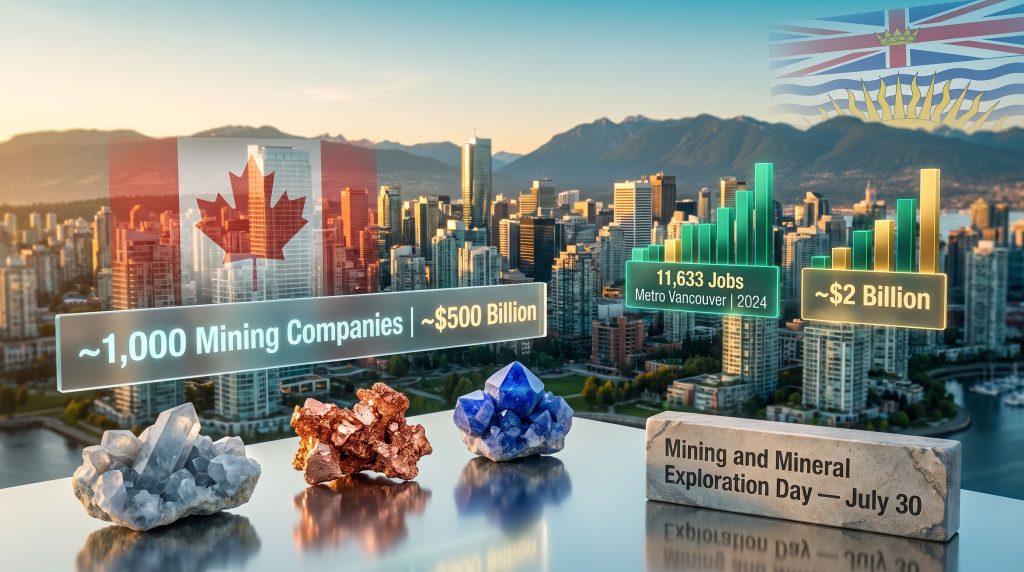
The declaration formally acknowledges Vancouver as the headquarters of approximately 1,000 publicly listed mining and mineral exploration companies, carrying a combined market capitalisation of roughly $500 billion. It also recognises the city's dense concentration of financial, legal, engineering, geoscience, and environmental professionals who support mineral projects operating across British Columbia and internationally.
Formal civic recognition of this kind matters because it embeds an industry into a city's public identity, shifting how regulators, residents, investors, and future talent perceive its economic relevance.
How Proclamation Requests Work in Vancouver
The process behind the Vancouver Mining Day proclamation is more deliberate than it might appear from the outside:
- Requests must be lodged with the City of Vancouver at least 15 business days before the intended proclamation date
- Requests typically require support from established industry associations, advocacy groups, or community organisations
- Once granted, a proclamation carries symbolic civic weight, formally embedding the recognised sector into Vancouver's public identity and policy narrative
The Numbers Behind Vancouver's Mining Economy
The economic data attached to the Vancouver Mining Day proclamation reveals a sector whose urban footprint is routinely underestimated by those outside the resource industry.
| Economic Metric | Figure |
|---|---|
| Publicly listed mining companies headquartered in Vancouver | ~1,000 |
| Combined market capitalisation | ~$500 billion |
| Direct, indirect, and induced jobs in Metro Vancouver (2024) | 11,633 |
| Jobs at Metro Vancouver suppliers and related businesses | ~8,250 |
| Metro Vancouver supplier spending by BC mines and smelters | ~$2 billion |
| Well-paying jobs within the City of Vancouver linked to mining | 5,500+ |
| Rural and remote BC economic activity supported by mining | ~$2 billion |
Source: Economic analysis prepared for Resource Works Society; City of Vancouver proclamation data, 2026.
The multiplier effect embedded in these figures is particularly striking. According to the economic analysis prepared for Resource Works Society, for every ten direct jobs created at a mine site somewhere in British Columbia, approximately six additional direct, indirect, and induced jobs are generated across Metro Vancouver. This ratio challenges the common assumption that mining's economic benefits accrue exclusively to the regions where extraction physically occurs.
What Kinds of Businesses Comprise Vancouver's Mining Ecosystem
The employment and economic activity figures above span a far broader professional base than corporate headquarters alone. Furthermore, Vancouver's resource economy workforce includes:
- Engineering and geoscience firms providing technical feasibility studies and project design
- Environmental specialists and Indigenous-relations professionals navigating community engagement and regulatory processes
- Capital markets professionals, investment banks, and brokerage firms structuring equity raises and project financing
- Legal and accounting firms managing securities compliance, mergers and acquisitions, and corporate governance
- Equipment, technology, and supply-chain providers supporting exploration campaigns and operational mines globally
Why a City Without Mines Can Legitimately Claim Mining Identity
One of the more analytically interesting tensions the Vancouver Mining Day proclamation resolves is a conceptual one: how does a coastal, urban, post-industrial city lay legitimate claim to a mining identity when no extraction occurs within its boundaries?
The answer lies in understanding that modern mining is not simply a physical activity. It is a knowledge-intensive, capital-dependent, institutionally complex industry whose most consequential decisions often happen thousands of kilometres from the ore body itself.
Resource Works Society president and CEO Stewart Muir has described Vancouver as one of the world's great mining cities precisely on this basis, articulating that while discoveries are made and resources produced elsewhere, much of the capital, technology, expertise, and entrepreneurship that makes those projects possible is concentrated within the city. Mayor Sim's proclamation formalises this connection as part of Vancouver's economic identity and its character as an internationally connected city.
Resource Works Society managing director Margareta Dovgal has further noted that Vancouver's connection to mining is visible in office towers, laboratories, professional firms, and supply-chain businesses across the city, describing these as well-paid, highly skilled jobs sustained by economic activity across the province. In her view, recognising this connection helps close the artificial divide between urban prosperity and resource development.
Vancouver functions not as a site of extraction but as the intellectual command economy of mineral exploration: the place where geological potential becomes financeable reality.
How Vancouver Compares to Other Global Mining Finance Centres
| City | Primary Mining Role | Key Strength |
|---|---|---|
| Vancouver, Canada | Exploration finance, junior mining, critical minerals | ~1,000 listed companies, ~$500B market cap |
| Toronto, Canada | Senior mining finance, major equity markets | TSX/TSXV exchange depth and liquidity |
| London, UK | Major mining M&A, institutional investment | LSE-listed global majors, deep capital pools |
| Perth, Australia | Operational mining HQ, ASX-listed producers | Proximity to Pilbara iron ore and WA resources |
| Johannesburg, South Africa | African mining operations, PGMs and gold | JSE-listed majors, deep operational expertise |
In addition, understanding the broader north American mining markets context helps explain why Vancouver consistently attracts global capital and technical talent relative to competing jurisdictions. North American mining markets have evolved considerably, with Vancouver increasingly central to cross-border exploration finance.
Mineral Exploration as the R&D Function of the Resource Economy
One of the more sophisticated framings embedded in the proclamation is the characterisation of mineral exploration as the research and development arm of the broader resource economy. This is not rhetorical decoration. It carries precise analytical implications for how investors, policymakers, and communities should evaluate the sector.
The exploration-to-production pipeline functions in distinct phases:
- Discovery stage: Geological surveys, geochemical sampling, and exploratory drilling identify potentially economic mineral deposits
- Feasibility stage: Technical, metallurgical, and environmental studies determine whether a deposit can be responsibly and economically developed
- Development stage: Capital is raised through equity and debt markets, permitting is secured, and construction commences
- Production stage: Mines generate direct employment, royalty revenues, and supply-chain activity for surrounding communities and urban service centres
Vancouver's professional ecosystem supports every stage of this pipeline, which is why the importance of mineral exploration activity cannot be overstated in terms of the city's long-term economic relevance. This is also why the city's economic stake in resource development is not contingent on proximity to any single mine.
The Association for Mineral Exploration's president and CEO Todd Stone has emphasised that every mine begins with a discovery, and that British Columbia's combination of geological endowment, skilled workforce, and entrepreneurial culture positions the province as a globally competitive exploration jurisdiction.
British Columbia's Geological Endowment and Critical Mineral Significance
The technical dimension of the proclamation's relevance extends into geology. British Columbia's geological framework is exceptionally well-endowed by global standards, hosting porphyry copper-gold systems, sediment-hosted lead-zinc deposits, and mineralisation associated with several commodities that have moved to the centre of modern supply chain priorities.
The province contains significant deposits of copper, gold, molybdenum, coal, and several critical minerals including nickel, cobalt, and rare earth elements. This geological diversity is not incidental to Vancouver's role as a mining hub. The proximity of high-quality geological targets within the same jurisdiction as the world's largest junior mining capital market creates a structural competitive advantage that few other regions can replicate.
Mining Association of British Columbia president and CEO Michael Goehring has stated that mining helped build British Columbia's prosperity and that it will be even more important in securing the critical minerals, jobs, and economic strength that the future demands. This forward-looking framing reflects a broader industry recognition that the commodity priorities of the next two decades differ meaningfully from those that dominated the prior century.
The Critical Minerals Dimension
The global transition toward electrified transport, grid-scale energy storage, and advanced manufacturing has created structural demand growth for a specific basket of minerals. Consequently, critical minerals demand has become a defining theme across resource policy in both Canada and Australia. These minerals include:
- Copper: Essential for electrification infrastructure, EV motors, and grid transmission
- Lithium: Primary component of lithium-ion battery chemistries used in EVs and grid storage
- Cobalt: Cathode material in many battery configurations, though demand profiles are evolving with chemistry shifts
- Nickel: Used in high-energy-density battery cathodes and stainless steel production
- Rare earth elements: Critical for permanent magnets in EV motors and wind turbine generators
British Columbia's geological position, combined with Vancouver's capital markets infrastructure, means the city sits at a structurally advantageous intersection of resource endowment and financing capability. Resource Works Society has positioned mineral exploration as the origin point of Canada's future supply chains, with Vancouver's strength lying in connecting discoveries with global capital, technical knowledge, and the capacity to convert opportunity into responsible development.
The next major ASX story will hit our subscribers first
The Dual-Layer Recognition Framework: Municipal and Provincial
The proclamation does not exist in isolation. It builds on a layered framework of public recognition that now spans both municipal and provincial governance in British Columbia.
| Recognition Level | Proclamation | Scope | Year |
|---|---|---|---|
| Municipal | Mining and Mineral Exploration Day (July 30) | City of Vancouver | 2026 |
| Provincial | Mining Month (May) | Province of British Columbia | 2025 |
This layered structure has practical implications beyond ceremony. When both municipal and provincial governments formally recognise the resource sector's economic contribution, industry associations gain an enhanced platform for engagement with regulators, infrastructure planners, and community stakeholders. It also signals to international investors that the jurisdictional environment maintains consistent institutional support for responsible resource development.
What Municipal Recognition Means for Industry Positioning
- Legitimacy in public discourse: Proclamations shift how media, academics, and urban communities frame the mining sector's relationship to city identity
- Talent pipeline signalling: Formal recognition of mining as a core component of Vancouver's economy supports workforce recruitment and professional development in a globally competitive talent market
- Advocacy infrastructure: Industry associations benefit from civic endorsement that strengthens their engagement across regulatory and community consultation processes
- ESG narrative alignment: The proclamation explicitly acknowledges that mining and mineral companies operate under high environmental standards, contribute to economic reconciliation with Indigenous communities, and apply innovation to improve ESG performance, providing a civic-level endorsement of the industry's evolving social licence framework
However, it is also worth noting that the mining claims framework in British Columbia continues to evolve alongside these recognition milestones, particularly regarding the relationship between resource development and First Nations engagement.
What the Proclamation Reveals About Urban-Resource Interdependence
The Vancouver Mining Day proclamation is most significant when read as a signal about how urban economies relate to the resource industries that partially sustain them. For much of the past three decades, a cultural and political divide has existed in many Western societies between urban centres and the resource communities that feed into their prosperity. The proclamation represents a deliberate effort to make that connection visible and valued.
Several structural trends make this reframing timely:
- Supply chain transparency pressure: As policymakers and consumers demand greater visibility into critical mineral sourcing, cities that house exploration finance and technical expertise acquire reputational stakes in responsible development outcomes
- ESG integration in capital markets: Vancouver's capital markets professionals increasingly require ESG compliance frameworks as a condition of project financing, making the city's expertise relevant to the governance dimension of mining, not just its economic dimension
- Geopolitical competition for critical minerals: As major economies compete to secure reliable mineral supply chains, Vancouver's role as a hub for exploration finance and technical knowledge takes on strategic dimensions that extend well beyond provincial economics
- Urban identity evolution: The proclamation challenges the conventional binary between resource communities and urban knowledge economies, recognising that these categories are structurally interdependent rather than economically distinct
For instance, the junior mining investment landscape that Vancouver anchors is directly shaped by these geopolitical and ESG pressures, with capital increasingly flowing toward jurisdictions that can demonstrate both geological merit and governance credibility. Furthermore, Mining Stock Education's coverage of the proclamation underscores how the broader investment community is interpreting this civic milestone as a positive signal for the sector's long-term positioning.
Disclaimer: This article contains forward-looking assessments regarding critical mineral demand, economic multipliers, and the strategic positioning of Vancouver's mining ecosystem. These assessments are based on industry analysis and publicly available data, and should not be construed as investment advice. Mineral exploration and mining investments involve significant risk, and past economic contributions are not necessarily indicative of future performance.
Frequently Asked Questions: Vancouver Mining Day Proclamation
When is Mining and Mineral Exploration Day in Vancouver?
July 30 was proclaimed as Mining and Mineral Exploration Day in Vancouver by Mayor Ken Sim in 2026.
How many mining companies are headquartered in Vancouver?
Approximately 1,000 publicly listed mining and mineral exploration companies are headquartered in Vancouver, with a combined market capitalisation of around $500 billion.
Does Vancouver have any active mines within city limits?
No. Vancouver's role in mining is as a financial, technical, and professional services hub supporting operations across British Columbia and internationally, not as a site of active extraction.
How many jobs in Vancouver are connected to mining?
An economic analysis prepared for Resource Works Society estimated that BC's operating mines and smelters supported 11,633 jobs throughout Metro Vancouver in 2024, with approximately 8,250 jobs at supplier and related businesses, and more than 5,500 well-paying jobs within the City of Vancouver itself.
What is the economic multiplier effect of mining on Metro Vancouver?
For every ten direct jobs created at a BC mine site, approximately six additional direct, indirect, and induced jobs are generated across Metro Vancouver.
How does Vancouver's Mining Day differ from BC's Mining Month?
Vancouver's Mining Day is a municipal proclamation covering the City of Vancouver, declared on July 30, 2026. BC's Mining Month is a provincial-level declaration covering the entire province, proclaimed in May 2025. Both serve to formally recognise the resource sector's economic and social contributions, but operate at different levels of governance.
Want to Capitalise on the Next Major Mineral Discovery Before the Market Does?
Vancouver's $500 billion mining ecosystem is built on turning geological potential into financeable reality — and Discovery Alert's proprietary Discovery IQ model does exactly that for ASX investors, delivering real-time alerts the moment significant mineral discoveries are announced. Explore historic discoveries and their remarkable returns to understand what early positioning can mean, then begin your 14-day free trial to ensure you're never on the wrong side of a major discovery announcement.