
July 31, 2026
When a Mine Closes, a Town Must Reinvent Itself
Remote Australian towns built around single industrial operations share a common vulnerability: when the industry leaves, the institutional scaffolding holding civic life together tends to dissolve alongside it. Roads, hospitals, supermarkets, and schools that were economically viable under the weight of a major employer become financially marginal almost overnight. The deeper challenge, however, is rarely about services alone. It is about land. Who holds it, who can trade it, who can borrow against it, and who governs it determines whether a community can attract the private capital and long-term residents it needs to survive beyond its industrial era.
The Nhulunbuy land tenure agreement sits at the centre of this challenge. Nhulunbuy is the remote township located on the Gove Peninsula in northeast Arnhem Land, Northern Territory. With Rio Tinto's bauxite mining and alumina refining operation scheduled to wind down by 2029, the town faces a structural transition that goes far deeper than workforce adjustment. The entire legal architecture of land use in the region must be reimagined, and the window to do so is narrowing.
When big ASX news breaks, our subscribers know first
The Legal Foundation: Aboriginal Land Rights and the Gove Peninsula
How the Aboriginal Land Rights Act Shapes Everything
The Gove Peninsula is classified as Aboriginal freehold land under the Aboriginal Land Rights (Northern Territory) Act 1976, one of the most consequential pieces of legislation in Australian history. This Act, now in its 50th year, established the framework through which vast areas of the Northern Territory were returned to Aboriginal ownership as inalienable freehold title. That classification has profound implications for anyone seeking to invest, develop, or reside on the peninsula.
Critically, the Act does not extinguish commercial activity on Aboriginal land. It channels it through a layered system of leases, subleases, and special purpose arrangements negotiated between traditional owners, statutory bodies such as the Northern Land Council, and external parties. Every commercial and residential tenure arrangement on the Gove Peninsula ultimately flows from this legislative foundation.
The 2011 Rio Tinto Alcan Gove Traditional Owners Agreement
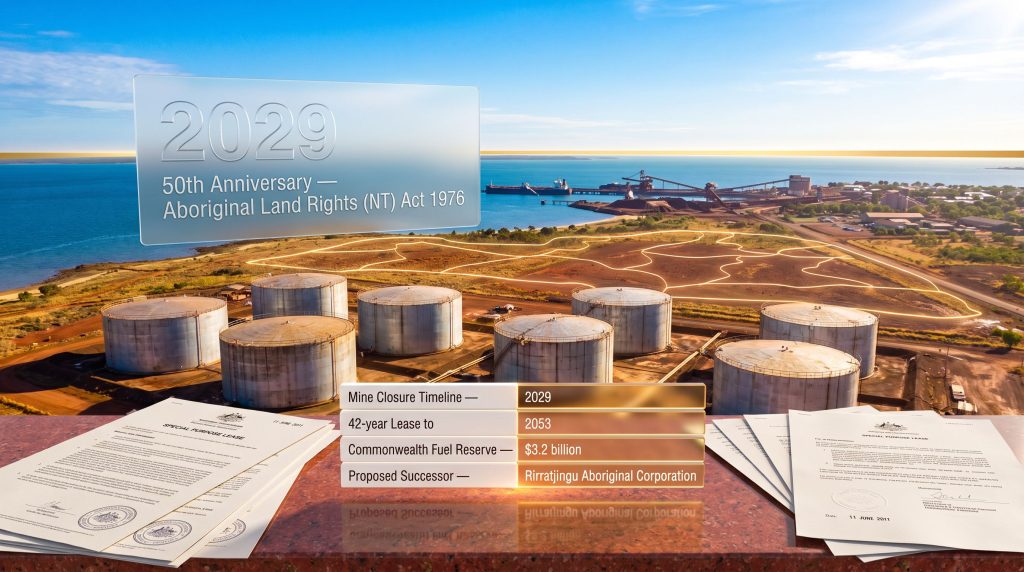
The current land use framework for Nhulunbuy was formalised on 11 June 2011, when Rio Tinto Alcan, the Yolngu traditional owner groups including the Gumatj, Rirratjingu, and Galpu clans, the Northern Land Council, and the Commonwealth Government entered into a comprehensive agreement. That agreement established a 42-year Special Purpose Lease structure covering the bauxite mine, alumina refinery, and the Nhulunbuy township itself, creating arrangements nominally extending to approximately 2053.
A Special Purpose Lease is a distinctly different instrument from freehold or standard commercial title. It allows an approved party to conduct specific activities on Aboriginal land without extinguishing the underlying Aboriginal freehold title held by traditional owners. In practice, this means the underlying land sovereignty remains with the Yolngu clans, while Rio Tinto has been able to operate its industrial complex through a defined lease arrangement.
The investment implications of this structure are significant. Special Purpose Leases carry limitations on mortgaging, subletting, and transferring interests that are not present in standard commercial property arrangements. Financial institutions, accustomed to conventional title instruments as the basis for lending decisions, often find these arrangements difficult to assess. This constraint has historically suppressed private investment and home ownership in the region, even while the mine sustained a functioning township economy.
Key Structural Insight: The legal architecture of Aboriginal land tenure in the Northern Territory is not designed to obstruct economic activity. It is designed to protect underlying freehold title. The practical investment challenge lies in building workable sublease instruments on top of that freehold base, something the 2026 in-principle agreement is specifically attempting to achieve.
The 2029 Closure and the Economic Anxiety It Has Unleashed
A Town Built on a Single Employer
Nhulunbuy's entire economic existence has been organised around Rio Tinto's Gove operations. The bauxite deposit at Gove is one of the largest in Australia, and the refinery complex has historically been a major regional employer across the Top End. Employment, housing demand, retail viability, and population size have all been calibrated around the continued operation of that industrial base. Furthermore, the resources sector economic contribution of comparable operations elsewhere in Australia underscores just how deeply a single major employer can shape an entire regional economy.
The announcement of a 2029 closure timeline has triggered a visible acceleration of economic anxiety. Long-established businesses, including the local Woolworths supermarket, have indicated they are preparing to exit the region. When anchor retailers begin withdrawing, the cascading effect on surrounding businesses, property values, and population retention typically accelerates rapidly.
The "ghost town" scenario, in which Nhulunbuy hollows out within a few years of Rio Tinto's departure, is not a remote possibility. It is the default trajectory without deliberate and legally robust intervention. The core mechanism of that intervention is land tenure reform.
The Legal Vacuum That Emerges When Rio Tinto Exits
When Rio Tinto surrenders its town lease upon cessation of operations, a structural legal gap opens. There is currently no automatic successor tenure arrangement. In the absence of a defined framework, the practical consequences would be severe:
- Financial institutions would have no clear title instrument against which to extend mortgages or commercial loans.
- New businesses would be unable to assess investment risk or secure leasehold interests.
- Existing residents would face uncertainty about the legal basis of their occupation.
- Infrastructure maintenance responsibilities would become ambiguous.
This is not a hypothetical scenario. It is a predictable consequence of industrial withdrawal from a community built on a Special Purpose Lease that was constructed to serve a specific corporate operator. The policy challenge is to close this gap before 2029, not after. Consequently, resource and energy export challenges of this nature demand proactive structural responses rather than reactive crisis management.
The 2026 In-Principle Agreement: What the Garma Announcement Established
A Traditional Owner-Led Tenure Model
At the Garma Festival on 31 July 2026, Northern Territory Chief Minister Lia Finocchiaro used her first keynote address at Australia's most prominent Indigenous policy forum to announce an in-principle agreement on Nhulunbuy's post-mining land tenure future. The announcement was made on the 50th anniversary of the Aboriginal Land Rights (Northern Territory) Act 1976, a timing that carries both policy and symbolic significance.
The proposed model centres on a transfer of the town lease from Rio Tinto to the Rirratjingu Aboriginal Corporation upon Rio Tinto's exit. Under this arrangement, the Rirratjingu clan would assume governance authority over the town's land as the principal leaseholder, operating within the existing freehold framework established by the Land Rights Act.
The key design features of the proposed model are:
- Tradeable sublease titles that allow residents and businesses to buy, sell, and mortgage their interests in land, functioning similarly to conventional property titles without extinguishing underlying Aboriginal freehold ownership.
- Long-term sublease arrangements providing the tenure security that financial institutions require before extending mortgages and commercial lending.
- An open town model explicitly designed to support non-Indigenous residents and investors alongside traditional owners, preserving Nhulunbuy as a prosperous and sustainable regional centre.
The Rirratjingu Aboriginal Corporation's leadership indicated that the board was encouraged by progress on the agreement and confirmed the Corporation's intention to continue working with its members, the Northern Land Council, and the NT government to finalise arrangements. The emphasis on achieving economic strength alongside cultural endurance reflects a sophisticated understanding within the Rirratjingu community that the two objectives are not in tension, but mutually dependent.
Comparing the Current and Proposed Tenure Structures
| Feature | Current Model (Rio Tinto Lease) | Proposed Post-Mining Model |
|---|---|---|
| Principal Lease Holder | Rio Tinto Alcan | Rirratjingu Aboriginal Corporation |
| Title Tradability | Limited (industrial purpose) | Tradeable sublease titles |
| Home Ownership Access | Constrained by lease structure | Enabled through sublease framework |
| Commercial Lending | Restricted by title limitations | Supported by tenure certainty |
| Governance Authority | Corporate (mining operator) | Traditional owner-led |
| Open Town Commitment | Implicit (employer-driven) | Explicitly structured |
Why Garma Was the Strategic Setting
Garma is not merely a cultural festival. It is the most politically significant annual gathering focused on Indigenous affairs in Australia, drawing federal and territory ministers, diplomats, and senior policy figures to northeast Arnhem Land each year. Announcing a major land tenure reform at Garma signals a commitment to Indigenous self-determination that goes beyond policy text.
Choosing the 50th anniversary of the Land Rights Act as the backdrop further reinforces the reform's framing: this is not an emergency measure to manage corporate withdrawal, but a deliberate step in the long arc from land return toward economic empowerment of Aboriginal Australians on their own country.
Stakeholders Shaping the Tenure Transition
The Rirratjingu Clan: Custodians and Future Leaseholders
The Rirratjingu are one of the principal Yolngu clan groups holding custodial authority over the Gove Peninsula. Their willingness to assume the town lease and explicitly support tradeable sublease arrangements for residents and businesses is the enabling condition for the entire proposed model. Without that consent, no tenure arrangement can be constructed under the Land Rights Act.
The Rirratjingu Aboriginal Corporation serves as the institutional vehicle through which this transition would be managed. The Corporation's governance process requires ongoing engagement with clan members, the Northern Land Council, and government counterparts before any finalised legal instrument can be executed.
The Gumatj Corporation: A Parallel Economic Track
While the Rirratjingu lead the tenure transition, the Gumatj Corporation is pursuing a parallel economic development agenda. At Garma 2026, the Gumatj Corporation announced a Memorandum of Understanding with the Laynhapuy Homelands Aboriginal Corporation, establishing a partnership aimed at driving traditional owner-run mining projects across the region.
The Gumatj's strategic logic is compelling: rather than waiting for external operators to arrive with new projects and new infrastructure, repurpose the substantial industrial assets Rio Tinto will leave behind. This approach minimises capital expenditure, accelerates deployment timelines, and keeps economic benefits within the traditional owner community. In addition, considerations around natural capital in mining transitions of this kind are increasingly informing how communities and corporations plan post-operational legacies.
The Northern Land Council: Statutory Legitimacy
The Northern Land Council holds a legislative mandate to represent traditional owners in all land use negotiations under the Land Rights Act. Its involvement as a party to any finalised tenure arrangement is not optional; it is legally required. The NLC's agreements framework provides the procedural safeguard and trust signal for external investors and financial institutions assessing the robustness of any new tenure instrument.
Fuel Security: The Second Strategic Pillar
Why Remote Fuel Supply Is a Structural Vulnerability
The economic viability of any remote Australian community depends on affordable, reliable access to diesel and aviation fuel. Supply chain disruptions, whether caused by weather events, geopolitical instability, or logistical constraints, can render remote townships economically unviable within days. The Gove Peninsula's remoteness amplifies this risk considerably.
The Commonwealth's $3.2 billion commitment to establish a one-billion-litre Australian Fuel Security Reserve of diesel and aviation fuel for regional areas reflects a national recognition of this structural vulnerability, elevated in part by geopolitical instability affecting global fuel supply chains in the mid-2020s.
The Gove Peninsula as a National Fuel Reserve Node
At Garma 2026, the NT Government, together with the Gumatj and Rirratjingu Corporations, formally called on the Commonwealth to include the Gove Peninsula in the national fuel security reserve strategy. The specific proposal involves recommissioning seven existing Rio Tinto fuel storage tanks as a regional fuel base, leveraging infrastructure already in place rather than constructing new facilities.
Infrastructure Logic: The Gove Peninsula already possesses deep-water port access, industrial-scale storage capacity, and established fuel logistics networks. Replicating this infrastructure from scratch elsewhere in the region would require hundreds of millions of dollars in capital expenditure and years of construction time.
The Gumatj Corporation's leadership has noted that existing Gove infrastructure represents a ready-made solution for the national fuel reserve challenge, and that reluctance by governments to commit funding to the region has been a persistent obstacle to realising this opportunity. Whether the Commonwealth responds to this call remains to be seen, and readers should note that no formal funding commitment from the federal government had been confirmed at the time of writing.
The next major ASX story will hit our subscribers first
The Broader Policy Implications: A Potential Template
Could This Model Be Replicated Elsewhere?
The Nhulunbuy land tenure agreement, if successfully finalised and implemented, would represent a meaningful policy innovation: a traditional owner-led, investment-ready tenure structure in a remote Aboriginal community facing post-industrial transition. Several elements of the proposed model could have broader application:
- Tradeable sublease titles layered on top of Aboriginal freehold, enabling mortgage lending without extinguishing underlying title.
- Institutional readiness at the traditional owner corporation level to assume lease governance functions from a departing corporate operator.
- Open town frameworks that signal to non-Indigenous investors and residents that tenure security is guaranteed alongside Aboriginal governance authority.
However, the Nhulunbuy model should not be over-generalised. The Rirratjingu's institutional capacity, the existing infrastructure base, and the deep-water port access at Gove are not universally present in comparable communities. The policy design elements may be transferable; the enabling conditions are context-specific.
The Evolution of the Land Rights Framework
The 50-year trajectory of the Aboriginal Land Rights Act traces a shift in policy ambition: from the return of land to Aboriginal peoples in the 1970s, toward the creation of conditions under which Aboriginal peoples can derive full economic benefit from that land without surrendering sovereignty over it. Tradeable sublease titles represent a practical expression of this evolution, enabling participation in mainstream property markets while preserving the freehold title that underpins cultural and governance authority.
Remaining legislative and regulatory barriers, particularly around the mechanisms for establishing and registering tradeable sublease interests, will need to be addressed before the proposed Nhulunbuy model can be fully operational. This is a technical task, but it is not an insurmountable one. Furthermore, the resources department restructuring occurring in adjacent jurisdictions signals a broader willingness among Australian governments to recalibrate how resource-sector transitions are managed institutionally.
The Timeline Risk: Three Years Is Not Long
Perhaps the most underappreciated dimension of this story is its urgency. The gap between an in-principle agreement and a legally binding, registered tenure instrument with operational sublease infrastructure is not trivial. Finalising the legal framework, legislating any necessary regulatory changes, and building the administrative systems to support tradeable titles in a remote community could realistically consume two to three years.
With Rio Tinto's departure set for 2029, that leaves a very narrow margin. Business confidence and population retention decisions are being made now, not in 2029. If the tenure transition is not clearly on track well before the mine closes, the economic contraction it is designed to prevent may begin before the framework is in place to stop it. The importance of mine reclamation importance planning in parallel with tenure reform should not be underestimated either, as both dimensions shape the post-closure landscape simultaneously.
Disclaimer: This article contains analysis of in-principle policy agreements, forward-looking timelines, and potential economic outcomes. These involve uncertainty and should not be interpreted as confirmed government commitments, guaranteed investment conditions, or assured policy outcomes. Readers should verify current developments through official sources including the Northern Land Council (nlc.org.au), the Northern Territory Government, and the Australian Institute of Aboriginal and Torres Strait Islander Studies (aiatsis.gov.au).
Frequently Asked Questions
What is the Nhulunbuy land tenure agreement?
The term refers to two related but distinct arrangements. The first is the 2011 Rio Tinto Alcan Gove Traditional Owners Agreement, which established the current 42-year Special Purpose Lease structure covering the mine, refinery, and Nhulunbuy township. The second is the 2026 in-principle agreement announced at Garma, which proposes transferring the town lease to the Rirratjingu Aboriginal Corporation after Rio Tinto concludes its operations in 2029.
Who owns the land at Nhulunbuy?
The Gove Peninsula is Aboriginal freehold land under the Aboriginal Land Rights (Northern Territory) Act 1976. The Rirratjingu and Gumatj clans are among the principal Yolngu traditional owner groups holding custodial authority. Rio Tinto holds the town lease as a Special Purpose Lease, which is an operational instrument distinct from the underlying freehold title.
What happens to Nhulunbuy after the mine closes in 2029?
Without a successor tenure arrangement, the town faces significant economic contraction as businesses lose confidence, mortgage lending becomes unavailable, and population declines accelerate. The 2026 in-principle agreement proposes a Rirratjingu-led tenure model with tradeable sublease titles designed to enable ongoing investment and home ownership after Rio Tinto's departure.
What are tradeable sublease titles and why do they matter?
Tradeable sublease titles allow holders to buy, sell, and mortgage their interests in land, operating similarly to conventional property titles. In the Aboriginal land rights context, they enable participation in mainstream property markets without requiring the extinguishment of the underlying Aboriginal freehold title held by traditional owners. This distinction is critical: economic participation and cultural sovereignty are structured to coexist rather than compete.
Key Facts at a Glance
| Dimension | Detail |
|---|---|
| Current Lease Holder | Rio Tinto Alcan (Special Purpose Lease) |
| Underlying Land Status | Aboriginal freehold under the Land Rights Act 1976 |
| 2011 Agreement Duration | 42-year lease, nominally to approximately 2053 |
| Mine Closure Timeline | 2029 |
| Proposed Successor Tenure Holder | Rirratjingu Aboriginal Corporation |
| Key Tenure Features | Tradeable titles, long-term subleases, open town model |
| Fuel Security Proposal | Recommission 7 Rio Tinto tanks as regional fuel reserve node |
| Commonwealth Fuel Reserve Fund | $3.2 billion committed for 1 billion litre national diesel/aviation reserve |
| Anniversary Context | 50th anniversary of the Aboriginal Land Rights (NT) Act 1976 |
| Status of 2026 Agreement | In-principle only, full legal instrument yet to be finalised |
Readers seeking further context on the legal and policy dimensions of Aboriginal land tenure in the Northern Territory can access publicly available resources through the Northern Land Council (nlc.org.au) and the Australian Institute of Aboriginal and Torres Strait Islander Studies (aiatsis.gov.au). For contemporaneous reporting on the Garma Festival announcement, ABC News Australia's coverage at abc.net.au provides the primary public record of proceedings.
Want to Track the Next Major ASX Mineral Discovery Before the Broader Market Does?
Discovery Alert's proprietary Discovery IQ model delivers real-time alerts on significant ASX mineral discoveries, transforming complex geological and commodity data into clear, actionable insights for investors at every experience level — explore the historic returns major discoveries have generated and begin your 14-day free trial today to position yourself ahead of the market.